To sever natural interrelations is not to make oneself independent, but to isolate oneself completely.

—Frédéric Bastiat

The Founders were explicit: The power to tax belongs to Congress, not the president. Nearly 250 years later, that same question—who levies tariffs?—landed before the Supreme Court in 2025.


In February 2026, the Supreme Court ruled six to three to strike down President Trump’s sweeping tariffs imposed under the International Emergency Economic Powers Act (IEEPA). It was a landmark victory for constitutional governance, economic liberty, and the rule of law, and Cato Institute lawyers and scholars were instrumental in making it happen. They argued this case in the courts, in the press, and in the public square.

In the courts, Ilya Somin, Cato’s B. Kenneth Simon Chair in Constitutional Studies, served as co-counsel in V.O.S. Selections, Inc. v. Trump, representing five small businesses challenging the administration’s legal overreach. Thomas A. Berry, director of the Robert A. Levy Center for Constitutional Studies, and Legal Fellow Brent Skorup filed amicus briefs at both the Federal Circuit (where their brief was cited in the controlling opinion) and the Supreme Court. Three Supreme Court justices applied the “major questions” doctrine, as urged in the Cato brief, and the entire majority concurred that Congress would have been more explicit if it wanted to authorize tariffs. In addition, trade scholars Scott Lincicome, Colin Grabow, and Clark Packard coauthored an amicus brief dismantling the administration’s claims that IEEPA tariffs are essential to US economic well-being, fiscal stability, or foreign policy.
In the press, Cato’s tariff work was cited more than 18,000 times across broadcast, print, and online outlets in 2025 alone. When “Liberation Day” tariffs landed in April, the trade team logged more than 25 media interviews in 48 hours. Somin appeared on CNN International, was cited by USA Today, and wrote in The Atlantic, “The president of the United States is no king, and he does not have the power to impose taxes in the form of tariffs whenever he feels like it.”

Scott Lincicome, vice president of general economics and director of the Herbert A. Stiefel Center for Trade Policy Studies, published a Wall Street Journal op-ed about the tariff ruling on the day the Supreme Court announced its decision. Previously, Lincicome had made the economic case in the Washington Post, arguing that invalidating the IEEPA tariffs would strengthen, not harm, the US economy. V.O.S. Selections owner Victor Owen Schwartz also told his story directly in Cato’s Free Society magazine.

Annual Report 2025 - Kaine, Paul, and Lincicome

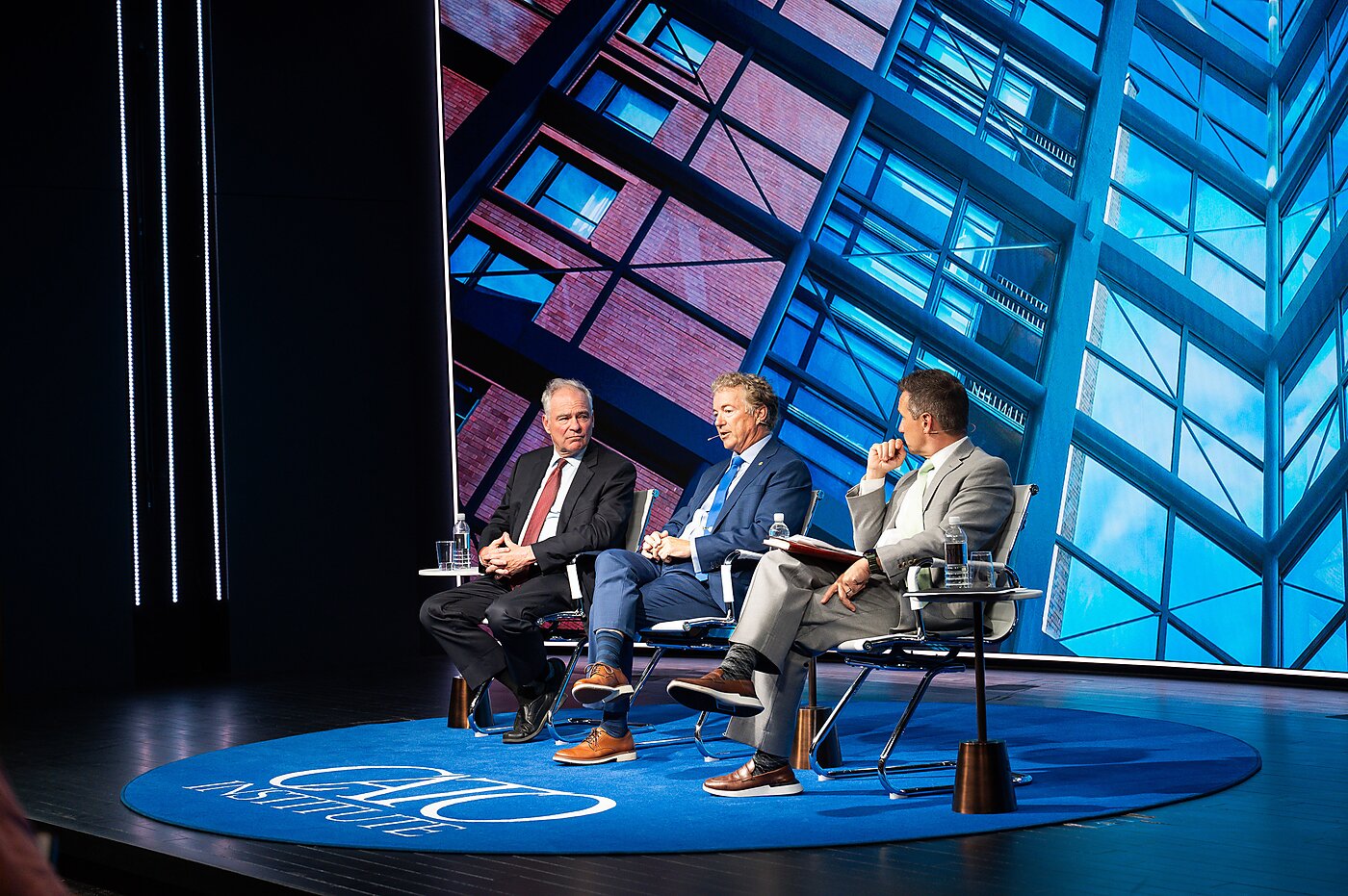
(Seated right to left) Cato Vice President Scott Lincicome spoke with Sen. Rand Paul (R‑KY) and Sen. Tim Kaine (D‑VA) at a Cato event in July 2025. They discussed how the challenges faced by American wine and bourbon producers due to Trump’s IEEPA tariffs were emblematic of the threat that protectionism posed to American farmers and manufacturers.

In the policy arena, Cato scholars rebutted the administration’s core justifications—that unilateral tariffs are necessary for national security, reciprocal in nature, or good for American manufacturing—and showed how these taxes are imposing serious economic harms, disproportionately burdening small business, and breeding cronyism. The scholars met with dozens of Capitol Hill staffers and held public events with members of Congress from both major parties on the tariffs’ legal weakness and the need for broader legislative reforms. And they’ve championed efforts to ensure that American businesses are refunded the tariffs the government illegally collected under IEEPA.

The tariff fight isn’t over. Even without the IEEPA, the president claims broad statutory authority to recreate much of the same trade chaos. And the deeper question remains: Do we believe markets should be free and government power should be restrained? The choice is between openness and control: rule of law or rule by decree. The Supreme Court ruled that the IEEPA does not allow the president—any president—to tax trillions of dollars in commerce on a whim. But other laws might give him similar powers. Congress must act to reclaim its constitutional authority over tariffs and foreign commerce, and Cato will keep urging it to do so.

(Re)Building the Free Trade Coalition

The erosion of trade liberty is a bipartisan issue. Scott Lincicome hosted Sen. Rand Paul (R‑KY) and Sen. Tim Kaine (D‑VA) at a July 2025 event to discuss how tariffs harm American businesses. Senator Paul denounced Trump’s tariffs as unconstitutional taxes, and Senator Kaine praised Cato’s unique role in standing up to the tariff scheme:

You should never have to live in a country where you are begging somebody for an exemption from a law. That’s Cuba. That’s Venezuela, that’s the Soviet Union.

—Sen. Rand Paul (R‑KY)

That’s why Cato is really important … the businesses that tell me they don’t like tariffs… when they themselves are afraid to make the argument, Cato can make the argument.

—Sen. Tim Kaine (D‑VA)

At a July Cato event on presidential tariff authorities, Rep. Suzan DelBene (D‑WA) spoke with Lincicome on presidential tariff authorities and how Congress can reclaim its constitutionally mandated authority.

Annual Report 2025 - Grabow Case Moylan

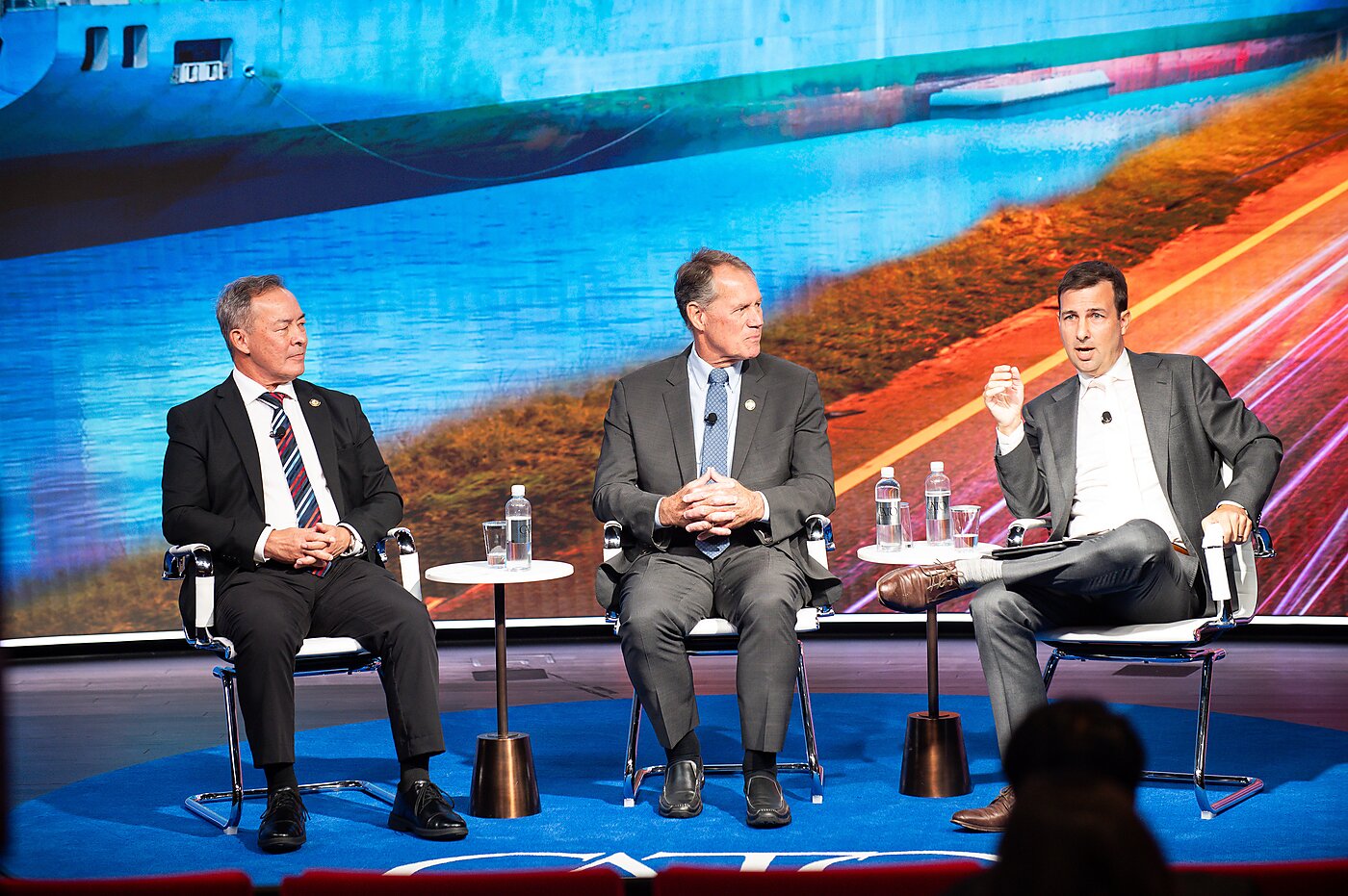
Colin Grabow (right) discussed the Jones Act’s broader economic costs, national security implications, and possible reforms at a Cato policy forum with Rep. Ed Case (D‑HI) (center) and Rep. James Moylan (R‑GU) (left).

Colin Grabow, associate director at the Cato Institute’s Herbert A. Stiefel Center for Trade Policy Studies, hosted two members of Congress from the noncontiguous United States—Rep. James Moylan (R‑GU) and Rep. Ed Case (D‑HI)—for a conversation about the disproportionately harmful impact of the Jones Act on their constituencies.

The increase of riches and commerce in any one nation, instead of hurting, commonly promotes the riches and commerce of all its neighbors.

—David Hume