The work of keeping liberty alive requires making the affirmative case for freedom to citizens wherever they are—in the classroom, through books that reframe how we understand human history, through digital platforms that meet young people on their own terms, and through data that prove concretely that freedom works. To that end, Cato invests in the next generation of liberty-minded leaders and in the ideas and tools that will reach millions beyond them.
Keeping the Flame Alive

Keeping the Flame Alive
A republic is not self-sustaining. Each generation must encounter the arguments for freedom early enough to be shaped by them.
Sphere Education Initiatives
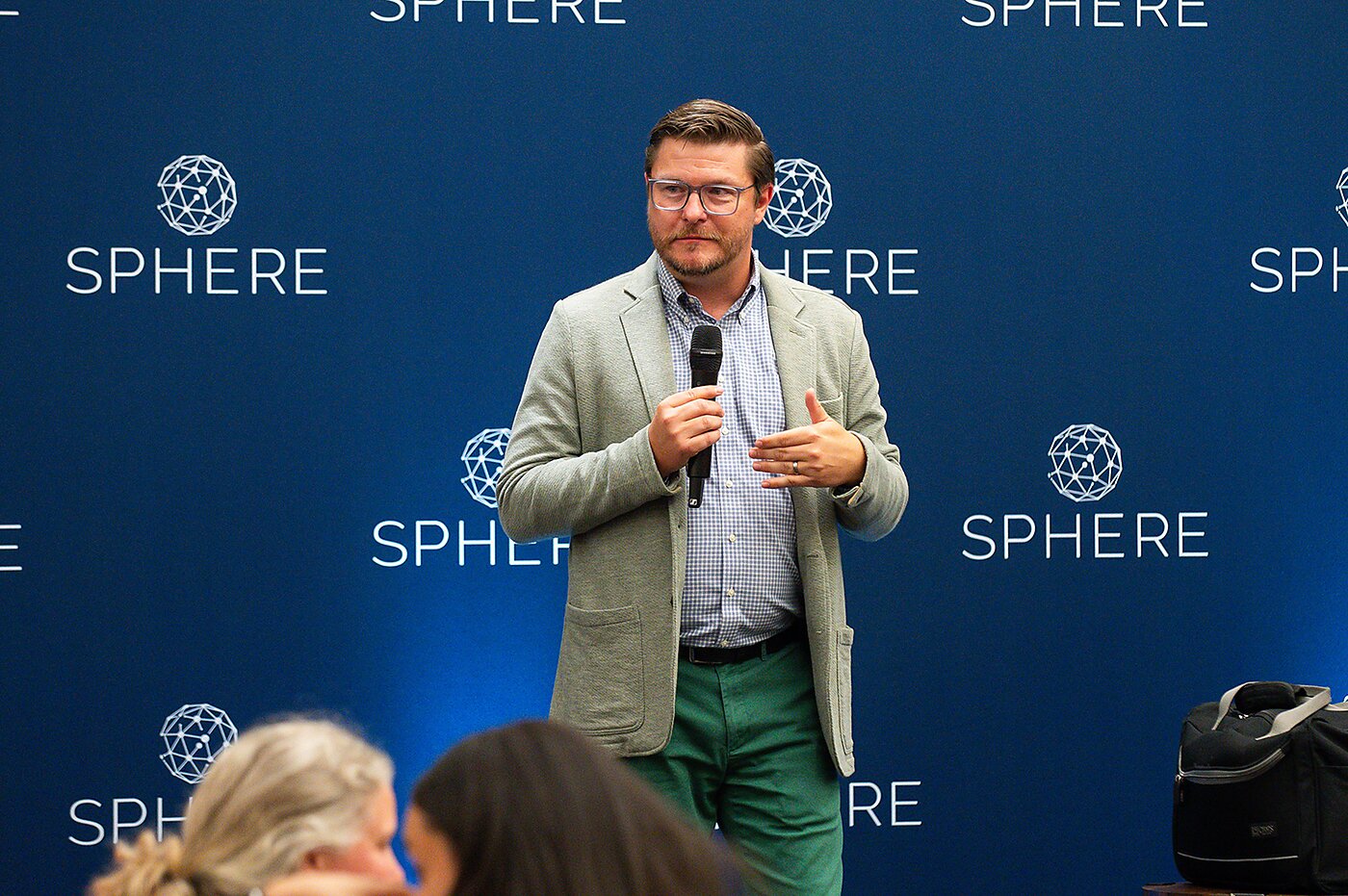
Sphere Education Initiatives equips educators with the resources to foster civil discourse, viewpoint diversity, and critical thinking—the foundational habits of republican citizenship—in their classrooms. And in 2025, the urgency of that mission was impossible to ignore.
Political violence reached American campuses, most shockingly in the assassination of Charlie Kirk. Meanwhile, students across the country faced suspension, expulsion, and institutional retaliation simply for expressing dissenting views.
In the aftermath, a Sphere alumnus wrote to us simply, “We in education are looking to you at Sphere. We see you as an island of sanity in an ocean of chaos.”
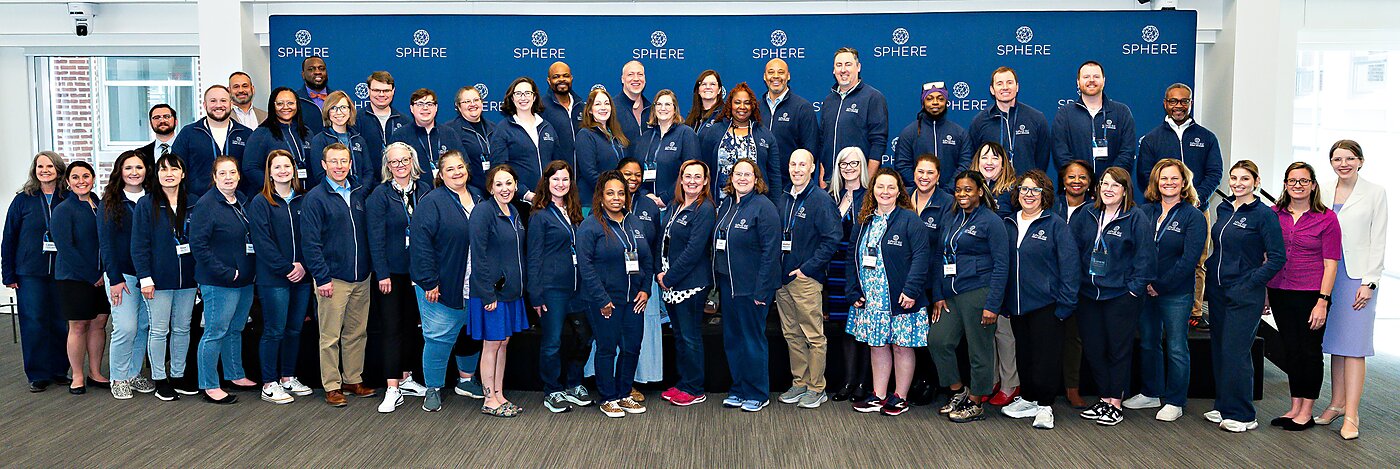
The numbers reflect a program hitting its stride. Sphere’s alumni network includes more than 23,000 educators, who in turn reach more than 3 million students annually. Last year, Sphere’s team hosted 128 events across the United States, increasing our “Sphere on the Road” programming efforts by 35 percent since 2024. A record 377 educators gathered at this summer’s Sphere Summits at Cato headquarters. A full 97 percent said they plan to use Sphere resources in their classrooms, and 98 percent would recommend the summit to a peer.
Demand for materials has surged to match. Cato distributed more than 36,000 materials at events on the road and more than 10,000 printed lesson plans at the Sphere Summits alone—more than four times the previous record—along with thousands of Cato books. To mark America’s 250th anniversary, Sphere launched a new resource exploring the Founding principles of the Declaration of Independence, the document on which our civic culture ultimately rests.
Sphere’s ongoing Fellowship Program, Content Advisory Board, webinar series, and other educational programs help teachers deliver core ideas to their students, including the principles of a free society, individual rights, and constitutional governance.
The educators who experience Sphere leave changed. As one Texas teacher put it, “No one has ever come to us to do this type of work. And what you’re sharing isn’t just good for classrooms; it’s good for our lives right now.”
Nadine Strossen, former president of the American Civil Liberties Union and senior fellow at FIRE (Foundation for Individual Rights and Expression), has made Sphere a fixture of her calendar, declaring, “Of my 200 or more public presentations each year, this is always number one, because the audience is the most important audience in the world. The students are ultimately the future of our society, and how they develop is in the hands of the teachers who participate in Sphere.”
Sphere is on track to reach 50,000 educators by 2030. In a republic that must be kept, that network may be among the most important ones we build.


Cato University
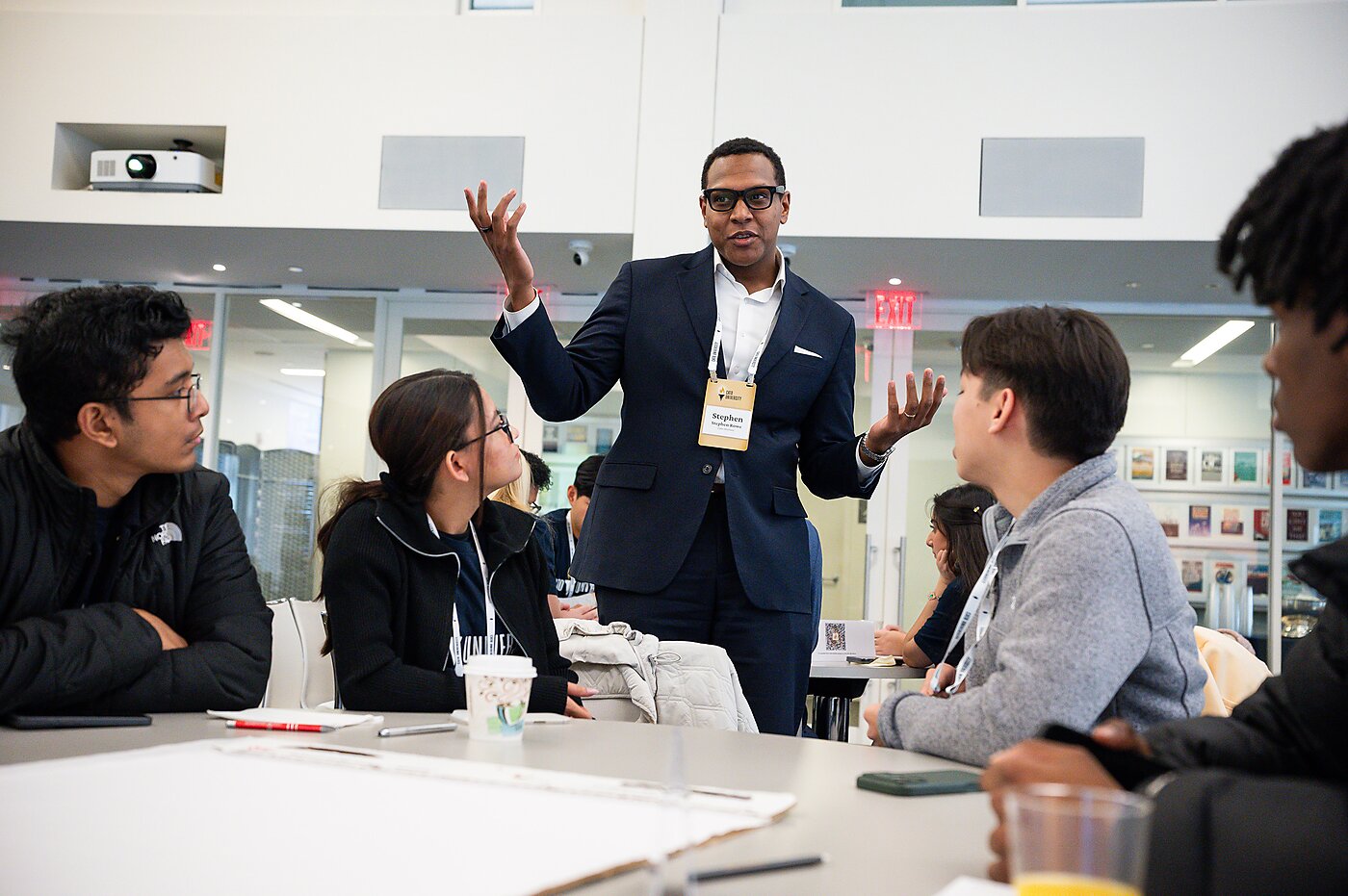
Classical liberal ideas have all but disappeared from college campuses. Individual liberty, limited government, free markets, constitutional order: At most American universities, these ideas are either absent from the curriculum or actively contested. Cato University exists to fill that gap.
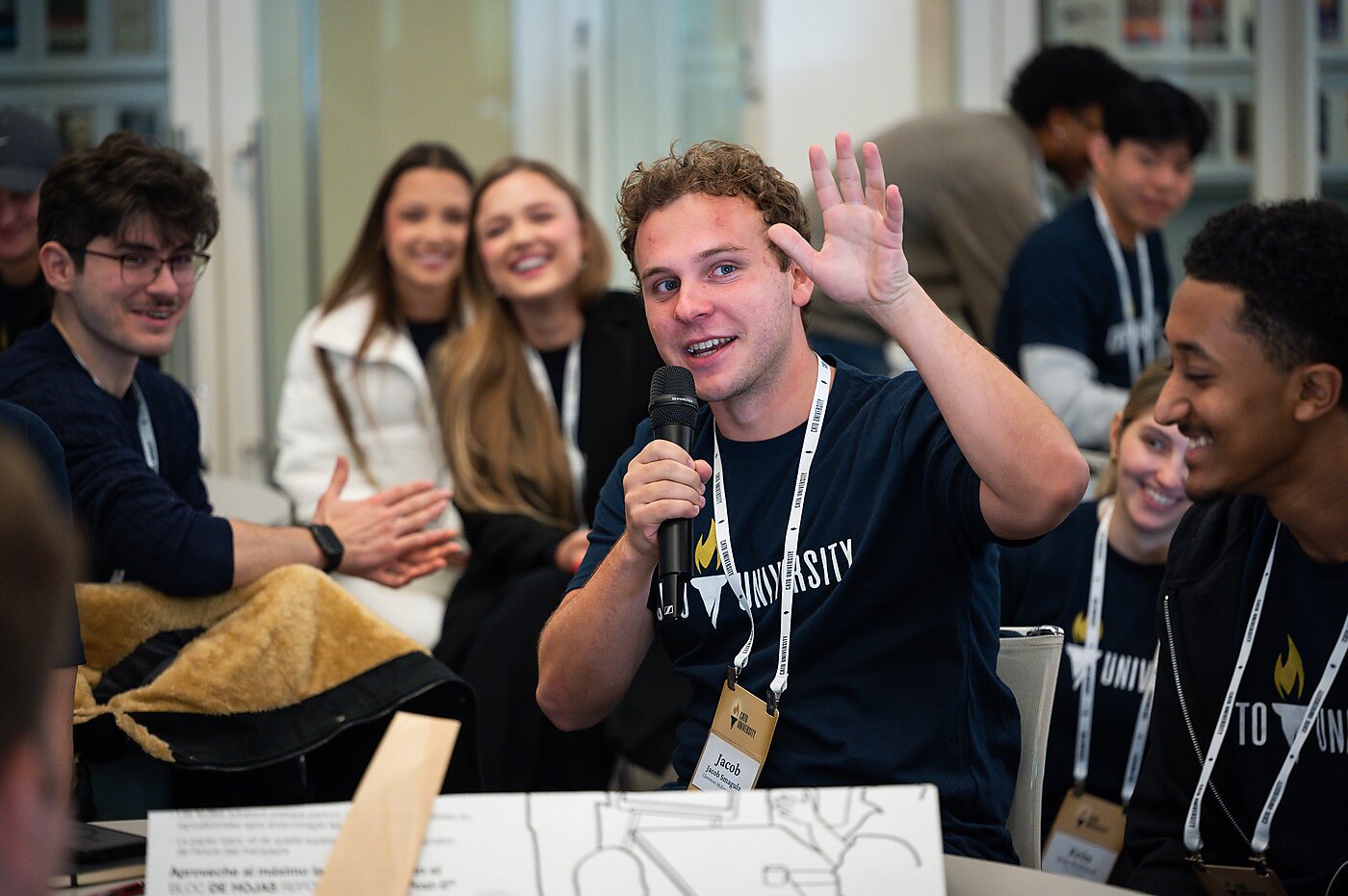
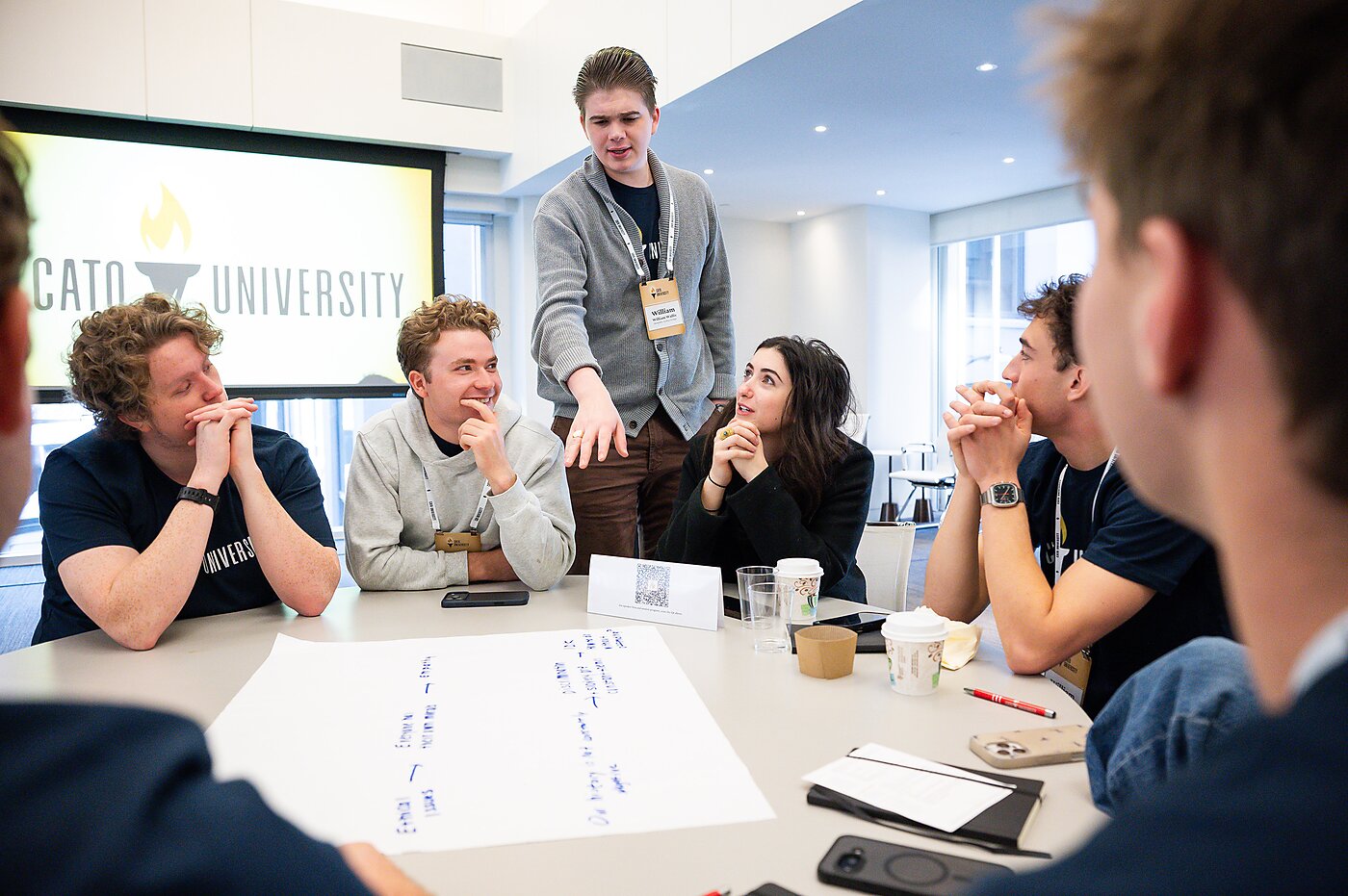
Since relaunching in 2024, Cato University, led by the very scholars who are advancing these ideas, has brought 500 college and graduate students into deep, rigorous engagement with libertarian thought and public policy.
Cato University reinforced my admiration of classical liberalism and affirmed my desire to become a Cato intern, which I now am! I walked away with a more complete view of individual liberty and with increased confidence that I could engage in civil discourse about important ideas.
The demand is real, the pipeline is growing, and Cato is scaling Cato University to meet it.

Cato Courses
What if a high school student in rural Texas could sit down with Thomas Paine to discuss individual rights? Or a college freshman in Ohio could evaluate the case for free markets with Adam Smith?
With Cato Courses, they can. Launched in October 2025, Cato’s new digital learning platform is built for the generation that learns on screens, at their own pace, on their own terms. Seven interactive courses are already live, covering human progress, capitalism, immigration, globalization, criminal justice, fiscal policy, and K–12 education; advanced AI features let students go further still, including having one-on-one conversations with history’s greatest champions of liberty.
In just months, Cato Courses is already beginning to scale, and the early adopters are putting it to work:
I will be able to utilize much of this information in my high school classroom and hopefully help my students look beyond their current worldview.
That instinct—to push students beyond what they think they already know—is exactly what Cato Courses was built to cultivate. Within five years, we aim to bring that experience to more than 10,000 learners.
The classroom has four walls. The case for liberty shouldn’t.

Internship Program
In nearly 50 years, thousands of interns have passed through Cato’s doors. Many have gone on to shape policy, lead institutions, and carry the case for liberty into careers in law, economics, journalism, and government. That pipeline doesn’t happen by accident.
Each year, Cato brings more than 70 interns into hands-on policy research alongside the scholars actually doing the work. Every intern cohort participates in the John Russell Paslaqua Intern Seminar Series, which was established by Kenneth Paslaqua in honor of his son John, a former Cato intern who passed away in 2017. The seminar series provides interns with a rigorous grounding in libertarian philosophy and introduces them to the full breadth of Cato’s scholarship. The series also features training in communications and nonprofit operations and other professional development.
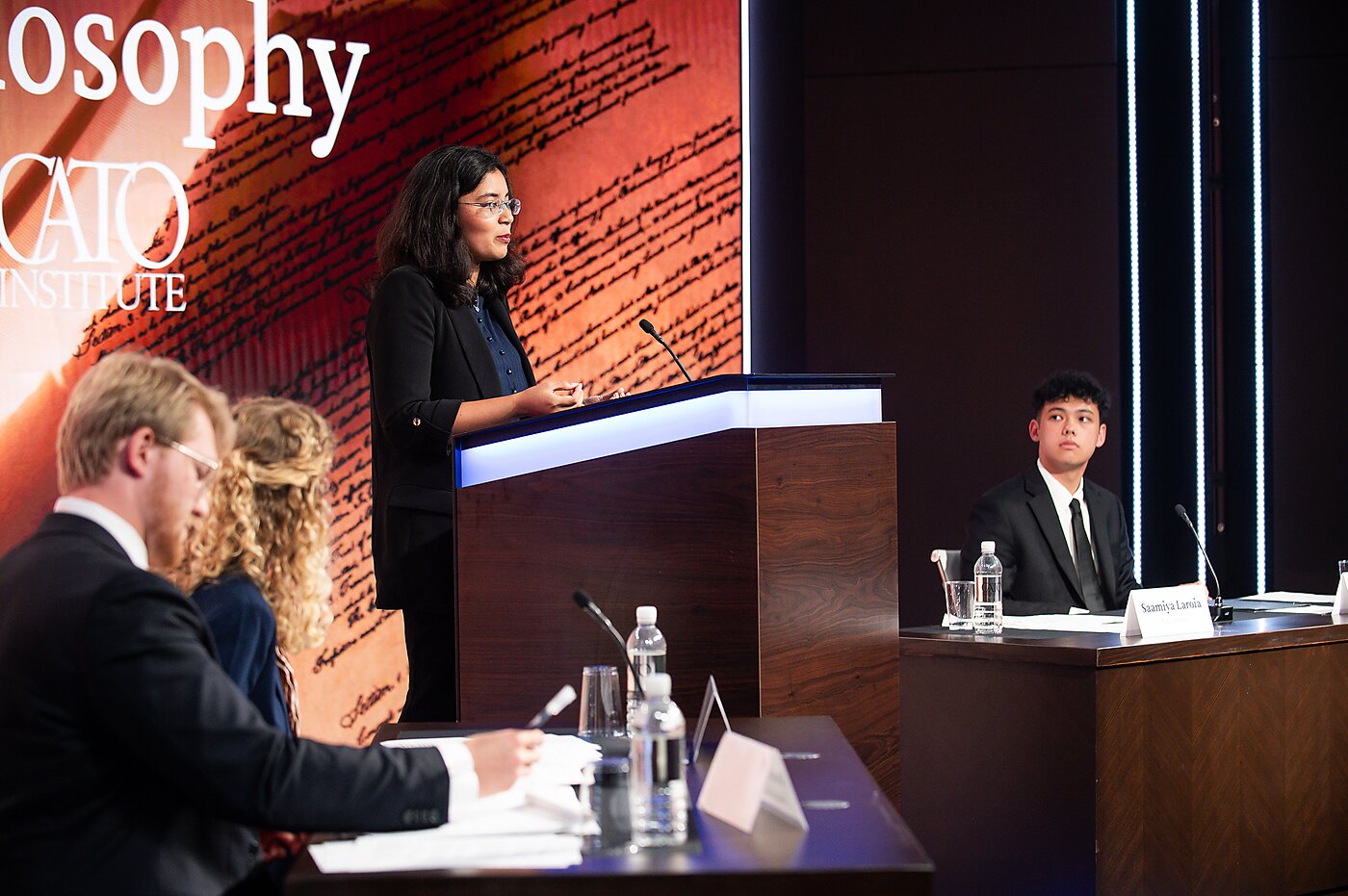
In the summer, that training was put to the test. After a rigorous selection process, two Cato interns stepped onto a public stage to debate two Heritage Foundation interns on trade policy, immigration, and the fundamental question that divides libertarians from conservatives: What should a free society look like?
We shouldn’t build our society around whatever moral vision happens to be popular at the time. What’s considered virtuous today can change in a generation, or it can change in an election cycle. That’s why we shouldn’t hand power to the state. That’s why we should build our society around liberty, because liberty endures. That’s the foundation that my mom found here [as an immigrant]. That’s what brought her across the world, gave her the freedom to build a life … Let’s make sure we protect it.
I had so many people come up to me to tell me my performance defending free trade resonated with them. That night redefined my self-confidence in a deeply impactful way. That will stay with me as I begin my career as an economist.
Arming the Next Generation with Rational Optimism
Teaching the next generation to value liberty requires more than philosophical arguments. It requires proof. And no one at Cato is building that evidentiary case more persistently or reaching more people with it than Marian L. Tupy.
Cato’s HumanProgress.org, led by Tupy, exists to counter the doomsday narratives that dominate classrooms, news feeds, and political rhetoric—with data. Not optimism as a mood, but optimism as a rational conclusion: the evidence that now is the most prosperous, most peaceful, most tolerant moment in human history and that personal and economic freedoms are the reasons for it. This website gives young people a framework for evaluating claims about free markets, poverty, and progress that inoculates them against the appeal of collectivist alternatives. The site’s content receives more than three million views per month.
HumanProgress.org remains at the forefront of an intellectual ecosystem of organizations applying rational optimism to humanity’s most pressing challenges—a growing “pro-progress” and “pro-abundance” movement that Tupy’s work helped catalyze. That ecosystem is reshaping how journalists, policymakers, and thought leaders understand the facts of human progress, and Tupy’s book Superabundance, coauthored with Cato adjunct scholar Gale Pooley, is a cornerstone of it. The book introduces a new way of measuring human prosperity, not in dollars, but in time: how many hours of work it takes the average person to afford the things that make life better and more enjoyable. By that measure, the story of the last two centuries is one of breathtaking abundance, driven by free markets and human ingenuity.
Mounting an influential rebuke of resurgent bad ideas, including socialism, Tupy published two important articles for the Wall Street Journal: “China’s Rare Earths Aren’t as Rare as You Think” and “AI Can’t Replace Free Markets,” coauthored with Peter Boettke. Tupy also coauthored an op-ed with Sen. Rand Paul (R‑KY) for The Spectator titled “Tariffs Will Make America Poorer.” Since 2023, 18,000 people have paid to watch Tupy and Pooley’s lecture series, “The Economics of Human Flourishing,” on Peterson Academy.
The reach of this work extends well beyond traditional policy audiences. Conservative commentator Ben Shapiro cited Superabundance as a “really informative and useful read” and his first book recommendation to listeners of The Ezra Klein Show, a signal of just how broadly Tupy’s optimistic, evidence-based case for freedom is traveling across ideological lines. “I think it’s important that we be grateful for our civilization,” Shapiro said, “that we be accurate about the great, positive movement in economics that has actually happened over the course of the last 40 years.”
Doing What It Takes to Keep the Republic
For nearly half a century, Cato has defended the foundations of a free society: individual liberty, limited government, free markets, and peace. These are not partisan principles. They are the operating system of our constitutional republic and what it takes to keep the republic.
As Senior Fellow Johan Norberg wrote for the Washington Post, “Next year marks America’s 250th anniversary. Few golden ages have lasted that long—and unless Americans adopt a new outlook, ours could soon be over, too.”
Cato’s 50th and America’s 250th anniversaries remind us that nothing lasts forever without people willing to defend it. Golden ages end when people and institutions abandon principles for convenience.
We need to be dedicated to the principles in which any moral struggle must be rooted. In the words of Frederick Douglass, “Stand by those principles. Be true to them on all occasions, in all places, against all foes, and at whatever cost.”
That commitment to principle—on all occasions, in all places, against all foes, and at whatever cost—is precisely what the Vision for Liberty Campaign expansion is designed to sustain. Not just for the next election cycle, but for the next 50 years.