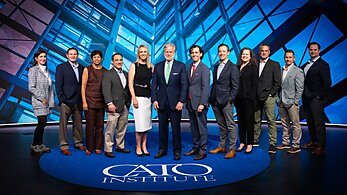
The results speak for themselves. When the politically impossible becomes possible—on trade, technology, or the Constitution—Cato now has the resources, the energy, and the scholar firepower to seize the moment. Our presence and visibility on Capitol Hill have never been higher, and that is no accident.
Making the Case to Congress

Getty Images
Making the Case to Congress
Cato’s work changes minds. Putting it in the right hands changes policy.
That’s the animating idea behind Cato’s Vision for Liberty, and nowhere is it paying off more concretely than on Capitol Hill, where Cato has dramatically expanded its government and external affairs teams to better engage the people making policy decisions.
“One of the first calls we make when an important issue comes up in the tech space is to Cato. You all have been there again and again and again.”
—Sen. Ron Wyden (D‑OR)
Senator Wyden recently made that remark at a Cato conference—one data point in a stretch that also saw Cato convene Sens. Rand Paul (R‑KY) and Tim Kaine (D‑VA) to work through the politics of tariffs, 14 congressional testimonies, and briefings reaching more than 300 Hill staff members from both parties.
Building a Pipeline: The Congressional Fellowship Program
Cato’s Congressional Fellowship Program—an 8- to 10-week bipartisan, bicameral immersion in libertarian policy thinking—has become one of the most sought-after professional development opportunities on the Hill. It is one of our most strategically important programs: a vehicle for introducing Cato’s ideas to the next generation of policy leaders and for building the relationships and reputation that make us a go-to institution for policy staff.
Cato hosted four fellowship programs in 2025, with cohorts of around 30 participants each, covering topics from tax and trade policy to constitutional studies. Each program invites congressional office staff to engage directly with Cato’s scholars on the hard questions of liberty and governance.
Applications now regularly exceed 100 for just 30 available spots per cohort, and the staff members filling those seats are increasingly senior. More than 30 alumni have returned for additional fellowships, a sign that the experience resonates long after it ends. Some fellowship participants go on to work for Cato, such as Legal Fellow Mike Fox.
The program now has more than 300 alumni across both parties and both chambers. And “bipartisan” here is not a token descriptor; Democratic and Republican staff alike participate in meaningful numbers. Vice President for Public Affairs Lawrence Montreuil stated, “With the capacity we have now, we have been able to continue scaling the fellowship by increasing the number of cohorts each year, resulting in an expanding bipartisan network of staff familiar with Cato’s scholarship across a wide range of issues. In 2027 alone, we are projected to grow this network by nearly 60 percent.”
One 2025 fellowship participant commented, “I really enjoyed the [constitutional studies] fellowship. To be honest, it was one of the most educational, maybe the most educational, of all the ones I’ve done in my six years or so on the Hill, and I did a number of them.”

Sen. Mike Rounds (R‑SD) addressed dozens of Capitol Hill policymakers about dissolving the Department of Education, along with Neal McCluskey (seated), former director of Cato’s Center for Educational Freedom.

Sen. Ron Wyden (D‑OR) commended the influence and insight of Cato’s technology policy analysts while speaking virtually at a Cato policy forum on free speech and the internet. Jennifer Huddleston, senior fellow in technology policy, connected with Sen. Wyden and the packed house during Cato’s “Section 230 at 30 years” policy forum.

Lawrence Montreuil, vice president for public affairs, congratulated one of the 100-plus Capitol Hill staffers who completed a Congressional Fellowship program in 2025.

Director of energy and environmental policy studies Travis Fisher (second from left) discussed energy policy on Capitol Hill with Talmage Tyler (left), a legislative assistant to Rep. Julie Fedorchak (R‑ND), assisted by Maria Sofia, former government affairs staffer at Cato, and Joshua Loucks, former research associate.
Deepening Cato’s network on the Hill creates the conditions for Cato scholars to be invited to testify, brief, and advise policymakers. During a single week in June 2025, Cato reached more than 20 members of Congress and between 250 and 300 congressional staff through testimonies, briefings, and events. Within a 72-hour window, two scholars testified before Congress, four spoke at staff briefings, two members of Congress came to Cato headquarters to address Cato Institute–hosted events, and 36 senior congressional staff members gathered for a fellowship session in constitutional studies.
Cato’s Vision for Liberty was built on the conviction that scholarly work fulfills its potential only when it reaches the people who are in a position to act on it. The expansion of Cato’s government and external affairs capacity through investments from the Vision for Liberty Campaign has made that connection more direct, more frequent, and more cross-ideological than at any other point in the institute’s history—a reflection of the enduring appeal of ideas grounded in principle rather than politics.


Research Fellow Andrew Gillen testified before the House Committee on Education and the Workforce on why price transparency reforms in higher education would benefit students and families.

Alex Nowrasteh, senior vice president for policy, testified before the House Judiciary Subcommittee on Immigration Integrity, Security, and Enforcement, demonstrating that the nonimmigrant visa system is already secure and effective and that recent travel bans lack evidence.

Research Fellow Erec Smith testified before the Subcommittee on Health Care and Financial Services of the House Committee on Oversight and Accountability, outlining how diversity, equity, and inclusion initiatives in higher education have spawned a costly administrative industry that ultimately disempowers the very students it claims to help.

Jennifer Huddleston, senior fellow in technology policy, testified before the Subcommittee on Financial Institutions of the House Committee on Financial Services, arguing that a growing patchwork of state and federal privacy legislation risks creating confusion, burdening smaller companies, and stifling innovation.

Jeffrey Singer, senior fellow in health policy studies and practicing general surgeon, testified before the Subcommittee on the Administrative State of the House Committee on the Judiciary, highlighting how the government-backed monopoly on medical residency accreditation creates an unnecessary limitation on the supply of licensed doctors and thus harms patients.

Legal Fellow Mike Fox testified before the House Judiciary Subcommittee on Crime, calling on Congress to restore jury powers and rein in prosecutorial overreach; his testimony helped inspire presidential pardons for two victims of federal overcriminalization, Tanner Mansell and John Moore. Read their story on pages 40–41.

Chris Edwards, the Kilts Family Chair in Fiscal Policy Studies, testified before the Subcommittee on Health Care and Financial Services of the House Committee on Oversight and Government Reform, arguing that the Low-Income Housing Tax Credit is a complex, costly, and inefficient program plagued by fraud and corruption.

David J. Bier, The Selz Foundation Chair in Immigration Policy and director of immigration studies, testified before the Subcommittee on Immigration Integrity, Security, and Enforcement of the House Committee on the Judiciary, reporting on how the Trump administration dismantled the legal immigration system and ignored immigration laws.
“The Framers understood that depriving a human being of their liberty wasn’t supposed to be easy.”
—Mike Fox’s May 2025 congressional testimony
Laboratories of Democracy
Our state affairs team increased its engagement in 2025, hosting 370 meetings with state legislators, senior policy staff, state-level think tanks, and more than 10 governors’ offices. We amplify our national reach by working with partners like the free-market State Policy Network, speaking and networking at events such as the National Conference of State Legislatures, and connecting our scholars to policymakers in states positioned to model legislation for others.
Across the country, the cost of everyday life (housing, childcare, health care) has become one of the defining concerns for American families, and state capitals are where many of the most consequential decisions get made. Cato’s economic scholars are meeting that moment head-on, proactively engaging state policymakers on the regulatory reforms that could make the biggest difference.
On housing, Cato scholars took dozens of meetings with state legislators in 2025 to make the case for zoning reform and the elimination of regressive regulations that artificially restrict supply and drive up costs for both buyers and renters. The argument is straightforward: When governments make it harder to build, families pay the price. The same logic applies to childcare, for which licensing requirements and facility mandates have made care unaffordable for millions of working families while doing little to improve outcomes. Cato scholars are helping state policymakers see that deregulation offers a direct path to affordability.
On health care, Senior Fellow in Health Policy Dr. Jeffrey Singer has been a tireless advocate for patient freedom and physician autonomy at the state level. One major barrier to widely accessible, affordable, and competent care is the shortage of health care providers authorized to diagnose and treat common ailments. Across the country, states have enacted licensing laws that prevent qualified practitioners from delivering all kinds of services. For example, Singer testified before the Texas State Senate about how Texas lags behind 30 other states that have already removed barriers to allowing nurse practitioners to diagnose and prescribe medications.
The thread connecting all this work is the same one that runs through Cato’s mission: that when you reduce the barriers government imposes on people’s choices, lives get better. That message is resonating in statehouses in ways it hasn’t before—and Cato is there to make the case.