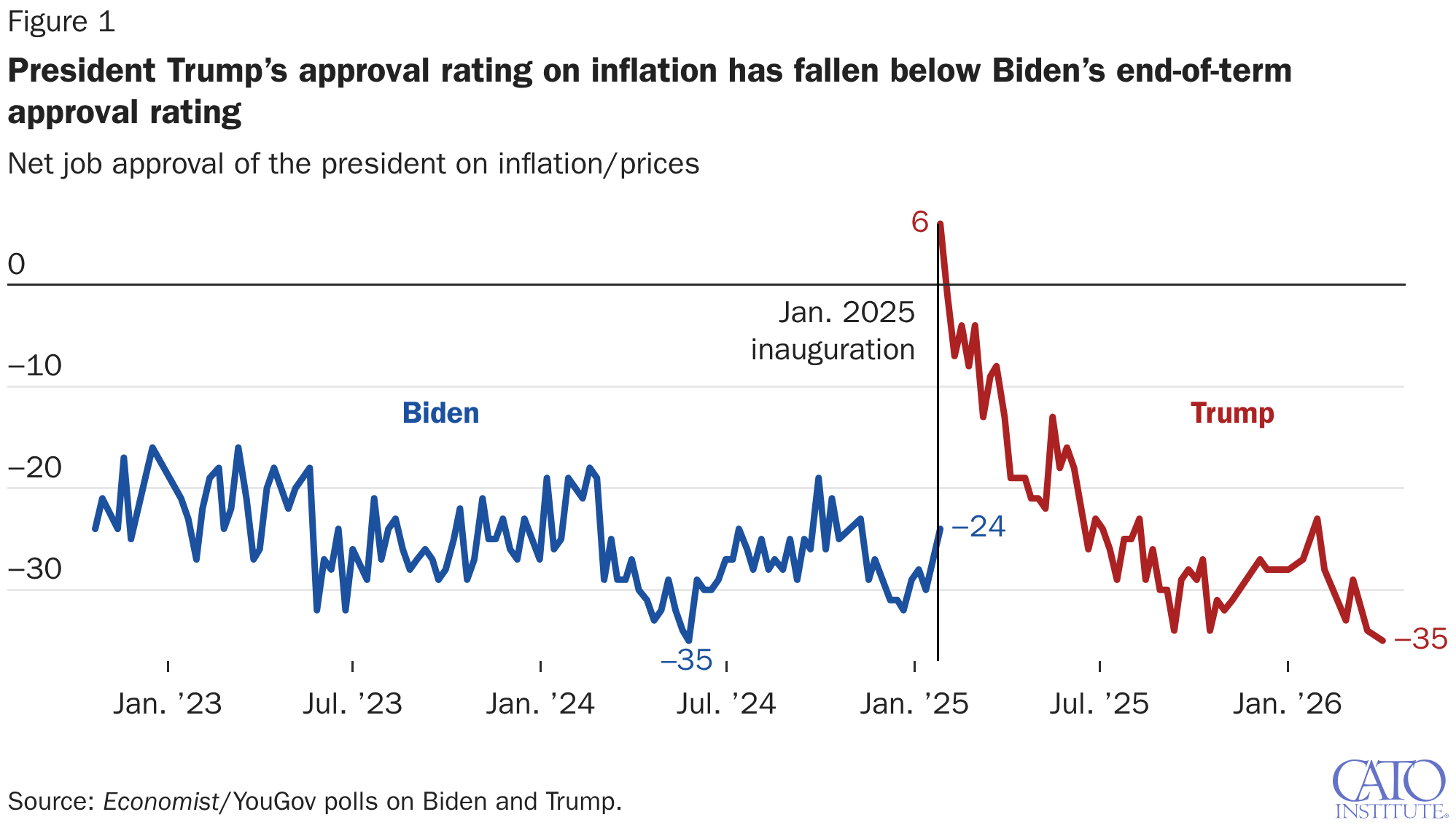
This cost-of-living pressure is a political problem for both parties. High inflation became a political albatross for former President Joe Biden and helped carry Donald Trump back into office. Yet since his January 2025 inauguration, President Trump’s own approval rating on handling inflation and prices has deteriorated sharply (Figure 1). This dissatisfaction mainly reflects disappointment that the president hasn’t delivered what he promised during the 2024 election: outright lower prices.
Introduction

Introduction
Washington, DC, has deemed 2026 “the year of affordability.” Inflation and the cost of living are Americans’ number one concern. After experiencing the highest inflation since 1981, voters remain livid that, by January 2026, consumer prices had climbed 24 percent in just five years, while interest rates on mortgages, car loans, and credit cards also rose sharply.
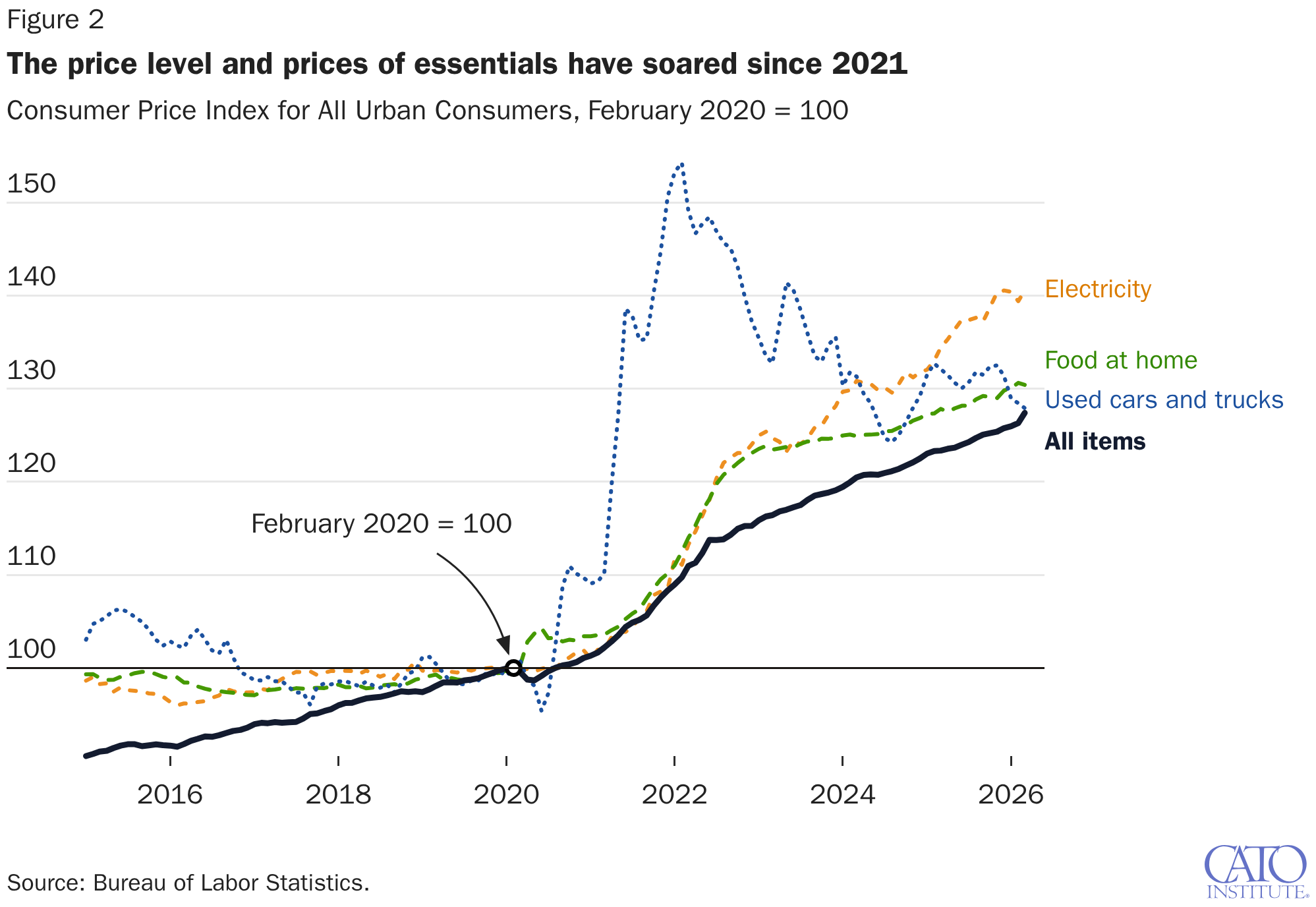
Scarred by grocery, electricity, and used car prices that are more than 30 percent higher than in 2020 (Figure 2), the public now increasingly equates high prices with a poor economy. In a recent Echelon Insights poll, nearly three-quarters of Americans said that only prices falling (i.e., deflation), not inflation slowing or wages growing faster than prices, would convince them that the cost of living was no longer a problem. But inflation—the rate of increase in the price level—has stayed positive, and in 2025 ran significantly above the Federal Reserve’s 2 percent annual target. That’s before the recent fallout of the Iran war.
All of this makes satisfying voters’ affordability concerns a tough political and economic needle to thread. They don’t just want inflation to slow to target or even fall below target for a while. They want prices in general to come down, fast. That would require an aggressive tightening of monetary policy to slash economy-wide spending, likely triggering a recession. It’s a trade-off the public doesn’t fully grasp, and one that neither Congress nor the Federal Reserve is willing to risk. So instead, under mounting pressure to “do something,” politicians are rummaging around for sector-by-sector interventions to provide relief on housing, energy, childcare costs, and more.
To date, most affordability proposals in Washington and state capitals flunk basic economics. Price caps, additional subsidies, or mandates might lower prices for some but bring fresh distortions, higher charges, and limited access for others. They dampen the signals that prices send about scarcity and where to direct resources efficiently. Most importantly, they don’t make things cheaper to produce. They mainly just reshuffle the burden and paper over the real, industry-specific drivers of high prices.
This handbook aims to bring some much-needed economic rigor to this hopelessly confused affordability debate. It provides two key takeaways, crucial to policymakers:
First, today’s frustration over affordability owes mainly to the recent high inflation, which was overwhelmingly created in Washington, DC, through overly expansionary monetary and fiscal policy.
Second, if the goal is to lower prices or broaden options for specific goods, the answer is not price controls, subsidies, and mandates. It is more economic freedom—specifically, removing existing government barriers that restrict supply and block competition.
Understanding the So-Called Affordability Crisis
“Affordability” has become a catchall political buzzword precisely because it’s ill defined. Economists instinctively understand affordability in terms of real wages: how much you can buy with what you earn. By that standard, 2025 looked all right. Average weekly earnings grew by 4.3 percent in the year that ended in January 2026, while inflation, measured by the Consumer Price Index, rose 2.4 percent. On various price and earnings metrics, real earnings per employee jumped by $1,200 or more. No wonder President Trump is frustrated that people talk of a worsening “affordability crisis.”
Clearly, voters aren’t parsing national real-wage calculations. They’re angry mainly because everything costs far more than it did just five years ago. Even though inflation has slowed, people still feel unmoored by prices having jumped so fast. The Biden administration found out the hard way that pointing to wage growth while Americans stare at 30-percent-higher grocery bills only deepens resentment.
What makes the term “affordability crisis” resonate with the public is that it encapsulates four distinct frustrations:
- Sticker shock. Prices are still shockingly higher than in early 2020. People remember both the struggle of adjusting to this reality and the lower nominal prices they used to pay.
- Expensive credit. Higher interest rates have made mortgages, car loans, and credit cards feel like brick walls blocking major life goals.
- Stubborn inflation. Inflation remains above target, and Trump-era policies—tariffs, deportations, deficit spending, pressure on the Fed, the Iran conflict—have raised some prices directly and made people worried that inflation could resurge.
- Structural price pain. In industries like housing, childcare, and health care, persistent supply constraints and structural features of the markets make even good wage growth feel as though it gets eaten up by rising bills.
These aren’t imagined grievances. But they’re not a single issue either. To respond effectively, it’s crucial that policymakers distinguish between inflation as a change in the general price level and relative price changes affecting specific sectors.
Inflation is a macroeconomic phenomenon. It occurs when broad money and then total nominal spending economy-wide grows faster than its capacity to produce goods and services. That’s what causes a dollar to lose purchasing power: too much money chasing too few goods. The Federal Reserve seeks to control inflation through the monetary conditions that shape broad money and nominal spending, by setting short-term interest rates, conducting open-market operations (buying or selling assets), adjusting reserve requirements, and guiding expectations through public communication. Congress either aids or undermines those efforts with how responsibly it manages long-term budgets.
But price hikes of individual goods don’t always reflect inflation. When voters complain about high rents, childcare costs, or insurance premiums, they are often complaining about relative price changes for specific goods or services. The surge in demand for face masks early in the COVID-19 pandemic pushed up their prices. Housing costs rise when zoning laws restrict new supply from meeting rising demand. Improving affordability in specific markets requires structural reform. Only a supply expansion—lowering production costs, opening markets to fresh competition—delivers lower prices without fewer people being able to access a good or service.
This distinction between inflation and relative prices is critical. You can’t fix high childcare costs using monetary policy, and you can’t fight inflation by revising building codes. Conflating the two is a recipe for disappointment and bad policy.
Yet this confusion permeates the affordability debate. Most of the affordability frustration clearly boils down to the massive jump in the general price level since 2021. That was caused by inflation, and that inflation overwhelmingly reflects excessive macroeconomic stimulus. But most affordability proposals amount to tinkering in individual markets, usually in destructive ways.
The story of recent inflation is not complicated. In spring 2020, the COVID-19 pandemic and lockdowns collapsed both total spending and real production. Policymakers responded with the normal recession playbook: vast spending, borrowing, and money creation to revive economy-wide spending. The Federal Reserve cut interest rates and allowed the broad money supply (M3) to balloon by over $6 trillion. Congress sent out three rounds of checks—$3,200 per adult—and dramatically expanded unemployment, business, and state government aid. Household balance sheets improved. Once the economy reopened fully, households and firms found themselves holding far more money than they wished to hold relative to their income and wealth. They sought to rebalance by spending more on assets, goods, and services, with total spending on final goods and services (Figure 3, Nominal GDP) exploding rapidly and far above its pre-crisis trend. The inflation that followed wasn’t a mystery but rather a reflection of too much money chasing the amount of stuff being produced.
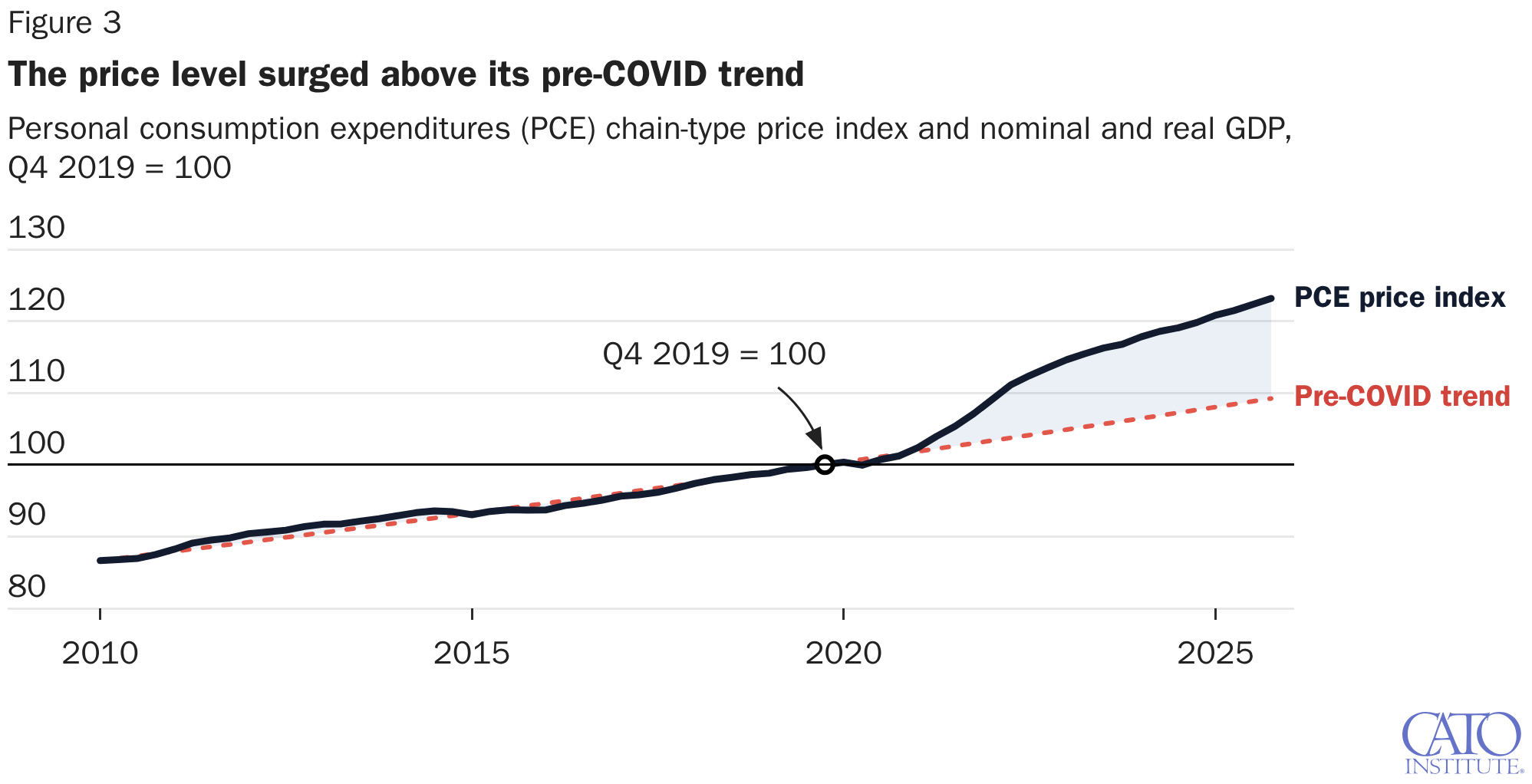
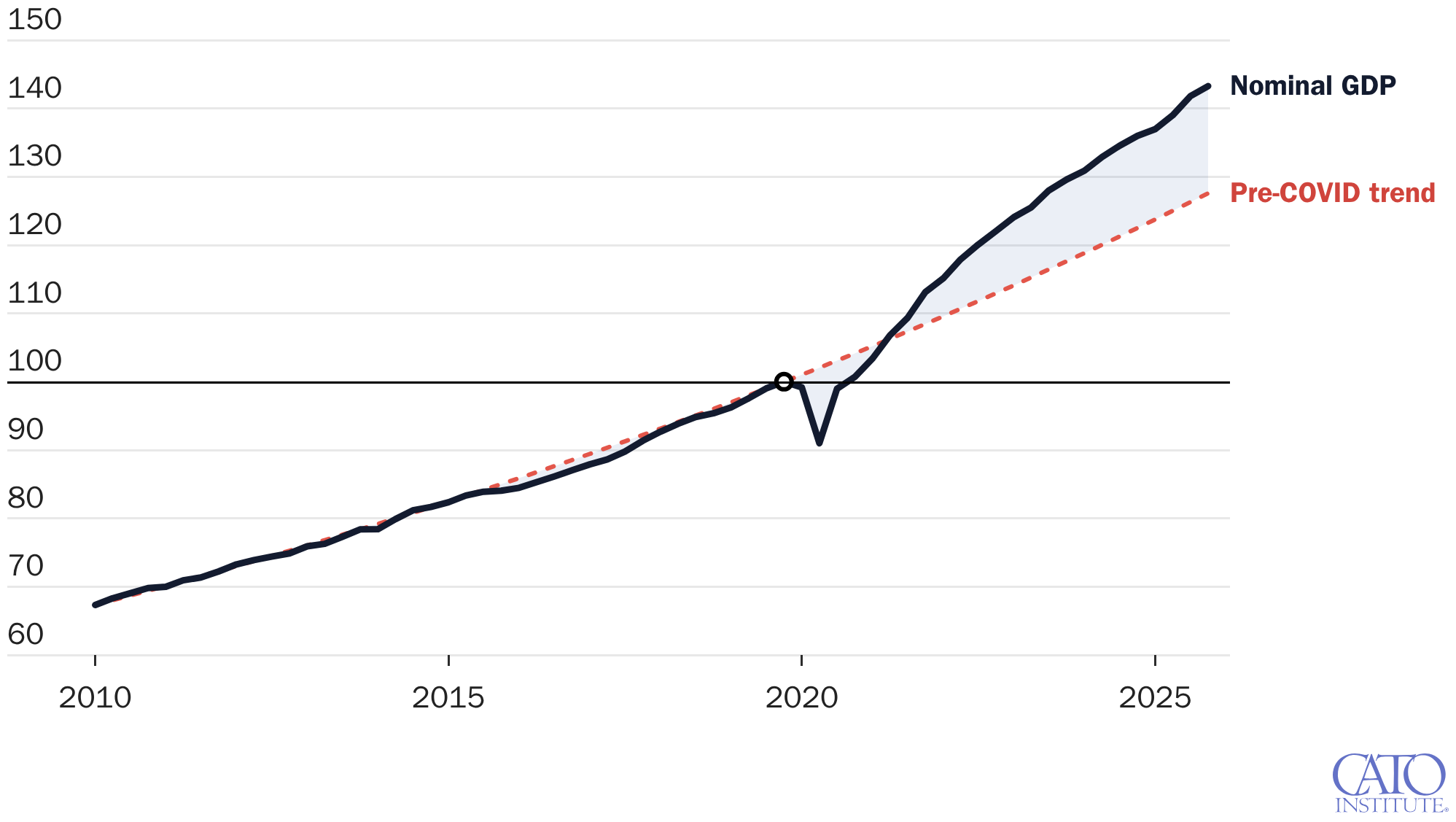
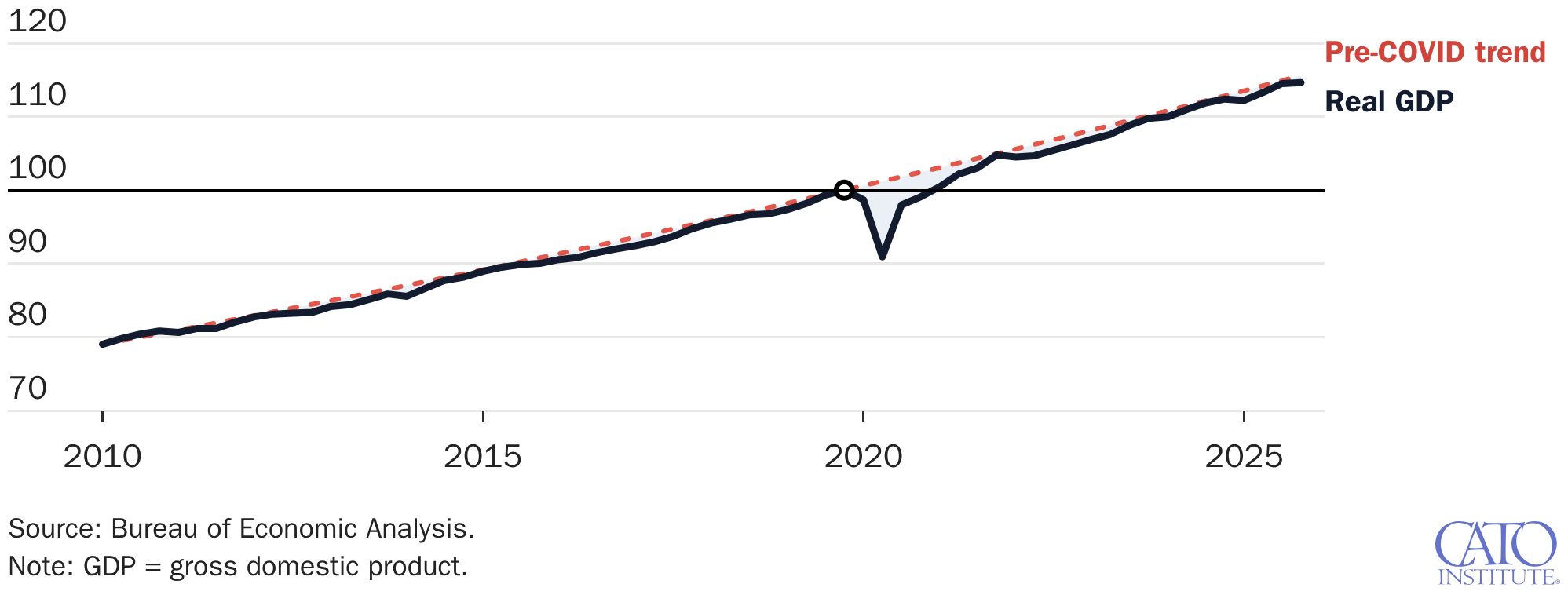
Economists can debate the relative role played by the Federal Reserve’s monetary policy or Congress’s borrowing, but the vast bulk of “excess” inflation came from macroeconomic policy creating too much money and goosing too much spending. Yes, the pandemic disrupted supply chains, and the Russia-Ukraine war drove up energy prices, just as the war in Iran has recently. These “supply shocks” undoubtedly exacerbated inflation at times. But they don’t explain why prices surged across the board or why consumer prices today remain 14 percent above pre-COVID trends. Real output has recovered to pre-pandemic trends (Figure 3), meaning we aren’t more supply constrained than expected. What broke from the trend—and stayed high—was total economy-wide spending. That’s what drove inflation.
Faulty and self-interested theories muddied this story. The Federal Reserve initially claimed inflation was “transitory,” blaming it on temporary supply disruptions and shifts in sectoral spending that the Fed couldn’t control and that would quickly unwind. As inflation spread and the Fed realized its error, the Biden administration instead deflected blame toward greedy corporations, landlords, meatpackers—anyone but macroeconomic policymakers.
These “greedflation” theories never passed the smell test. Even if some firms had slightly more pricing power in a world of supply shocks, that would explain only relative price shifts, not broad-based inflation. Temporary profit bumps in some sectors were themselves a symptom of excess demand or global supply disruptions, not a sudden breakdown in competition allowing corporations to gouge customers. And consumers had to be willing and able to pay those higher prices. (They could, because they were holding large money balances.) The problem wasn’t greed; it was too much money chasing goods and services.
Still, these faulty theories encouraged misguided policy proposals. If inflation reflected corporate pricing power, the thinking went, the answer must be regulation. Rent controls, junk fee bans, antitrust crusades, and anti–price gouging laws were championed. Yet these could never have fixed inflation, because they don’t reduce overall spending growth or meaningfully expand the economy’s productive capacity. They would have mainly distorted price signals, resulting in shortages, quality declines, and black markets.
This history matters for today’s debates for two reasons.
First, if we forget what really caused inflation, we’ll repeat it. “Running the economy hot,” reckless budgeting, or lax monetary policy all risk another surge in prices in the future.
Second, many who downplayed the risks of excessive stimulus or denied that inflation had macroeconomic roots now push price controls and mandates to appease voters discontented by the fallout. They’re doubling down on their initial bad analysis.
This handbook resets the conversation. High inflation was largely a macroeconomic mistake. High prices in specific sectors beyond that stem from structural issues. Each demands a different solution. Mixing them up risks an affordability mess.
The Wrong Path to Improved Affordability
Policymakers under pressure to “do something” about affordability are nevertheless targeting individual, salient prices. But most proposed interventions treat high prices not as crucial signals of scarcity but as political nuisances to be suppressed. The bulk of more recent federal and state “affordability” proposals fit into three categories: price controls, subsidies, and regulatory mandates.
Price controls—such as rent freezes, credit card APR caps, and anti–price gouging laws—ignore the supply-and-demand factors driving high prices and instead force prices to lie about reality. Holding prices below market levels creates shortages, queues, and black markets, as seen in 1970s gas lines or supply collapses in heavily rent-controlled cities. Firms also respond to price caps by cutting quality, hiking hidden fees, or rationing access—distortions that worsen over time as controls bind harder. Price controls are simply a recipe for discoordination and chaos.
Subsidies can lower out-of-pocket costs for subsidized consumers for services such as childcare or health care, but only by shifting the payment burden from consumers to taxpayers. Subsidies do not reduce costs of provision. By increasing demand, they raise market prices, leaving unsubsidized consumers worse off. And worse still, subsidies rarely come alone: They’re usually tied to costly regulatory mandates on staffing and coverage that increase provision costs. Zohran Mamdani’s supposedly free childcare plan is a case in point: It would mandate teacher-level pay for childcare workers, pushing up costs that taxpayers would then cover.
Regulatory mandates don’t cap prices outright but still distort markets. Banning or restricting institutional investors such as private equity firms and real estate investment trusts from buying single-family homes might shave some local prices by reducing bidding pressure today, but it will shrink rental supply and discourage new rental construction, raising rents in the future. Stretching mortgages to 50 years lowers monthly payments, but it also inflates total interest costs, adds financial risk for taxpayer-backed entities, and drives up home prices by artificially boosting buyers’ purchasing power. Other mandates—such as aggressive antitrust enforcement or restrictions on business models—can outlaw the very scale and specialization that make goods and services more affordable.
These proposals share a common flaw: They treat the symptoms of high prices, not their causes. They don’t reduce costs or expand supply. They merely reshuffle the bill, hide the trade-offs, and stoke economic dysfunction.
A Better Approach
This handbook’s alternative approach acknowledges two realities.
First, Americans are frustrated about affordability mainly because of recent high inflation delivering a higher price level.
Second, in an election year, policymakers face mounting pressure to “do something” to improve affordability by targeting high-salience sectors like housing, health care, energy, and food. Most existing proposals are ill considered.
Affordability improves as productivity rises and wages grow relative to prices. But that takes time, and voters want visible, near-term price cuts—not promises of future real-wage gains. “Pro-growth policy” is therefore desirable but isn’t targeted enough to assuage concerns. Nor is broad “relief” through tax cuts or new checks the answer to today’s discontent. While taxes are a major living cost—and state sales taxes raise prices directly—the net impact of broad tax cuts, or indeed government checks, depends on how the policy is financed. In Washington’s case, runaway borrowing itself risks unpopular inflation again.
Instead, this handbook offers a more disciplined response to affordability concerns, targeting both inflation and specific relative prices separately.
Part One focuses on restoring a sound macroeconomic foundation to get and keep inflation low. That means keeping the Federal Reserve focused on price stability and having Congress confront federal deficits that could undermine the Fed’s independence or fuel future inflation.
Part Two lays out practical, pro-market reforms across sectors that make up over 75 percent of household budgets: housing, energy, health care, transportation, childcare, food, and more. These proposals aim to lower prices by liberating supply, intensifying competition, and removing regulatory choke points that restrict or outlaw lower-cost alternatives.
We don’t claim that every reform would be politically easy or would solve all problems. Industries like health care and higher education are heavily distorted by extensive government subsidies fueling overconsumption. Paring these back is desirable policy but would worsen near-term affordability for many consumers who currently receive subsidies. They are beyond our scope.
Instead, the policies we present here would offer meaningful, medium-term relief without relying on price controls, subsidies, or mandates that shift costs or suppress demand. The policy ideas would unlock innovation, improve the responsiveness of markets, and raise real incomes by improving economic efficiency.
The better approach to addressing affordability concerns is surprisingly simple: sound macroeconomy policy coupled with more economic freedom to supply goods and services.
About the Author


This work is licensed under a Creative Commons Attribution-NonCommercial-ShareAlike 4.0 International License.