A pair of conservative groups founded with the help of Republican political guru Karl Rove raised more than $70 million since their inception last spring.…
“After a successful 2010, we are shifting toward our goals for 2011 and beyond,” Collegio said, adding that the Crossroads duo will be “active throughout 2011 in support of a conservative, free-market legislative agenda.”
Cato at Liberty
Cato at Liberty
Pulitzer Prize-winning columnist Eugene Robinson at the Washington Post complains about Republicans’ insistence that tax rates not go up next month, while they also resist more government spending:
In other words, there’s no additional money in the national coffers for the victims of the most devastating recession since the Great Depression. But to help investment bankers start the new year right, perhaps with a new Mercedes or a bit of sun in the Caribbean? Step right up, and we’ll write you a check.
No. No. No. When the government fails to raise taxes, no one “writes a check.” People who are not taxed don’t get a check from the government, they simply get to keep the money they have already earned. No check will be coming from “the national coffers” to taxpayers if tax rates are left at their current rates.
Robinson seems to think that all the money in America is “in the national coffers,” and the question for Congress is who to give it to.
Related Tags
Writing about the meeting between President Obama and congressional leaders — where some hoped to find some agreement on taxes and spending issues — Dana Milbank quotes two skeptics:
“There’s a reason why we have Democrats and Republicans,” incoming House speaker John Boehner said at his news conference. “We believe in different things.”
“We have two parties for a reason,” Obama said a few minutes later. “There are real philosophical differences.”
No doubt there are. But it’s hard to find the differences on this chart of the upward march of government spending, handily provided by the Heritage Foundation:
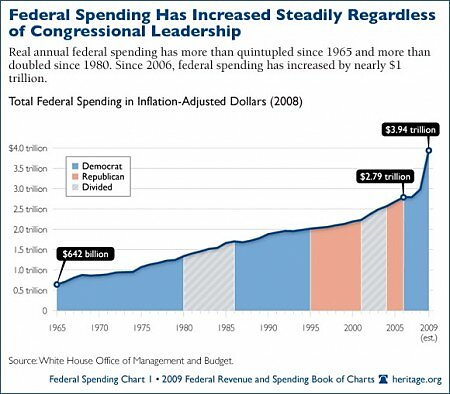
To the naked eye, it looks like a pretty steady climb through the Johnson-Nixon-Ford-Carter-Reagan-Bush-Clinton years, with a bit of acceleration under Bush II and then a sharp jump in 2008 and 2009. Heritage’s color-coding refers to Congress only, so you can’t see that the slight slowdown in the Clinton years occurred under divided government. And of course the TARP and other 2008 spending was proposed and forced through by the Republican White House, even though Congress was indeed Democratic at the time.
But the bottom line is: If we have two parties for a reason, because they believe in different things, why don’t we see some real differences in the growth of federal spending?
Related Tags
Over at Downsizing Government, we focused on the following issues this week:
- The Obama administration adopts Cato’s federal employee pay proposal.
- Social Security Disability Insurance: What was supposed to be a narrowly tailored program to help individuals who could no longer work has blossomed into a gigantic budgetary burden that acts more like an unemployment program.
- Rep. Jack Kingston (R‑GA) has some good ideas for reforming the House Appropriations Committee.
- The Fiscal Commission’s report provides a useful menu of reform options that incoming members of a more conservative Congress can pursue next year.
- The Government Accountability Office reports that the Federal Aviation Administration’s new air traffic control system could ultimately cost four times more than originally estimated.
Related Tags
Although the Bowles-Simpson deficit reduction commission has come up short of the 14 votes among its members that it needs to force Congress to vote up-or-down vote on implementing its recommendations, the debate over ways to cut spending will certainly continue. Of particular note is the emerging consensus that military spending cannot be held sacrosanct in the search for savings.
Over at The National Interest Online, I try to shed some light on the actual scale of the cuts proposed by various deficit reduction reports. Kim Holmes and others affiliated with the Defending Defense alliance claim that the cuts are deep, indisciminate, and dangerous. I show that the proposed cuts, even if they were to materialize, would bring U.S. military spending back to 2006 or 2007 levels, and this would still be more than we spent on average during most of the Cold War.
But the more relevant point pertains to why military spending can safely be cut, not merely in Washington’s “slower growth” terms, but in real terms; historically, military spending comes down when our perceptions of threats change.
I predict a similar scenario playing out in the next decade. As the wars in Iraq and Afghanistan draw to a close (and that should move more swiftly than currently planned), recent increases in the ground forces could be rolled back to pre‑9/11 levels. Additional savings can be realized if the United States were to terminate its outdated deployments in Europe. We could also revisit the role played by U.S. troops in South Korea and Japan. The Pentagon’s civilian workforce could be cut, chiefly through attrition, and save tens of billions of dollars. Finally, tighter scrutiny over the Pentagon’s spending, beginning with an audit, would allow taxpayers to realize additional savings, while ensuring that our men and women in uniform are provided with the highest quality equipment at the lowest possible price.
You can read the rest here.
With Republicans taking control of the House in January, long-time Federal Reserve critic Rep. Ron Paul is in line to take over chairmanship of the House Financial Service Committee’s Subcommittee on Domestic Monetary Policy and Technology. This is the subcommittee with direct oversight of the Federal Reserve.
The thought of having some actual oversight of the Fed is apparently making Wall Street and the rest of the banking industry nervous. Recent disclosures of Fed lending to foreign banks and Wall Street did not help the public image of either Wall Street or the Fed. With Congressman Paul pushing for a full audit of the Fed, it is likely even dirtier secrets of the Fed may come to light.
So where have the Fed and Wall Street turned for protection? According to Bloomberg, the Fed’s new protector might be incoming House Speaker John Boehner. Next week, House Republicans meet to select their committee and subcommittee chairs. Bloomberg sources report that, at the request of the major banks, Boehner is looking for avenues to either deny Paul that subcommittee chair or to restrict his ability to oversee the Fed.
While I always expected the House Republicans to eventually revert back to their old ways, I did think they’d at least wait until 2011. I believe this will be a real test of Boehner: Does he choose to rein in Ron Paul or rein in the Federal Reserve?
Related Tags
Fans of soccer and liberal democracy — I’m in both groups — were disappointed to hear that the FIFA grandees awarded the 2018 World Cup to Putinland Russia and the 2022 event to Qatar (!). My friend Grant Wahl has a typically sharp immediate reaction for Sports Illustrated that boils down to three points: (1) the choices prove once again that FIFA is not exactly a model of integrity and transparency; (2) Qatar? Really? Really?; and (3) the U.S. put together a strong bid and left everything on the pitch.
I would expand Grant’s first point to darned-near all elite international organizations, from the International Olympic Committee all the way to the United Nations (though the Wall Street Journal today said FIFA makes the UN look like a model). Where there is no democratic accountability and plenty of rent-seeking opportunities, is corruption and non-merit-based decisionmaking all that surprising?
And of course this isn’t a matter of the United States losing out to a nation with a deep soccer (or any athletic) tradition, or even to a developing country set to burst onto the geo-political stage (like awarding the 1968 Olympics to Mexico City, the 1988 Games to Seoul, or the 2008 Games to Beijing). No, this was a matter of petro-wealthy sheiks buying a major sporting event. Bully for commercial competition, of course, but (a) those are sovereign, not private funds in play (though the distinction is observed in the breach in the Middle East); (b) playing in 110-degree heat can’t make sense (see the problems with the relatively balmy 1996 Atlanta Olympics — and I’ll believe the air-conditioned outdoor stadiums when I see them); and (c) who knows what the political situation will be in the region 12 years hence. Plus bribing officials and riding anti-American sentiment — shocking, I know, given that George W. Bush was not part of the Bill Clinton/Morgan Freeman-led lobbying team — ain’t exactly a testament to the free market.
Speaking of economics, though, one silver lining to the U.S. disappointment — and that of England, once favored for the 2018 Cup but finishing with only two votes — is that hosting a “mega-event” like the World Cup or Olympics really doesn’t do much for a national economy (and more often than not has a detrimental economic impact). And while I haven’t studied the details of the U.S. bid, it’s safe to assume that whatever public stadium and other subsidies were in it — probably not much compared to luring/keeping pro sports teams — paled in comparison to Qatar’s bid (let alone Russia’s). And so American soccer fans’ loss is almost certainly American taxpayers’ gain.
In short, the Russia-Qatar double is a cynical course of events that will harm soccer’s long-term prospects in the United States and the reputation of international athletic bodies everywhere. (Just in time for the annual peak in anti-BCS vitriol among lovers of American football, this time with a neat antitrust twist — on which more at some later point.)
Perhaps the biggest question, though, is how will Qatar’s strict alcohol laws affect fans’ enjoyment of “the beautiful game”?