Between Paris and Brussels obstacles of many kinds exist. First of all, there is distance, which entails loss of time, and we must either submit to this ourselves, or pay another to submit to it. Then come rivers, marshes, accidents, bad roads, which are so many difficulties to be surmounted. We succeed in building bridges, in forming roads, and making them smoother by pavements, iron rails, etc. But all this is costly, and the commodity must be made to bear the cost. Then there are robbers who infest the roads, and a body of police must be kept up, etc.Now, among these obstacles there is one which we have ourselves set up, and at no little cost, too, between Brussels and Paris. There are men who lie in ambuscade along the frontier, armed to the teeth, and whose business it is to throw difficulties in the way of transporting merchandise from the one country to the other. They are called Customhouse officers, and they act in precisely the same way as ruts and bad roads.
Cato at Liberty
Cato at Liberty
Topics
President Obama’s Most Amazing Accomplishment
After nearly five years in office, what’s President Obama’s most significant accomplishment?
This is a serious question, so no jokes about the Nobel Prize he received for not being Bush. And no partisan GOP answers about the 2010 election, either.
Put yourself in the position of a future historian and think about what you would put in a book to describe Obama’s biggest accomplishment.
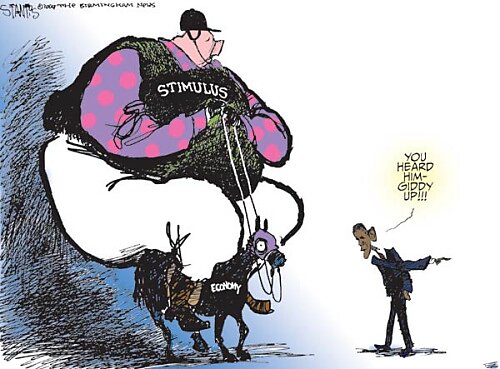
I don’t think anyone, regardless of ideology, would pick the so-called stimulus. Advocates of small government say it was a waste of money based ondeeply flawed Keynesian theory.
Proponents of big government, by contrast, also aren’t big fans of the stimulus, though they’re dissatisfied because they think Obama should have wasted even more money.
Another potential answer is Obamacare. Libertarians and conservatives, needless to say, would say it was a significant accomplishment in the same sense that the Titanic had a significant maiden voyage.
Leftists, by contrast, obviously can’t be pleased by the way Obamacare is imploding in the short run, but they nonetheless may think that it will be worth it in the medium run because more people will be dependent on government (though they may regret their choice in the long run).
Killing Osama bin Laden is probably a good answer, but if terrorism and conflict with the Islamic world are still big issues in the future, then I suspect the achievements of Seal Team Six won’t be seen as making that much of a difference.
For what it’s worth, I think the change in public opinion may be the President’s most long-lasting and significant accomplishment. Take a look at these remarkable results just published by Gallup. A record share of the population now say that big government is the biggest threat to the nation’s future.
Wow. I’m tempted to say that this is strong evidence of the effectiveness of the Cato Institute (and there is independent data to support that position), but I feel compelled to admit that Obama also deserves a good bit of the credit.
Even more amazing, President Obama has done something that is probably beyond even the ability of Cato. He’s convinced partisan Democrats that big government is a serious threat. Look at how the numbers have dramatically changed since 2008.
What’s particularly amazing about the shift among Democrats isn’t that 56 percent now view big government as the major threat today, compared to 32 percent about five years ago. What’s shocking is that this change happened with a Democrat in the White House.
This is newsworthy because partisan Republicans and Democrats have a tendency to say things are good or bad depending on whether “their team” is in charge.
While these numbers are remarkable, I suppose it’s too early to say the growing concern about big government is the most significant accomplishment of the Obama presidency.
That being said, anxiety about big government may lead to big political changes in 2014 and 2016, and those political changes may then lead to big policy changes such as entitlement reform and tax reform.
And if that happens, then the shift in public opinion during the Obama years may turn out to be profoundly important. In other words, Obama may turn out to be another Herbert Hoover – a politician whose statist policies set the stage for dramatic changes in public policy.
And if that happens, Obama truly will deserve to be named “libertarian of the year.”
P.S. While big government is the biggest threat to the country’s future, big business and big labor can be very dangerous to liberty when they get in bed with big government.
Related Tags
Vermont’s Chief Justice Cites Cato Portugal Study
From the Seven Days publication:
In recent weeks, Vermont Chief Justice Paul Reiber has gone public with an unusually assertive critique of the war on drugs and the “tough on crime” approach that has defined criminal justice for decades.
Reiber, who holds an office in which occupants usually avoid saying anything remotely controversial, has stopped short of recommending policy or criticizing any individuals or government bodies. But in a pair of speeches and a brief interview with Seven Days, he has declared ineffective the current reliance on police and punishment, and touted the merits of treatment-based models for dealing with crime rooted in substance abuse.…
In his Boston speech, Reiber highlighted reforms in Portugal, which in 2001 abolished criminal penalties for possession of all drugs, and replaced incarceration with drug treatment. Vermont’s chief justice called the results of that experiment “astonishing,” citing a study from the libertarian Cato Institute showing that Portugal experienced a large drop in drug use and a spike in the number of people seeking treatment.
Check out the Cato report on Portugal’s drug decriminalization policy here.
Germany Lurches Left: Sacrificing German Liberty and Germany’s Future
BERLIN—Germany’s Christian Democrats and Social Democrats have formed another “Grand Coalition.” The political center in Europe’s wealthiest and most populous state now swallows most of the ideological spectrum. However, the entire political spectrum has lurched to the left.
The Christian Democratic Union-Christian Social Union combination (sister parties which run as one) is a pale version of the Republican Party. The CDU-CSU long ago made peace with Germany’s generous welfare state.
Even less inclined to act is CDU Chancellor Angela Merkel. She pulled her party leftward in 2005 into a Grand Coalition with the Social Democratic Party, which went on to do essentially nothing.
She won a second term in 2005 but did little more to liberate German life. Her latest reelection campaign was based on keeping everything the way it was.
The CDU-CSU fell only five votes short of a majority. However, the poll was a disaster for the CDU-CSU’s coalition partner, the Free Democratic Party. Created in 1948 out of the ruins of the Third Reich, the FDP emphasized civil liberties, economic freedom, and entrepreneurship. In 2009, the Free Democrats enjoyed their best showing ever, 14.6 percent, and their support made Merkel Chancellor.
However, they proved to be less adept in governing. As the September election approached, the Free Democrats lacked any noticeable achievements.
A new political competitor, Alternative for Germany criticized the endless Euro bail-outs while backing the same market-oriented economic policies as the Free Democrats. Many FDP voters shifted allegiance.
The FDP fell just short of the five percent threshold, receiving 4.76 percent of the vote. It went from 93 Bundstag seats to none. The Free Democrats still hold some seats in regional parliaments and the European Parliament, but have no obvious path back to national power. The AFD came in just behind the FDP, with 4.7 percent, and also won no seats. However, it is well-positioned to advance, putting the FDP’s survival at risk.
The Free Democrats’ collapse left the Bundestag with a narrow left-wing majority. However, both the SPD and Greens pledged not to join forces with Die Linke, or Left party, since it was the successor to the Communists who once ruled East Germany.
As I pointed out in my Forbes online column:
Although the CDU-CSU was much stronger in the Bundestag, the Social Democrats demanded specific concessions, such as a national minimum wage, which will reduce Germany’s employment advantage over its European neighbors, limitations on temporary employment, which will cut job opportunities, expanded pension benefits, which will add to the financial burden of an aging society, higher than necessary state pension contributions, which will be looted to fund political initiatives, and urban rent controls, which will discourage apartment construction and maintenance.
The Economist magazine warned of “Die Grosse Stagnation” likely to come. Europe’s largest economy faces slow labor productivity, falling investment, and minimal reforms since the start of the Euro crisis.
It is not just the government which has moved left. During the last Grand Coalition the FDP was the largest opposition party, leaving its leader the unofficial opposition leader. In this Bundestag the largest opposition party will be Die Linke. Just behind will be the Greens, traditionally known for their environmental commitment but of late pushing leftist economic nostrums as well.
Nor does the drift stop with the left-wing parties. The Free Democrats held a special party congress in Berlin and responded to the election debacle by making Christian Lindner of North Rhine-Westphalia the new party chairman. Lindner is seen as less committed to the party’s liberal principles.
Like Americans, the German people have worked hard to prosper despite an ever-expanding regulatory welfare state. But they will find it ever more difficult to succeed as their government moves further left. Then they will come to miss having a voice for economic and social liberty in the Bundestag.
Related Tags
Fast Track Is a Waste of Time
As Cato’s Dan Ikenson has pointed out before, the Obama administration likes grand trade policy proposals, like the Trans-Pacific Partnership or the proposed U.S.-EU trade agreement, but isn’t putting in the political effort needed on the domestic side to secure approval of these agreements.
The president’s decision to nominate Senator Max Baucus (D‑MT) to be the next U.S. ambassador to China is a perfect example of this problem. Three years into negotiations toward the Trans-Pacific Partnership agreement, the president finally decided to seek fast track trade promotion authority this fall, and Baucus has been instrumental in putting together a bipartisan bill. With Baucus being sent to China, there will be no prominent Democrats in either the House or the Senate supportive of fast track.
This development should surely not engender confidence in the ultimate success of the TPP, but there’s one counterintuitive way to help bring much-needed focus to U.S. trade policy: Stop worrying about fast track.
Fast track authority is an arrangement between the president and Congress designed to ease the passage of trade agreements. Congress agrees to hold a timely, up-or-down vote on future trade agreements. In exchange, the president agrees to adopt a series of negotiating objectives demanded by Congress.
Many trade advocates believe that fast track authority is necessary to gain Congressional approval of free trade agreements, but I have a new bulletin out today explaining how, right now, fast track will do more harm than good.
First, with the current partisan alignment in Congress, we don’t need fast track to pass the TPP. And second, the negotiating objectives Congress imposes through fast track include bad policies that could disrupt the negotiations at this late stage, and even delay completion of the agreement.
If there were a chance that Congress would use the fast track bill to make the TPP a better free trade agreement, then I would support it. But there is absolutely no indication that anyone in Congress is going to push for that. Taking up fast track now accomplishes nothing of value, but will serve as divisive political theater while ultimately reducing the quality of the TPP.
You can learn more by reading the bulletin.
The Economic Impact of NSA Spying
At some point, I hope someone does a thorough, empirical study of the impact of NSA spying on U.S. companies. But for now, all we have is anecdotal evidence, like this:
Today Brazil’s government announced it won’t buy $4.5 billion worth of US fighter jets in a move attributed to anger over controversial US intelligence-gathering that targeted Brazilian citizens and officials, including president Dilma Rousseff.
The Brazilian government’s official statements pointed to performance and cost issues as the reason to pick Sweden’s Saab AB to develop 36 fighters, though many observers had believed Boeing had the upper hand while bidding to expand Brazil’s air force.
Calling the decision “disappointing” in a statement, Boeing says it isn’t done trying to sell to Brazil, a major client for the company’s commercial air business, noting that ”over the next several weeks, we will work with the Brazilian Air Force to better understand its decision.”
One way to understand it: “The NSA problem ruined it for the Americans,” a Brazilian government official told Reuters. Public opinion turned against the US, and Brazil is leading the charge for a United Nations resolution that would limit electronic surveillance. Edward Snowden, the former National Security Agency contractor whose leaks revealed the US surveillance, obliquely requested asylum in Brazil earlier this week, but it looks the country isn’t interested in hosting the whistleblower.
Today, a White House panel charged with assessing American electronic snooping released a report urging new limits on US intelligence agencies. One of its recommendations is to more carefully assess the costs of surveilling foreign leaders like Brazil’s Rousseff. On this front, Brazil’s decision on the fighter planes is a costly object lesson for the US government.
Low Job Satisfaction in the Federal Bureaucracy
Other than providing generous pay and fat pensions, many federal agencies are not great places to work, according to federal employees themselves on a new survey.
A Washington Post story summarized the OPM results:
“The average government worker comes in 13 points below the average private-sector employee in terms of job satisfaction, according to the ‘Best Places to Work in the Federal Government’ report.
‘This is an ongoing train crash,’ said Max Stier, president of the Partnership for Public Service.
Hay Group, which collaborated on the data, found that job satisfaction in the private sector was not only higher than in the public sector, it even climbed since last year — from 70.0 to 70.7 points out of 100 — all while the government numbers fell.
Of the 10 questions that both public and private employees answered, government scored higher on only question: Do you like the kind of work you do?
On every other question, including how well colleagues cooperate and how well management keeps employees informed, private-sector workers gave their organizations higher marks.”
During the Bush years, government failures were explained away by liberal pundits as being the result of a Republican administration that (supposedly) did not believe in government. But the government-loving Obama administration has now been in office five years and federal employees are more dissatisfied than they have been in at least a decade.
Many liberal experts—such as these folks—will admit that the government bungles a lot of its activities. They usually call for reforms like more coordination, reduced overlap, and better leadership to solve the government’s mismanagement problems.
However, the government will never operate as effectively as private enterprise for many reasons. One is that government workplaces will always be buried under piles of rules and regulations that frustrate workers and stifle initiative. Another is that the government has rigid pay structures that don’t differentiate between the slackers and the hard workers. Ludwig von Mises discussed some of the fundamental differences between private enterprises and government bureaus in his book Bureaucracy seven decades ago. Little has changed since then, despite repeated efforts to “reinvent government.”
One reason why our federal government is a particularly poor performer is that it has become so large, complex, and immune to oversight. If Americans want Washington to work better, they should insist that it be downsized as much as possible. Some agencies should be abolished, such as the lowest scoring agency on the new survey, the Economic Development Administration, which is an unneeded pork barrel machine. Other agencies should be privatized, such as the low-scoring Transportation Security Administration.
Less would be more when it comes to government and its performance.