This Reuters headline says it all: “Cigna CEO: Don’t repeal U.S. health law.”
Cato at Liberty
Cato at Liberty
Government and Politics
As a campaigner, President Obama promised that bills sent him by Congress would be posted online for five days before he would sign them. It’s a simple, measurable transparency promise that we have followed on this blog.
With attention beginning to turn to the 2012 presidential election (believe it or not!), President Obama’s fealty to campaign promises will become a focus. So here’s an update on his Sunlight Before Signing promise.
First, a brief summary table. Congress has presented President Obama 283 bills, 124 in 2009 and 159 in 2010. He posted six online for the requisite number of days in 2009, and 103 in 2010. (One emergency bill did not require posting. It’s non-posting is consistent with the president’s promise so we treat it as “compliant” in summary materials.)
| Number of Bills | Emergency Bills | Bills Posted Five Days | |
|---|---|---|---|
| 2009 | 124 | 0 | 6 |
| 2010 | 159 | 1 | 103 |
| Overall | 283 | 1 | 109 |
The graph below illustrates well that the administration has improved on the, frankly, lousy start it got with Sunlight Before Signing. In the month of May, every bill was posted on Whitehouse.gov for five days before the president signed it.
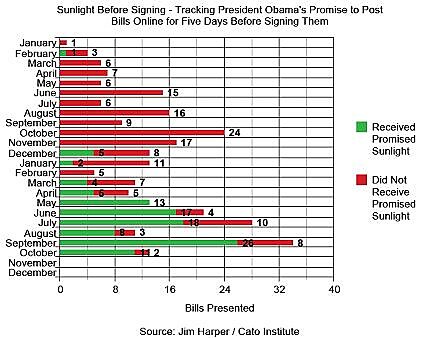
There remains a residuum of bills that don’t seem to get Sunlight Before Signing, and those may be the ones where political expedience takes precedence over the president’s campaign promise to his voters. But the White House is clearly positioned to fulfill this promise completely in the second half of the president’s term.
The chart below (that is, after the break) exhibits the same data—Sunlight Before Signing compliance by month—with percentages of non-compliance and compliance. After that, you’ll find a table of every bill the president has signed and its treatment in terms of sunlight.
There will be a short spate of bills during the lame duck session. The next report in late December will capture the entire first half of the president’s term, setting the stage for reporting on the White House’s 100% success rate in 2011 and 2012.
Full compliance will give the press and public a way to know exactly what hits the president’s desk, and an opportunity to make a habit of reviewing Congress’ work before bills become laws.
Sunlight Before Signing, Month-by-Month (%)
| Did Not Receive Promised Sunlight | Received Promised Sunlight | |
|---|---|---|
| January | 1 (100%) | 0 (0%) |
| February | 3 (75%) | 1 (25%) |
| March | 6 (100%) | 0 (0%) |
| April | 7 (100%) | 0 (0%) |
| May | 6 (100%) | 0 (0%) |
| June | 15 (100%) | 0 (0%) |
| July | 6 (100%) | 0 (0%) |
| August | 16 (100%) | 0 (0%) |
| September | 9 (100%) | 0 (0%) |
| October | 24 (100%) | 0 (0%) |
| November | 17 (100%) | 0 (0%) |
| December | 8 (62%) | 5 (38%) |
| January | 11 (85%) | 2 (15%) |
| February | 5 (100%) | 0 (0%) |
| March | 7 (64%) | 4 (36%) |
| April | 5 (50%) | 5 (50%) |
| May | 0 (0%) | 13 (100%) |
| June | 4 (19%) | 17 (81%) |
| July | 10 (36%) | 18 (64%) |
| August | 3 (27%) | 8 (73%) |
| September | 8 (24%) | 26 (76%) |
| October | 2 (15%) | 11 (85%) |
Sunlight Before Signing, Bill-by-Bill
(Parentheses indicate a separate Whitehouse.gov page with a link to Thomas legislative database)
* Page now gone, but it was either directly observed, evidence of it appears in Whitehouse.gov search, or White House says it existed.
[Brackets indicate a link from Whitehouse.gov to Thomas legislative database]
† Bill was posted for five days after final passage, though not formal presentment. Counted as “Yes.”
‡ Link to final version of bill on impossible-to-find page.
E! Emergency legislation not subject to five-day posting. Counted as “Yes” in simplifying graphs and tables.
Related Tags
This month at Cato Unbound we’re debating campaign finance regulation, with a panel of notable contributors and a big, new idea.
That idea is semi-disclosure, in which information about campaign funding is collected and disseminated, but, much like the census, personal names and addresses aren’t attached. Political scientist Bruce Cain suggests semi-disclosure might break the impasse between privacy and the right to know. Others? Well… you’ll just have to wait and see. Joining us will be Nikki Willoughby of Common Cause, election law scholar Richard Hasen of Loyola Law School, and the Cato Institute’s own John Samples. Discussion will run through the rest of the month on this vital issue to our nation’s democracy.
The White House recently released a video, narrated by Austan Goolsbee of the Council of Economic Advisers, asserting that higher tax rates on the so-called rich would be a good idea.
Since Goolsbee’s video made so many unsubstantiated assertions and was guilty of so many sins of omission, here’s a rebuttal video, narrated by yours truly.
This new Center for Freedom and Prosperity video includes the full footage of the White House production, so viewers can decide for themselves which side is correct.
Related Tags
The Hill reports that the likely Speaker of the new Republican House, John Boehner (R‑OH) will move first to cut representatives’ pay.
Cutting member pay would show voters the new GOP majority in the House is going to lead by example in their efforts to rein in spending and start with their own wallets, say officials with three prominent taxpayer advocacy groups in Washington, D.C.
Give a read to the whole article, and some themes recur: “gesture”, “symbols”, “symbolic gestures”, “symbolic moves”, “symbolic things”, “the right message”, “signals and symbols”, “symbol to the public”.
Symbols are great, but they don’t actually do anything. Rather than symbols, it might be better to hear a commitment to substance.
Or even procedure! A commitment to pass the appropriations bills on time would be good, for example, providing the public an opportunity to weigh in on the spending priorities of Congress.
Related Tags
The Wall Street Journal reports, “From New York to Florida to Arizona, some taxpayers are opposing agreements to fund baseball projects after a decadeslong boom in publicly financed ballparks. The fights are complicating plans for stadiums, pitting residents against one another and driving some local governments to turn to U.S. stimulus programs.”
Well, it’s good to know that if local taxpayers don’t want to line the pockets of millionaire players and billionaire owners, the U.S. government’s stimulus program stands ready to oblige.
Several Cato studies over the years have looked at the absurd economic claims of stadium advocates. In “Sports Pork: The Costly Relationship between Major League Sports and Government,” Raymond Keating finds:
The lone beneficiaries of sports subsidies are team owners and players. The existence of what economists call the “substitution effect” (in terms of the stadium game, leisure dollars will be spent one way or another whether a stadium exists or not), the dubiousness of the Keynesian multiplier, the offsetting impact of a negative multiplier, the inefficiency of government, and the negatives of higher taxes all argue against government sports subsidies. Indeed, the results of studies on changes in the economy resulting from the presence of stadiums, arenas, and sports teams show no positive economic impact from professional sports — or a possible negative effect.
In Regulation magazine, (.pdf) Dennis Coates and Brad Humphreys found that the economic literature on stadium subsidies comes to consistent conclusions:
The evidence suggests that attracting a professional sports franchise to a city and building that franchise a new stadium or arena will have no effect on the growth rate of real per capita income and may reduce the level of real per capita income in that city.
And in “Caught Stealing: Debunking the Economic Case for D.C. Baseball,” Coates and Humphreys looked specifically at the economics of the new baseball stadium in Washington, D.C., and found similar results:
Our conclusion, and that of nearly all academic economists studying this issue, is that professional sports generally have little, if any, positive effect on a city’s economy. The net economic impact of professional sports in Washington, D.C., and the 36 other cities that hosted professional sports teams over nearly 30 years, was a reduction in real per capita income over the entire metropolitan area.
Related Tags
Though it has been relatively successful in the marketplace lately, the Ford Motor Company continues to confound in its public policy commitments.
First, the company remained silent for the better part of two years as its chief domestic rivals General Motors and Chrysler were nursed back to viability by a doting government dispensing $65 billion of taxpayer-funded nourishment. Not once (to my knowledge) did Ford publicly complain that the government bailout of its struggling competitors was an affront to its own prospects or that it would deny the company its rightful increase in sales and market share (the so-called spoils of competition).
But now Ford is trumpeting its opposition to the U.S.-Korea Free Trade Agreement. In a full page ad in today’s Washington Post, Ford implores Americans to reject the agreement as it currently stands, arguing that it would “allow Korea to remain one of the most closed automotive markets in the world.” So all of a sudden Ford is concerned about sales and market share?
Had GM and Chrysler been allowed to contract to a degree commensurate with their reckless decisions over the years, Ford might have hit the mother lode of sales and market share. But Ford didn’t even attempt to make that case. If Ford is so concerned about sales and market share, where is the outrage over the $45.4 billion in unconventional tax deferrals being granted GM as part of the ongoing bailout bonanza? Aren’t those deferrals just subsidies to help GM regain market share … at Ford’s expense?
Instead, Ford has chosen to target a trade agreement that promises enormous benefits to American businesses and consumers, a slew of new domestic employment opportunities, and annual increases in GDP of anywhere from $17 to $43 billion (bailout-type sums!) on the grounds that the agreement contains no guarantees of increased U.S. auto sales in Korea.
There are no guarantees in trade. But that’s what Ford and others in the U.S. auto industry and in Congress want: guaranteed sales figures, bilateral trade balance within the auto sector, managed outcomes. Is that what Ford means in the ad where it claims to support free trade?
Granted, the Korean auto market has been notoriously difficult to penetrate. Behind-the-border taxes levied on engine size and other non-tariff barriers have discouraged purchases of U.S. automobiles in Korea. But without the agreement, none of that will change. With the agreement, Korea reduces its tariff on passenger vehicles from 8% to 0 immediately, while the United States reduces its tariff on passenger vehicles from 2.5% to 0 immediately. So both are good reforms, but there is no question that U.S. auto exporters get a relatively bigger boost from the agreement. And though there are no guarantees of hard sales quotas, one can be pretty well assured that only the most inept producer/exporter would fail to capitalize on an 8 percent cost reduction granted with the stroke of a pen.
Ford should stop politicking and stay focused on the goal of making better automobiles.