
The Washington Post editorializes:
A balanced-budget amendment would deprive policymakers of the flexibility they need to address national security and economic emergencies.
A fair point. Statesmen should have the ability to “address national security and economic emergencies.” But the same day’s paper included this graphic on the growth of the national debt:
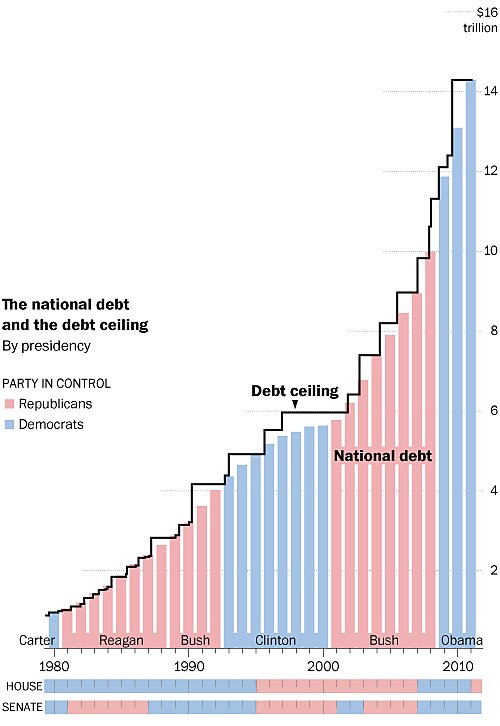
Does this look like the record of policymakers making sensible decisions, running surpluses in good year and deficits when they have to “address national security and economic emergencies”? Of course not. Once Keynesianism gave policymakers permission to run deficits, they spent with abandon year after year. And that’s why it makes sense to impose rules on them, even rules that leave less flexibility than would be ideal if you had ideal statesmen. Indeed, the debt ceiling itself should be that kind of rule, one that limits the amount of debt policymakers can run up. But it has obviously failed.
We’ve become so used to these stunning, incomprehensible, unfathomable levels of deficits and debt — and to the once-rare concept of trillions of dollars — that we forget how new all this debt is. In 1980, after 190 years of federal spending, the national debt was “only” $1 trillion. Now, just 30 years later, it’s sailing past $14 trillion.
Historian John Steele Gordon points out how unnecessary our situation is:
There have always been two reasons for adding to the national debt. One is to fight wars. The second is to counteract recessions. But while the national debt in 1982 was 35% of GDP, after a quarter century of nearly uninterrupted economic growth and the end of the Cold War the debt-to-GDP ratio has more than doubled.
It is hard to escape the idea that this happened only because Democrats and Republicans alike never said no to any significant interest group. Despite a genuine economic emergency, the stimulus bill is more about dispensing goodies to Democratic interest groups than stimulating the economy. Even Sen. Charles Schumer (D., N.Y.) — no deficit hawk when his party is in the majority — called it “porky.”
Annual federal spending rose by a trillion dollars when Republicans controlled the government from 2001 to 2007. It has risen another trillion during the Bush-Obama response to the financial crisis. So spending every year is now twice what it was when Bill Clinton left office. Republicans and Democrats alike should be able to find wasteful, extravagant, and unnecessary programs to cut back or eliminate. They could find some of them here in this report by Chris Edwards.
In the Kentucky Resolutions, Thomas Jefferson wrote, “In questions of power, then, let no more be heard of confidence in man, but bind him down from mischief by the chains of the Constitution.” Just so. When it becomes clear that Congress as a body cannot be trusted with the management of the public fisc, then bind them down with the chains of the Constitution, even — or especially — chains that deny them the flexibility they have heretofore abused.
That’s the upshot of a recent decision by the Seventh Circuit Court of Appeals in the case of Ezell v. City of Chicago. This was a challenge to the new regulations the city enacted in the wake of McDonald v. City of Chicago case, which applied the Second Amendment to the states.
In an attempt to circumvent the Supreme Court’s clear holding, Chicago’s ordinance first mandates that would-be gun owners receive training at a firing range but then prohibits firing ranges from operating in the city. The court, in a striking opinion by Judge Diane Sykes (put her on your Supreme Court shortlist for the next Republican administration), tells the city to go back to the drawing board.
I won’t go into the details, but the court applied something greater than intermediate (but “not quite strict”) scrutiny and found that Chicago has not presented anything approaching a compelling reason for its restriction. Here’s an analysis of the opinion by Josh Blackman and some follow-up commentary from Cato associate policy analyst Dave Kopel.
Gratifyingly, Judge Sykes cites the Pandora’s Box article that Josh and I published early last year in the run-up to the McDonald argument (see footnote 11 on page 31). It’s quite an honor to appear in the same footnote as Randy Barnett, Steven Calabresi, Brannon Denning, Glenn Harlan Reynolds (the Instapundit), and many other noted scholars — including Akhil Amar, who in the wake of our Obamacare debate and bet may not appreciate it as much.
Congratulations to the intrepid Alan Gura (who also litigated McDonald and Heller v. District of Columbia) and to all the citizens of Chicago!
In my speeches, especially when talking about the fiscal crisis in Europe (or the future fiscal crisis in America), I often warn that the welfare state reaches a point of no return when the people riding in the welfare wagon begins to outnumber the people pulling the wagon.
To be more specific, if more than 50 percent of the population is dependent on government (employed in the bureaucracy, living off welfare, receiving public pensions, etc.), it becomes difficult for taxpayers to form a majority coalition to fix the mess. This may explain why Greek politicians have resisted significant reforms, even though the nation faces a fiscal death spiral.
But you don’t need me to explain this relationship. One of our Cato interns, Silvia Morandotti, used her artistic skills to create two images (click pictures for better resolution) that show what a welfare state looks like when it first begins and what it eventually becomes.
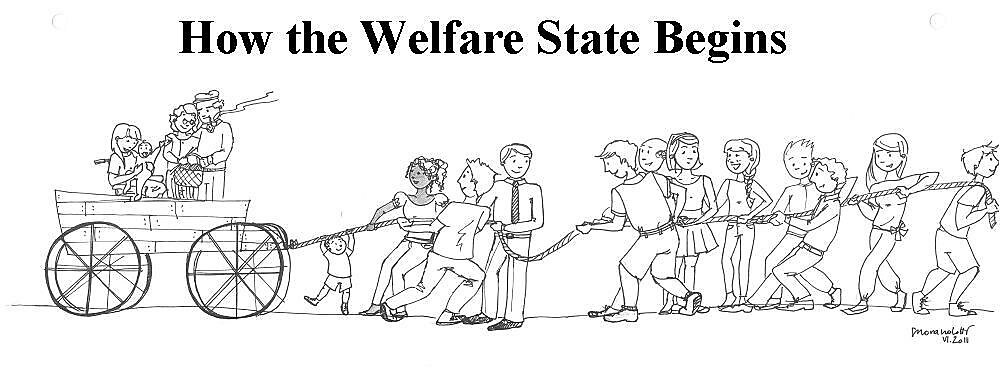
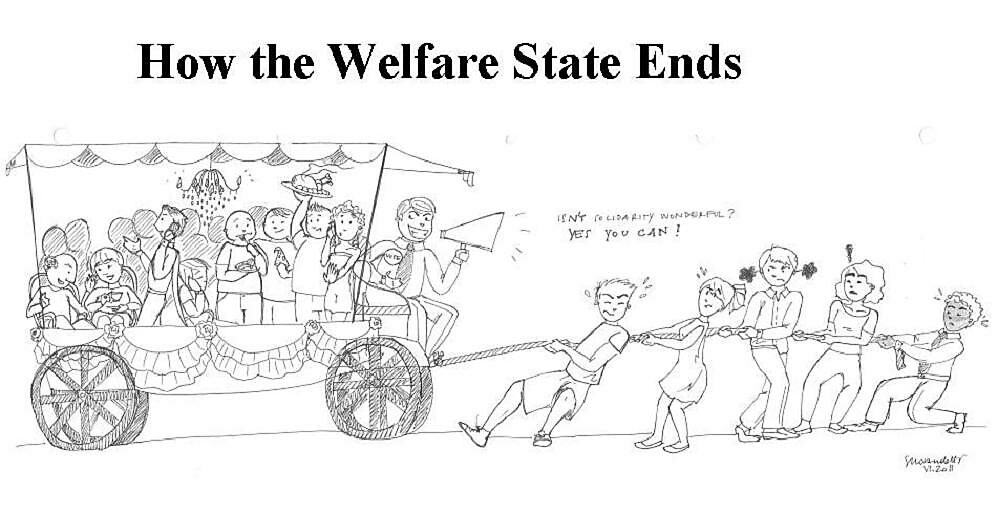
The welfare state starts with small programs targeted at a handful of genuinely needy people. But as politicians figure out the electoral benefits of expanding programs and people figure out that they can let others work on their behalf, the ratio of producers to consumers begins to worsen.
Eventually, even though the questionable beneficiaries should realize that it’s not in their interest to over-burden the people pulling the wagon, the entire system breaks down.
Then things get really interesting. Small nations like Greece can rely on bailouts from bigger countries and the IMF, but sooner or later, as larger nations begin to go bankrupt, that approach won’t be feasible.
I often conclude my speeches by joking with the audience that it’s time to stock up on canned goods and bottled water. Many people, I’m finding, don’t think that line is very funny.
The United States has been on a decade-long spending binge. Thanks to the profligate policies of both Bush and Obama, the burden of federal spending has climbed to about 25 percent of economic output, up from 18.2 percent of GDP when Bill Clinton left office.
The political class tells us that more government is good for the economy since it an “investment” and/or a “stimulus.”
The academic research, however, tells a different story. Here are some brief excerpts from a recent study by two Swedish economists, including a critically important observation about the impact of bigger government on economic performance.
…most recent studies typically find a negative correlation between total government size and economic growth. …the most convincing studies are those most recently published. …In general, research has come very close to a consensus that in rich countries there is a negative correlation between total government size and growth. It appears fair to say that an increase in total government size of ten percentage points in tax revenue or expenditure as a share of GDP is on average associated with an annual lower growth rate of between one-half and one percentage point.
Let’s focus on the last sentence of the excerpt and contemplate the implications. The research cited above tells us that annual growth is 0.5 percentage point‑1.0 percentage point lower if the burden of government rises by 10 percentage points of GDP. Well, the burden of federal spending has jumped by more than 5 percentage points of GDP during the Bush-Obama years, indicating that annual growth in America is now 0.25 percentage point‑0.5 percentage point lower than it otherwise would be.
Now let’s take the best-case scenario, and assume that annual growth has only dropped by 0.25 percentage points, and consider what that means. It may not sound like much, but even small differences in growth rates become very important over time. For an average household over a 25-year period, the loss of 0.25 percentage points of growth means annual income will rise, but the total increase will be about $5,000 smaller by the 25th year.
The budgetary implications of growth also are rather important. According to the Congressional Budget Office, the economy’s performance has a large impact on tax receipts (more growth means higher incomes and more taxpayers) and a small effect on government spending (more growth means fewer people at the public trough). CBO even publishes a “sensitivity table” with specific estimates (Table B‑1).
If we once again use the best-case scenario and assume the Bush-Obama spending binge has reduced annual growth by only 0.25 percentage points, the CBO numbers show this means more than $750 billion of additional red ink. This is something to keep in mind as the White House argues that job-killing class-warfare tax hikes will somehow improve the budget situation.

Let’s now return to the academic research. The authors included a very helpful table showing the results of recent studies on the relationship between the size of government and economic performance. Click on the image for a full-size look at how the majority of scholarly research this century confirms that big government is bad for prosperity.
For all intents and purposes, all this research shows that developed nations are on the downward-sloping portion of the Rahn Curve. Named after my Cato colleague Richard Rahn and explained in the video below, the Rahn Curve is sort of a spending version of the Laffer Curve. divIt shows that growth is maximized by small governments that focus on core “public goods” like rule of law and protection of property rights. But when governments expand beyond a certain growth-maximizing level (the research says about 20 percent of GDP, by I explain in the video why the right number is probably much smaller), the result is slower growth and less prosperity.
With the exception of high-growth Hong Kong and Singapore, all developed nation have public sectors that consume at least 30 percent of economic output. This means that government spending is undermining prosperity all around the world. And since the burden of government spending is close to 40 percent of GDP in the United States…well, you can fill in the blanks.
That’s the title of an essay I wrote for SCOTUSblog as part of their symposium on United States v. Arizona. This is the big immigration case that will hit the Supreme Court’s doorstep later this month when Paul Clement, recently hired by Arizona, files his cert petition.
Here’s an excerpt:
…state governments, feeling tremendous pressure from their citizens to address the consequences of the federal failure to meet this nation’s immigration needs, are acting for themselves. Arizona happens to be the “tip of the spear,” but we’ve also seen various other immigration-related laws passed in states as different as Utah, Georgia, and California. Whether related to enforcement, expanded work permits, sanctuary cities, or other types of policy innovations, Congress’s abdication of its duty to manage our immigration system has spawned a host of federalism experiments.
And so we come to S.B. 1070 (as amended by H.B. 2162), which exemplifies the crucial distinction between law and policy that both liberals and conservatives tend to forget. A law that is good policy might be unconstitutional or preempted by some higher law. Here we see the converse: while S.B. 1070 is (with the exception of one provision) constitutional, it’s bad policy.