Here are some of my views on Paul’s Ryan’s fiscal proposals.
His 10/25 tax plan:
His proposed spending reforms:
https://www.cato.org/paul-ryans-spending-plan/
His budget plan discussed at a Cato forum
Here are some of my views on Paul’s Ryan’s fiscal proposals.
His 10/25 tax plan:
His proposed spending reforms:
https://www.cato.org/paul-ryans-spending-plan/
His budget plan discussed at a Cato forum
A Politico article on Paul Ryan’s views on the Pentagon’s budget concludes:
A key question for the coming weeks will be how Ryan, one of Washington’s biggest budget wonks, interprets and explains the Romney campaign’s positions on defense spending. That could be a clue as to how realistic he actually believes they are.
I certainly hope so.
I was among the first to comment on Romney’s plan to spend at least four percent of GDP on the Pentagon’s base budget (war costs would be extra), and have revisited the question several times since. I have separately looked at Paul Ryan’s budget (here and here), and pointed out how military spending increased under his plan, just not as much as Romney.
During a series of lectures over the past several months, and with help from Charles Zakaib and Andy Stravers, I’ve included a variation on the chart at bottom, showing Romney’s four percent plan (achieved within four and eight years); projected Pentagon spending under the Ryan plan; the current baseline per OMB; and the levels called for under sequestration, per CBO’s latest (.pdf). I’ve adjusted these for inflation from DoD’s 2012 Green Book (.pdf) for 2012–2016, and extrapolated over the out years. I’ve estimated Romney’s totals using CBO’s GDP estimates (Romney’s own projections assume higher GDP, and therefore more military spending than shown here).
Here is how the totals shake out relative to the current baseline over the ten-year period, 2013–2022, in constant dollars:
By pledging to increase the military’s budget above the rate of inflation, Ryan’s basic argument is that the Pentagon’s budget should remain near historic highs in real, inflation-adjusted terms. That would mean spending more than we did during much of the Cold War, and much more than we did in the 1990s. I think we are safer now than when we were confronting the Soviet Union, and that we could and should spend less. I hope that reporters and prospective voters will ask Paul Ryan if he thinks we are safer. His budget implies that we are not.
Still, Ryan has not (yet) endorsed the kinds of massive military spending increases that Romney champions. What’s more, the Ryan plan spelled out specific proposals for cutting domestic spending, both discretionary programs and entitlements, that would allow the Pentagon’s budget to grow above the current baseline. Mitt Romney has not.
So how will Paul Ryan help Mitt Romney make up the difference? What additional spending will be cut, taxes raised, or debt increased?
As I explain in today’s Cato Daily Podcast, I anxiously await the answer.

Today POLITICO Arena asks:
Can Ryan boost Romney’s poll numbers?
My response:
Ryan is the shot in the arm that Romney needed. If last night’s “60 Minutes” interview of the two is any indication, Romney is finally focused on the big issues. It’s rare that a vice-presidential pick adds much to a ticket, but this case may be the exception. So, yes, Ryan can boost Romney’s poll numbers. Just look at the weekend crowds.
Ryan put it simply: The country’s going broke. You’d never know that from listening to the Democratic response to the pick. For that side, it’s all about what the Romney-Ryan team will take away from seniors, women, students, and the middle class — as if all of that “stuff” were free from government. They’re counting on seniors being too senile, women being too emotional, young people being too uneducated, and the middle-class being too focused on their mortgages to understand the situation we’re in, where we borrow 40 percent of what we spend and add trillions to the national debt every year. The Ryan budget won’t push Granny over the cliff. The Obama team’s head-in-the-sand will.
And it isn’t as if the Obama team doesn’t know exactly what they’re doing. In Obama’s latest ad, run last night during the Olympics closing ceremonies, he himself states plainly that the nation faces two fundamentally different visions of where we’re going. But he talks only about government benefits, not about costs — the “Life of Julia” nonsense. It’s a cynical view of the American public — a view that this election, more than any in recent memory, will put to the test.
The burden of federal spending in the United States was down to 18.2 percent of gross domestic product when Bill Clinton left office.
But this progress didn’t last long. Thanks to George Bush’s reckless spending policies, the federal budget grew about twice as fast as the economy, jumping by nearly 90 percent in just eight years This pushed federal spending up to about 25 percent of GDP.
President Obama promised hope and change, but he has kept spending at this high level rather than undoing the mistakes of his predecessor.
This new video from the Center for Freedom and Prosperity Foundation uses examples of waste, fraud, and abuse to highlight President Obama’s failed fiscal policy.
Good stuff, though the video actually understates the indictment against Obama. There is no mention, for instance, about all the new spending for Obamacare that will begin to take effect over the next few years.
But not everything can be covered in a 5‑minute video. And I suspect the video is more effective because it closes instead with some discussion of the corrupt insider dealing of Obama’s so-called green energy programs.
The honest answer is that it probably means nothing. I don’t think there’s been an election in my lifetime that was impacted by the second person on a presidential ticket.
And a quick look at Intrade.com shows that Ryan’s selection hasn’t (at least yet) moved the needle. Obama is still in the high 50s.
Moreover, the person who becomes Vice President usually plays only a minor role in Administration policy.
With those caveats out of the way, the Ryan pick is mostly good news.
Here are the reasons why I’m happy.
Here are two reasons why I’m worried.
But as I said above, don’t read too much into Ryan’s selection. if Republicans win, Romney will be the one calling the shots.
Though this does give Ryan a big advantage the next time there’s an open contest for the GOP nomination – either 2016 or 2020.

Paul Ryan is an excellent choice as running mate for Mitt Romney. He understands federal spending and tax policies in enormous detail. He has said that he started reading federal budgets when he was in high school. He’s also read Global Tax Revolution, my book with Dan Mitchell about the implications of globalization and tax competition. He knows that the American economy will not thrive with high tax rates, especially on business income and capital. He shares Mitt Romney’s goal of chopping the corporate tax rate to revive investment and job creation.
Ryan is an articulate defender of free enterprise, and he consistently argues not just for the practical advantages of smaller government but also about the moral imperative to cut. America will face giant fiscal and economic emergencies unless we make major reforms to the government. Mitt Romney, of course, has had a rather mixed record regarding free markets and limited government. And Ryan–as a good politician–has compromised many times as well. But if the next administration is Republican, and if it decides it wants to push major reforms, Paul Ryan is uniquely qualified to lead the charge.
Average private sector wages in the United States rose 3.0 percent in 2011, which was more than the 1.2 percent average increase for federal government workers. This was the second year in a row that average private pay rose faster than average federal pay, but that comes after many years of an escalating federal pay advantage.
Figure 1 shows average wages for private and federal workers, based on newly released data from the federal Bureau of Economic Analysis (see Tables 6.2D, 6.3D, 6.5D, and 6.6D). Federal pay has generally grown faster than private pay since the early 1990s, which is reflected in the widening gap between the two lines in the figure. The good news is that the gap has narrowed slightly the last two years, partly as a result of the recent federal pay freeze, or quasi-freeze .
Figure 2 shows similar trends for total compensation—wages plus benefits—of private and federal workers. On average, federal workers make twice the total compensation of private workers ($128,226 vs. $64,560).
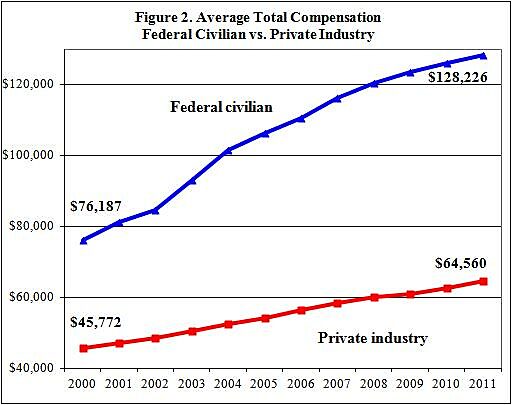
The BEA data are just one way to compare pay between private and federal workers. The Government Accountability Office recently described some other comparison methods. I’ve summarized some of the issues regarding federal pay in this essay. However, we know for sure that we’ve got a $1 trillion budget deficit and that federal workers have done very well for themselves. It makes sense to keep the federal pay freeze in place, while also beginning to cut back on overly generous federal pension plans and other benefits.