In the Republican debate last night, former Gov. Mike Huckabee of Arkansas criticized calls for Social Security reform, saying “people paid their money. They expect to have it,” and that the country needs to honor its promises to seniors. There are problems with this line of argument: the Social Security payroll taxes a person pays are not tied to the benefits they receive in a legal sense, and the ‘promises’ made by Social Security are, and always have been, subject to change.
Congress has had the authority to alter Social Security since its inception. Section 1104 of The Social Security Act of 1935 explicitly says: “The right to alter, amend, or repeal any provision of this Act is hereby reserved to the Congress.”
Not only does Congress have the right to make changes, it has done so multiple times in the past. Sometimes these changes are smaller things, like a technical correction to the indexation formula, but there were also larger reforms that were part of attempts to address the programs solvency issues.
The Supreme Court revisited the issue of Social Security’s promises in Flemming v. Nestor, in which Nestor, who had paid into Social Security for 19 years and begun to receive benefits, was then deported for previous ties to the Communist Party. Nestor tried to appeal the termination of his benefits, citing his previous contributions, but the Supreme Court upheld it, saying:
To engraft upon the Social Security system a concept of ‘accrued property rights’ would deprive it of the flexibility and boldness in adjustment to ever changing conditions which it demands… It is apparent that the non-contractual interest of an employee covered by the [Social Security] Act cannot be soundly analogized to that of the holder of an annuity, whose right to benefits is bottomed on his contractual premium payments.
The other aspect Huckabee touches on is the link between the taxes paid in and the benefits a person ultimately receives, implying that a worker’s contributions are kept in some kind of silo to be paid out to them at a later date. As another Supreme Court case found, this is not true.
In Helvering v. Davis (1937)the Court held that Social Security was not a contributory insurance program in the sense that “[t]he proceeds of both the employee and employer taxes are to be paid into the Treasury like any other internal revenue generally, and are not earmarked in any way.” Despite how Huckabee and his fellow defenders of the status quo describe the program, the payroll tax payments a person pays into Social Security have no direct link to the benefits that they receive in a legal sense: they are subject to future changes made by Congress and dependent on the program having sufficient revenue.
Huckabee doesn’t need to familiarize himself with these decades-old Supreme Court cases or the Social Security Act to be able to understand the problems with his invocation of the program’s ‘promises’. Anyone, including Huckabee, can see this for themselves in the Social Security Statement that the Social Security Administration periodically sends to workers:
Your estimated benefits are based on current law. Congress has made changes to the law in the past and can do so at any time.
The ‘promises’ with Social Security always came with an asterisk, and beneficiaries are not entitled to a certain amount because they have contributed payroll taxes. In the past the law has been altered to change the deal facing beneficiaries, and there will undoubtedly have to be more changes in the future if Social Security is to remain viable. If we maintain the status quo and do nothing, benefits will have to cut by 23 percent across the board when the combined trust fund is exhausted in 2034. There can be disagreements about the best way to reform Social Security, but when it is facing trillions in unfunded obligations and the certainty of drastic cuts in the future absent reform, doing nothing is not a feasible option.
Cato at Liberty
Cato at Liberty
Tax and Budget Policy
The tax-reform landscape is getting crowded.
Adding to the proposals put forth by other candidates (I’ve previously reviewed the plans offered by Rand Paul, Marco Rubio, Jeb Bush, Bobby Jindal, and Donald Trump), we now have a reform blueprint from Ted Cruz.
Writing for the Wall Street Journal, the Texas Senator unveiled his rewrite of the tax code.
…tax reform is a powerful lever for spurring economic expansion. Along with reducing red tape on business and restoring sound money, it can make the U.S. economy boom again. That’s why I’m proposing the Simple Flat Tax as the cornerstone of my economic agenda.
Here are the core features of his proposal.
…my Simple Flat Tax plan features the following: • For a family of four, no taxes whatsoever (income or payroll) on the first $36,000 of income. • Above that level, a 10% flat tax on all individual income from wages and investment. • No death tax, alternative minimum tax or ObamaCare taxes. • Elimination of the payroll tax and the corporate income tax… • A Universal Savings Account, which would allow every American to save up to $25,000 annually on a tax-deferred basis for any purpose.
From an economic perspective, there’s a lot to like. Thanks to the low tax rate, the government no longer would be imposing harsh penalties on productive behavior. Major forms of double taxation such as the death tax would be abolished, creating a much better environment for wage-boosting capital formation.
And I’m glad to see that the notion of a universal savings account,

popularized by my colleague Chris Edwards, is catching on.
Moreover, the reforms Cruz is pushing would clean up some of the most complex and burdensome sections of the tax code.
But Cruz’s plan is not a pure flat tax. There would be a small amount of double taxation of income that is saved and invested, though the adverse economic impact would be trivial because of the low tax rate.
And the Senator would retain some preferences in the tax code, which is somewhat unfortunate, and expand the earned income credit, which is more unfortunate.
It maintains the current child tax credit and expands and modernizes the earned-income tax credit… The Simple Flat Tax also keeps the current deduction for all charitable giving, and includes a deduction for home-mortgage interest on the first $500,000 in principal.
But here’s the part of Cruz’s plan that raises a red flag. He says he wants a “business flat tax,” but what he’s really proposing is a value-added tax.
…a 16% Business Flat Tax. This would tax companies’ gross receipts from sales of goods and services, less purchases from other businesses, including capital investment. …My business tax is border-adjusted, so exports are free of tax and imports pay the same business-flat-tax rate as U.S.-produced goods.
His proposal is a VAT because wages are nondeductible. And that basically means a 16 percent withholding tax on the wages and salaries of all American workers (for tax geeks, this part of Cruz’s plan is technically a subtraction-method VAT).
Normally, I start foaming at the mouth when politicians talking about value-added taxes. But Senator Cruz obviously isn’t proposing a VAT for the purpose of financing a bigger welfare state.
Instead, he’s doing a swap, imposing a VAT while also getting rid of the corporate income tax and the payroll tax.
And that’s theoretically a good deal because the corporate income tax is so senselessly destructive (swapping the payroll tax for the VAT, as I explained a few days ago in another context, is basically a wash).

But it’s still a red flag because I worry about what might happen in the future. If the Cruz plan is adopted, we’ll still have the structure of an income tax (albeit a far-less-destructive income tax). And we’ll also have a VAT.
So what happens 10 years from now or 25 years from now if statists control both ends of Pennsylvania Avenue and they decide to reinstate the bad features of the income tax while retaining the VAT? They now have a relatively simple way of getting more revenue to finance European-style big government.
And also don’t forget that it would be relatively simple to reinstate the bad features of the corporate income tax by tweaking Cruz’s business flat tax/VAT.
By the way, I have the same specific concern about Senator Rand Paul’s tax reform plan.
My advice to both of them is to ditch the VAT and keep the payroll tax. Not only would that address my concern about enabling the spending proclivities of statists in the future, but I also think Social Security reform is more feasible when the system is financed by the payroll tax.
Notwithstanding my concern about the VAT, Senator Cruz has put forth a plan that would be enormously beneficial to the American economy.
Instead of being a vehicle for punitive class warfare and corrupt cronyism, the tax code would simply be the method by which revenue was collected to fund government.
Which gives me an opportunity to raise an issue that applies to every candidate. Simply stated, no good tax reform plan will be feasible unless it’s accompanied by a serious plan to restrain government spending.
Related Tags
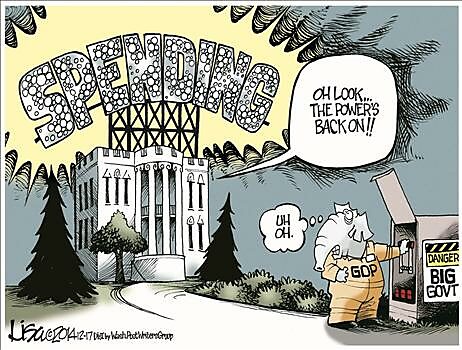
The budget agreement between congressional leaders and the Obama administration would break prior budget caps and increase spending over the next two years by $80 billion. The Bipartisan Budget Act (BBA) of 2015 would theoretically offset that cost with savings down the road, but promises of future savings are worth little given that GOP leaders have shown they will break agreed-to restraints whenever the time comes. The Heritage Foundation is right that the deal is a “colossal step” in the wrong direction and “does nothing to reduce the size and scope of government.”
If passed, the deal would undermine a crucial GOP policy plank going into 2016. The issue that unifies all the Republican presidential candidates is the promise of major tax cuts for individuals and businesses. It has been heartening to see so many candidates proposing pro-growth cuts. The Tax Foundation has run the numbers on the plans, and nearly all of them would generate revenue losses for the government and savings for the people.
I’m all for a large tax cut, but how do Republicans plan on passing such a cut if they keep increasing spending? The next president will be confronted with very ugly budget numbers looking forward, thanks partly to the bipartisan profligacy of recent years. Coming into office in 2017, the new president will see deficits exploding to more than $1 trillion by the early 2020s, and $8 trillion more in debt projected to be piled up over the coming decade.
The best pro-growth tax cuts should be enacted regardless of the deficit situation. In particular, a permanent corporate tax rate cut would generate strong economic growth and would not increase the long-term deficit because the corporate tax base is so dynamic. But to cut taxes, the next president will have to convince enough members of Congress to go along, and the higher are spending and deficits, the harder it will be to get moderates on board.
By repeatedly caving into President Obama, Republican leaders are undermining the ability of the next president, if a Republican, to follow though on major tax reforms and stronger economic growth.
The chart below shows total federal spending on programs, and excludes spending on interest, which has been abnormally low in recent years. While current spending is down from the stimulus peak of 2009, it is still substantially above spending during the Bush years, which in turn was substantially above spending during the Clinton years. With the new budget deal, non-interest spending will be about 19.9 percent of gross domestic product (GDP) in 2016, up more than two percentage points from the Bush years.
That may not sound like much, but two points of GDP is about how much the government collects in corporate income taxes each year. If Obama and the Republicans hadn’t splurged on spending in recent years, we would have had the budget room to completely abolish the corporate income tax—a reform that would generate a powerful boom and rising prosperity for all Americans.
Rising spending matters because it damages the economy. But it also matters because it balloons deficits and makes desperately-needed tax reforms more difficult.

Data note: the 2009 spending spike was not quite as high as shown because recorded TARP spending did not materialize.
Related Tags
In Washington, the word “bipartisan” usually means “watch your wallet.” If anyone needs any further proof, just look to the bipartisan budget agreement announced yesterday.
Hailed in the name of “coming together” and “compromise” to “get things done,” the proposed deal is a dog’s breakfast of every bad budgetary idea to land on the table in recent months.
It’s a deal so bad that even incoming House Speaker Paul Ryan says it “stinks” (although, it appears, he will still be voting for it). Still, current speaker John Boehner, House Minority Leader Nancy Pelosi, Senate Majority Leader Mitch McConnell, and Senate Minority Leader Harry Reid, who hammered out the deal behind closed doors, can probably put together enough votes to push it through, with a united Democratic caucus and just enough pro-defense spending Republicans.
The deal essentially guts the spending limits in place under the 2011 Budget Control Act which brought about sequestration. It would increase spending by at least $80 billion over the next two years above current spending limits, split equally between domestic and defense spending. It would also increase funding for the military’s Overseas Contingency Operation slush fund by $32 billion, meaning the total spending hike would top $112 billion. More domestic spending for Democrats. More defense spending for Republicans. Everyone wins except the taxpayers.
But the deal is much worse than just the particular spending increases it contains. Sequestration may have been a blunt instrument but it has been one of the few successful restraints on federal spending in recent years. Without it and the caps in the Budget Control Act, federal spending would have been at least $200 billion higher since 2011.
This really would mark the second consecutive budget deal in which Congress agreed to ignore the caps. That’s a pretty clear signal that Congress plans to return to its wide open tax and spend past.
The deal would supposedly offset these increases through a rehashed collection of budget gimmicks such as selling some of the strategic petroleum oil reserves, auctioning telecommunications spectrum (again), and making changes to the crop insurance program. Been there. Done that. Still paying for the t‑shirt.
In fact, this deal actually weakens long term entitlement reform. For example, it cancels coming increases in Medicare Part B premiums for the 30 percent of beneficiaries not already shielded from premium increases by a hold harmless provision. It would also allow Congress to avoid reforming the Social Security Disability Insurance program by shifting funds to it from Social Security’s retirement program. The move weakens Social Security’s overall financing, but props up the disability program for another six years.
So we will spend more on domestic discretionary programs, more on defense, and more on entitlements, while papering over the cost. Happy days all around.
The deal would also raise the debt ceiling by enough to last through March 2017. In fact, the deal doesn’t just raise the debt ceiling, it simply does away with it for a year and a half.
Of course, no one really expected Congress not to raise the debt ceiling eventually. But this deal surrenders even token Republican leverage.
We’ve been fortunate the last few years. A combination of renewed economic growth and sequestration-driven spending restraint has reduced our budget deficit to just (just!) $435 billion. But this is only a temporary respite. Within just a couple of years, deficits are expected to start growing once more. By 2025 we could again see $1 trillion deficits. Worse, our $18.2 trillion debt is scheduled to rise to $26.9 trillion over the same period. And all of this is before the big cost of entitlements really kicks in. By some measures, our real debt tops $80–90 trillion.
But at least we’ve found something everyone in Washington can agree on: screwing the taxpayer.
Related Tags
During the 1980 presidential campaign, Ronald Reagan famously said “there you go again” when responding to one of Jimmy Carter’s attacks.
Well, the Gipper’s ghost is probably looking down from Heaven at the new budget deal between congressional leaders and the Obama Administration and saying “there they go again.”
That’s because we basically have a repeat of the distasteful 2013 budget deal.
The new agreement, like the 2013 deal, busts the budget caps. In this case, the politicians in DC have approved $50 billion of additional spending for the 2016 fiscal year (which started on October 1) and $30 billion of additional spending in the 2017 fiscal year (starting October 1, 2016).

Which means that the President gets to further undo his biggest fiscal defeat.
And what do Republicans get in exchange?
Many of them want higher defense spending, of course, and some of them doubtlessly are happy to have more domestic spending as well. Those politicians are presumably happy, at least behind closed doors.
So let’s rephrase the question: What do advocates of fiscal restraint get in exchange?
Well, if you peruse the agreement, it’s apparent they don’t get anything. Sure, there are some promises of future restraint. But if the 2013 deal and the current agreement are any indication, those promises don’t mean much.
The deal has a handful of back-door revenue increases, including an assumption that the IRS will be more aggressive in squeezing money out of taxpayers. And there are some budget gimmicks, along with some tinkering with entitlement programs, especially the fraud-riddled disability program, that ostensibly will lead to some modest savings.
The net result is that we have a pact that leads to guaranteed spending increases over the nest few years, combined with some nickel-and-dime proposals that will probably offset each other in the future.
So the bad news — assuming the goal is enforceable spending restraint — is that policy has moved in the wrong direction.
In other words, I was right to worry that Republicans would fumble away a guaranteed victory.
And this deal probably sets the stage for another bad deal two years in the future since more spending in 2016 and 2017 will make it harder to meet the spending caps for 2018 and beyond.
Now for the good news…
…
…
…
…
Ooops, there isn’t any good news.
About the only positive thing to say is that this new agreement is not a huge defeat. There will still be budget caps, which is better than no spending caps.
And the new spending, while wasteful and counterproductive, is relatively small in the context of an $18 trillion economy.

Moreover, the deal only partially unwinds the fiscal discipline that already has been achieved thanks to the spending caps.
Last but not least, nothing in this deal precludes a better and more comprehensive spending cap, perhaps modeled after Switzerland’s very successful debt brake, once Obama is out of the White House.
P.S. This new deal also increases the debt limit. Some view this as a defeat, but it more properly should be viewed as a missed opportunity to get some much-needed reforms.
That being said, I can’t resist commenting on the deliberately dishonest scare tactics from our statist friends. They routinely claim that the United States government would have to default on its debt and cause a global crisis unless there is approval for more borrowing.
For instance, exuding an air of faux hysteria, one writer for the Washington Post asserted that, “Failure to raise the debt ceiling would unleash hell on the U.S. economy.” Another Washington Post columnist fanned the flames of fake despair, writing, “The chaos…is about to have some very serious effects on the entire country.” And a third Washington Post reporter falsely fretted that not raising the debt limit by November 3rd, “could plunge the United States into default, an outcome that…could lead to economic catastrophe.”
Oh, please, we’ve heard this song and dance before. But it’s utter nonsense.
Here’s some of what I said as part of my testimony to the Joint Economic Committee in 2013.
…there is zero chance of default. Why? Because…annual interest payments are about $230 billion and annual tax collections are approaching $3 trillion. …there’s no risk of default – unless the Obama Administration deliberately wants that to happen. But that’s simply not a realistic possibility.
But some folks may wonder whether my analysis is accurate. After all, maybe I’m some sort of nihilistic libertarian who fantasizes about laying waste to Washington.
And other than the nihilistic part, that’s actually a good description of my long-run goals.
But that doesn’t mean I’m wrong. So for backup, let’s look at some identical analysis from an ultra-establishment source, as reported in The Hill.
Moody’s Investors Service announced Monday that, despite dire warnings from the Treasury Department, the government would find a way to pay money owed on its debt, regardless of whether lawmakers agree to raise the $18.1 trillion borrowing cap. …“Even if the debt limit is not raised, …the government will order its payment priorities to allow the Treasury to continue servicing its debt obligations,” says Moody’s Senior Vice President Steven Hess.
Gee, maybe all the partisans at the Washington Post are the ones who are wrong. Along with the partisan and status-quo voices from the political establishment.
Related Tags
After Germany, the Netherlands, and Great Britain, it is now Italy’s turn to privatize its postal service. It seems that even “old Europe” welfare states are more reform-minded on some economic matters than Congress and the current U.S. administration.
Italy will this week launch its biggest privatisation in more than a decade with the partial sale of Poste Italiane — an initial public offering on which the government of prime minister Matteo Renzi has staked its reformist reputation.
The government is planning to sell up to a 40 percent stake in Poste Italiane, Italy’s national post office, and raise a maximum of €3.9bn in proceeds. The IPO is due to have a price range of €6 to €7.5 a share, giving the company an equity value of up to €9.8bn.
Poste Italiane is a 153-year old behemoth, and generates €28.5bn in annual group revenue, holds €420bn in postal savings deposits, and has 32m customers.
Why is the government selling Poste Italiane? “Because of the decline in its letter business caused by email, and the rise of e‑commerce,” notes the FT. That is one of the same concerns that prompted the 2013 sell-off of Britain’s Royal Mail, and it is also central to the downward spiral of the U.S. Postal Service (USPS). If Italy can sell its 153-year old behemoth, and Britain can sell its 500-year old behemoth, then America can sell its dinosaur, USPS.
On the Italian sale, Reuters notes, “A successful listing of Poste Italiane will then open the way for the sale of air traffic control operator Enav in the first half of 2016, while the listing of the national railway company is scheduled for the second half of next year.”
Americans look to Italy for the best in fashion. Our government-run postal services, air traffic control, and national railway company are looking very drab and old-fashioned. It is time for an Italian-style privatization makeover.
Related Tags
This week, the New York Times editorial board wrote in support of greater taxes on sweetened drinks, citing new research from a team Mexican and American researchers. They praise the novel design of the tax, which is levied on drink distributors rather than consumers. This caused the tax to be included in shelf prices, making the increase in total cost clear to consumers. The research found that soda consumption fell 12 percent in a year, and 17 percent among the poorest Mexicans.
The Times admits that we do not know whether any health benefits will actually result from soda taxes. In this article in Regulation, the University of Pennsylvania’s Jonathan Klick and Claremont McKenna’s Eric Helland examined the effects of soda taxes. They conclude that a one percent increase in soda taxes led to a five percent reduction in soda consumption among young people. But consumers substituted to other beverages. A 6‑calorie reduction in soda consumption was accompanied by an 8‑calorie increase in milk consumption and a 2‑calorie increase in juice consumption. Thus, the tax on soda led to an increase in overall calorie consumption, which offset the benefits of falling soda consumption. Moreover, there was “no statistically significant effect of soda taxes on body weight or the likelihood of being obese or overweight”.