Illustration by Pablo Declan
The Conspicuous Fist of Trump’s State Corporatism
From steel and semiconductors to defense and mining, the federal government is increasingly intertwined with private firms. This new era of “state corporatism” threatens the market-driven dynamism and innovation that have long underpinned American prosperity.

The Conspicuous Fist of Trump’s State Corporatism
From steel and semiconductors to defense and mining, the federal government is increasingly intertwined with private firms. This new era of “state corporatism” threatens the market-driven dynamism and innovation that have long underpinned American prosperity.
s the left and the right increasingly agree that the government should embrace stronger economic intervention and industrial policy, they abandon the principles that made the United States the world’s most prosperous country and undisputed technological leader.
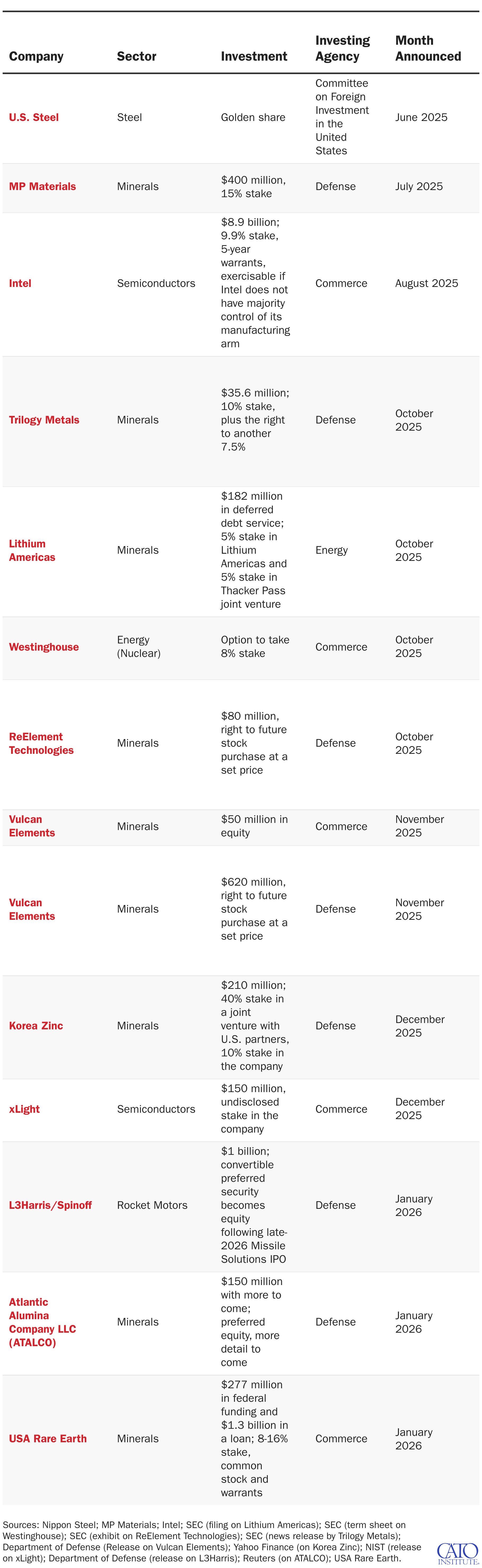
The most troubling development in this regard is the Trump administration’s rapid embrace of “state corporatism” across a range of companies and industries. As of this writing, the US government has taken permanent and direct equity stakes in 12 private firms, in most cases making Washington the company’s largest shareholder, with options for an even greater share of state ownership in the future. The government has also wrested a “golden share” in U.S. Steel, giving the state control over an array of corporate decisions and transactions, and has demanded a significant cut of Nvidia’s and other US semiconductor firms’ sales in China in exchange for lifting security-based export controls. Trump administration officials have also promised more of these moves in the months ahead.
The federal government’s state corporatism is unprecedented. Washington has long supported domestic firms with tariffs, subsidies, procurement preferences, tax and regulatory favoritism, and other interventions, but these measures are broad, provided at arm’s length, often authorized by law, and subject to limited government oversight. The policies raise economic and political concerns, of course, but they’re fundamentally different from state corporatist policies that give the federal government an ongoing, direct, and in most cases financial interest in a single company’s day-to-day business operations, its public share price, and its ultimate success or failure—and do so under the thinnest of legal authority (if any at all).
State corporatism is also more coercive. In almost all past cases of US industrial policy, a company’s involvement with the government was voluntary—if the company’s management and shareholders failed to see a financial benefit in participating in a certain program, it could refuse (or exit). Trump’s state corporatism, on the other hand, has routinely been accompanied by at the very least the appearance of state coercion: Equity stakes followed government officials’ threats to reject a foreign acquisition (U.S. Steel), agitate public opposition to management (Intel), or ban the export of certain products unless the state gets its cut (Nvidia).
In the rare instances in which the US government has taken full or partial ownership of a private firm, the arrangement occurred during a genuine economic or foreign policy emergency and was expressly temporary, with the government’s exit planned in advance and conditioned upon the achievement of certain objectives (e.g., the company returning to solvency). State corporatism, by contrast, has no such characteristics. It is not the wartime nationalization of a steel mill to make tanks, or the emergency rescue of failing automotive giants during a financial collapse. It is the repeated, open-ended, non-crisis intervention in private enterprise—something that will be extremely difficult to unwind and that sets new precedent for even more such actions in the years ahead.
With Uncle Sam as a shareholder, capital flows for political reasons instead of commercial ones, the government dictates routine business decisions (something we have already seen with U.S. Steel), and entrepreneurial dynamism is replaced by static rent-seeking.
In explaining the Obama administration’s unprecedented intrusions into private industry during the Great Recession, former White House chief of staff Rahm Emanuel infamously said at a Wall Street Journal CEO council in November 2009: “You never want a serious crisis to go to waste. And what I mean by that—it’s an opportunity to do things that you think you could not do before.” Sixteen years later, no crisis is needed. A president can just trot out vague language about national security to explain the partial nationalization of a tech giant like Intel or the effective control of the nation’s third-largest steelmaker.
Some call the government’s new approach “state capitalism,” but it’s clearly not capitalism in any legitimate sense of the word. It’s also not quite socialism, either. It’s the “Middle Way between ‘atomistic’ competition and central direction” that F. A. Hayek warned about in The Road to Serfdom:
“Nothing indeed seems at first more plausible, or is more likely to appeal to reasonable people, than the idea that our goal must be neither the extreme decentralization of free competition, nor the complete centralization of a single plan, but some judicious mixture of the two methods. Yet mere common sense proves a treacherous guide in this field. Although competition can bear some admixture of regulation, it cannot be combined with planning to any extent we like without ceasing to operate as an effective guide to production.”
When the conspicuous fist of state corporatism displaces the invisible hand of the market, liberty suffers, along with the dynamism, innovation, and prosperity that it fosters. With Uncle Sam as a shareholder, capital flows for political reasons instead of commercial ones, the government dictates routine business decisions (something we have already seen with U.S. Steel), and entrepreneurial dynamism is replaced by static rent-seeking—from both the acquired firm and those seeking to curry favor with its government owner.
The danger of this new government shadow conglomerate is not just rampant market distortions, lower productivity, and reduced growth, but that the government’s balance sheet will expand under its own weight, locking the US into a top-heavy politicized economic model that is antithetical to economic freedom and American flourishing.
State corporatism is thus a serious new policy problem. It also, unfortunately, isn’t unexpected.
Washington’s Growing Portfolio
Intervention’s Mission Creep
Bailouts that began with the Troubled Asset Relief Program (TARP) during the financial crisis of the late 2000s laid the groundwork for the government to take equity stakes in private companies today.
Through TARP, the US government offered support to more than 700 institutions, including temporary equity stakes in five companies. The largest of these bailouts was $50 billion for General Motors, netting the government a 60.8 percent ownership stake. The government sold those shares over the next few years, resulting in a direct loss to taxpayers of $10.5 billion. Chrysler received about $12.5 billion in federal assistance, at a loss of $1.3 billion for the US Treasury.
A simple accounting of financial losses captures only part of the costs of those bailouts. The federal government rewrote bankruptcy law on the fly, eroding the rule of law and longstanding precedent. It denied the spoils of competition to more prudent automakers like Ford, Honda, and Toyota, upending the vital process of creative destruction that weeds out bad bets and rewards good ones.
Perhaps most important, as Cato Institute scholars warned at the time, these bailouts set the stage for stronger state intervention in the economy in the future, just as we’re seeing now. My predecessor as the director of Cato’s Herbert A. Stiefel Center for Trade Policy Studies, Dan Ikenson, made that exact point when he appeared before Congress in June 2011:
“If it is considered a success, the threshold for interventions will have been lowered and Americans will have the opportunity to judge similar bailouts in the future.… Americans will be more willing to extend powers without serious objection to the executive branch that we would not extend in the absence of a perceived crisis.”
During the same period, the US government also began to think of itself as a public venture capitalist, throwing taxpayer dollars at unproven but politically connected firms. The $800 billion American Recovery and Reinvestment Act of 2009 (ARRA) authorized federal grants, loans, tax credits, and other supports with the goal of boosting energy innovation. The $475 million Solyndra boondoggle is undoubtedly the ARRA’s most notorious industrial policy failure, but, as I documented in 2021, numerous other projects from that period also failed or never needed taxpayer funds to begin with. It’s no surprise, then, that a 2024 study found that politically connected firms were more likely to win ARRA grants, but those firms created fewer jobs than their non–politically connected competitors, despite job creation being a main objective of the stimulus bill.
The ARRA was a textbook case of the perils of US industrial policy, yet some in Washington saw it as a road map. Thus arose the even larger industrial policy experiment championed by former President Joe Biden during the pandemic. In both the Inflation Reduction Act and the CHIPS and Science Act, the federal government showered trillions of dollars in subsidies and other supports to producers of renewable energy and semiconductors, respectively—far more than what the ARRA provided.
These measures have raised concerns about waste and politicization, and their precise economic effects are still the subject of much debate. But one thing is clear: The laws have helped President Trump implement state corporatism in a much more aggressive and intrusive manner than his predecessors.
When Capital Follows the Crown
Trump’s opening salvo, however, arose from a different law, the Defense Production Act of 1950 and subsequent amendments, which authorizes the president to suspend or prohibit security-related foreign investments via the interagency Committee on Foreign Investment in the United States (CFIUS). When CFIUS refused to approve Japanese steelmaker Nippon Steel’s purchase of U.S. Steel, a long-struggling firm in what is arguably the US’s most coddled industry, it kicked the final decision to Trump, who promptly used that leverage to acquire a “golden share” in the firm in exchange for approving the deal. While the US government has no formal voting rights in U.S. Steel, the golden share gives any US president complete veto power over countless day-to-day business decisions, including relocation of the company’s headquarters, closing or idling plants, shifts in near-term investments, and even pricing strategies.
The Trump administration has already exerted its new control over the company. When U.S. Steel announced in September that it would halt operations at its decaying plant in Granite City, Illinois, which Trump visited and claimed credit for revitalizing with tariffs in his first term, Commerce Secretary Howard Lutnick called U.S. Steel’s chief executive to say the president wouldn’t allow the plant to stop rolling steel slabs, according to the Wall Street Journal. Now, the site’s century-old blast furnaces—so dirty and inefficient that they were slated for demolition mere months ago—are back up and running.
Recent US industrial policy has enabled subsequent state corporatist actions. The government’s largest equity stake so far is in Intel, which was also the largest beneficiary of the CHIPS Act, receiving $8.9 billion in subsidies. Former Intel CEO Pat Gelsinger was one of the most prominent voices on Capitol Hill shaping that legislation, but was ousted in December 2024 amid slumping revenue and replaced by Lip-Bu Tan.
Trump was soon publicly urging Intel’s board to fire Tan, baselessly alleging he was compromised by China and threatening to withhold CHIPS Act funding that the ailing firm needed to implement Tan’s turnaround plan. After frog-marching Tan into the Oval Office for a meeting in August, Trump agreed to back down on his attacks, but only if the company gave the government 9.9 percent of its public shares in exchange for $8.9 billion in CHIPS Act grants. The deal came with sweetheart terms, allowing the government to purchase shares at $20.47 instead of the $24.80 mark it closed at before the meeting, a discount at the expense of current shareholders. It also gave the government the right to purchase an additional 5 percent at $20 per share if Intel exits the manufacturing side of its business by scaling back foundries—clear pressure on the company not to divest, even if doing so makes sound business sense.
The government has leveraged other subsidies, as well as federal contracts, to acquire equity stakes in several companies involved in rare-earth mining and processing: MP Materials, Lithium Americas, Trilogy Metals, Vulcan Elements, ReElement Technologies, Korea Zinc, USA Rare Earth, and Atlantic Alumina. It has tapped the CHIPS Act to make a $150 million investment in the semiconductor manufacturer xLight, a start-up whose executive chairman is Gelsinger, the former Intel CEO and chief lobbyist for the very same CHIPS Act. The Commerce Department has murkily leveraged Trump’s “emergency” tariffs to convince Japan to fund the US government’s acquisition of up to 20 percent of domestic nuclear reactors built by Westinghouse. And the Department of Defense recently invested $1 billion in defense contractor L3Harris Technologies’ missile business, meaning that the Pentagon will have an ownership stake in a company that routinely bids on Pentagon contracts.
Even when the government doesn’t get an equity stake, it still gets a cut. In August, the Trump administration lifted export controls on Nvidia and AMD semiconductor sales to China in exchange for 15 percent of the revenue from the transactions, and did it again in December for more advanced chips (and a 25 percent cut). To avoid the Constitution’s ban on export taxes, Trump invoked Section 232 of the Trade Expansion Act—and “national security,” of course—to impose a 25 percent tariff on a narrow set of advanced semiconductors that are imported into the US for re-export abroad. (All other chip imports have been spared—for now.)
More of these deals, the administration promises us, are in the works, including in different industries. And with them comes rampant capital misallocation, with private investors chasing bureaucratic darlings instead of productive firms or promising start-ups.
Intel’s stock has roughly doubled since the government took a stake, while shares of other companies such as Lithium Americas and Trilogy Metals have also shot up. Traders and institutional investors have taken note: A Jefferies Financial Group executive told Bloomberg that “part of this analysis of businesses going forward has to be this political relationship with the state,” with more dollars inevitably flowing to the government’s favored firms. Another investment group has already filed paperwork with the SEC to create an exchange-traded fund that mirrors the government’s balance sheet.
Companies receiving these private investment dollars will likely enjoy higher share prices and more capital, at least in the short and medium run, but they’ll do so by taking finite capital away from productive, well-performing alternatives, including in the very same industries. In the end, this capital misallocation will mean less efficiency and lower growth—and a weaker US economy.
In the world of state corporatism, costs and profits are second to connections and appearances, and failure is rewarded with more government support.
Opportunities for cronyism, if not outright corruption, are also inevitable. Beyond Gelsinger’s sweet deal, there’s Vulcan Elements, which has connections to President Trump’s son. White House deputy chief of staff Stephen Miller, meanwhile, made a mint after unloading his shares of MP Materials, which had spiked following the firm’s government tie-up, according to the New York Times.
State corporatism is also accelerating Washington’s revolving door. Intel, for example, named former Trump administration official Robin Colwell its new senior vice president of government affairs in December. She’ll stay in Washington but leave her previous role as a deputy assistant to the president.
So much for draining the swamp.
The Rent-Seeker’s Republic
The Trump administration’s state corporatism doesn’t show any sign of slowing down. Lutnick has reportedly asked other semiconductor firms such as TSMC, AMD, and Micron Technology if they would consider similar arrangements to Intel’s. Quantum computing firms and defense contractors are also reportedly in the president’s crosshairs. Though national security is the supposed reason for these moves, recent Trump statements make clear that there are no guardrails. “We should take stakes in companies when people need something. I think we should take stakes in companies,” Trump told the Wall Street Journal in December. “Now, some people would say that doesn’t sound very American. Actually, I think it is very American.”
It is not remotely American—in fact, it is antithetical to the market-based principles that made America the world’s technological leader. Free-flowing capital markets should reward innovation and punish inefficiency, not allocate resources based on political connections and the president’s whims. Other countries might do these kinds of deals, but America hasn’t—and we’ve benefited greatly from this restraint.
Indeed, perhaps most galling about the government’s new state corporatism push is that there’s no need for it. The dynamism of free markets is much more efficient at coordinating information and directing capital than the state’s clumsy efforts to pick winners and losers. Private venture capitalists, for example, poured a record $600 million into critical-mineral start-ups in the US last year, according to a Wall Street Journal report that noted “startups from Silicon Valley to North Carolina” are providing “new solutions to China’s crackdown on critical mineral exports.” One such case is in Oakland, where the critical-minerals start-up Brimstone is coming up with innovative new methods to produce aluminum, magnesium, and other minerals.
Hundreds of miles away, Provo-based Ionic Mineral Technologies, a start-up with no federal equity stake, announced in December that it had confirmed a “major, high-grade deposit of rare earth and critical minerals” along Silicon Ridge—a discovery that the company’s founder characterized as a “watershed moment for American resource independence.” It will commence nearby refining operations soon, with the benefit of sound infrastructure and light-touch regulation, not top-down planning.
In January, Tesla announced that its Texas lithium refinery, the largest and most advanced in the United States, is now operational after breaking ground on the plant just two years ago, again with limited US government involvement.
Not all of these start-ups and investments will pan out, of course, but failure is also an essential part of the market process—disciplining firms, informing investors, and ensuring that survivors are durable and globally competitive. A genuine market system is defined by both profits and losses. “You need to make a process that is lower cost and higher profit, or you cannot bring production to the United States,” Brimstone chief executive Cody Finke told the Wall Street Journal.
State-invested favorites that Washington implicitly deems too big to fail don’t face such discipline. In the world of state corporatism, costs and profits are second to connections and appearances, and failure is rewarded with more government support. State corporatism also makes the president a dealmaker in addition to a policymaker, a role Trump seems to crave, and elevates the executive branch to a position inconsistent with a healthy constitutional order.
Insulated from the pressure of market forces, the state’s investments are bound to struggle eventually. And minus congressional oversight, the executive’s authority surely will expand even more. The real question is not whether this unbounded state corporatism is a problem; it’s “how do we unwind it?”