Illustration by Pablo Delcan
Liberty Versus Power in Milei’s Argentina
Argentine President Javier Milei entered office nearly two years ago on the promise of returning his country to its classical liberal roots. Since then, his administration has slashed government spending, reined in inflation, and deregulated large parts of the economy, but Argentina’s libertarian renewal is far from finished and under attack from the Peronist opposition.

Liberty Versus Power in Milei’s Argentina
Argentine President Javier Milei entered office nearly two years ago on the promise of returning his country to its classical liberal roots. Since then, his administration has slashed government spending, reined in inflation, and deregulated large parts of the economy, but Argentina’s libertarian renewal is far from finished and under attack from the Peronist opposition.
“
iberalism is the unrestricted respect for the life project of others based on the principle of non-aggression and the defense of the right to life, liberty, and private property.”
So declared President Javier Milei of Argentina in his inaugural address on December 10, 2023. As he had done for years in countless media appearances and speeches and during the election campaign, Milei was quoting his intellectual mentor, Alberto Benegas Lynch Jr.—Argentina’s most prominent classical liberal thinker and a Cato Institute adjunct scholar. That concept of freedom, Milei added, is the “new social contract chosen by the Argentines.”
Argentines indeed elected Milei in a landslide on an explicitly libertarian platform, showing the political viability of those ideas when they are well articulated. His proposal represented nothing less than a paradigm shift: to return the country to prosperity by overturning 80 years of thoroughgoing statism and replacing it with policies and institutions that limit power, restore the rule of law, and open the economy.
To be sure, Milei set an ambitious agenda, and he faced widespread skepticism from the political mainstream and intellectual elite. Prior to his election, more than 100 economists, including Thomas Piketty, author of Capital in the Twenty-First Century, signed a letter that warned of the “devastation” a Milei win would entail. Even Milei’s center-right opponents believed a government led by him was not just undesirable but also likely to collapse almost immediately.
Milei’s challenge was made all the more daunting by the economic crisis he inherited. Twenty years mostly ruled by the populist Peronist party of the left had produced 42 percent poverty, yearly inflation of 211 percent, a quasi-fiscal deficit of 15 percent of GDP, massive public debt, an effectively bankrupt central bank, and an economy that had stagnated for a dozen years and was now in free fall. Argentina was heading toward hyperinflation, debt default, and complete economic collapse.
Despite those challenges, the first 20 months of Milei’s presidency have yielded impressive results. He has achieved more than what most people expected, and in many ways has made Argentina’s move toward liberal democracy an example for an increasingly illiberal world. But with critical midterm elections approaching, a hostile National Congress eager to derail his reforms, and murky corruption allegations, Milei faces new challenges in sustaining Argentina’s remarkable turnaround and realizing his libertarian agenda.
Argentina’s Turnaround
Argentina’s recovery from crisis has followed the pattern Milei warned his compatriots about in nonpopulist fashion, atypical for Argentine politics: that things will get worse before they get better. “I prefer to tell you an uncomfortable truth,” he explained, “rather than a comfortable lie.”
There was inevitable pain, a legacy of past mismanagement. But the recovery has also been swift. GDP grew by 6.3 percent and investment by 32 percent in the second quarter of 2025 on a yearly basis, after an economic contraction in the first half of last year. Growth estimates by the International Monetary Fund and others for this year range from 4.7 to 5.5 percent. Yearly inflation reached 289 percent early in Milei’s administration but has dropped to 34 percent, or under 2 percent per month—still high, but a vastly improved trajectory. After initially rising to 53 percent, poverty fell to 32 percent, thus pulling more than 11 million people out of destitution. Consumption is up, employment has grown, and exports have risen.
Milei has accomplished as much by being true to his chainsaw-wielding image. Prioritizing economic stability, he cut the budget by 30 percent and balanced it by his second month in office. Ending Argentina’s uncontrolled deficit spending, a chronic source of the country’s instability, greatly helped reduce inflation as it facilitated a more disciplined monetary policy. Public debt has fallen by 12 percent in absolute terms.
Argentina, which had never been able to implement significant adjustments without defaulting on its debt or falling into high or hyperinflation, is now a rare example of expansionary austerity. The president has vowed to slash spending even further and has repeatedly pledged that as long as he is president, the budget will not be unbalanced.
Milei has also prioritized cutting bureaucracy and red tape. He has abolished 10 ministries (merging some with others), gotten rid of hundreds of sub-agencies, and fired more than 53,000 public employees.
Through August 2025, Milei has implemented an astounding 1,246 deregulations, about two per day. The reforms have affected a range of sectors, from energy and agriculture to real estate and health. Some of the deregulations disentangled Argentina’s complicated international trade controls, while others reduced paperwork and bureaucratic procedures for businesses and opened markets for competition.
His proposal represented nothing less than a paradigm shift: to return the country to prosperity by overturning 80 years of thoroughgoing statism and replacing it with policies and institutions that limit power, restore the rule of law, and open the economy.
New businesses and services have thus appeared, and numerous goods have seen their prices drop. For example, after the government eliminated an import-licensing scheme, the price of home appliances fell by 35 percent. In another example, livestock producers were required to use a vaccine that protects against foot-and-mouth disease but was produced by only one Argentine laboratory. Milei liberalized that market and allowed Argentina, a major meat-producing country, to import vaccines from abroad, where they were one-third the price.
Deregulation has proceeded fully in accordance with Argentine law and the country’s democratic process, bolstering its legitimacy and popularity. In July 2024, Milei created the Ministry of Deregulation and State Transformation staffed with accomplished economists and legal professionals. The ministry has led the bulk of Milei’s regulatory reforms under a law that gave the president authority to issue deregulations by decree for one year. That period ended last July but deregulations continue apace, as the ministry is now focusing on undoing regulations that previous presidents issued by decree rather than passed through the National Congress.
Last but not least, Milei has eliminated, left to expire, or reduced some 22 types of federal taxes, mostly those that distorted productive structures and trade. Among the most significant measures are the reduction of export taxes in agriculture and the expiration of Impuesto País, a tax that ranged as high as 30 percent on foreign currency purchases.
Those measures are consistent with Milei’s goal of opening the economy. He has praised free trade and excoriated “the protectionist lie, because, in the end, it is nothing more than a scam between politicians and rent-seeking businessmen.” To that end, among many other measures, Milei reduced taxes and raised the limit on foreign purchases to $3,000 per package, and liberalized the importation of a wide variety of goods ranging from pharmaceuticals to toys. He has also facilitated visas for citizens of China and the Dominican Republic and put in place international standards for refugees and asylum seekers.
Stories from a Freer Economy
As Milei’s administration has cut spending and rolled back regulations, Argentines are finding it easier to save, invest, and plan for the future. From entrepreneurs expanding their businesses to renters able to secure mortgages for the first time, everyday life is beginning to change.
One of the earliest and most far-reaching reforms under the Milei administration was the immediate end of rent control. Prior to Milei, rental regulations were stringent in the extreme. Apartment contracts had to be set for three years, and rent had to be paid in pesos amid a backdrop of high and unpredictable inflation, for example. As a result, thousands of landlords decided to remove their properties from the market, which reduced supply and increased prices.
In a Reason piece earlier this year, our colleague Ryan Bourne and one of us (Marcos Falcone) interviewed Bruno Panighel, a financial consultant from Córdoba, who told us about how liberating the change has been. Back in 2023, “[rent] prices were so high that in many cases it was cheaper to live at a hotel. I made the calculations myself,” said Panighel. In just one year, he went from signing three-month, Airbnb-like contracts—with no certainty they would be honored—to securing a yearlong lease. Landlords no longer need to cover themselves through temporary contracts and are now able to adjust rent prices per inflation as agreed with the other party. Previously, as annual inflation was rising to over 200 percent, landlords were allowed to do this only once a year, which made renting out property unprofitable unless the initial price level was extraordinarily high.

Pedro Gassiebayle is seen here on his family’s farm in Argentina’s northern province of Corrientes. After Milei deregulated parts of the agriculture industry, Gassiebayle said he is able to reinvest in the farm and focus on efficiency for the first time.
The rent control law that was supposed to protect tenants left them with barely any homes—except expensive ones, just as economic theory predicts. Rental housing supply has tripled and real prices have fallen by 30 percent since Milei repealed the law by decree in December 2023.
But it wasn’t just rental conditions that improved under Milei. Opportunities are now also available for people to get credit and own the homes where they live. Indeed, 28-year-old Franco R., who asked to be identified by only his first name for privacy reasons, has just signed a 30-year mortgage to buy his first apartment in Buenos Aires—unthinkable only a couple of years ago. “For young people like me, applying for a mortgage was not a possibility,” he says. There were only 3,875 mortgages signed in the entire country in 2023, according to its central bank, but that number tripled in 2024.
For Argentines like Franco, applying for a mortgage was not merely about the possibility of buying his own apartment, but also about being able to stay in the country in the first place. “If Milei didn’t win, I was seriously considering moving abroad,” Franco says. That’s a decision over 1.8 million Argentines have made since 2013, according to Guillermo Francos, the country’s chief of the cabinet of ministers. Franco signed his mortgage because, among other reasons, he is confident he will be able to pay it as long as he has a job.
In fact, according to the World Bank, domestic credit to the private sector as a whole represented only 15 percent of Argentina’s GDP in 2023, compared to 71 percent in Brazil, 109 percent in Chile, and 192 percent in the United States. Banks were not lending money to people because their main client was the government, which ran such large fiscal deficits that its demand for financing crowded out funding for anyone else. Now that the country has balanced its budget, the banks can start working with the private sector again.
Life has also improved in Argentina’s countryside. Pedro Gassiebayle, whose family owns land in the northern province of Corrientes, cannot recall a time when livestock farming was as profitable as it is today. Gassiebayle says “now is the time to focus on efficiency,” a seemingly impossible task when inflation was skyrocketing and mere survival was the goal. With some price controls removed and export taxes reduced, he can now think of reinvesting in his family’s business, something they were previously disincentivized from doing. For a long time, Argentines would joke that the best minister of finance of neighboring Brazil, Paraguay, and Uruguay was the Argentine president. Not anymore.
Gassiebayle, who is thinking of incorporating more technology into his business, is likely to benefit from used farm equipment that can now be imported because of the Milei administration’s policies. He can also spend more time on his own farm as he is now connected to the world through Starlink, a service previously prohibited from operating in Argentina—the eighth-largest country in the world by area—until Milei deregulated the satellite internet market in early 2024. Before then, being on Gassiebayle’s farm meant being cut off from the rest of the world.
In other cases, improvement has come through unorthodox tax relief. Cecilia O., who asked to be identified by her first name only in order to speak candidly about Argentina’s tax system, works as a freelancer in digital marketing. She is enrolled in monotributo, a simplified income tax regime for low- and middle-income independent workers that effectively taxes them at about 5 percent or less. Introduced in the late 1990s, monotributo was conceived for workers who earned up to $144,000 a year. But over the last two decades, Peronist administrations did not update the program’s income limit to keep track with high inflation, thus continually lowering the program’s income tax limit. By December 2023, monotributo was effectively capped at a meager $6,300 a year.
If someone enrolled in the program is found to exceed that limit, Argentina’s tax authorities will reclassify them as “autonomous,” a category where the income tax abruptly jumps to 35 percent and in which they are also required to pay the 21 percent value-added tax. For Cecilia and the other 2.5 million people enrolled in the program, this was catastrophic: Exiting monotributo and becoming autonomous meant such a high tax hike that it largely made freelance work impossible.
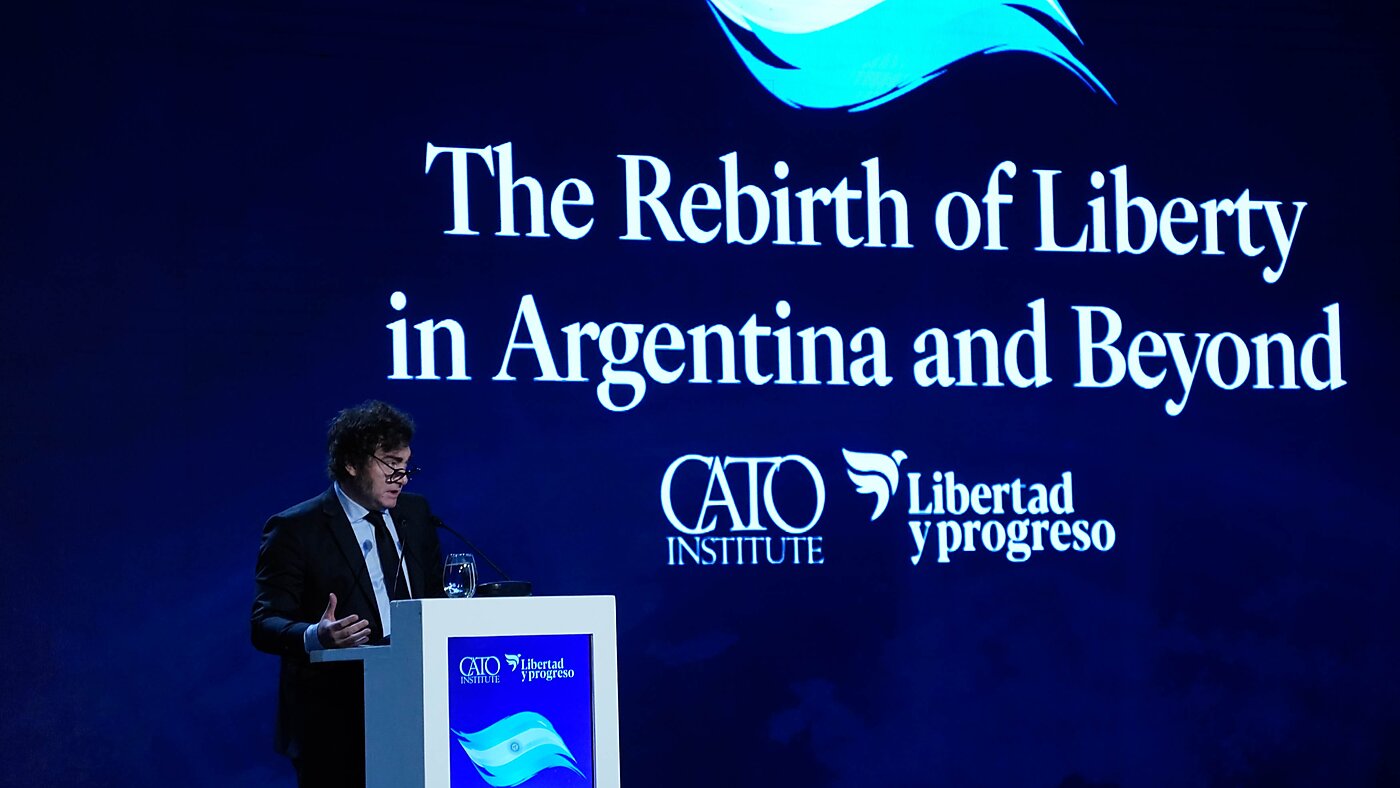
“Either we persist on the path of decadence, or we dare to travel the path of freedom,” Milei declared at a conference co-hosted by the Cato Institute in Buenos Aires last year
Cecilia remembers what it was like to do business before Milei: “I had two clients pay me off the books and send me cash through a delivery platform just so that I could avoid writing invoices for them and thus not exceed the monotributo limit.” Stories of other independent workers who had their relatives apply for monotributo and sign fake invoices under their names were also common. All these nightmares ended as soon as the Milei administration decided in 2024 to update the program’s limit, which is now about $72,000—over 11 times what it was previously. While other taxes have also been repealed, lowered, or left to expire, the monotributo story represents a massive, silent tax relief for millions of Argentineans. “I’m relaxed now,” says Cecilia, who can finally focus on her work instead of spending time with her accountant trying to navigate convoluted tax laws.
Argentina’s Dramatic Battle of Ideas
At a Cato Institute conference in Buenos Aires last year, President Milei promised to turn Argentina into the freest country in the world, appealing once again to the tradition of liberty from which Argentina departed at least 80 years ago. It was a stark reminder of the dramatic battle of ideas in which Milei has engaged his country, pitting classical liberalism against a pernicious and very Argentine form of statism.
Argentina became prosperous in the second half of the 19th century on the basis of its classical liberal constitution of 1853. The father of that constitution, Juan Bautista Alberdi, admired the US Founders, the US Constitution, and the leaders of Argentina’s independence movement earlier that century, who also held the American Founders in high regard.
By the early 20th century, Argentina ranked among the 10 wealthiest countries in the world. In 1913, its per capita income was higher than that of Germany, France, Sweden, Italy, and Spain. Economist Armando Ribas called Argentina “a miracle of history” since it was “the only country created under an Anglo-Saxon or Anglo-American political-philosophical process and implemented by descendants of Spaniards.”
In fact, Argentina was also drawing from a broader Hispanic tradition of liberty, one going back to the Spanish School of Salamanca of the 16th and 17th centuries that influenced Enlightenment thinkers and Argentina’s own founding fathers, as our colleague Gabriela Calderón de Burgos explains in her new book on the liberal leaders of Latin American independence movements, En busca de la libertad: vida y obra de los próceres liberales de Iberoamérica. When Milei calls for a return to “Alberdian” classical liberalism, he too is drawing on that broader tradition.
Argentina still needs to implement major reforms, many of which will require congressional support, to become one of the freest countries in the world.
As happened elsewhere in the world, illiberal ideas began to make inroads in Argentina in the first half of the 20th century. This led to a definitive break from classical liberalism in the 1940s with the rise of Juan Domingo Perón, who, after having overthrown an elected president with a group of military officers, was democratically elected on a populist platform.
The system Perón set up was explicitly modeled on European fascism, which inspired him after his visits to Nazi Germany and Mussolini’s Italy. In both of those countries, Perón said, the state was organized “for a perfectly ordered community, for a perfectly ordered people as well, a community where the state was the instrument of that people whose representation was, in my opinion, effective.”
Perón proceeded to create a corporate state in which the government organized with business, and labor, to control the economy. The state doled out privileges and served as arbiter of competing interests through regulation and public spending.
The Peronist system strengthened unions, protected domestic firms from international trade and competition, increased state ownership of businesses, imposed export taxes and price controls, produced an explosion of regulation, and generally centralized government power. Government agencies such as the central bank lost any semblance of independence. Reckless public spending led to undisciplined monetary policy.
The result was a political system of entrenched interests that strengthened over time, regardless of political regime, and produced recurring cycles of high inflation, debt crises, devaluations, and defaults. Through booms and busts, Argentina experienced long-term decline. Since 1950, it has spent more time in recession than any other country in the world and has alternated between democracy and dictatorship. Politically and economically, Argentina became the most erratic country in the most erratic region of the world.
That reality led to a popular saying among Argentines that goes back to at least the 1980s: “Argentina is a country where, if you go on a trip for 20 days, everything has changed when you return, and if you go on a trip for 20 years, nothing has changed when you return.”
Unlike in Germany and Italy, where war crushed fascism, Argentina’s central problem since the rise of Perón has been that its state corporatism, instilled when the country was still relatively rich, never died. By the time Milei assumed power, 20 years of mostly Peronist-party rule had once again brought the country to ruin and repression. According to the Human Freedom Index, an annual co-publication of the Cato Institute and the Fraser Institute in Canada, the Argentine economy was one of the most closed and most regulated in the world, and it had among the world’s worst monetary policies. In terms of economic freedom, Argentina ranked 159 out of 165 countries in 2023.
Against that Peronist legacy, Milei became the first political leader in 80 years to propose that the whole corporatist state had to be torn down and replaced with limited government. “Embracing the ideas of freedom,” he explained, “is the only way we can climb out of the pit in which they have put us.”
When Milei turned the mainstreaming of libertarian thought into political victory in 2023, he caught the attention of the world. But, as our colleague Daniel Raisbeck documented at the time, Milei’s rise did not occur in an ideological vacuum: It was “the result of a decades-long struggle by a few individuals to promote free-market ideas and the principles of classical liberalism in a thoroughly hostile environment.”
One of those individuals was Alberto Benegas Lynch Sr., who started a think tank in the 1950s and invited Austrian economist and leading classical liberal Ludwig von Mises to Argentina in 1959, after Peronism had generated a few of its early economic crises. In a lecture during his visit, Mises described Germany’s recovery from the devastation of fascism in simple terms that remain relevant to Argentina today:
You have read in many newspapers and speeches, about the so-called German economic miracle—the recovery of Germany after its defeat and destruction in the Second World War. But this was no miracle. It was the application of the principles of the free market economy, of the methods of capitalism, even though they were not applied completely in all respects. Every country can experience the same “miracle” of economic recovery, although I must insist that economic recovery does not come from a miracle; it comes from the adoption of—and is the result of—sound economic policies.
In the years since Mises’s visit, classical liberal ideas spread, and Argentina developed the most extensive and sophisticated intellectual ecosystem in Latin America in support of those ideas. Alberto Benegas Lynch Jr. founded a business school in the 1970s that would teach Austrian economics, classical liberal professors began teaching at important universities, and free-market think tanks were founded in Buenos Aires and other cities across the country. That network was in place when Milei joined and supercharged his country’s battle of ideas, and it continues to be in place today.

Argentines walk around a plaza near the Casa Rosada, the Argentine president’s office, as Javier Milei nears the two-year mark of his administration. (Photo by Jon G. Fuller/VW Pics/Universal Images Group via Getty Images)
Will This Time Be Different?
Will Milei be able to live up to the ideals of classical liberalism that he espouses and the high expectations that he’s set? Will he be able to make progress on his extensive, unfinished agenda? Most important, will this time be different from previous episodes of adjustment, and will Milei be able to finally break the grip of Peronism on the country’s political system?
Those questions are especially relevant in the run-up to Argentina’s critical midterm elections at the end of October. Milei’s achievements, after all, have come about with a National Congress in which his party holds only about 15 percent of the seats. To continue his reform agenda, Milei’s party will need to make up at least one-third of the legislature, a large enough share to prevent the opposition from overriding any presidential vetoes and thus large enough to eliminate Peronist legislative threats.
The Peronists have already tried to undermine Argentina’s fiscal balance—the centerpiece of Milei’s reform agenda—by passing spending bills that would put the budget in deficit and by overriding vetoes on some of that spending. Likewise, an audio secretly recorded last year of a high-level official alleging corruption involving Milei’s sister was recently made public in a politically timed release. Milei has called such claims lies. At the time of this writing, they are being investigated, and it remains too early to judge.
Additionally, Milei himself has established dubious electoral alliances with Peronists, alienating part of his base. While he claims these alliances are necessary to defeat Peronism in the districts where it is strongest, many fear that these Peronists will quickly defect from Milei’s party after the October midterm elections and weaken his standing in the National Congress. This has happened in the past.
All of these developments have weakened the peso and produced some uncertainty about Argentina’s political future, because they suggest the possibility that Peronism will regain strength and undermine Milei’s reforms. What is certain is that the Peronist opposition is willing to go to great lengths, including spurring economic instability or crisis, for political gain. Milei has a notable nationwide advantage over the opposition, but the political relevance and strength of Peronism—as shown in a recent local election in the province of Buenos Aires—have become the main threats to the Argentine economy.
Argentina still needs to implement major reforms, many of which will require congressional support, to become one of the freest countries in the world. Despite progress in reducing trade barriers, the economy remains largely closed and the country still belongs to the protectionist Mercosur trade bloc. Labor reform (Argentina’s labor regulations are among the world’s most rigid), pension reform, privatization of state-owned enterprises, much tax reform, and further deregulation are necessary. Capital controls should also be fully lifted.
Most urgently, Milei should liberalize the exchange rate. His government chose to stabilize the economy before opening it to the world, and that stabilization is certainly responsible for much of Milei’s remarkable success. But the managed exchange rate also led to an overvalued peso that began slowing the economy earlier this year. The current exchange-rate system put in place this April, in which the government sets upper and lower limits to the value of the peso is also inconsistent with free-market principles, has required government interventionism, and makes the currency vulnerable to speculative attacks that could lead to economic crisis and undermine the reform agenda—something the increasingly assertive Peronists are well aware of.
Finally, Milei should make good on his central campaign promise to dollarize the economy and close the central bank. Dollarization—allowing people to use the currency of their choosing—would further stabilize the economy. Shutting down the central bank, meanwhile, would put an end to the perennial enabler of Argentina’s macroeconomic turmoil and signal a credible institutional commitment to stability.
Fortunately, what makes this time most different in Argentina is the country’s biggest current asset: Milei’s belief in free markets and his record on moving the country in that direction. That differs significantly from the half-hearted or seriously incoherent reform efforts of previous governments. Indeed, Milei continues to promise dollarization and the full set of market reforms even as he faces political constraints.
For the United States, Argentina is a cautionary tale of a country that was once prosperous but began a long-term decline as it departed from its classical liberal roots. But under Milei, it has so far also been an example for the world at a time when so many countries have chosen illiberal paths. The success of Milei’s efforts to restore liberal democracy is more important than ever.