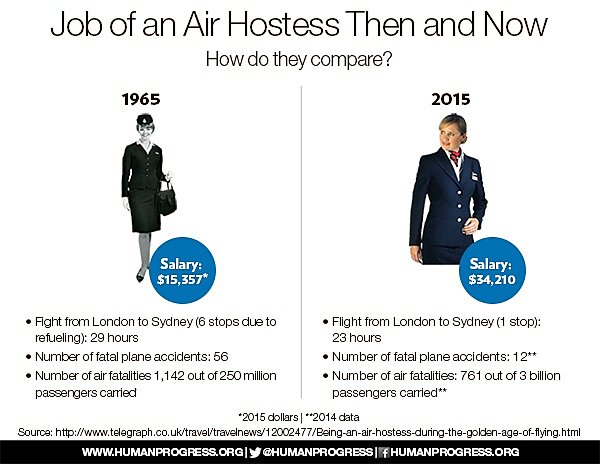
In the mid-1960s, being an air hostess was considered to be a glamorous job. Back then, however, air stewardesses were paid less than half of what they make today. They also had to endure much longer flights, since 1960s airplanes carried relatively little fuel and had to stop for refueling. That also meant that flight attendants had to serve more meals and, consequently, worked harder during the flight. Most importantly, the likelihood of dying on the job declined substantially. In 1965, there were 1,142 airplane fatalities per 250 million passengers carried worldwide. Only 761 people died out of over 3 billion people who flew in 2014.
Cato at Liberty
Cato at Liberty
Topics
General
NCLB Compromise Looking Pretty Bad
Is pre-kindergarten part of elementary and secondary education? By definition, no. But according to preliminary reports about what is in a compromise to reauthorize the No Child Left Behind Act – really, the latest iteration of the Elementary and Secondary Education Act (ESEA) – a preschool “competitive grant” program will be added to the law. And that’s just one of several troubling items that will reportedly be in the final legislation.
One hallmark of good lawmaking are laws that are easily understood by the people, and larding on lots of items not germane to the topic of a law is one way to move away from that democratic ideal. Adding pre‑k to the ESEA lards on, though as I’ll discuss in a moment, apparently the preschool addition isn’t all that will heavily complicate the legislation.
The bigger problem with expanding federal funding and reach on preschool is that the evidence is preschool has few if any lasting benefits, at least that have been rigorously documented for any large, modern efforts. Infamously, that includes Head Start and Early Head Start, which the federal government’s own studies have found to be largely impotent, and in the case of Early Head Start, potentially detrimental to some groups. The compromise would apparently also keep the 21st Century Community Learning Centers program, which federal research has also shown to be impotent or even counterproductive, but at least it is k‑12.
The second major strike against this compromise, assuming the early reporting is correct, is that it will apparently be very complex. This is a big problem: Not only is complicated legislation inaccessible to the public, it can enable ambitious executives to exploit impenetrability and essentially write law through regulation. And if we have learned any lesson from the Obama administration’s NCLB waivers – and the wisdom of the Founders – it is that presidents will tend to use whatever power they are allowed.
Third, the compromise apparently would require states to intervene in the bottom five percent of schools based on test-score performance; schools with less than two-thirds of kids graduating; and schools where various achievement gaps aren’t closing. That sounds like NCLB-lite: not as many schools and districts directly subject to state and federal control, but still quite a few.
Finally – at least until more information comes out – there is no evidence that the compromise eschews the back-door veto over state plans that both the House and Senate bills would give the Secretary of Education. This would continue to keep great power in the hands of the executive branch, albeit more shadowy by requiring that the Secretary keep saying “no” to things he doesn’t like rather than just saying what he wants. But that’s what telephones and visits to states are for, right?
Oh, one more thing: This is all unconstitutional.
Related Tags
Vermont Official Foresaw Collapse of ObamaCare Co-Ops
The Daily Caller has an excellent article recounting that it wasn’t just opponents who saw trouble ahead for ObamaCare’s health-insurance cooperatives, of which more than a dozen have now collapsed.
Susan L. Donegan was commissioner for Vermont’s Division of Insurance in 2013 when she refused to issue a license to the proposed Vermont Health CO-OP, saying it failed to meet state standards. Her action barred the Obamacare non-profit from selling health insurance in the state…
Today, she looks like a prescient state official who likely saved thousands of Vermonters from buying their health insurance from a doomed insurer.
That’s because 13 of the 24 co-ops set up under Obamacare have collapsed, costing the federal treasury $1.3 billion. More than 800,000 co-op customers now find themselves without health insurance coverage and are scrambling to find new policies due to the co-op failures.
Turns out that some of the biggest problems she identified two years ago in her state also doomed co-ops across the country…
Denying a license to the health co-op was not an easy decision for Donegan, who first joined Democratic Gov. Peter Shumlin’s administration as a deputy insurance commissioner in 2010.
First, she already knew when the co-op’s application arrived at her her office that federal officials in Washington, D.C., had pre-approved the co-op’s plan and allocated to it $33 million in taxpayer funds.
Second, she knew the co-ops were an important part of President Obama’s signature health reform effort. Obama is extremely popular in Vermont, having garnered 67 percent of the vote in his 2008 and 2012 campaigns…
Donegan sensed trouble as soon as she read the co-op’s application. There were optimistic and questionable forecasts, a board filled with friends, sweetheart deals, high salaries, deep conflicts of interest and a staff with little business expertise.
The failure of more than a dozen other ObamaCare co-ops suggests these problems were not limited to Vermont’s proposed co-op. Yet regulators in those states, not to mention CMS, nevertheless approved them.
One might even say the rule is that government regulators either were unable to spot these co-ops’ looming insolvency, or worse, allowed political considerations to trump their judgment; and Vermont is the exception, where regulators both identified the problem and had the courage to pay the political cost of denying that carrier a license. Something to keep in mind when contemplating the costs and benefits of government regulation of insurance-carrier solvency.
Any count of failed ObamaCare co-ops should be sure to include Vermont’s.
H/T: Greg Scandlen.
Related Tags
Score One for For-Profit Colleges This Veterans Day
There is nothing easier or seemingly more popular in higher education than bashing openly for-profit colleges. (I use “openly,” by the way, for a reason.) If you burrow into the demographic and funding weeds, however, you’ll see that proprietary schools are likely no worse, as a whole, than any other sector of uber-subsidized higher ed. And now Gallup has produced a little more good news for these beleaguered schools, to the extent that any news from our bloated Ivory Tower is good: For-profits seem to do a better job of serving veterans – at least from the vets’ perspective – than public colleges and, depending on how you slice the data, nonprofit private colleges as well.
As the table below shows, when veterans rank how well they feel their schools understood their needs, the percentage giving a 4 or 5 – the top scores – to for-profit schools beats any other sector, and at just the 5 level only nonprofit private institutions surpass them. Comparing for-profit and public schools, for-profits get more 4s and 5s by a 15 percentage point margin.
It’s probably not a mystery why this is. For-profits are more nimble than public colleges, and their desire for profits may actually – get ready – make them more responsive to the needs of the students who buy their services. Yes, there are bad for-profit actors – though the extent to which that is the case is unclear – but maybe on the whole they work better for students than lumbering, impersonal public institutions that get big taxpayer subsidies upfront. At the very least, that’s what this evidence suggests. Not that evidence has mattered much in this debate so far.
Related Tags
Whatever Happened to the Left’s Love of Free Speech?
There was a time in America when the Left could be counted on to defend free speech. But as countless examples today demonstrate, those days are long gone. From campus speech codes to campaign finance to prosecutorial threats against climate change critics and more, the evidence is as fresh as this morning’s newspapers.
Campus assaults have been so well documented by the Foundation for Individual Rights in Education (FIRE) that they need no elaboration here. But the latest campaign finance “reform”—“until the court reverses its decision in Citizens United”—can be found championed in an op-ed in this morning’s Washington Post by such stalwarts of the Left as Yale Law School’s Bruce Ackerman and Ian Ayers. On Tuesday last, it seems, Seattle voters approved a measure that would “give” each registered voter a $100 “democracy voucher” that could be spent “for only one purpose—to support their favorite candidates for municipal office.” The city can of course “give” that $100 voucher only if it first “takes” the $100 from its taxpayers, which it will do in all the unequal ways that modern tax systems exhibit. Thus is the political speech of private individuals reduced by forcing the funds they might otherwise direct to candidates of their choice to be redirected through this public funding scheme to candidates they may oppose.
But that inroad on free speech pales in comparison to recent attacks on what most Americans would have thought were the free speech rights of climate skeptics, the RICO-ing of whom my colleague Walter Olson has been covering—along with the machinations of New York Attorney General Eric Schneiderman. The latest from the latter is all over the papers today, the Post’s headline reading “Exxon investigated over climate change research.” The Left has already browbeaten Exxon Mobil into ending its funding for think tanks and advocacy organizations that express climate change skepticism. Now, however, it’s getting more serious, with Schneiderman issuing a subpoena that focuses, we’re told, “on whether Exxon Mobil intentionally clouded public debate about science and hid from investors the risks that climate change could pose to its business.” “Clouded?” What, a debate that is crystal clear? That of course is what the environmental establishment would like as to believe.
And circling back to the academy, so too, apparently, would one Naomi Oreskes, a professor of the history of science at Harvard University and a critic of Exxon who laments that we haven’t yet implemented a carbon tax. There are many reasons we haven’t, she tells the Post, but a significant one “is the role of Exxon Mobil and others in fomenting disinformation, undermining public support for such initiatives, and lobbying against policies that would have begun to decrease our fossil fuel dependency.” And this from a professor of the history of science, the annals of which are littered with the corpses of “settled science.” Clearly, if we don’t stop this speaking and lobbying, we could have one more corpse.
Related Tags
Curb Your Enthusiasm: Down with the “Joyful Campaign”
I have a piece running in the Federalist this week on the notion that presidential candidates should campaign “joyfully,” as Jeb Bush ever more desperately insists that he is. It’s not clear why we’re supposed to want joyful candidates, but that seems to be the prevailing norm. Hardly a week goes by without reporters needling the contestants: are you having fun yet? I wrote the column before former Senator Fred Thompson passed away on Sunday, but it occurred to me that his failed 2008 run is a perfect illustration of how perverse the cult of campaign-trail positivity has become.
By almost any measure, Thompson had a full life: a Watergate Committee counsel whose questioning revealed the existence of the White House tapes; U.S. senator from Tennessee; “Law and Order,” “The Hunt for Red October,” “Die Hard 2.” But his short-lived presidential campaign isn’t part of the highlight reel. The Tenneseean put it gently in their obituary: “Mr. Thompson underwhelmed” in his 2008 bid. The press was harsher when Thompson dropped out of the race. “You must show an interest in running for the most powerful office in the world to gain that office,” John Dickerson scolded in Slate, but “The press copies of his daily schedule always looked like they’d been handed out with a couple of the pages missing. The candidate seemed like he might just show up for events in
sweatpants.” “As his hopes cratered,” Politico chided, “the former Tennessee senator increasingly voiced his displeasure with a process he plainly loathed. Thompson’s stump speech became mostly a bitter expression of grievance against what was expected of him or any White House hopeful.” Ha: what a weird old grouch! I mean, the guy’s an actor, and he still couldn’t fake it! What’s wrong with him?
And yet, earlier generations of Americans would have viewed Thompson’s reticence as reassuring. As the political scientist Richard J. Ellis explained in an insightful 2003 article, “The Joy of Power: Changing Conceptions of the Presidential Office,” early American political culture took it as self-evident that anyone who seemed to relish the idea of wielding power over others couldn’t be trusted with it. “Presidential candidates largely stayed home in dignified silence,” he wrote, “ready to serve if called by the people.…Distrusting demagoguery and tyranny, the dutiful presidency demanded dignity, reserve and self-denial from its presidents.”
By the mid-20th century, those cultural expectations had been upended, replaced with a demand for happy warriors with fire in their bellies and joy in their hearts. Changes in the nomination process reinforced the new norms, increasingly favoring boundless ambition and stamina. Campaigning for president “was something I didn’t do well,” Thompson himself reflected in 2014, “You have to about want it more than you want life itself.” But it’s worth asking: what sort of person wants the job that badly? And, are we sure we want that sort of person for the job?
As I wrote in the Federalist:
A latter-day Cincinnatus might put down his plow in the hour of his country’s need; he’s not going to sign up for a two-year ultramarathon of pleading with high-dollar donors, glad-handing his way through primary states, and saying things no intelligent person could possibly believe. Instead, we get the sort of person who wants presidential power badly enough to do what it takes to get it, 16 hours a day, feigning joy all the while.
At least, we should hope it’s feigned. Anyone who approaches “the process” with genuine joy in his heart is a maniac who should be kept as far away from “kill lists” and nuclear weapons as possible.
Years later, one of Thompson’s former aides said he’d have been “a great president, if he didn’t have to campaign for it.” I don’t know about the “great president” bit. I’m increasingly unsure that such a creature is possible. But Thompson’s inability to feign enthusiasm for the process spoke well of him. It suggested that he was psychologically healthy and normal. Those qualities are ruthlessly winnowed out by the modern presidential race, which rewards those with an unhealthy appetite for presidential power and glory. You’ve got to want it to win it, and they want it more.
Related Tags
Creation of Artificial Life and Other Recent Discoveries
So, Dr. Craig Venter, the genius who first sequenced the human genome, is at it again. This time, he has created artificial life. Does the man ever sleep? Anyhow, here is the latest installment in my innovation-that-you-might-have-missed series. Included you will find news on the 3D-printing of a human heart, pain management, a new electric battery breakthrough and my personal favorite—sideways elevators!
Researchers Now Capable Of 3D-Printing a Human Heart Using Organic Materials
A recent breakthrough in bio-printing technology may allow for the creation of human hearts. A research team at Carnegie Mellon used a consumer printer to create a heart out of organic material. While 3D-printing has previously been used to solve a lot of different problems, it had, until now, built things out of plastic and metal—inorganic materials that don’t necessarily adapt well to the human body. Hopefully, further progress of this sort in bio-printing tech will revolutionize the treatment of tissue damage and organ failure.
New Foam Batteries Promise Faster Charging, Higher Capacity
Despite billions of dollars spent on investment, innovation in batteries has lagged relative to other technologies. However, a growing number of researchers are looking at three-dimensional batteries that tend to have porous, sponge-like structures, as opposed to the traditional “2‑D” form (i.e., thin layers of metal in a liquid electrolyte solution inside a box). A recent startup, called Prieto Battery, claims to have succeeded in producing a 3‑D battery that would be cheaper to make, faster to charge, safer, smaller, and less environmentally toxic than conventional batteries. Prieto’s innovation increases the battery surface area, thereby reducing the distance that the ions have to travel, thus increasing both power and energy density. While the first applications of these new batteries will be limited to small wearable systems and consumer electronics, they could eventually spread to cars, and one day, even grid-scale storage systems.
Scientists Discover How to “Turn Off” Pain
Researchers have discovered that people who suffer from chronic pain (e.g., arthritis) develop more receptors that respond to opiate pain relief. Having extra receptors makes the body more resistant to pain—both by using our bodies’ natural painkillers, endorphins, and through prescribed opiates such as morphine. Put differently, people who regularly underwent physical pain, such as arthritis sufferers as well as those who exercised regularly, were more resistant to pain due to their brains’ increased opiate receptor density. Increasing the receptor density may, therefore, hold the key to more effective pain relief treatment.
Skype Founders Invent Self-Driving Robot That Can Deliver Groceries For $1.50
Through the company Starship, the cofounders of Skype have created a robot that can deliver groceries five to fifteen times cheaper than current delivery services. These robots are able to autonomously drive at a speed of 4 mph and carry 20 lbs. worth of groceries, while recharging at hubs that are in close proximity to grocery stores. However, human operators have the ability to take control of the robot at anytime. Starship claims that a delivery will only take 30 minutes and cost £1 ($1.50). They hope to have the robots on the market in 2016.
The Sideways Elevators of the Future Will be Shown Off for the First Time
As more of the world’s population moves to urban areas, the demand for elevator technology will grow. To answer the call, ThyssenKrupp AG has created a ten meter tall elevator prototype that uses magnetic levitation instead of the traditional steel cable system. This technology allows for the vertical and horizontal movement of elevator cars, while also having multiple cars in the same shaft. The technology is not fully developed, but in the future it could rival the contemporary elevator system.
Craig Venter Creates Life for the First Time in Laboratory
Dr. Craig Venter has recently created artificial life by injecting a synthetic chromosome into an empty cell where it proceeded to multiply, which is the very definition of basic life. Compared to the synthetic life form, human DNA has roughly forty times as many genes and three-thousand times as many base pairs or “rungs” on the DNA ladder. Future uses of synthetic life could range anywhere from new vaccines for fighting disease to finding new energy sources.