Cato at Liberty
Cato at Liberty
Topics
General
Obama Backpedals on Ground Zero Mosque
Politico Arena asks today for continued comment on Obama’s Ground Zero mosque “correction.”
My response
Well, well: What a difference a day makes. Yesterday [Saturday] most POLITICO Arena contributors — including law professors, shockingly — were falling over themselves to defend President Obama’s Friday night Ground Zero mosque remarks — on constitutional principle, no less — while a very few of us were cutting through that nonsense.
Meanwhile, the president and the White House were struggling to get the word out that constitutional principle wasn’t really the point at issue here. It was, rather, the “wisdom” of building a mosque so close to Ground Zero. Now that we’re clear about that, perhaps Arena contributors can focus on that issue, not the straw man they erected to skewer the constitutionally benighted they imagined afoot.
But there’s another issue here, too. On Friday night we saw, once again, the real Barack Obama, the Obama who disparages Americans who “cling to guns or religion,” the Obama who rushes to condemn Cambridge policemen who act “stupidly.” No White House spinmeister can take any of that back
Related Tags
Obama on the Ground Zero Mosque
Politico Arena asks for comments today on President Obama’s Ground Zero Mosque remarks:
My response:
Speaking expressly “as President” last evening [Friday], Mr. Obama has weighed in on the Ground Zero Islamic mosque controversy — and blatantly misstated it.
This controversy has nothing to do with Muslims having “the same right to practice their religion as anyone else in this country” or with their “right to build a place of worship and a community center on private property in lower Manhattan,” as Obama put it. Nor does it have anything to do with the First Amendment. Rather, the issue is simply one of common decency and sensitivity to the feelings of others.
The president is right about one thing: Ground Zero is “hallowed ground.” It is the ground where some 3,000 people of all faiths lost their lives in a brutal attack by radical Muslims acting in the name of their religion, however distorted their beliefs may have been. Those who lost loved ones that day, to say nothing of the rest of us, cannot be indifferent to that fact — as those who support the mosque’s location near Ground Zero seem to be.
Related Tags
‘Mountain of Debt’
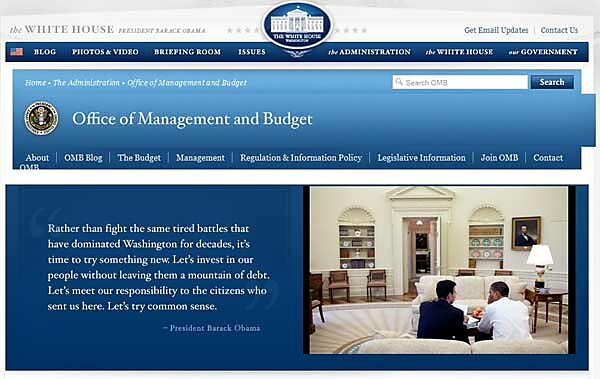
The White House Office of Management and Budget homepage currently features the following quote from the president:
President Obama says he wants to “invest in our people without leaving them a mountain of debt.”
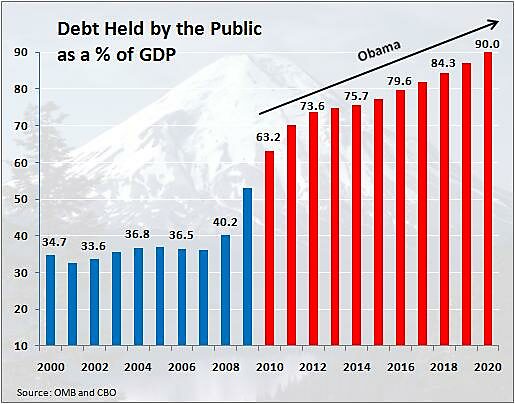
That’s a curious statement because the Congressional Budget Office’s analysis of the president’s current budget proposal projects that publicly held debt as a share of the economy would reach levels last seen at the end of the Second World War.
When the CBO’s numbers are plugged into a bar chart, the projected Obama debt levels (red bars) look like…the upward slope of a mountain (!):
To be fair, Obama’s predecessors — particularly the previous Bush administration — share in the responsibility for the mountainous rise in federal debt. However, that’s all the more reason for the Obama administration to work toward a peak instead of a steeper incline.
Related Tags
Fordham Feeds the Paranoia
You might recall several weeks back when Chester Finn, president of the Thomas B. Fordham Institute, called people like me “paranoid” for seeing federal money driving states to adopt national education standards as cause for serious concern that (a) the feds will take over schools’ curricula, and (b) the new federal curriculum will be taken over by potent special interests like teachers’ unions. (You know, the kinds of special interests that can get Democrats to give them $10 billion by cutting food stamps.) Well, in last week’s Education Gadfly, Fordham published a piece by Eugenia Kemble, president of the union-dedicated Albert Shanker Institute, saying that national standards demand a national curriculum.
This interesting little happening — Fordham publishing a piece by a union stalwart arguing that a national curriculum must go with national standards — didn’t go unnoticed by fellow paranoiac Greg Forster, who is now in a blog dispute with Kemble. It makes for telling reading, especially Kemble’s rejoinder. It features an all-too-casual use of the charged term “balkanization” to seemingly describe anything not centralized, and utterly fails to mention federal funding when implying that the common standards push is state led and voluntary.
Unfortunately, Kemble mainly just sidesteps Forster’s primary point: Fordham has provided yet more evidence that national standards funded by the feds will lead to a national curriculum that could very well be controlled by special interests. Heck, Fordham is in league with at least one component of the teachers’ unions here, which is fine if they share the same goals. All Forster is trying to emphasize is that it is ridiculous to call people crazy when they simply point out what so much evidence seems to show.
Related Tags
Bob Gates Against the World
Defense Secretary Robert Gates has again made headlines with a proposal to slow the growth of the Pentagon’s budget — already higher than at any point since World War II — by cutting overhead, waste and a top-heavy command structure.
The proposed shuttering of Joint Forces Command (Jif-Com) has elicited most of the press attention today, and prompted an impassioned plea from Virginia politicians, including Gov. Bob McDonnell, that the command remain open. Unhelpfully for Gov. McDonnell, outgoing Jif-Com head James Mattis (who will assume the title of CENTCOM), reportedly supports Gates’s decision.
But this isn’t the first time that opportunistic politicians have latched onto defense spending as a way to sprinkle economic benefits to their constituents, and at the expense of the rest of us. (In the same vein, Gates reportedly repeated his pledge to kill the entire DoD appropriation if it includes the unwanted C‑17 and the alternate engine for the Joint Strike Fighter that some members of Congress continue to push.)
Leaving aside the predictable political wailings, the reforms that Gates proposed are neither revolutionary, nor particularly controversial to most objective observers. Politico’s Gordon Lubold and Jen DiMascio in their ever-helpful Morning Defense newsletter point out that “The cuts seemed to take several pages out of the Defense Business Board task force led by [Arnold] Punaro that recently recommended many of the same trims.” (For more on that report, see here.)
The true object of Gates latest round of economizing is to forestall calls for deeper cuts by a public frustrated by the high costs and dubious benefits of our military’s exertions over the years. Gates explained:
“What we need is modest, sustainable growth over a prolonged period of time that allows us to make sensible investment decisions and not have these giant increases and giant decreases that make efficiency and doing acquisition in a sensible way almost impossible.” (my emphasis)
But Gates either misapprehends or mischaracterizes the true source of the problem. U.S. military spending has grown for 13 years, 86 percent in inflation-adjusted dollars from 1998 to 2011. Claiming that uncertainty over future military spending impedes effective planning and creates waste ignores that relative certainty over ever-rising defense budgets has enabled the very waste and mismanagement that Gates now proposes to cure.
Gates also succumbs to (or, worse, propagates) the sort of threat inflation that has afflicted U.S. foreign policy for decades, and about which Ben Friedman and John Mueller have written much. Gates claims that the U.S. military needs to grow because the world is becoming “more dangerous.” More dangerous than what? The notion that a few hundred al Qaeda ragamuffins and their Taliban allies poses a greater threat to Americans than a nuclear-armed Soviet Union is absurd on its face, and yet we spend more on our military today than at the height of the Cold War.
This threat inflation distorts our strategic planning, and does more harm to our long-term security than too many high paid civilians in the Pentagon. Although Pentagon waste and excessive overhead is a problem, it isn’t the problem. The fact that we have too many flag officers doesn’t explain why the United States spends more on its military than every other country in the world. Rather, it is our overly ambitious foreign policy that needlessly wastes U.S. taxpayer resources around the world in quixotic enterprises to rebuild failed states, reform sclerotic political systems, hunt after terrorists, and otherwise defend other countries who should defend themselves.
Cuts in military spending — real cuts, not merely slowing the rate of growth — would impose some short-term pain on an overburdened military that has been used and misused by our political class since the end of the Cold War. A better solution would be to adopt a more restrained grand strategy, one dedicated to defending our security and advancing our interests, but that forced other countries to play a larger role in doing the same. Restraint would allow for a much smaller — and less expensive — U.S. military, and would result in no diminution of American security.
The Washington establishment is unlikely to embrace such a strategy any time soon, however, because it would impose some real constraints on both the military and on Congress, the latter of which continues to use the Pentagon’s budget as a vehicle for dispensing pork under the guise of making Americans safer.
Unhappily for Gates, but especially for our troops, cuts in military spending are likely to come without an attendant change in how our military is used.
Related Tags
Grigori Rasputin Bailout
Sending billions of federal taxpayer dollars to teachers and other public school employees is the bailout that just won’t die. It’s been sliced, shot up in a firefight between Democrats, and even had a battle with food stamps, but it just can’t be killed!
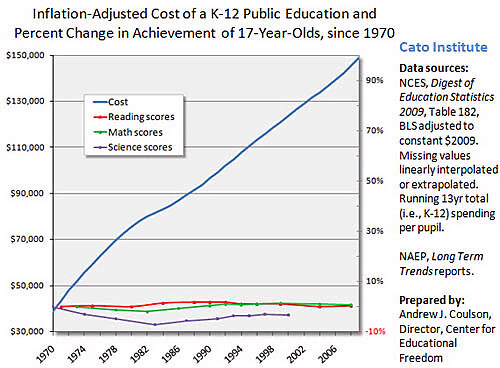
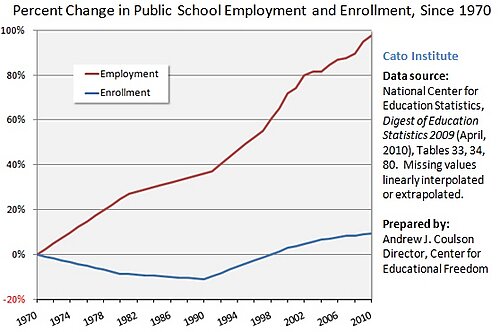
Now, let’s be clear: This is not some wonderful crusade all about helping “the children.” It is pure political evil, a naked ploy to appease teachers’ unions and other public school employees that Democrats need motivated for the mid-term elections. It has to be, because the data are crystal clear: We’ve been adding staff by the truckload for decades without improving achievement one bit. Since 1970 (see the charts below) public school employment has increased 10 times faster than enrollment, while test scores have stagnated.
But suppose there were some rational reason to believe that we need to keep staffing levels sky-high despite getting no value for it. Lots of teachers’ jobs could be saved without a bailout if unions would just accept pay concessions like millions of the Americans who fund their salaries. But all too often, they won’t.
Sadly, this is all just part of the one education race that Washington is always running, and it absolutely isn’t to the top. It is the incessant race to buy votes. And guess what? Despite its reputation even among some conservatives, the Obama administration, just like Congress, is running this race at record speeds.