Last week was a busy one for advocates of reforming the Jones Act. On Thursday the Cato Institute held a well-attended conference on the subject that featured a veritable Who’s Who of Jones Act experts and reform advocates. Video of the conference has now been posted, and those who were unable to participate or watch live should make sure to check out the many outstanding presentations that were made. But ours was not the only gathering where the law was placed under scrutiny. Last week also saw a panel discussion held on the Jones Act as part of the National Hispanic Caucus of State Legislators’ (NHCSL) annual summit in San Diego. Unfortunately, the panel consisted only of myself and a moderator as invitations to groups supportive of the 1920 law apparently went unanswered. Nevertheless, the discussion was lively and opposition to the law in abundance. Just how abundant became clear the next day, when the NHCSL voted on a resolution calling for the law’s repeal. Co-sponsored by New Jersey State Senator Nellie Pou and Pennsylvania State Representative Ángel Cruz, it passed by an overwhelming 56–10 margin. The resolution, whose provisions include a call for NHCSL members to put forward similar measures in their respective legislatures calling for the Jones Act’s repeal, already appears to be bearing fruit. Puerto Rico Rep. José Aponte has announced his intention to introduce such a resolution. Others are sure to follow. These are only the latest signs of support, particularly at the grassroots level, for reform of this failed law. Earlier this year, for example, the New York City Bar Association endorsed a permanent Jones Act exemption for Puerto Rico. Unfortunately, too many in Washington still don’t grasp the necessity of revisiting the Jones Act. But even here in D.C. there is good news to be found, with reform advocates set to be bolstered by the arrival of newly elected Rep. Ed Case of Hawaii. A longtime opponent of the law, Case was victorious in his race against another Jones Act critic, Cam Cavasso. Congressional races where the nominees from both major political parties compete to burnish their anti-Jones Act credentials is certainly a refreshing change and would seem to speak to mounting opposition to the law. The Jones Act has existed for over 98 years, and the edifice’s immediate collapse is unlikely. But cracks in the foundation are beginning to appear.
Cato at Liberty
Cato at Liberty
Project on Jones Act Reform
Although the Jones Act’s stated purpose is to ensure that the United States “shall have a merchant marine of the best equipped and most suitable types of vessels sufficient to carry the greater portion of its commerce and serve as a naval or military auxiliary in time of war or national emergency,” this plainly isn’t the case. But don’t take my word for it, just listen to ardent backers of the law such as Rep. John Garamendi (D‑CA):
Our military relies on privately-owned sealift capacity and highly trained and credentialed merchant mariners to transport and sustain our armed forces when deployed overseas during times of conflict. But the number of ocean-going U.S.-flag vessels has dropped from 249 in the 1980s, to 106 in 2012, to at most 81 today.
The consequences of this steep decline are not just theoretical. Our military has had to turn to foreign-flagged vessels for sustainment in times of war, and experience shows that can have dangerous consequences. In the 1991 Gulf War, our armed forces relied on 192 foreign-flagged ships to carry cargo to the war zone. The foreign crews on thirteen vessels mutinied, forcing those ships to abandon their military mission. Would foreign flag carriers be any more reliable today, especially for a long-term deployment into active war zones?
But the number of ships is not the only issue: The U.S. Transportation Command and Federal Maritime Administration estimate that our country is now at least 1,800 mariners short of the minimum required for adequate military sealift, even with the Jones Act firmly in place. Without the Jones Act, our nation would be wholly unprepared to meet the labor demands of rapid, large-scale force projection for national security.
The House Coast Guard and Maritime Transportation Subcommittee’s ranking member is absolutely correct about the sad state of the U.S. merchant fleet. Some of his numbers, however, are off the mark. The drop in the number of ocean-going U.S.-flag vessels is even more dramatic than what he states, declining from 737 in 1985 to a current figure of 180. Regarding the 1991 Gulf War, meanwhile, the actual number of foreign-flagged ships used as part of the U.S. sealift was 177 rather than 192. It’s also inaccurate to say that thirteen vessels were forced to abandon their military mission, with eight of those vessels ultimately delivering their cargo after initial hesitations.
Although an article of faith in pro-Jones Act circles, the congressman’s claim that the United States would be in even more dire straits absent the law is open to question. The Jones Act’s domestic build requirement, for example, forces U.S. carriers to purchase vessels at vastly inflated prices compared to foreign shipyards (4x is a figure used by many observers while a 2017 Congressional Research Service report placed the U.S. price at 6–8x higher). Using basic microeconomics we can intuit that higher prices mean fewer ships, and thus fewer mariners to crew them.
Linking to a Cato Institute analysis of the Jones Act, Garamendi then turns his attention to accusations that the law is an “outdated protectionist anachronism”:
Opponents of the Jones Act routinely claim that it is an outdated protectionist anachronism that does more harm than good, but nothing could be further from the truth. A comprehensive 2018 survey of seafaring and industrial nations around the world shows that cabotage laws such as the Jones Act, which provide for domestic preference for shipping policies, are the norm, not the exception. Ninety-one U.N. member states comprising 80 percent of the world’s coastlines have cabotage laws protecting domestic maritime trade. The conclusive fact from this survey is clear: seafaring nations understand the importance of their domestic maritime industries, and have laws on the books to safeguard them.
This misses the point. While cabotage laws are indeed common, the Jones Act’s stringent requirements—and in particular its mandate that ships must be built in the United States—place it well outside the mainstream. Indeed, the World Economic Forum calls the Jones Act the world’s “most restrictive example” of cabotage laws, noting that not even China has a domestic build requirement.
Finally, he addresses the Jones Act’s economic impact on Puerto Rico:
Just as important, a recent nonpartisan economic study found that the Jones Act does not impact consumer prices in Puerto Rico. Rather, the Jones Act has a net positive economic impact, because the certainty of the regularly scheduled coastwise trade allows shippers to invest in state of the art maritime technologies and local port investments. In fact, consumer price comparisons of common household commodities between Puerto Rico and other Caribbean islands found that consumer prices on Puerto Rico are commonly lower.
The referenced study may have been “nonpartisan” but it was hardly the product of disinterested observers, having been funded by the pro-Jones Act American Maritime Partnership. As discussed in a previous blog post the study’s methodology is dubious and its claims should be treated with a great deal of skepticism.
In addition, the logic behind the claim that the Jones Act has a net positive economic impact on Puerto Rico is unclear. State of the art maritime technologies and local port investments are certainly good for the carriers, but it is unclear how this benefits the average Puerto Rican. If the argument is that these confer efficiencies that allow Jones Act carriers to lower transport costs, then they should have little to fear from competing against foreign-flag ships. The fact that they steadily refrain from doing so and instead cling to the Jones Act’s protections, however, is telling.
It’s also worth noting that regularly scheduled trade with Puerto Rico happens outside of the Jones Act, with Tropical Shipping (whose owner, Saltchuk, also owns Jones Act carrier TOTE Maritime), for example, offering regular service from Halifax, Canada.
Although the Jones Act’s alleged economic benefits to Puerto Rico are fictional its costs are very real and well documented. A 2012 report from the Federal Reserve Bank of New York, for example, stated that shipping a twenty-foot container of household and commercial goods from the East Coast to Puerto Rico costs roughly twice that of shipping the same goods to nearby Jamaica or the Dominican Republic.
In addition, a 2013 GAO report points out that the high cost of shipping resulting from the Jones Act results in Puerto Rican farmers purchasing grain from Canada instead of New Jersey and jet fuel from countries such as Venezuela rather than the Gulf Coast. The report also highlighted price fixing in the Jones Act trade servicing Puerto Rico, with a federal investigation resulting in three of four Jones Act carriers pleading guilty and fined about $46 million. Six executives were sentenced to a total of more than 11 years in prison.
All of these points and much more will be discussed during the Cato Institute’s upcoming conference on the Jones Act in December, the culmination of which will be a debate between those who favor and oppose the law.
We invite Rep. Garamendi to participate in this debate and defend the Jones Act in this public setting.
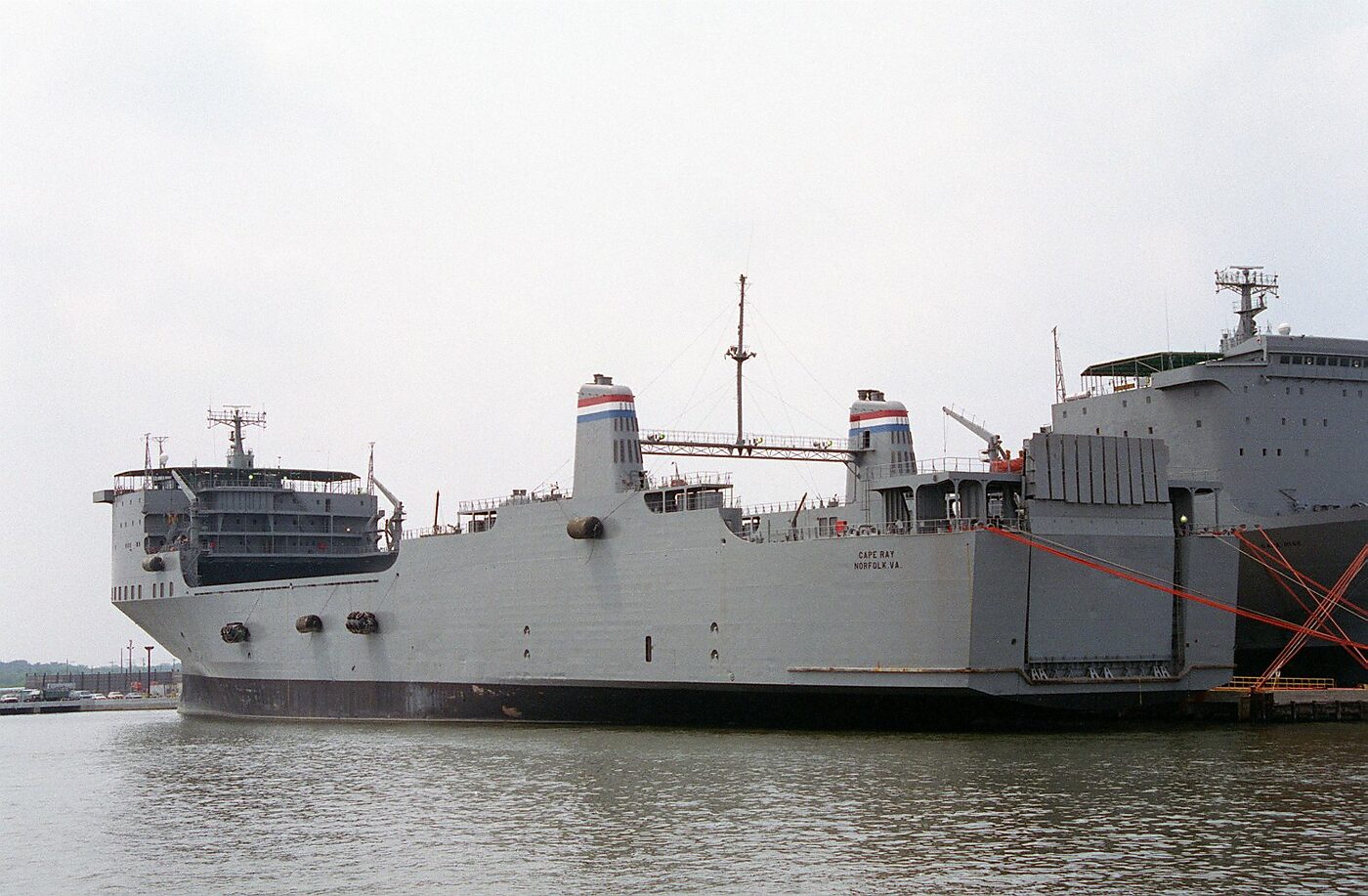
As North Carolina grapples with the aftermath of Hurricane Florence, transportation officials in the state are attempting to secure the use of a U.S. government-owned vessel, the Cape Ray, to transport supplies to the port of Wilmington. With the city temporarily transformed into an island by recent flooding, the roll-on, roll-off ship—or “ro-ro” in maritime parlance—will enable trucks filled with needed goods to drive aboard.
It’s a good thing the ship is government-owned—under private ownership the Cape Ray’s provision of relief supplies would be illegal. This absurd situation is due to a nearly 100-year-old law called the Jones Act. Passed in 1920, the law mandates that ships transporting goods between two points in the United States be U.S.-owned, crewed, flagged and built. The Cape Ray, however, was built in Japan.
Even if officials sought the private sector’s help and a Jones Act-compliant ro-ro ship to transport the trucks, none are available. According to data from the U.S. Maritime Administration (MARAD) there are only seven ro-ro ships in the entire Jones Act fleet. The closest one to North Carolina, the Delta Mariner, isn’t even an ocean-going vessel but rather operates on the Tennessee River. The other six vessels ply routes between the West Coast and Alaska or Hawaii.
The picture is little improved if Jones Act containerships and general cargo ships are also included, with a total of six such vessels currently on the East or Gulf Coasts (MARAD shows five but does not include the recently commissioned El Coquí). The closest one to the North Carolina flood victims is a 47-year-old general cargo ship, the Coastal Venture, which is currently moored near Charleston.
One reason behind the dearth of ships is the fact that U.S.-built vessels cost up to eight times as much as those built overseas. Such exorbitant prices mean that fewer are purchased, with fewer available for both general commerce and emergency situations.
In contrast, there is little difficulty locating foreign-flagged ro-ro vessels in the mid-Atlantic region. The Marshall Islands-flagged Morning Pride, for example, is making its way up the East Coast toward Philadelphia, while the Norwegian-flagged Höegh Asia is bound for Baltimore. A combination cargo/ro-ro vessel, the Saudi-flagged Bahri Tabuk, is currently off the coast of North Carolina.
But because of the Jones Act, none of these ships are eligible to take on relief supplies at a U.S. port and speed them to Wilmington.
The Jones Act’s stated purpose is to ensure that the United States “shall have a merchant marine of the best equipped and most suitable types of vessels sufficient to carry the greater portion of its commerce and serve as a naval or military auxiliary in time of war or national emergency.” But when faced with a genuine emergency, such as Hurricane Maria in 2017 or Hurricane Florence today, the Jones Act fleet is often found wanting.
By its own terms, the law is a failure that actually impedes the realization of its goals. It’s time for the Jones Act to go.
Rep. Duncan Hunter is not pleased with the Cato Institute’s efforts to repeal the Jones Act. Taking notice of a recent op-ed I penned criticizing the California congressman’s support of this costly law, Hunter took to the pages of the same newspaper last weekend to defend his stance. It’s worth reviewing the piece in full, as it recycles several arguments typically offered in support of the Jones Act—and exposes some glaring weaknesses.
Hunter begins his defense of the Jones Act by disputing accusations that the law negatively impacts Puerto Rico’s economy:
Like many opponents of the Jones Act, the CATO Institute attempts to conflate this 100-year old law with the struggles of Puerto Rico’s economy. They repeat the same tired argument that the Jones Act is responsible for high prices and economic instability, going so far as to make the ridiculous implication that the Jones Act adds $5 to the cost of a pint of ice cream.
A recent economic study disputed these price discrepancies but if concerns remain, it is important to recognize that Puerto Ricans have other options. Most of the ships that call on Puerto Rico are foreign flagged and current law allows them to deliver as many goods from foreign ports as Puerto Ricans can consume. A 2013 Government Accountability Office Study failed to conclude that removing the Jones Act would benefit Puerto Rico and, in fact, acknowledged that the regulation provides a number of advantages. Other studies have found that the Virgin Islands — approximately 100 miles from Puerto Rico — has no Jones Act requirement, but has higher shipping prices than Puerto Rico from the mainland.
There’s a lot to unpack here, but let’s begin by noting that the “recent economic study” Hunter refers to was funded by a pro-Jones Act special interest group with a questionable methodological approach. Pointing out that Puerto Ricans have options for obtaining needed goods that are not subject to the Jones Act, meanwhile, is essentially telling them to eat cake. The rest of the United States is, by far, Puerto Rico’s largest trading partner. Simply doing business with other countries instead of the world’s largest economy with which Puerto Rico shares deep political and cultural links is oftentimes not a feasible option.
But that doesn’t mean Puerto Ricans don’t try to hunt for cheaper alternatives. The 2013 GAO report cited by Hunter highlights numerous examples of this dynamic, including farmers who purchase feed from Canada instead of New Jersey due to lower shipping costs and the sourcing of jet fuel from Venezuela rather than domestically for the same reason.
As for the fact that shipping rates are higher to the U.S. Virgin Islands than Puerto Rico, this is an apples to oranges comparison. The U.S. Virgin Islands have a population and economy roughly 30 times smaller than Puerto Rico. With its smaller size comes smaller trade flows, smaller economies of scale, and reduced efficiency in servicing this market that is reflected in higher transport costs.
Hunter then pivots from discounting the Jones Act’s economic cost to Puerto Rico to highlighting its alleged national security benefits:
In a time of war, without the Jones Act, quickly rebuilding our shipyard industrial base would be next to impossible and training the American merchant mariners to man ships would take precious time we will not have. Instead, we would have to rely on shipyards overseas to supply our ships and we would likely have to pay foreign mariners to operate those ships. Is this really a position in the best national security interest of our nation?
We can have the strongest military in the world, but without the ships and U.S. merchant mariners to bring supplies to service members overseas, our capabilities would be severely limited, a position acknowledged by Gen. Darren McDew, Commander of U.S. Transportation Command.
The reality is that the Jones Act has presided over the steady decline of the U.S. shipyard industrial base. Since the early 1980s the United States has lost more than 300 shipyards. It’s a statistic Hunter should be familiar with given that it was mentioned on several occasions during a 2013 congressional hearing that he chaired. Furthermore, claims that the United States would be forced to rely on foreign shipyards without the Jones Act overlooks the existing reliance on foreign components and know-how to produce the few and vastly overpriced commercial ships that emerge from American shipyards.
Dependence on foreigners to support the U.S. military, meanwhile, is a description of the status quo. When the United States found itself needing to quickly transport vast amounts of equipment and war matériel to Saudi Arabia following Iraq’s invasion of Kuwait, foreign-flagged and crewed ships played a key role. According to the U.S. Transportation Command’s official history of its role in that conflict, 26.6 percent of total unit cargo was carried by foreign-flagged vessels.
While Jones Act supporters claim that the law assures the United States of ready access to ships and merchant mariners in times of war, the Pentagon found its transport capabilities so strained during that conflict that it twice requested the use of a transport ship from the Soviet Union—and was rejected both times. On the mariner front, the United States was forced to press two octogenarians into service and one 92-year-old sailor. Turning to the present day, meanwhile, the U.S. Maritime Administration published a 2017 report which, in its own words, “documents a deficit of mariners with unlimited credentials to meet the national security and force projection needs.”
Hunter continues in a similar vein:
The Jones Act also improves our safety and security. Rather than having unvetted foreign workers sail ships on our inland waterways, the Jones Act mitigates safety risks by ensuring that vessels are operated by U.S. mariners only.
Pure demagoguery. Foreign mariners already operate in U.S. waters on a daily basis and present no established threat. As a 2011 GAO report noted, overwhelmingly foreign maritime crews already make millions of entries into U.S. ports each year and yet there has never been a reported terrorist attack involving one of these seafarers. What reason is there to think these same foreign mariners would suddenly become a menace if permitted to operate on inland waters?
Furthermore, Hunter is factually wrong. Foreign mariners are already allowed to work on Jones Act vessels, with the minimum number of American crew set at 75 percent, not 100. As for safety, let’s note that it was a Jones Act ship with an American captain, the Exxon Valdez, that is responsible for one of the worst environmental disasters in U.S. history.
Congressman Hunter concludes with some comments about the Jones Act’s economic impact:
The Jones Act also provides significant economic benefits, including here in Southern California. The thousands of Jones Act vessels support nearly 500,000 domestic jobs with nearly $100 billion in economic impact.
The fact is, there are cheaper places to build ships than the United States, and I am sure that there are plenty of Chinese shipyards with cheap Chinese steel eager to undercut ones here at home. I am also sure we could find cheaper foreign workers to operate the ships currently sailed by Americans.
If building the cheapest ship manned by the lowest paid workers is the end goal, then by all means, let’s get rid of the Jones Act. If you are like me, and you value good paying U.S. jobs in American Shipyards and the Americans who can man those ships in times of conflict, then the Jones Act is clearly worth protecting.
By acknowledging that Americans could buy ships at lower cost abroad—as much as eight times cheaper—Hunter essentially concedes that the law imposes a significant economic cost. Paying vastly more to obtain the same good is the path to impoverishment, not prosperity. The secret to economic growth and an improved standard of living lies in increased efficiency and doing more with less. By blocking Americans from lower-cost alternatives, the Jones Act does the opposite.
The national security advantages we allegedly receive in exchange for the Jones Act’s price tab, meanwhile, are a figment of the imagination. If anything, the law makes us less secure, not more.
The Jones Act isn’t working. Its promised benefits have failed to materialize while the law imposes significant burdens on the U.S. economy. The time for its repeal is long past due.
Late last month that rarest of commodities, a new U.S.-built commercial transport ship, completed its maiden voyage by entering the harbor of San Juan, Puerto Rico to deliver its cargo. Called El Coquí, the vessel is among the world’s first hybrid roll-on/roll-off container vessels—a “ConRo” in industry parlance—that is powered by liquefied natural gas. Supporters of the Jones Act, a protectionist law which mandates that ships transporting goods between U.S. ports be U.S.-owned, crewed, flagged, and built, have pointed to El Coquí as a symbol of the measure’s success. The President of the Shipbuilder’s Council of America cited “American skill and ingenuity, as well as critical laws like the Jones Act” in his remarks praising the new ship. A senior official with Crowley Maritime, which owns the ship, added that investments such as El Coquí “would not have been possible without the [Jones] Act.” What El Coquí truly represents is the outdated thinking behind this law. According to its supporters, the Jones Act helps ensure U.S. expertise in shipbuilding and a domestic capability that can be relied upon in times of war. But as El Coquí demonstrates, it’s unclear how much expertise the U.S. shipbuilding industry possesses or how purely American this capability really is. The vessel’s very DNA, for example, is more foreign than American, with design work largely performed by Finnish company Wärtsilä using a team mainly located in Poland and Norway. In addition, testing for a model of the ship took place at a facility in the Netherlands. That’s not all. Its celebrated LNG propulsion system features engines from a German company, MAN Diesel & Turbo, that were produced in Japan. The actual LNG tanks were supplied by another German firm, TGE Marine Gas Engineering. No doubt a thorough inventory of the various components used to build the ship would reveal numerous other examples of sourcing from abroad. The only parts of El Coquí guaranteed to be truly U.S.-built are the hull and superstructure, which is how compliance with the Jones Act’s domestic build requirement is assessed. This demand, however, brings with it a fearsome price tag. To take delivery of El Coquí as well as a sister ship, Crowley Maritime is estimated to have paid $350 million, or $175 million per vessel. For perspective, the largest containership in the world, the G‑Class, features a price tag of $950 million for six ships, or $158 million per vessel. That’s a $17 million discount for a ship with a vastly larger cargo capacity. And despite its bigger size, the first G‑Class ship was delivered in a mere 18 months. El Coquí required 45 months. That’s about as much time as it took the United States to secure victory in World War II. The key difference between El Coquí and the G‑Class is that the latter is built by Samsung Heavy Industries in South Korea. While the number of large oceangoing commercial vessels built in the United States per year typically numbers in the single digits, Samsung says that its Geoje shipyard alone churns out 30 ships. With vastly greater numbers of ships under construction the South Korea shipyard is able to realize larger economies of scale than its U.S. counterparts, producing at significantly lower cost and in less time. Because of the Jones Act these cheaper ships are effectively forbidden fruit. Instead, carriers engaged in domestic transport must purchase their vessels from U.S. shipyards at vastly higher prices. These high prices, in turn, deter competition and raise costs to consumers. The law’s alleged national security upside, meanwhile, rings hollow given the industry’s deep international exposure and reliance on foreign know-how. Jones Act-compliant ships may be officially labeled as U.S.-built, but—as is the case with all manner of manufactured products—the production process spans the globe. The Jones Act brings with it considerable disadvantages in exchange for benefits that, upon closer examination, are almost entirely mythical. It’s time to rid ourselves of this nonsensical and counterproductive law.
In a new op-ed I take issue Rep. Duncan Hunter (R‑CA) for his unstinting support of maritime special interests and the Jones Act at the expense of average Americans. Particularly egregious is Hunter’s promotion of a recent report funded by a special interest group, the American Maritime Partnership, which makes the incredible claim that the Jones Act imposes no cost to consumers in Puerto Rico. Indeed, Hunter actually presided over a gathering of the House Subcommittee on Maritime Transportation meant to highlight its dubious findings.
While Hunter’s support for the AMP and the unseemly nexus between legislators and maritime special interests is the op-ed’s focus, the shortcomings of the AMP-funded report are worth exploring in greater detail.
From simply a theoretical perspective, the notion that the Jones Act would leave consumers in Puerto Rico unscathed is highly implausible. The Jones Act, which among other provisions prohibits foreign-flagged ships from transporting cargo between domestic ports and Puerto Rico, is a protectionist law. Keeping out competition is the entire point. It violates our understanding of economics to believe this is consequence-free for either costs or prices. Further note that competition among Jones Act carriers that provide service to Puerto Rico is sufficiently restrained that several of them were found guilty of price fixing.
Even if we were to believe that a perfectly competitive market exists in Puerto Rico despite the Jones Act’s restrictions, let us also remember that the law raises costs to those providing cargo transport by mandating the use of ships built in the United States. These ships are wildly more expensive than those constructed overseas, with a purchase price up to eight times higher. If consumers aren’t feeling the impact of these higher costs, then who is? Are we to believe that profit-maximizing companies that transport the cargo or the retailers who sell the goods in Puerto Rico happily absorb the costs of these expensive vessels?
If the theoretical underpinnings of the AMP’s claim are questionable, the methodology used to support it is doubly so. The finding that the Jones Act has no impact on consumers in Puerto Rico is in large part based on a price comparison, conducted via Walmart’s website, for 10 grocery items and three durable goods at the retailer’s locations in Jacksonville, Florida and San Juan, Puerto Rico. For these 13 items the price of each was found to be either the same or less in San Juan.
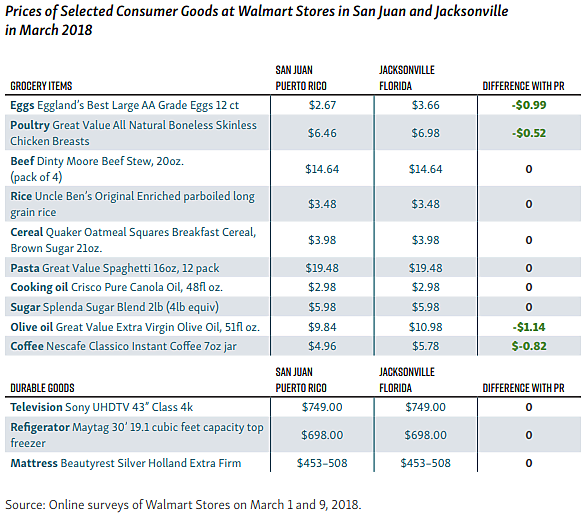
The defects of this approach are numerous. For starters, no explanation is provided for how the basket of goods was selected. Walmart sells thousands of items—why were these chosen? This is significant as it isn’t difficult to find items for sale at both locations that tell a rather different story. A 48 oz container of Breyers ice cream, for example, is priced at $2.98 in Jacksonville but $8.12 in San Juan. Numerous other price discrepancies indicating a premium paid by consumers in San Juan are easily found.


Beyond questions over how the limited basket of goods was selected, one must also wonder why Walmart should be considered representative of Puerto Rico’s retail sector and the impact that the Jones Act has on the territory’s consumers. Walmart is an extraordinarily efficient firm famous for its ability to squeeze margins from suppliers, likely including those it depends on for transportation. Do other retailers in Puerto Rico enjoy Walmart’s cost structure, or share in any discounts on ocean transport it is able to negotiate?
Furthermore, why should retail prices be regarded as a proxy for transportation costs or evidence of their burden? As Crowley Maritime, a member of AMP and the largest carrier that provides service to Puerto Rico states, “There are many factors affecting prices on the island – energy, taxes, trucking, warehousing, rent, market size and more.” Indeed. Unless all other costs are controlled for, the impact of transportation alone is unknowable.
One retailer. Thirteen items. No explanation for how the goods are selected. No controls to isolate the cost of transportation. And yet on this basis we are offered a rather sweeping conclusion.
A conclusion, it should be added, that is at odds with respected resources on cost of living differences in the United States. According to the Instituto de Estadísticas de Puerto Rico, grocery items in the territory are the 13th most expensive out of 297 locations in the United States. The group also shows food items, contra the AMP report, as 18.4 percent higher in Puerto Rico than in Jacksonville.
Other aspects of the report’s approach are similarly questionable. To bolster its case that the Jones Act does not impose higher costs on Puerto Rico the report offers up a chart (based, it appears, on confidential data from the carriers that is unverifiable) which shows revenue per container for ships traveling between the continental United States and other ports in the northern Caribbean:
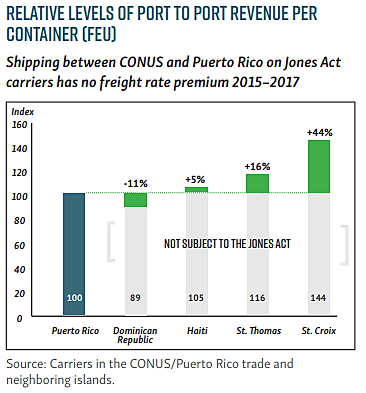
At first glance this appears to show that Puerto Ricans are getting a relative deal compared to a number of neighboring islands, but are they really? St. Croix, for example, has a smaller container port than San Juan, and likely operates with less efficiency due to its reduced scale. The fact that Puerto Rico has vastly greater trade volumes with the rest of the United States—nearly four times that of other Caribbean countries combined per a 2002 report—also likely unlocks efficiencies unavailable to other Caribbean ports.
To the extent higher revenue per container reflects the higher prices necessary to cover the higher costs of providing service on less efficient routes, this tells us nothing about the Jones Act’s impact or what freight rates between Puerto Rico and the continental United States might look like in a post-Jones Act environment. In short, it is not apparent that this is an apples-to-apples comparison or that such figures provide much in the way of relevant information.
The remainder of the report in large part consists of claims about the high level of service provided by Jones Act carriers to Puerto Rico. It cites, for example, that the use of “vessels and intermodal equipment that are uniquely designed to closely integrate the commonwealth with the advanced logistics systems of the mainland provides cargo owners with major economic and service advantages.”
But the alleged advantages and cost-effectiveness of the Jones Act carriers raises the question of why the law is then needed. If the Jones Act carriers already provide a high-quality service at a competitive price, then why should they fear a change to the status quo? If they are as competitive as they claim to be, why not open the market for sea transport with other parts of the United States to foreign competition?
The evident fear of such competition and employment of dubious analytical methods are instructive. Equally so is that pro-Jones Act politicians such as Duncan Hunter eagerly seize on this special interest-funded report despite its obvious flaws. It’s time to give the residents of Puerto Rico, and the rest of the United States, a break from this costly and outdated law.
Ike Brannon’s recent post on the Jones Act is excellent, and those who have not done so already should give it a read. He notes some of the many economic hardships imposed by the law, which are shielded from proper scrutiny because its large costs are spread across the population and benefits concentrated among a relatively limited number of entities such as shipbuilders.
Brannon’s concluding sentences, however, may be too kind to the political process:
[P]laces like Puerto Rico, Hawaii and Alaska would benefit most of all [from getting rid of the Jones Act], since they are overly dependent upon shipping prices.
However, as those are only two low population states and a territory with no voting representation, their inconveniences won’t resonate much with Congress.
Such language implies that the elected representatives of Alaska and Hawaii are fully cognizant of the burdens imposed by the Jones Act, but are prevented from making headway toward its removal due to insufficient political sway. The truth is far worse. As I noted yesterday at USAToday.com, all four members of Hawaii’s congressional delegation—Sen. Brian Schatz, Sen. Mazie Hirono, Rep. Colleen Hanabusa, and Rep. Tulsi Gabbard—stand foursquare in support of the law. Among the three members of Alaska’s delegation, both Sen. Lisa Murkowski and Rep. Don Young have touted their backing of the Jones Act (I have been unable to determine the position of Sen. Dan Sullivan, who has only held his current position since 2015).
Why is this? While the definitive motivations of these politicians are known only to themselves, a reasonable guess can nonetheless be hazarded.
We can first dispense with partisan explanations, as Hawaii’s congressional delegation is comprised entirely of Democrats while Murkowski and Young are both Republicans. More relevant is the fact that according to the American Maritime Partnership, Alaska is ranked #3 among the 50 states for maritime jobs per capita. Hawaii, being the lone U.S. state comprised of an island chain which imports as much as 90% of its food, presumably has a significant maritime sector as well. Those engaged in such employment, and who profit most from the Jones Act’s concentrated benefits, are much more invested in its future than the consumers forced to bear its significant but relatively small individual costs. Commensurate pressures from constituents then win out over economic sense when politicians set their positions.
Further food for thought is to be found in the fact that the Senate’s most committed Jones Act critic, Sen. John McCain, hails from the landlocked state of Arizona. McCain’s legislation to grant Puerto Rico a permanent exemption from the Jones Act enjoys co-sponsorships from Sen. Mike Lee of Utah and Sen. James Lankford of Oklahoma, also of landlocked states. As a result, these Senators are more likely attuned to the Jones Act’s net economic drag than benefits to maritime special interests. This may all be coincidence, but it fits perfectly with the public choice model of special interests.
When it comes to protectionist U.S. policy, bitter experience has shown that the truth is often worse than we think.