Cato at Liberty
Cato at Liberty
Government and Politics
Eric Holder has been busy playing his racial games. Not only did his Justice Department issue a joint guidance with the Education Department on how best to ignore the Supreme Court’s recent affirmative action ruling, but yesterday the attorney general announced a new lawsuit challenging North Carolina’s new election laws, which include voter-identification requirements. This action follows on the heels of lawsuits already filed against the Tarheel State by such groups as the ACLU and NAACP.
Never mind that the Supreme Court approved the constitutionality of voter-ID as recently as 2008 in the case of Crawford v. Marion County (Indiana) Election Board — in a 6–3 opinion written by the liberal Justice John Paul Stevens — but just last year Holder had to back off a similar suit in South Carolina. The formula for valid voter-ID laws is clear: don’t put obstacles (be they monetary or geographical) in the way of someone’s ability to get an approved form of identification and you’ll sail through the courts.
These regulations simply shouldn’t be a partisan issue. Requirements to show proof of identity before voting have been around for decades in all parts of the country. There’s no constitutional right to early voting — many states, including blue ones like New York, don’t have it at all — and North Carolina kept total hours constant anyway, just reducing the number of days of early voting.
And forget partisan divides; the DOJ’s argument that voter-ID laws and other attempts at orderly election administration disproportionately hurt minorities — on top of being offensive — don’t even seem to make sense to those they purport to support. For example, a Washington Post poll last year found that 65 percent of blacks and 64 percent of Latinos support voter-ID.
In our TSA-NSA-show-ID-to-get-into-an-Eric-Holder-speech world, shouldn’t we have the most basic safeguards for the machinery of democracy? And even if most voter fraud comes in through absentee and other mail-in ballots rather than in-person, shouldn’t we at least put in simple measures that demonstrably increase confidence in elections?
While too many so-called civil rights leaders are stuck in the 196Os — memo to Al Sharpton and Jesse Jackson: Jim Crow is dead and he ain’t coming back — government officials should know better. It’s shameful to fan the flames of racial division for personal and political gain.
Two months ago I wrote about the University of Texas’s attempts to delay the final reckoning from the Supreme Court’s near-unanimous ruling in the Fisher case that public institutions must overcome a high constitutional bar when they use race in admissions decisions. Courts must make “a careful judicial inquiry into whether a university could achieve sufficient diversity without using racial classifications.”
“The university must prove,” Justice Kennedy wrote for the 7‑justice majority, “that the means chosen by the university to attain diversity are narrowly tailored.” Far from attempting to prove that, however, UT-Austin is playing lawyer games and trying to re-litigate previously decided procedural issues.
But at least UT-Austin recognizes that its back is against the wall. The Obama administration, for its part, is pretending that nothing has changed, that colleges can continue discriminating based on skin color to achieve their elusive “diversity.”
On Friday, the federal Justice and Education Departments issued a joint “guidance” on the meaning of Fisher v. UT-Austin. This advice, consisting of a platitudinal cover letter and a superficial Q & A. The government’s position, remarkably, is that Fisher simply reaffirmed 2003’s ruling in Grutter v. Bollinger, which held that educational diversity could be a compelling interest that justified racial preferences at the University of Michigan. “Run along, nothing to see here,” the various civil-rights-division bureaucrats seem to say, “the Supreme Court just vacated the lower court’s decision because it didn’t check all the procedural boxes.
To say that the government is being disingenuous here would be like saying that Ted Cruz has a mild distaste for Obamacare. As Richard Kahlenberg comments at the blog of The Chronicle of Higher Education:
This reading of the two Supreme Court cases as essentially identical would presumably be surprising to the justices of the court. Five Supreme Court justices participated in both Grutter and Fisher, yet four of them switched sides in the two cases. Justices Anthony M. Kennedy, Antonin Scalia, and Clarence Thomas dissented in Grutter, in part because universities were not made to demonstrate that race-neutral strategies were insufficient to produce racial diversity, yet those justices were in the majority in Fisher.
Meanwhile, Justice Ruth Bader Ginsburg switched in the other direction, from the majority in Grutter to the dissent in Fisher. Her dissent complained that the majority would push universities to adopt race-neutral strategies like Texas’ top 10-percent plan, which she viewed as disingenuous. (Justice Stephen G. Breyer, alone, was in the majority in both cases.)
Moreover, the government is green-lighting any and all diversity initiatives rather than giving actual guidance about how to survive the legal minefield that administrators now inhabit. As Roger Clegg put it at National Review Online:
The fact is that this guidance is designed not to help schools follow the law, but to push them to adopt dubious race-based policies that the Supreme Court has warned against, and that have prompted lawsuits in the past, but that the Obama administration and its political allies stubbornly support. The whole tone of the new guidance is to offer encouragement to schools that want to engage in racial and ethnic discrimination: The administration promises that it “will continue to be a resource” for such schools.
It is as if the FBI offered eager encouragement to state and local police that wanted to engage in racial profiling without violating the law. Whether such discrimination may sometimes be legally permissible or not, why should the federal government issue a document the tone of which is not a stern warning about the many legal pitfalls, but cheerful encouragement to the police to do as much of it as they can get away with? Why urge schools to get as close to the legal line as they can, when it is unnecessary and bad policy for them to approach it at all?
In short, the government not only pretends that the Supreme Court didn’t mean what it said, but is encouraging college officials in their massive resistance to yet another Supreme Court ruling on civil rights. These actions enable the type of “holistic” racial balancing that results in greater racial-achievement gaps than illegal quotas ever did. Racial preferences today, racial preferences tomorrow, racial preferences forever.
It would be comical if it weren’t so sad — and if it weren’t backed by the full force of the nation’s chief law enforcement officers.
All eyes are on the government shutdown battle over Obamacare. Here are a few thoughts:
- House Republicans had six months to strategize since the last budget battle, so why did they leave it until the last minute to figure out what to do? They seem to have been unified in recent votes to defund and delay Obamacare. So why didn’t they announce their strategy months ago, draw a hard line, and then spend the summer building public support for their plan? The Democrats have a stronger hand because they have been giving a consistent message.
- The lack of leadership from the House created a void that Senator Cruz filled. Some House members didn’t like Cruz getting the spotlight and telling them what to do, but they should have had their act together.
- Obamacare opposition has been rising steadily this year. Even if Republicans don’t succeed with defunding Obamacare at this point, the polls may convince them to try again later. This battle could have been just a warm-up for a future battle if the polls get even worse for Obamacare.
- Why might the polls get worse? Some reasons are: more employers dropping health benefits, more employers cutting worker hours, more insurers cutting doctors out of their plans, premiums continuing to rise, individuals rebelling against the mandates and penalties, health exchanges suffering glitches and meltdowns, rising privacy concerns from the massive government data grab created by the law, etc, etc. See Mike and Mike for more.
- Obama and the Democrats brought the Obamacare backlash onto themselves, not only by imposing a very bad law, but also by slamming it through Congress in a very partisan manner. No Republican voted for it in either the House or the Senate. If you want a law to garner sustained political support, it is much better to pass it in a bipartisan manner, as was the case with welfare reform in 1996 and tax reform in 1986.
- The 2001 Bush tax cuts garnered 28 House Democratic votes and 12 Senate Democratic votes. Yet even with that bipartisanship, Democratic leaders spent the subsequent decade relentlessly demonizing the law and trying to repeal parts of it. So for Democrats to say that it is unfair for Republicans to try and repeal Obamacare just because the president was reelected is ridiculous.
- Democrats say that it is irresponsible to hold the economy and budget “hostage” to Obamacare repeal efforts. I don’t think so. Unless repealed, Obamacare is a huge issue for the nation’s health care system and the economy in coming years, so any short-term unpleasantness is a trifle compared to what’s at stake. As for the economy, the stock market rose during the last shutdown period in 1995/1996.
- It is not fair for media stories to say that it is just a few “extremists” who want to delay or defund Obamacare. The House delay vote garnered all the Republicans except two, which made for a substantial majority in the people’s chamber. Indeed, Republicans probably wouldn’t be trying to defund Obamacare without the people’s strong and consistent opposition.
- The way to limit Washington’s battles from harming the economy is to untether the economy from Washington. We should, for example, privatize many of the national parks or hand them over to the states and privatize air traffic control. Washington budget battles will likely get even more disruptive in the years ahead, so let’s start privatizing and devolving as many federal activities as we can right now. The problem isn’t the GOP taking the budget “hostage” to repeal Obamacare, it is the government taking hostage far too much of the American economy.
- So I favor government shut-downs. That is, permanent shut-downs of federal activities that ought to be funded by state governments, the private sector, or nobody at all.
Related Tags
Lyrics:
What’s hated by unions
has businesses wary
and dropping coverage
like the ‘Skins secondary?
Causing thousands of layoffs
taking it’s toll?
What’s so good for people
that they’re forced to enroll?
What’s a law that’s so good
folks who passed and defended it
see it and got waivers
to be exempted? It’s
like Olestra, at first
it sounded hip
but we quickly found ourselves
dealing with a whole lot of sh…
Obamacare, Obamacare
Unions and businesses both in despair
So to recap, young people,
your hours get cut
and your income goes down
and your premium’s up
and the taxes you pay
with the cash you have left
go to pay for a stupid
video contest, touting
Obamacare, Obamacare
Unions and businesses both in despair
It’s hated by doctors and unions are mad.
Not since Billy Ray Cyrus
has someone made something this bad.
Related Tags
The politicians, bureaucrats, lobbyists and interest groups in Washington are hyperventilating that the federal gravy train may get sidetracked for a day or two by a shutdown fight between Republicans and Democrats.
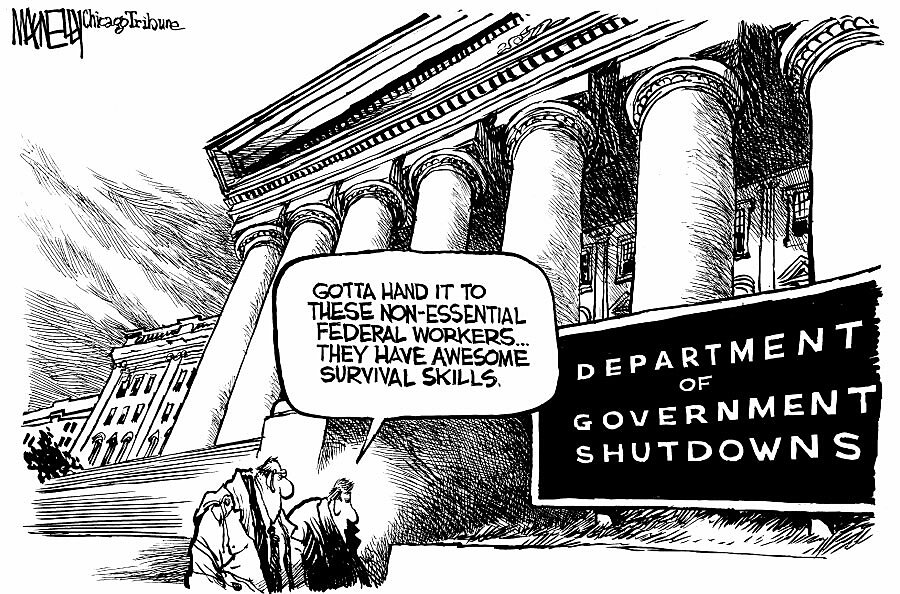
I’m not sure why they’re so agitated. After all, the shutdown is really just a slowdown since only non-essential bureaucrats are sent home. And everyone winds up getting paid for those unplanned vacations, which is why the bureaucrats I know are crossing their fingers for a lengthy confrontation.
But that describes what may happen when the new fiscal year begins tomorrow. What’s been happening in recent days, culminating today, is a feeding frenzy of end-of-the-fiscal-year wasteful spending.
Here are some details from a Washington Post expose.
This past week, the Department of Veterans Affairs bought $562,000 worth of artwork. In a single day, the Agriculture Department spent $144,000 on toner cartridges. And, in a single purchase, the Coast Guard spent $178,000 on “Cubicle Furniture Rehab.” …All week, while Congress fought over next year’s budget, federal workers were immersed in a separate frantic drama. They were trying to spend the rest of this year’s budget before it is too late. …If they don’t, the money becomes worthless to them on Oct. 1. And — even worse — if they fail to spend the money now, Congress could dock their funding in future years. The incentive, as always, is to spend. So they spent.
If you’re a taxpayer, you’ll be especially delighted to know that the “use it or lose it” spending orgy is so intense that federal contractors have to cater lunches for their sales staff. Can’t have them away from their desks, after all!
It was the return of one of Washington’s oldest bad habits: a blitz of expensive decisions, made by agencies with little incentive to save. Private contractors — worried that sequestration would result in a smaller spending rush this year — brought in food to keep salespeople at their desks. Federal workers quizzed harried colleagues in the hallways, asking if they had spent it all yet. …“Use it or lose it” season is not marked on any official government calendars. But in Washington, it is as real as Christmas. And as lucrative. …In 2012, for instance, the government spent $45 billion on contracts in the last week of September, according to calculations by the fiscal-conservative group Public Notice. That was more than any other week — 9 percent of the year’s contract spending money, spent in 2 percent of the year.

The IRS may win the prize for the most egregious example of last-minute waste.
In 2010, for instance, the Internal Revenue Service had millions left over in an account to hire new personnel. The money would expire at year’s end. Its solution was not a smart one. The IRS spent the money on a lavish conference. Which included a “Star Trek” parody video starring IRS managers. Which was filmed on a “Star Trek” set that the IRS paid to build. (Sample dialogue: “We’ve received a distress call from the planet NoTax.”)
But it’s not just tax collectors who flush our money down the toilet in creative ways.
One recent study, for instance, found that information technology contracts signed at year’s end often produced noticeably worse results than those signed in calmer times. …they listed dumb things they had seen bought: three years’ worth of staples. Portable generators that never got used. One said the National Guard bought so much ammunition that firing it all became a chore. “When you get BORED from shooting MACHINE GUNS, there is a problem,” an anonymous employee wrote.
Impressive examples of waste, though I confess I’m curious about the part about ammo and the National Guard. Does this mean bullets are like milk and have to be fired before an expiration date?
Beats me, but at least someone in the government acknowledged that (at least up to a point) it’s cool to fire a machine gun. Maybe that person should hook up with the Texas cop who likes tanks.
Oh, and you’ll be happy to know that spendaholic bureaucrats and crafty interest groups keep track of time zones so they can squander money until the very last second.
On Monday, Richer’s people will sell until midnight. Then they will keep selling. “Money rolls across the continent,” the feds say. Cash not spent in Washington might be spent by federal offices in California in the three hours before it is midnight there. When it is midnight in California — 3 a.m. in Washington — they will keep on. There are federal offices in Hawaii, after all. And it will still be three hours until midnight there.
Makes me think that we may need a slogan for the bureaucracy. Perhaps this modification of the Postal Service’s unofficial motto: “Neither snow nor rain nor heat nor gloom of night — nor even different time zones — stays these bureaucrats from spending every possible penny of other people’s money.”

But let’s close on an upbeat note. Whether you give credit to the Tea Party, to Republicans, to gridlock, or to Obama, the good news is that the federal government in the past two years has been wasting money at a slower rate.
So taxpayers can smile…or at least not frown as much. The bureaucracy and contractors may be throwing a party today, but not with the same reckless abandon they displayed a between 2001 and 2010.
Related Tags
Word on the street is that today House Republicans will pass a bill that would keep non-essential government functions open until mid-December, delay ObamaCare for one year, but not block the illegal ObamaCare exemption President Obama’s Office of Personnel Management granted to members of Congress and their staff. If Republicans fail to include language blocking that exemption, they truly deserve the moniker of The Stupid Party.
ObamaCare blocks members of Congress and their staffs from participating in the Federal Employees Health Benefits Program where most of them now purchase health insurance, and thereby denies them the “contribution” the federal government had been making toward their premiums. Starting in 2014, members and staff must obtain coverage either through an ObamaCare Exchange or whatever other options that can scrape together. The purpose of this provision was to ensure that members and staff would experience ObamaCare the same way the rest of the country does — so that just in case the law is a disaster, Congress will have to suffer just like everybody else. Since ObamaCare is throwing lots of Americans out of their prior health coverage, and causing lots of people to take pay cuts due to job losses and reduced hours, so far, so good.
Naturally, members don’t like the way ObamaCare is treating them and people about whom they care. By all accounts, members are extremely agitated about the impact on their staffs. But because Democrats don’t want to repeal the entire law, and neither Republicans nor Democrats want to get caught giving themselves an ObamaCare exemption that others don’t get, a coalition of Republican and Democratic members begged the president for a special exemption. For his part, President Obama didn’t want Congress to reopen the law, so he obliged. His administration announced that OPM will make the same “contribution” to each member and staffer’s Exchange premiums that it made to their FEHBP premiums, despite having absolutely no statutory authority to do so. And thus the political class set itself above the people it governs. The administration’s defenders, like Uwe Reinhardt, note that ObamaCare says “absolutely nothing” about whether OPM can continue to make those payments. Exactly. If Congress has not authorized those payments, OPM cannot make them. Moreover, no one else who works for a large employer may receive a tax-free “contribution” from their employer toward their Exchange premiums. Why should members and staff enjoy such privilege, when the law doesn’t provide for it and allowing it would fly in the face of this provision’s purpose?
This issue gives ObamaCare opponents tremendous leverage, if they are willing to use it. Senate Democrats are likely to strip a one-year delay of ObamaCare’s major provisions from the House Republicans’ “continuing resolution.” But few Democrats would dare to strike a provision blocking the OPM rule. Heather Higgins and Bill Pascoe write, “92 percent of the public does not think it is right that Congress and their staff are letting the Obama administration exempt them from the costs of Obamacare.” Moreover, “with a minimal push, the issue makes inroads even [against incumbents] most analysts thought beyond reach.” In other words, if the House Republicans’ CR blocks Congress’ ObamaCare exemption, then either vulnerable Senate Democrats will vote to preserve it, or they will be turned out by voters. If the Senate preserves it, which is likely, then even more Senate Democrats will be accept a one-year delay so that Congress can work out some arrangement that eliminates this pay cut for members and staff while providing equivalent relief to average Americans.
Unfortunately, House Republicans appear unwilling to tap their greatest source of leverage. I wish I could say that failure is inexplicable. But the reason is obvious. House Republicans got their ObamaCare fix, and (for now) that is more important to them than saving the rest of the country from this law. President Obama’s “OPM rule” is an attempt to buy their votes, and it appears those votes are for sale. They must not be thinking about what their base will do to them.
It’s great that House Republicans are sending the Senate a bill delaying ObamaCare for a year. Why don’t they want it to pass?