Cato Institute scholars Daniel J. Mitchell and Chris Edwards evaluate the plans offered by Republicans for lowering federal spending using a so-called “Cut, Cap and Balance” proposal that would make small cuts to federal spending in the short run, cap federal spending, and balance the federal budget using a tax-limited balanced budget amendment to the Constitution.
Cato at Liberty
Cato at Liberty
Tax and Budget Policy
Over at Downsizing the Federal Government, we focused on the following issues this past week:
- People here in Washington are now considering military spending cuts that they thought strategically unwise and politically impossible just a few years ago. And conservatives are joining in.
- Federally funded spaceflight is the quintessential neoconservative project: a giant, wasteful crusade designed to fill Americans’ supposedly empty lives with meaning.
- The Obama administration wants to send bureaucrats from federal agencies that are notorious for wasting other people’s money to help local bureaucrats do a more “efficient” job of spending other people’s money.
- President Obama’s Fiscal Commission handed Republicans ready-made spending cuts on a silver platter — Republicans will never get better political cover for insisting on spending cuts than now.
- $500 billion in cuts and a $500 billion debt increase would certainly be better than Senator McConnell’s chicken-out plan.
Follow Downsizing the Federal Government on Twitter (@DownsizeTheFeds) and connect with us on Facebook.
Related Tags
In my speeches, especially when talking about the fiscal crisis in Europe (or the future fiscal crisis in America), I often warn that the welfare state reaches a point of no return when the people riding in the welfare wagon begins to outnumber the people pulling the wagon.
To be more specific, if more than 50 percent of the population is dependent on government (employed in the bureaucracy, living off welfare, receiving public pensions, etc.), it becomes difficult for taxpayers to form a majority coalition to fix the mess. This may explain why Greek politicians have resisted significant reforms, even though the nation faces a fiscal death spiral.
But you don’t need me to explain this relationship. One of our Cato interns, Silvia Morandotti, used her artistic skills to create two images (click pictures for better resolution) that show what a welfare state looks like when it first begins and what it eventually becomes.
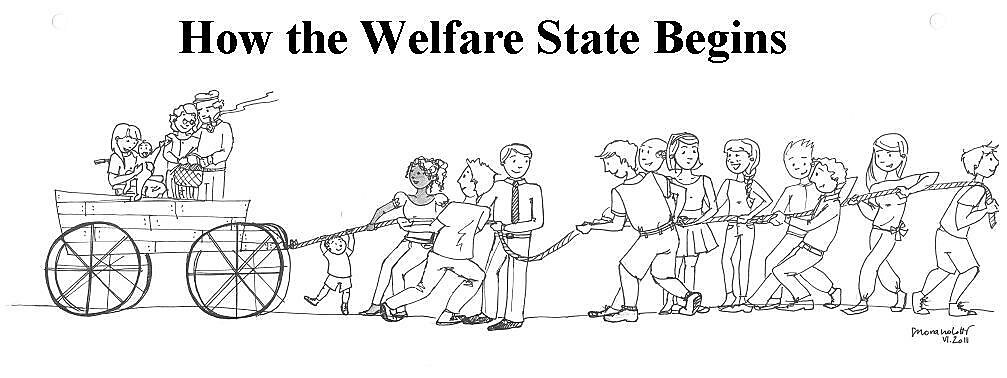
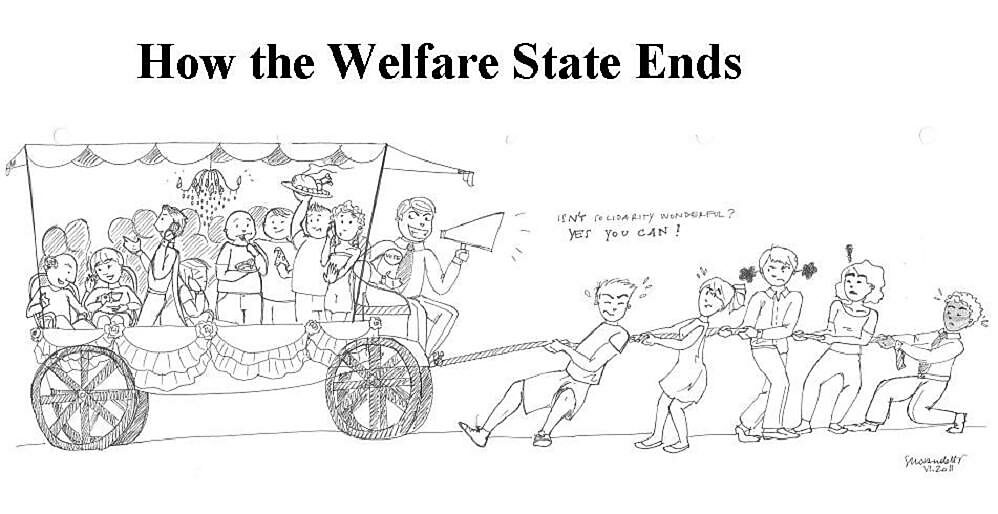
The welfare state starts with small programs targeted at a handful of genuinely needy people. But as politicians figure out the electoral benefits of expanding programs and people figure out that they can let others work on their behalf, the ratio of producers to consumers begins to worsen.
Eventually, even though the questionable beneficiaries should realize that it’s not in their interest to over-burden the people pulling the wagon, the entire system breaks down.
Then things get really interesting. Small nations like Greece can rely on bailouts from bigger countries and the IMF, but sooner or later, as larger nations begin to go bankrupt, that approach won’t be feasible.
I often conclude my speeches by joking with the audience that it’s time to stock up on canned goods and bottled water. Many people, I’m finding, don’t think that line is very funny.
Related Tags
Charles Krauthammer is absolutely right that Republicans must call President Obama’s bluff on the debt-limit vote. I suggested that the House GOP pass $2 trillion in cuts tied to a $2 trillion debt increase, thus handing the matter over to the Senate and the president and refusing to budge.
Krauthammer has the same idea, but with $500 billion in cuts and a $500 billion debt increase. That would certainly be better than Senator McConnell’s chicken-out plan, and it would have the advantage of being so modest in size that I think it would ultimately get large support in the Senate from moderates.
The cuts–small “trims” really–could be taken right from Obama’s own Fiscal Commission report. The table below illustrates how modest and limited are the reforms needed to hit $500 billion in savings over 10 years. Indeed, the data from the commission only covers a nine-year period and includes just some of the proposed entitlement savings.
| Obama Fiscal Commission Entitlement Trims | $Billions |
| Trim Health Care Subsidies | |
| Reduce subsidies for medical education | $60 |
| Expand Medicare cost sharing | $110 |
| Enact tort reform | $17 |
| Reduce Medicaid tax gaming | $44 |
| Reform Tricare | $38 |
| Trim Social Security Growth | |
| Increase benefits by chained CPI | $89 |
| Trim Growth in Other Entitlements | |
| Increase other entitlements by chained CPI | $43 |
| Reform federal retirement benefits | $73 |
| Reduce farm subsidies | $10 |
| Reduce student loan interest subsidies | $43 |
| Total Trims, 2012–2020 | $527 |
It would be blindingly obvious to most voters that Obama would be responsible for a debt default if he couldn’t bring himself to sign such modest cuts that were proposed by his own fiscal commission. Then, when the government runs up against the debt limit again five months from now, the GOP should have another package of cuts ready to be passed. This next time they could perhaps focus on discretionary program terminations, some of which I’ve proposed here.
Related Tags
The United States has been on a decade-long spending binge. Thanks to the profligate policies of both Bush and Obama, the burden of federal spending has climbed to about 25 percent of economic output, up from 18.2 percent of GDP when Bill Clinton left office.
The political class tells us that more government is good for the economy since it an “investment” and/or a “stimulus.”
The academic research, however, tells a different story. Here are some brief excerpts from a recent study by two Swedish economists, including a critically important observation about the impact of bigger government on economic performance.
…most recent studies typically find a negative correlation between total government size and economic growth. …the most convincing studies are those most recently published. …In general, research has come very close to a consensus that in rich countries there is a negative correlation between total government size and growth. It appears fair to say that an increase in total government size of ten percentage points in tax revenue or expenditure as a share of GDP is on average associated with an annual lower growth rate of between one-half and one percentage point.
Let’s focus on the last sentence of the excerpt and contemplate the implications. The research cited above tells us that annual growth is 0.5 percentage point‑1.0 percentage point lower if the burden of government rises by 10 percentage points of GDP. Well, the burden of federal spending has jumped by more than 5 percentage points of GDP during the Bush-Obama years, indicating that annual growth in America is now 0.25 percentage point‑0.5 percentage point lower than it otherwise would be.
Now let’s take the best-case scenario, and assume that annual growth has only dropped by 0.25 percentage points, and consider what that means. It may not sound like much, but even small differences in growth rates become very important over time. For an average household over a 25-year period, the loss of 0.25 percentage points of growth means annual income will rise, but the total increase will be about $5,000 smaller by the 25th year.
The budgetary implications of growth also are rather important. According to the Congressional Budget Office, the economy’s performance has a large impact on tax receipts (more growth means higher incomes and more taxpayers) and a small effect on government spending (more growth means fewer people at the public trough). CBO even publishes a “sensitivity table” with specific estimates (Table B‑1).
If we once again use the best-case scenario and assume the Bush-Obama spending binge has reduced annual growth by only 0.25 percentage points, the CBO numbers show this means more than $750 billion of additional red ink. This is something to keep in mind as the White House argues that job-killing class-warfare tax hikes will somehow improve the budget situation.

Let’s now return to the academic research. The authors included a very helpful table showing the results of recent studies on the relationship between the size of government and economic performance. Click on the image for a full-size look at how the majority of scholarly research this century confirms that big government is bad for prosperity.
For all intents and purposes, all this research shows that developed nations are on the downward-sloping portion of the Rahn Curve. Named after my Cato colleague Richard Rahn and explained in the video below, the Rahn Curve is sort of a spending version of the Laffer Curve. divIt shows that growth is maximized by small governments that focus on core “public goods” like rule of law and protection of property rights. But when governments expand beyond a certain growth-maximizing level (the research says about 20 percent of GDP, by I explain in the video why the right number is probably much smaller), the result is slower growth and less prosperity.
With the exception of high-growth Hong Kong and Singapore, all developed nation have public sectors that consume at least 30 percent of economic output. This means that government spending is undermining prosperity all around the world. And since the burden of government spending is close to 40 percent of GDP in the United States…well, you can fill in the blanks.
Related Tags
There are three reasons why I’m not very hopeful about the outcome of the debt-limit battle.
1. There is no unity in the GOP camp.
Republicans have been all over the map during this fight. Some of them want a balanced budget amendment. Some want a one-for-one deal of $2 trillion of spending cuts in exchange for a $2 trillion increase in the debt limit. Others want some sort of spending cap, akin to Senator Corker’s CAP Act. Some want to mix all these ideas together in a cut-cap-balance package. Others want Obamacare repeal. And the latest proposal is Sen. McConnell’s proposal to let Obama unilaterally raise the debt limit.
These are mostly good ideas, but the failure to coalesce around one proposal – preferably one that is easy to understand – has made the Republican position difficult to define, defend, or advance.
2. The fear of demagoguery is high.
As I explained months ago, Fed Chairman Ben Bernanke and Treasury Secretary Tim Geithner are trying to spook financial markets with hyperbolic warnings about a risk of default. This is blatant dishonesty and demagoguery, but Republicans are nervous that this tactic might be successful if there is a high-stakes showdown as the government’s borrowing authority runs out.
For those with short memories, this is what happened with TARP back in 2008. The initial bailout proposal was rejected, leading to short-run market gyrations, and many Republicans panicked and switched their votes to yes.
3. Republicans don’t control the Senate or the White House.
I’m stating the obvious, of course, but people seem to forget that any debt limit increase will need to get through the Senate and get signed by Obama.
Imagine you are Harry Reid or Barack Obama. Is there any reason why you would acquiesce to Republican demands? Yes, you need to at least pretend to care about big government, wasteful spending, and red ink, but why not hold firm and then strike a deal based on make-believe spending cuts? That’s exactly what happened during the “government-shutdown” debate earlier this year.
This post, incidentally, is not an attack on Republicans. I’m very willing to attack GOPers when they do the wrong thing, but I’m not sure they deserve to get hammered in this case.
Simply stated, I don’t think there’s a winning strategy, so I don’t see any point in going nuclear.
If nothing else, at least Republicans resisted the siren song of tax increases, which is not a trivial achievement since Democrats clearly were hoping to trick GOPers into giving up one of their strongest political positions.
Related Tags
A non-statist would never write something like this:
We had a big surplus. It was time to do something with it. Brad DeLong, a former Clinton administration official and an economist at the University of California at Berkeley, didn’t want to see the surplus spent on tax cuts. He wanted to see it spent on public investments.
To a statist, all resources belong to the state. The government doesn’t tax 40 percent of your earnings; it magnanimously spends the other 60 percent on you. When the government reduces your taxes, it isn’t taking less money from you; it’s spending more of its money on you.
The above quote comes from an article titled, “We Have a Taxing Problem, Not Just a Spending Problem.” But since statists believe that not taxing equals spending, both halves of that title actually mean the same thing: “We Have a Not-Taxing-You-Enough Problem.”