President Trump is tweeting about NASA today. He is worried about “all of the money we are spending” on the agency.
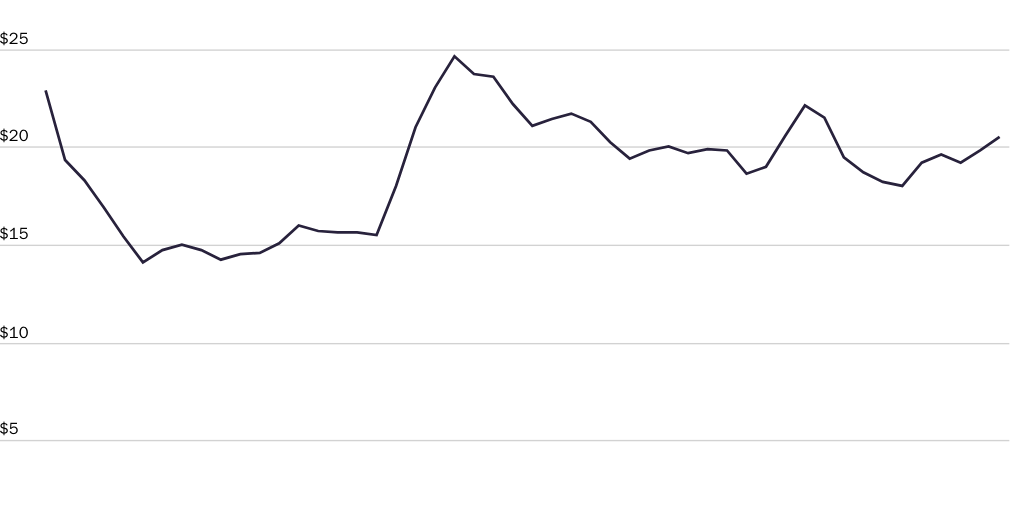
It is $21 billion this year. The chart shows spending on NASA since 1970 in real or inflation-adjusted dollars.
President Trump is tweeting about NASA today. He is worried about “all of the money we are spending” on the agency.
It is $21 billion this year. The chart shows spending on NASA since 1970 in real or inflation-adjusted dollars.
Mail volumes are falling and the U.S. Postal Service is losing billions of dollars a year while accumulating large liabilities.
The USPS has partly offset declining mail revenues with growth in package revenues. But the company’s finances look pretty bleak overall.
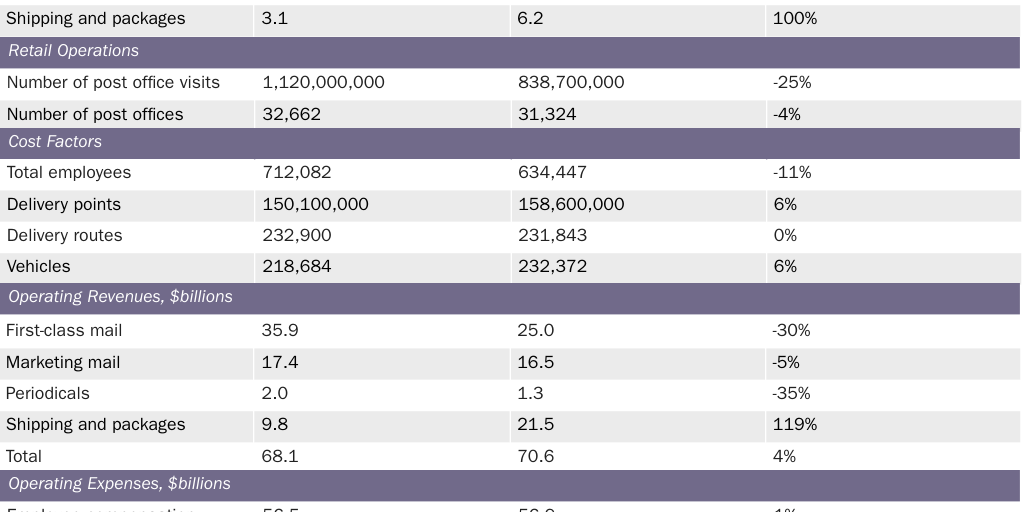
The table below illustrates the USPS’s predicament with data from 2009 and 2018 from here, here, and here.
The data in the table reflects that:
What’s the solution? I testified to Congress that the USPS should be privatized and postal markets opened to competition. Those reforms would give the USPS the flexibility it needs to cut costs, diversify, and innovate, while creating equal tax and regulatory treatment of businesses across postal and package markets.
Federal spending will rise more than 7 percent this year and annual deficits will soon top $1 trillion. The government’s rising debt could generate a major financial and economic crisis. Members of Congress know about these problems and may feel uncomfortable about loading $22 trillion of debt onto young people.
But Congress is not taking any action to address overspending and debt. The Republican president rarely addresses the issue and most congressional Republicans follow his lead. As for Democrats, they seem consumed by their political battles with the president and do not focus on fiscal restraint.
What about the Freedom Caucus? These are 32 House Republicans whose raison d’etre is cutting the government. If anyone in Congress is focused on the deficit problem and pushing spending cuts, it should be these folks.
My intern, David Titus, and I examined the congressional websites of Freedom Caucus members hoping to find discussions about deficits and proposals for cuts. But we found little about those topics on member websites. We looked through the “issues” and “about” parts of member websites and we examined member press releases back to January 2017.
Some Freedom Caucus members are leaders of government restraint in areas such as foreign policy and civil liberties. But on spending cuts, most members have little to say, at least on their official websites.
The table below tallies the number of different programs Freedom Caucus members identify to cut or reform on their websites, and it tallies the number of general statements about the need for spending cuts. We summed these two items for an overall score. We think we counted fairly but don’t claim scientific precision. This is a rough tally.
The federal government runs 2,300 different subsidy or benefit programs. Yet, on average, Freedom Caucus members only mention four that they want to cut or reform. For example, Rep. Morgan Griffith suggests reforms to Medicaid, food stamps, flood insurance, and Obamacare. Some members only identify smaller programs to cut, such as Planned Parenthood.
On average, member websites include just three general statements about overspending. For example, Rep. Justin Amash says he “believes government overspending is one of the biggest threats to our economic health and national security, and he has introduced an innovative balanced budget amendment.” Amash identifies one program to cut, the Export-Import Bank.

Member websites are just one way that members interact with the public. They also talk to reporters, speak at hearings, and use social media. It is also true that the Republican Study Committee has proposed detailed spending reforms here.
However, as Amash says, “overspending is one of the biggest threats.” As such, every concerned member of Congress should be using their websites to inform the public about the threat and proposing detailed and specific solutions.
A Freedom Caucus member might say, “I’d like to cut many specific programs, but since those reforms wouldn’t get through the House or Senate, I won’t stick my neck out.” But that creates a vicious cycle. We won’t get momentum to pass cuts if members don’t propose them and push them. And if members don’t push specific cuts, the media won’t report on them and we won’t move the public discussion forward.
President Trump has proposed substantial cuts in his annual budgets. Those proposals are often discussed in the media for a while before they die. Why do Trump’s proposed cuts die? Because Republicans don’t defend and advance them on Capitol Hill. I noted here, for example, that Trump’s proposed cuts often don’t garner support from GOP members in committee hearings.
Many Freedom Caucus members have good voting records from a small-government perspective. But we also need them—and other members concerned about deficits—to press for specific spending cuts. Members can find cut ideas at Downsizing Government and in the Heritage Foundation’s Blueprint for Balance publication.
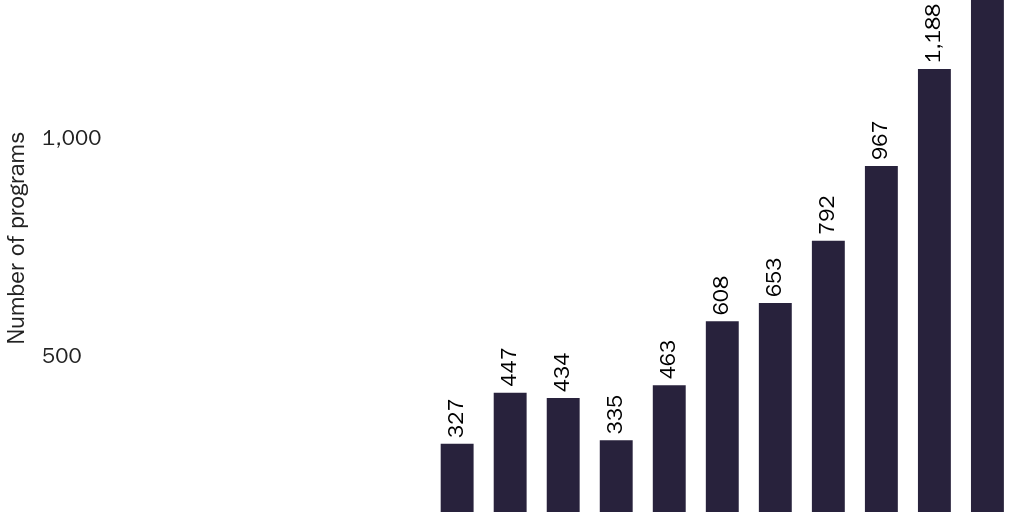
The federal government spends $750 billion a year on 1,386 different subsidy programs for state and local governments. The number of aid programs has tripled since the 1980s as shown in the chart below.
My new Cato study describes 18 harmful effects of the federal aid system. The system undermines responsible and efficient governance. It encourages excessive and misallocated spending. And it reduces accountability for failures while generating costly bureaucracy and regulations.
The federal aid system stifles healthy policy diversity and undermines democratic control. And by imposing one-size-fits-all policies when there is no national consensus, the aid system divides society and increases political conflict.
Read the full study here.
Despite rising federal deficits, Congress is set to pass another budget-busting spending bill. This time it is a $19 billion package of disaster-related subsidies.
The Washington Post reports “taxpayer spending on U.S. disaster fund explodes.” It documents increases in disaster spending by the Federal Emergency Management Agency (FEMA). In a typical recent year, “spending on the federal disaster relief fund is almost 10 times higher than it was three decades ago, even after adjusting for inflation.”
The story identifies two causes of the spending increases: climate change and population growth in disaster-prone areas. But it ignored perhaps the most important cause: increased federal intervention in the sorts of emergencies that used to be handled by the states, as I discuss here.
The Post is correct that more Americans are moving into disaster-prone areas:
Many more Americans have moved into harm’s way, with growth exploding in the Gulf Coast region and along the Continental Divide, where tornadoes frequently occur, according to a study on the “expanding bull’s eye effect” by Stephen M. Strader of Villanova University and Walker S. Ashley of Northern Illinois University.
Since 1970, 35 million more people and their homes have moved to coastal shoreline “in the direct path of potentially devastating storm surges,” the researchers found, a 40 percent increase.
“We’ve put more stuff in the wrong place the wrong way,” said W. Craig Fugate, a former FEMA administrator under President Barack Obama. “We’ve got a lot more stuff — bigger houses, multiple cars, more people — in high-hazard areas.”
More people are also living in fire-prone areas of California.
The Post does not explore an important reason why Americans are moving into these areas: government subsidies. Federal subsidies for flood insurance, flood control structures, beach replenishment, and disaster rebuilding have encouraged development in coastal areas, as I discuss here. Meanwhile, state policies have contributed to building in California’s fire-prone areas.
American governments are not alone in pursuing policies that increase disaster hazards. A World Bank / United Nations study identified such policies in numerous countries and discussed market-based reforms to mitigate risks.
In the United States, federalism is supposed to undergird our system of handling disasters, particularly natural disasters. Under the 1988 Stafford Act, the federal government is supposed to get involved in disasters only if they are of “such severity and magnitude that effective response is beyond the capabilities of the state and the affected local governments.”
However, presidents and congresses have increasingly ignored this limit. The number of presidential disaster declarations has soared and the costs of disaster bills have increased as politicians shoe-horn subsidies unrelated to immediate emergency response into bills.
Growing federal intervention is undermining the role of the states and private institutions in handling disasters. This intervention stems from politics not practical benefits. State and local governments and the private sector are better positioned to handle most disaster response. Also, states, cities, and private utilities aid each other during disasters.
Rising FEMA spending is not a good metric for measuring the severity of natural disasters striking the United States. Rather, it reflects growing populations living in risky areas and growing disregard for federalism in disaster-related response and rebuilding.

Montana Governor Steve Bullock is entering the Democratic race for the White House.
NPR reports that “Bullock’s more moderate positions could be problematic in a party that’s been moving more toward the left.” But Bullock’s frequent pushing for tax hikes since he entered office in 2013 puts him squarely in the Democratic fold.
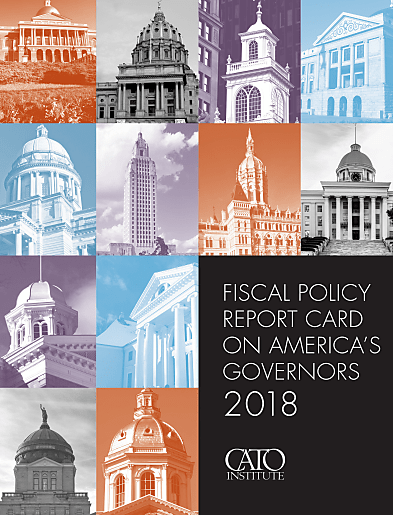
Cato scores the tax and spending policies of the nation’s governors in its biennial fiscal report cards. We assign letter grades from A to F.
Bullock received a C in 2018, a C in 2016, and a D in 2014. The governor’s grades were pulled down by his support for tax increases. He advocated tax increases on individual income, gasoline, cigarettes, beer, wine, and other items. Bullock also vetoed tax reforms passed by the state legislature.
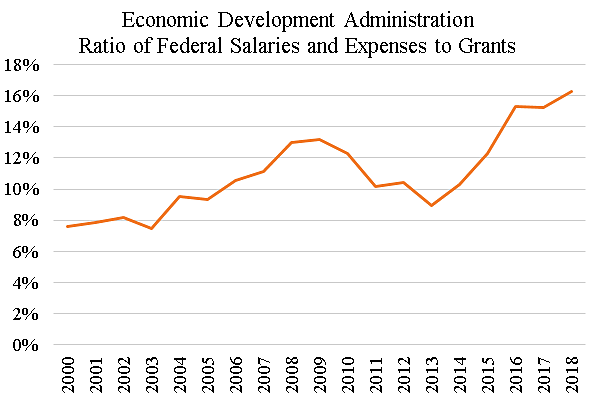
The Economic Development Administration (EDA) is a small agency within the Department of Commerce. Its purpose is to give money to governments and businesses to fund local activities, such as $2 million to “repurpose the West Frankfort Mall” in Illinois and $150,000 for the Brick River Cider company in St. Louis to make “authentic hard cider.”
The EDA has never made sense, as Tad DeHaven and I discuss here, and the Trump administration is right to propose eliminating it.
Funding local activities from the federal level creates unneeded bureaucratic costs, which are a loss to the overall economy. According to the federal budget, the EDA handed out $240 million in grants in 2018 for various local and business activities.
The agency’s expenses for salaries, benefits, and other office costs were $39 million. That spending did not go to “economic development,” but rather to support the comfy lifestyle of inside-the-Beltway bureaucrats. Thus, the federal “overhead” costs of the $240 million were 16 percent. The chart shows the overhead cost ratio in recent years.
In an upcoming Cato study, I discuss 18 reasons why federal aid for state and local activities should be cut. One of the reasons is the bureaucratic costs. In 2018, taxpayers living across the nation sent $279 million to D.C. to fund the EDA, of which $39 million stayed in D.C. and only $240 million was distributed back across the nation. Why don’t communities just keep their own money and spend the whole amount?
By the way, if billionaire Wilbur Ross wants to invest in malls and cider companies, he can afford to do so with his own money.