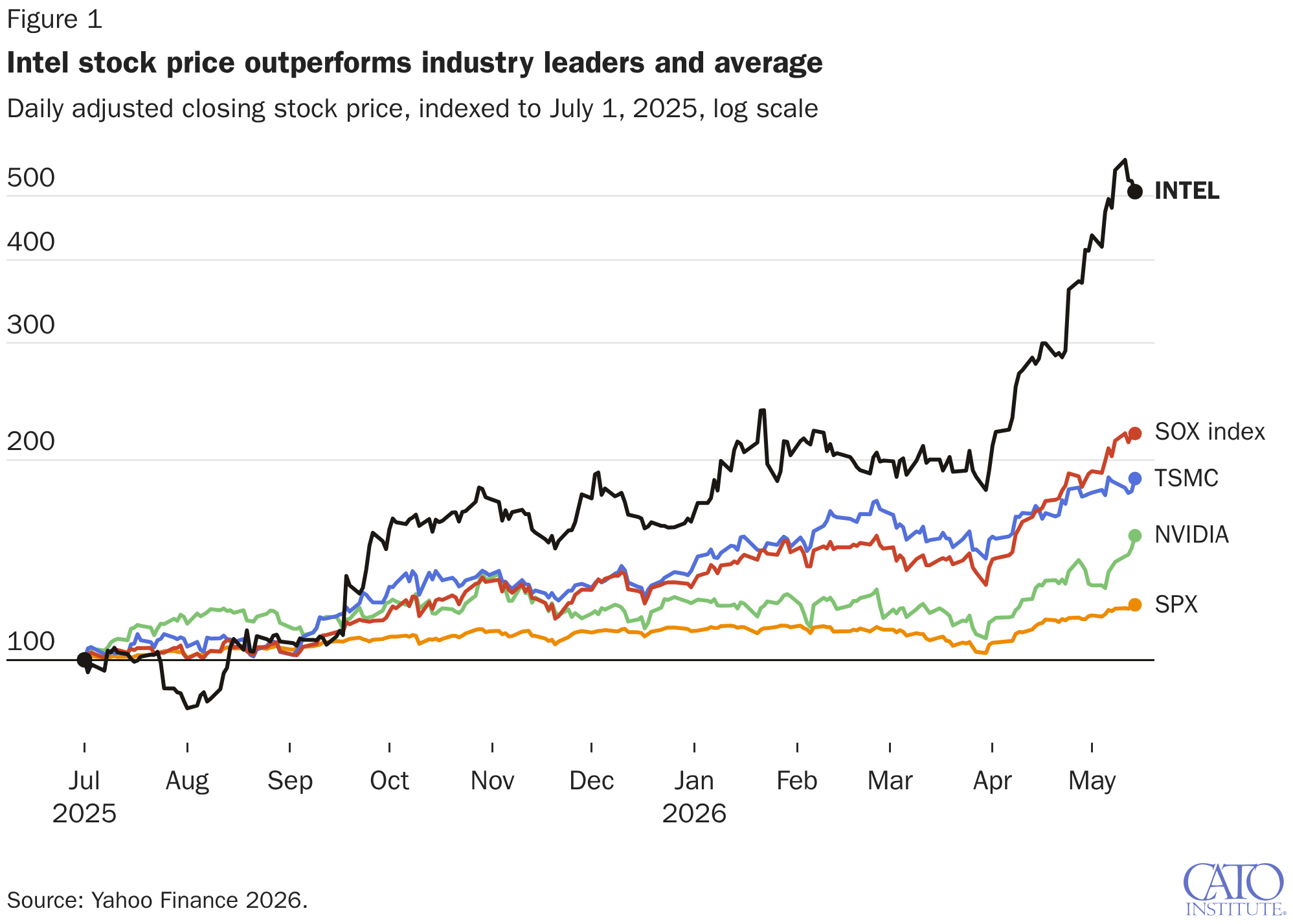
This is textbook capital misallocation, and it goes beyond Intel. The share prices of the private US firms in which the government has invested have zoomed higher than broader indices after the deals were announced. In each case, the targeted companies will suck up scarce resources for months or years—resources that could have gone to other, more productive alternatives. Unrelated investments become distorted too. Bloomberg News reported in November 2025, for example, that speculators have started “trying to think like Trump to find the next targets of the US government’s ownership stakes in public companies, which tend to see massive gains following the investment.” Some institutional investors now evaluate companies based in part on their “political relationship with the state.” Another investment group has already filed paperwork with the Securities and Exchange Commission to create an exchange-traded fund that mirrors the government’s balance sheet.
Companies receiving these private investment dollars will likely enjoy higher share prices and more capital, at least in the short and medium run. But they’ll do so by taking finite funds away from productive, well-performing alternatives, including in the very same industries. In the end, research shows that this kind of capital misallocation inevitably means lower productivity, weaker growth, and a smaller, less vibrant economy even if state-backed champions don’t fail—something the government might not let happen.
The second problem is that the government will dictate the routine business decisions of the firms it owns—as we’ve already seen with U.S. Steel. The Defense Production Act of 1950 and subsequent amendments authorize the president to suspend or prohibit security-related foreign investments via the interagency Committee on Foreign Investment in the United States (CFIUS). When CFIUS refused to approve Japanese steelmaker Nippon Steel’s purchase of U.S. Steel, a long-struggling firm in what is arguably the United States’ most coddled industry, it kicked the final decision to Trump, who promptly used that leverage to acquire a “golden share” in the firm in exchange for approving the deal. While the US government has no formal voting rights in U.S. Steel, the golden share gives any US president complete veto power over countless day-to-day business decisions, including relocation of the company’s headquarters, closing or idling plants, shifts in near-term investments, and even pricing strategies.
The Trump administration has already exerted its new control over the company. When U.S. Steel announced in September 2025 that it would halt operations at its decaying plant in Granite City, Illinois, which Trump visited and claimed credit for revitalizing with tariffs during his first term, Commerce Secretary Howard Lutnick called U.S. Steel’s chief executive to say that the president wouldn’t allow the plant to stop rolling steel slabs. Now, the site’s century-old, coal-fired blast furnaces—so dirty and inefficient that they were slated for demolition mere months ago—are back up and running. Similar concerns arise from U.S. Steel’s vague and suspicious promise to restart uneconomical tin mill facilities in the face of high canned goods prices, which have surged because of tariffs and the Iran war.
Third, there’s the clear threat that state corporatism will cause entrepreneurial dynamism to be slowly replaced by government favoritism and rent-seeking, from both a target firm and those seeking to curry favor with its government owner. Just recently, for example, a former Department of Energy official who reviewed potential targets in the rare-earth minerals space divulged that “the companies proactively offering up equity stakes were the least viable and most eager to secure a government financing package.” Dying Spirit Airlines, meanwhile, first approached the Trump administration about an equity-based bailout, only to see the deal collapse after a group of its bondholders balked at the administration’s demand that it give the state 90 percent of the company. On the flip side, we’ve learned that Intel’s much-ballyhooed deals with Nvidia, Elon Musk, and Apple—deals that sent its share price even higher—were driven at least in part by pressure from Secretary Lutnick and a direct request from President Trump.
Problems are also sure to arise after government investments have been made. State-backed champions might ask their government partner to tilt the subsidy or regulatory playing field in their favor (or against their competitors). Politicians might do so without such a request, as companies’ share prices become public scoreboards for measuring the efficacy of their economic policies.
Fourth, state corporatism risks breeding even more cronyism and corruption in Washington, or at least the public perception thereof. Last year, for example, the government invested $150 million of CHIPS and Science Act funds in semiconductor start-up xLight, whose executive chairman, Pat Gelsinger, is the former Intel CEO and chief lobbyist for the very same CHIPS Act. The Pentagon’s push to acquire equity stakes in private companies is led by former executives of Capital Cerebrus Management, which invests in many of the same industries the Pentagon is targeting. New state investment in Vulcan Elements has connections to President Trump’s son, and White House Deputy Chief of Staff Stephen Miller made a mint after unloading his shares of MP Materials, which had spiked following the firm’s government tie-up. Required disclosures additionally show that, in the first quarter of 2026, President Trump made thousands of peculiar stock trades involving Intel, Nvidia, and several other “major companies that have dealings with his administration.” The odds are strong that more of these suspicious activities have occurred out of sight.
State corporatism is also accelerating Washington’s revolving door. Intel, for example, named former Trump administration official Robin Colwell as its new senior vice president of government affairs in December 2025. She’ll stay in Washington but leave her previous role as a deputy assistant to the president. So much for draining the swamp.
Finally, there is the open question of whether the federal government will extract itself from the state corporatism it has birthed. Equity stakes raise a catch-22 for the government: Realizing gains from state investments requires Washington to sell its shares, but such divestment might collapse the share prices and finances of the firms at issue—and thus undermine the original stated goal of government support. Politics also might prevent the government from admitting failure and cutting bait when target firms fail to meet the economic or geopolitical objectives the government has promised, a longstanding problem with US industrial policy generally. And, of course, the Trump administration’s actions lay the groundwork for the next US president—Republican or Democrat—to go even further, investing even more taxpayer dollars and otherwise tilting the playing field in favor of the companies and industries that he or she personally prefers. The urge might prove irresistible; thus far, the law offers no clear answers as to when or how the state will cease being so intertwined with favored firms.
The dangers of the new government shadow conglomerate that the Trump administration has created are not just rampant market distortions, lower productivity, reduced growth, and abundant cronyism. They also include the risk that the government’s balance sheet will expand under its own weight, locking the US into a top-heavy, politicized economic model that is antithetical to economic freedom and the American tradition—and more fitting to openly corrupt states in the developing world.
State corporatism is thus a serious new policy problem. It also, unfortunately, isn’t unexpected.