


-
As people become richer, they want more sports, and entrepreneurs in countries around the world have consistently delivered them.
-
Concepts such as zero-sum trade or degrowth seem absurd when applied to sports.
-
Rich athletes and big corporations make sports worth watching, contrary to the villainization of wealth in other industries.
In the world of sports, globalization goes in only one direction: forward. Counterexamples such as the rare Olympic boycott are noteworthy because they are the exception to the rule. Sports leagues often begin in one country with players from only that country; the really successful leagues expand with international talent and exposure. Just about everyone involved gets richer, and fans get to see the world’s greatest athletes compete. Interestingly, there’s something about sports that makes the shortcomings of many populist economic tropes immediately apparent.
People enjoy competition and excellence, contrary to the populist desire for stability and mediocrity. Sports are a constant in human history, going back at least to ancient Greece. Humans seem to naturally invent games in which they compete with one another for recreation and entertainment. They don’t do the same for bureaucracies or labor unions. As people become wealthier, the games they invent become more complicated and organized.
Sports also includes an emphasis on fair play, or as F. A. Hayek might put it, the rule of law, not of men. Fans and players are outraged when the rules are unevenly enforced and flatly reject attempts to favor some teams over others. That’s true even if a case could be made that one team was deserving of favoritism. Fans want the rules to be consistently enforced by neutral officials. In fact, one of the top criticisms of an official is that he’s “making the game about himself.” If only more people had a similar attitude toward the government in everyday life.
Most of the issues sports fans get upset about—corruption in sporting organizations, imbalance between teams, and losing good players to other teams, to name just a few examples—come from a lack of competition and capital, not an excess of it. Despite many of them being multimillionaires, athletes don’t usually make politicians’ lists of evil rich people who need to be taxed more. Most fans somehow understand that the best athletes are paid a lot for a reason, and some fans even celebrate huge contracts for their favorite players.
Two aspects of the sports world illustrate the benefits of globalization particularly well: foreign-born athletes in American sports leagues, and the growth of the sports industry alongside the worldwide reduction in extreme poverty. Sports fans aren’t protectionists—or if they are, they don’t stay that way for long. And good luck finding any sports fans calling for degrowth.
Sports Fans Love “Imported” Athletes
The US has a massive trade deficit in current Major League Baseball (MLB) players. It exports only a handful of players abroad (the number of Americans who happen to be on the Toronto Blue Jays) but imported 28 percent of MLB players in 2024. In fact, the percentage of MLB players from foreign countries has been in the high 20s for most of this century.
The Dominican Republic supplies the highest number, 108 of the 264 foreign-born MLB players in 2024. Second and third are Venezuela and Cuba, with 58 and 18 players, respectively. Both are communist countries and enemies of the United States. To the extent that anyone views this as a national security problem, it’s the Venezuelan and Cuban governments, who are afraid of players defecting.
Contrary to arguments for fair trade, MLB teams have worked quite intentionally to make player development in the Dominican Republic unfair to other countries. All 30 MLB teams have established academies in that country where boys train and are paid at much higher rates than ordinary workers to become professional baseball players. These aspiring pros are low paid by American standards, but few Americans complain or brand the academies “sweatshops.”
One might object that of course Americans are happy to accept MLB players from abroad because a supermajority of players are born in the US. The economy at large has been “hollowed out” by international trade, the story goes. But the proportion of MLB players from other countries, 28 percent, is double the proportion of the US economy that comes from imports, which is 14 percent. Has MLB been hollowed out by Shohei Ohtani, Ronald Acuña Jr., and all the other foreign players? Has it been hollowed out twice as badly as the US economy overall? Or are fans simply grateful to watch these gifted athletes play?
There’s another aspect of popular acceptance of foreign-born athletes that goes against populist economics. Populists often appeal to what economists call the lump of labor fallacy, which holds that the labor market is zero-sum. That means one person’s getting a job denies a job to someone else because there is a fixed amount of labor to do. When someone talks about immigrants “taking our jobs,” they are appealing to the lump of labor fallacy.
It’s a fallacy because it’s based on a false premise. In a real economy, the amount of labor is never fixed, and it expands to satisfy consumers’ desires. Employment is not zero-sum.
You’d be hard-pressed to find a fan who argues that foreign-born MLB players should be curtailed because they take jobs from American players. People who do, such as Phyllis Schlafly in 2016, are generally seen as cranks. Some people might argue against their favorite team signing a foreign player. They might say the team is overpaying, or that there is some other player they want the team to sign instead. But they’ll basically never object to a player’s signing based solely on his nationality. In fact, if someone did raise such an objection, they’d probably get made fun of by other fans.
This is all the more remarkable because the lump of labor fallacy isn’t a fallacy in pro sports. Unlike in the real economy, it’s actually true that in Major League Baseball, the amount of labor is fixed. There are only 30 teams in the league, and each of them plays only 162 games per baseball season. Every player on a team’s 40-man roster is actually denying a spot to another player. But fans understand that competition and quality are more important than country of origin. They understand that if signing a foreign player helps the team win and is financially sensible, it’s a good idea.
MLB’s openness to foreign players has not reduced American baseball talent or made MLB reliant on foreign countries for players. Foreign player signings don’t always work out, just as domestic player signings don’t always work out. Fans understand this has nothing to do with country of origin. Nobody wants to ban players from Japan because Kosuke Fukudome didn’t become the superstar the Chicago Cubs hoped he would when they gave him a big contract in 2007, for example.
MLB is not the only major sports league with many foreign-born players (Figure 1). Seventy percent of National Hockey League (NHL) players are foreign born, and about 30 percent are from outside North America. They don’t “look like America” at all, with Russians, Swedes, and Finns significantly overrepresented and Mexicans, Indians, and Chinese significantly underrepresented. Yet rather than treating these athletes as a threat to the American way of life, hockey fans seem happy to cheer for them.
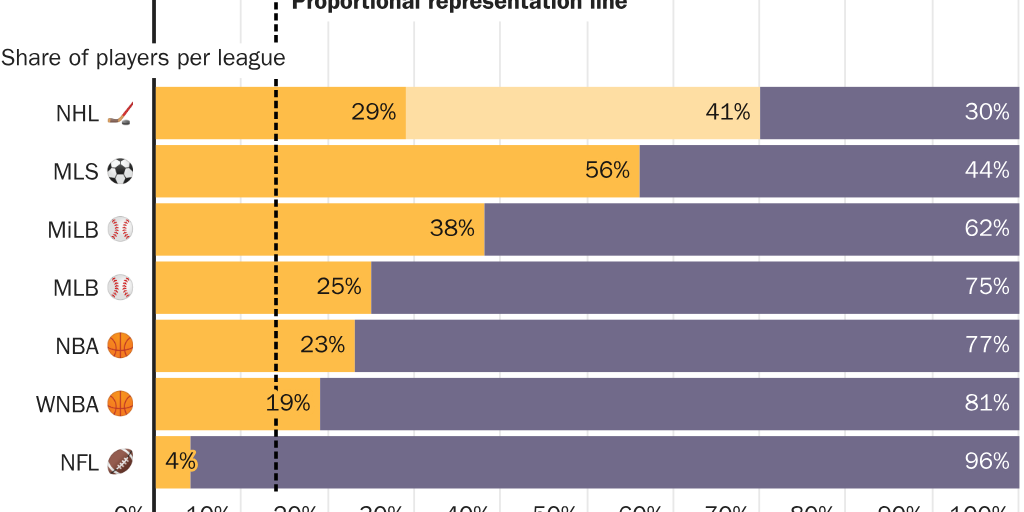
There was a huge influx of foreign-born NHL players all at once after the fall of the Soviet Union: Call it the Russia Shock. The Detroit Red Wings signed five former Soviet players (Viacheslav Fetisov, Sergei Fedorov, Vladimir Konstantinov, Slava Kozlov, and Igor Larionov) on their way to dominating the NHL in the 1990s, winning the Stanley Cup in 1997 and 1998. Teams realized they were leaving wins on the ice by not signing Russian players, and today it’s simply a matter of course that Alexander Ovechkin is one of the best scorers in the league.
Some NHL fans and players were Russophobic at the time of the influx. The New York Times quoted Alan Eagleson, then head of the NHL Players Association, in 1989: “There are plenty of folks in North America who still have the feeling that these are the bad guys, and that they’re going to come over here, take away jobs, and then take their money back home and build atom bombs to kill us.”
Thankfully the NHL didn’t listen to those people. It didn’t ban Russian players or put tariffs on teams that signed them. It essentially told fans they’d get used to it and would come to appreciate the gains from accepting Russian players.
Nowadays most fans would be perfectly fine with signing a talented Russian player if it helped their team win. That’s true despite Russia’s continued adversarial relationship with the US and awful wars in Georgia and Ukraine. Though the entry of Russian players into the NHL was destabilizing when it first happened, good luck finding fans who wish it hadn’t happened at all.
Did North American hockey become more Russian, or did the Russian players become more North American? Change went in both directions. The Soviet style of hockey was different from the North American style, and players had to adjust. This was no doubt challenging for some of them, but hockey made it through.
The National Basketball Association (NBA) has also experienced an influx of foreign talent in the past few decades that has included different ways of playing the game. As with the NHL, it has been an adjustment, but one worth making, most fans would conclude. Players such as Manu Ginóbili (Argentina), Yao Ming (China), and Giannis Antetokounmpo (Greece) are among fans’ most beloved players in recent league history.
There are examples of athlete protectionism in other countries. The Japanese and Korean professional baseball leagues have a “posting system” akin to export controls on players who wish to join MLB. The Canadian Football League (CFL) has parallel awards for Canadian players, since Americans usually win the league-wide awards (e.g., there’s a Most Outstanding Player award and a Most Outstanding Canadian award). The CFL also classifies players as either National (Canadian), American, or Global (not Canadian or American) and has a roster quota system. At least 21 players per team must be National, and at least 1 player per team must be Global. (The CFL consists of nine teams.) The Russia-based Kontinental Hockey League (KHL), generally recognized as the best hockey league outside North America, also has a roster quota system limiting the number of foreign players. In these cases, the protectionism is an admission of inferiority on the part of the leagues.
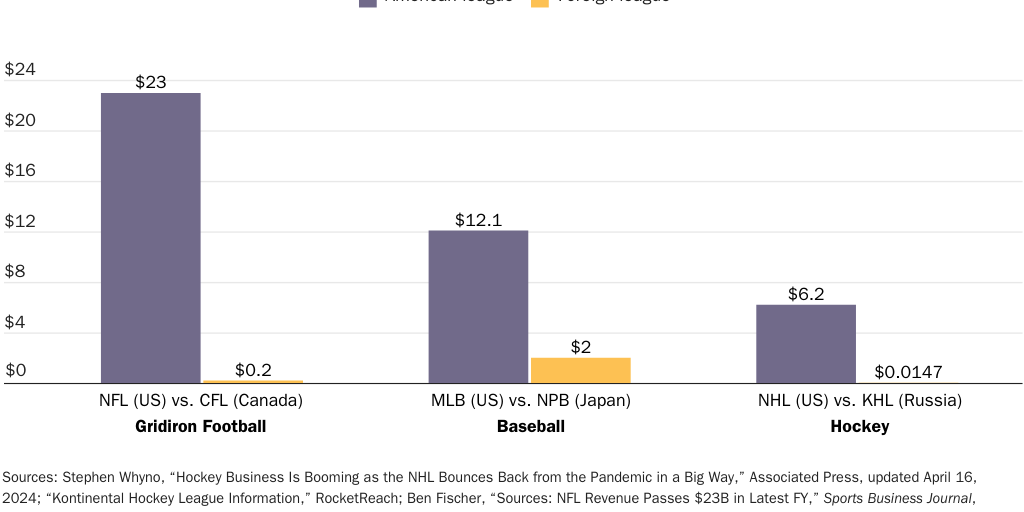
US professional sports leagues attract so many foreign players because the US has a ton of sports fans who are willing to spend a ton of money on sports (Figure 2). In the same way, the US attracts so many foreign goods because the US has a ton of consumers who are willing to spend a ton of money on foreign goods. The trade deficit and the player deficit arise from the same basic concept: The US is the richest country on earth and the best place in the world to do business.
Sports Fans Don’t Want Degrowth
There’s a concentrated effort, especially in Europe, to convince people that less is more and that the future of economics is to constrain rather than expand economic growth. This is often done in the name of environmentalism or reducing the ills of consumerism. The degrowth movement is supposed to be the future.
The sports world has apparently not heard of degrowth, or has rejected it soundly if it has. That’s not to say there have never been skeptics of sports expansion. Conn Smythe, the longtime owner of the Toronto Maple Leafs, objected to the league’s expansion from 6 to 12 teams in 1967, saying it would dilute the quality of hockey. Now there are 32 teams, and the NHL continues to be the best hockey league in the world.
According to the Global Institute of Sport, the sports industry is the ninth-largest industry in the world, with revenue of $2.65 trillion in 2023. And it is growing rapidly, adding over $300 billion in revenue between 2019 and 2023. This growth is linked with globalization’s near eradication of the most extreme forms of poverty. As people become wealthier, they have more free time to spend on being sports fans.
The Indian Premier League (IPL) is one of the greatest recent examples of how professional sports leagues can grow. Founded in 2008, the IPL is India’s franchise Twenty20 (T20) cricket league. As I wrote in a 2023 piece for National Review, the growth of the IPL has been explosive:
Forbes estimated that the average valuation of an IPL franchise went from $67 million in 2009 to $1.04 billion in 2022, growing on average by 24 percent each year. The most valuable franchise, the Mumbai Indians, is worth $1.3 billion, more than several MLB teams and almost every NHL team. Five years of IPL media rights sold for $6 billion in 2022, double what the previous five-year deal had been. The championship match is played in Narendra Modi Stadium—the world’s largest stadium, with a seating capacity of around 130,000—in Ahmedabad. Between TV and streaming, around 600 million people watch the IPL in a given season.
What makes these numbers even more impressive is that the IPL season is only about two months long, consisting of only 74 matches in 2023. Only the [National Football League] and the English Premier League make more revenue per contest than the IPL does.
This growth has been concomitant with the emergence of the Indian middle class, a few hundred million people who have disposable income for the first time. They want more cricket, not less.
The IPL has succeeded because Indians imported the North American franchise sports model. Before the IPL, cricket occurred mostly on two planes: international matches between national teams, and domestic matches between national subdivisions (counties in England, states in India, etc.). The IPL became the first major successful league based on the US franchise model, and it has been copied in Pakistan, Sri Lanka, Australia, England, and other cricket-playing countries.
Investors have now re-exported the franchise sports model back to the US with an American franchise cricket league, Major League Cricket (MLC). The six teams are based in Dallas, Los Angeles, New York, San Francisco, Seattle, and Washington, DC, all cities with sizeable populations of South Asian descent. Three of the teams share names with IPL teams. The league’s investors are mostly tech entrepreneurs of Indian descent, including Satya Nadella (Microsoft), Aditya Agarwal (Facebook and Dropbox), Shantanu Narayen (Adobe), and Subrah Iyar (Webex).
MLC played its first season in 2023. It has attracted some of the world’s best players, happy to play for an American audience even if the vast majority of Americans don’t know anything about cricket. Indian Americans do, there are about five million of them, and they have some of the highest median incomes of any ethnic group in the US. They have money to spend on cricket, and there’s more than enough room for them at the bountiful table of American sports.
Major League Soccer (MLS) pursued a similar growth strategy earlier this century, originally building a fan base among Hispanic immigrants in the US. There are many more Hispanic Americans than Indian Americans, of course, and MLS has also had more time to develop. It’s now pretty well established as the US’s fifth major sports league.
An interesting thing to note is how the relative positions of the major sports leagues have changed over time. The National Football League (NFL) is the top dog now; MLB used to be. The NBA is growing, especially internationally. The NHL probably used to rank ahead of the NBA and no longer does. But all four have roughly the same level of attendance today as they did 20 years ago, much higher attendance than 50 years ago, and far, far bigger valuations.
Buying a major American sports franchise is basically a guaranteed way to make a lot of money, even for relatively small-market teams. Herb Kohl bought the NBA’s Milwaukee Bucks in 1985 for $18 million; he sold the team in 2014 for $550 million. After winning the NBA Finals in 2021 and riding the overall wave of NBA valuation increases, the team is now worth $3.5 billion. Owners don’t even have to be particularly effective to make money: Daniel Snyder of Washington, DC’s NFL franchise, widely regarded as one of the worst owners in professional sports, rode the team’s valuation from $800 million when he bought it in 1999 to $6.05 billion when he sold it in 2023 under a cloud of lawsuits and losing seasons. Growth, growth, always growth.
Advertising is everywhere in sports. This is most apparent in auto racing, probably the most expensive sport, where cars and racetracks are coated in company logos. The corporate sponsor can become so associated with a driver that it becomes a primary identifier alongside the car number. In NASCAR, Jimmie Johnson’s Lowe’s no. 48 or Jeff Gordon’s DuPont no. 24 were immediately recognizable to fans in large part because of those brands. Aren’t those big greedy corporations? Maybe, but the famously loyal racing fans don’t mind. The protectionist impulse also seems to go away: German automaker Mercedes-Benz owns the naming rights to the Atlanta Falcons’ home stadium with hardly a peep of discontent among fans.
Those fans know that corporate support drives growth. When a race car driver gets a big-name sponsor or a basketball player gets a shoe deal, that means they are succeeding. Nascent sports leagues strive for big-name sponsors and investors. Rather than running from big business, the leagues want to make sure you know billion-dollar corporations support them.
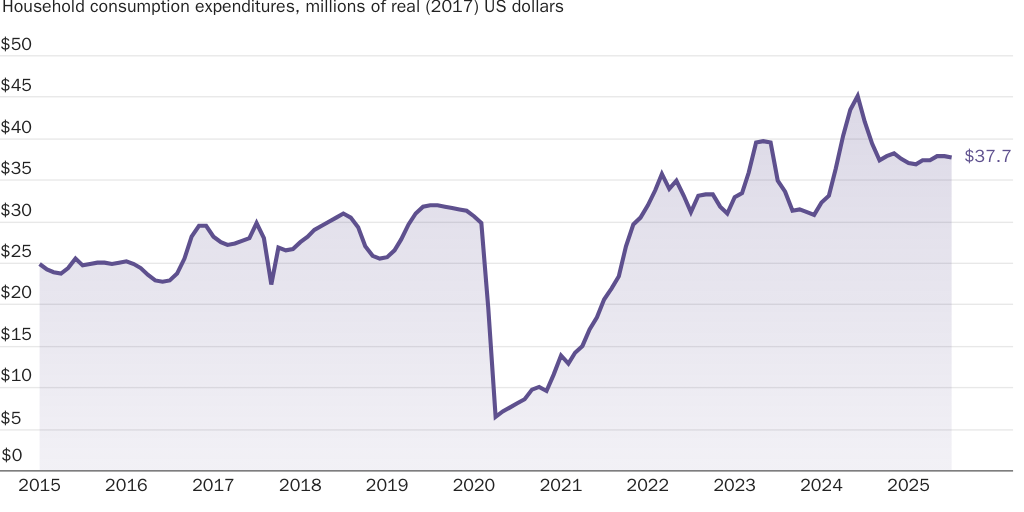
It makes perfect sense that many corporations want to be associated with sports. The average American household spent $1,122 on sports in 2024, according to Bank of America. Indeed, spectator sports account for about one-third of total revenue for the US entertainment industry. The steep drop shown in Figure 3 for 2020 is one measurement of how COVID-19 restrictions made Americans’ lives worse by canceling sporting events, and the subsequent increase pretty well tracks the reopening of the economy and return to normal life for many.
Conclusion
Of course, there are problems in sports, as there are in any human endeavor. Big-time athletes can let fame go to their heads and behave poorly. Among fans, sports can enable vices such as gambling and drinking. These are not minor concerns and can cause real harm.
But it’s hard to say it’s a coincidence that sports fandom grows as countries become wealthier, and the wealthiest country in the world is the most sports-obsessed. It’s a luxury that people want to have, and entrepreneurs in any developing country find ways to get it to them. And there are plenty of other positive effects that accompany this growth.
The sports industry interacts with other industries already covered in Cato’s Defending Globalization series, such as video games, fashion, and television, to create even more growth. Watching a regular-season game out-of-market used to be a nearly insurmountable challenge, but now it’s as easy as downloading an app and paying a subscription fee. Kids love wearing their favorite players’ jerseys, and parents and grandparents love giving them as gifts.
Sports create bonds between people that wouldn’t otherwise exist. Team loyalty is one of the most powerful intergenerational bonds, as it is often passed down within families. Perhaps even more powerfully, strangers can see a team’s logo on a hat or shirt and instantly connect with one another, regardless of skin color or age or other differences.
As sports globalization continues, expect more changes. As India marches toward becoming the world’s third-largest economy, expect cricket to rise in prominence. Expect more countries to begin supplying players to US leagues. Expect different ways to watch games as people shift away from traditional television. The world of sports is always innovating, always changing, always global—and people love it.
About the Author


This work is licensed under a Creative Commons Attribution-NonCommercial-ShareAlike 4.0 International License.