
As the Trump administration imposes a barrage of illegal and unprecedented tariffs on an ever-increasing number of imported products, the rest of the world is showing that it can continue trading despite these tariffs and without the United States. Other countries are lowering trade barriers with each other by concluding new bilateral and plurilateral trade agreements, and exporters are reconfiguring supply chains to route around American protectionism. Regardless of whether the United States remains indispensable to the global economy, international trade is still happening—and it is happening increasingly without the United States.
At the same time, these countries should not be doing what they have mostly been doing: forging new trading arrangements outside the World Trade Organization (WTO). Although the temptation to go outside the WTO legal framework is understandable, the better course of action would be for the other 165 WTO members to redouble their efforts toward trade liberalization within the institution while taking a different approach. That approach should be WTO-based plurilateralism that can build up to multilateralism, which is precisely how, over decades, the original General Agreement on Tariffs and Trade (GATT) evolved into the WTO.
For this approach to succeed, WTO members must move on from their continued insistence on decisionmaking by consensus, without waiting any longer for the United States. Consensus and American engagement at the WTO is ideal, but plurilateral agreements represent an opportunity to address unfinished business and negotiate rules that meet the demands of the 21st-century economy, while also leaving the door open for other countries to join any agreements if they are willing to be bound by them.
The 165 other WTO members must also stand together to defend their rights under the WTO treaty. Although the singular actions of the United States have, at least for now, reduced the Appellate Body to a paper tribunal, that does not have to mean other WTO members have no recourse for standing up to the Trump administration’s bullying and for holding the US accountable under WTO dispute settlement.
Introduction
Every now and then, those of us who are fortunate enough to be Americans benefit from being reminded that we are not the only people in the world. Five percent of the world’s people are Americans. This means that 95 percent are not. Though the people who comprise the vast majority of the human population may well be affected by what we Americans do or do not do in our country, they are not citizens of the United States of America.
What is true of the world population is also true of the world economy, including world trade. The United States is a huge trading country, without doubt a major factor in world trade. But ours is by no means the only country engaged in it. The United States accounts for 15 percent of world trade. Although the remaining 85 percent of world trade is certainly influenced by what the US chooses to do relating to its 15 percent, the rest of the world’s countries can continue to trade with each other irrespective of US actions.
This is worth keeping in mind at a time when the United States seems determined to undermine much of its own international trade because of its leaders’ professed dissatisfaction with how they believe US trade has been treated by America’s trading partners, allies, and competitors alike. President Trump’s illegal and unprecedented barrage of tariffs on US imports is the wrong answer to the right question, which is how to create a much deeper and more broad-based prosperity for the American people. The US government’s embrace of this wrong answer, however, is not a reason for it to be embraced by others. The rest of the world can go on trading without raising tariffs and without the United States playing a major role. In such a scenario, the US will continue to play a role, albeit a much reduced one.
What is more, they can do so without abandoning the rule-based global trading system overseen by the World Trade Organization. President Trump and his trade-wary team have tossed aside WTO rules against trade discrimination, WTO commitments not to raise tariffs, and the WTO system for resolving international trade disputes. For the most part, the Trump administration is generally ignoring the WTO and other US trade treaties and obligations. Yet this is no reason the 165 other member countries of the WTO should follow suit. The rest of the WTO membership can carry on increasing the flow of trade both within the WTO and through other international trade arrangements. They can free up more trade by going around the chaotic commercial recalcitrance of the United States.
Not only can they do so, they must. At least for now, and likely for the foreseeable future, the United States has abandoned its bipartisan commitment of nearly a century to lowering barriers to trade (begun by Franklin Roosevelt and Cordell Hull during the New Deal). In so doing, the US has also abandoned its longstanding position of leadership in the rule-based world trading system—a system Americans played a leading role in creating and, for decades, in strengthening and sustaining. (Again, on a bipartisan basis.) Now, in the absence of the United States, it falls to other countries to come together to lead the system, maintain it, and modernize it to meet the unfolding new challenges of the 21st century.
Since the demise of the Doha Development Round in 2015, the rest of the members of the WTO have been waiting for the US to lead the way toward further global trade liberalization within the WTO. This has proven to be a lot like the experience of the characters in Samuel Beckett’s famous play who are waiting for Godot, who never appears. It is past time for the WTO members to stop waiting for the United States to return to its previous role in multilateral trade leadership. For the foreseeable future, at least, Godot is not coming.
Those who are currently entrusted with leadership of the United States remain unwilling to take the domestic political actions that should have been taken during the past few decades to help Americans adjust to globalization (and other beneficial but disruptive forces) and thrive—while also maintaining the American commitment to opening markets to more trade in the US and worldwide. Instead, for the most part these US leaders will continue to try to deceive the American people about what needs to be done, blaming foreigners for supposedly mistreating us and pointing an accusing finger at imports—while offering tariffs as an all-purpose anodyne for what ails the American economy.
We Americans are currently in the clutches of a self-defeating economic nationalism. US tariffs are at their highest average rate since 1941. The weighted average applied tariff rate on all imports is 18.2 percent. According to the Tax Foundation, the avalanche of Trump tariffs adds up to an average tax increase for each American household of $1,200 in 2025 and $1,600 in 2026. These tariffs are expected to reduce US gross domestic product (GDP) by 0.6 percent—before taking into account foreign retaliation.1 Depending on the whims of the capricious president of the United States, often announced on social media, the harm these tariffs do to the US could turn out to be much worse. Economically and otherwise, the better angels of the American nature are, at least for now, hard to find.
Given this, the United States cannot be expected in the near term to do much more than posture performatively within the WTO and elsewhere in trade deliberations and negotiations. The US will mostly continue to show up and sit with others around the WTO table, but it will not say much that is helpful in the multilateral trading system. American proposals for WTO reform, such as they are, offer no real path toward consensus on new or revised rules and are mainly political manifestations of economic nationalism.2 This leaves it to the rest of the world to do the serious work of improving the global economy by increasing trade. For as long as President Trump and those who share his passion for the current economically suicidal course of putting “America First” remain in power in Washington, the rest of the world must stop waiting for the Americans to act responsibly and start acting together to advance world trade without the United States playing a leading role.
Trading Around the United States
Much of the serious work to be done, alas, requires the continued opposition of the other WTO members to much that the United States has been advocating in the deliberations and negotiations around the WTO table. But there is much more to the world economy than international trade deliberations and negotiations, as vital as they are. Outside the chambers of global governance, there is the day-to-day workaday world of individual traders exchanging goods and services, both within countries and between and among them. It is in this wider world of global commerce, beyond the frustrations of intergovernmental deliberations and negotiations, that we are beginning to see the emerging shape of world trade without the United States.
Most Americans might assume that the role of the United States in world trade is so large that other countries cannot go around us in conducting international trade. This is one of our many misconceptions about how the world today operates. Shockingly to the solipsistic American sensibility, it turns out that the United States of America is not the only country in the world. There are many other countries, and they can act independently of the US. In the wake of the United States’ imposition of the costly Trump tariffs, and amid the ongoing uncertainty about where they will be applied, how high they will be, and how long they will last, many of these other countries are indeed beginning to trade more by trading around us.
As the WTO has recounted, there is plenty of evidence that world trade patterns have already been altered by President Trump’s arbitrary and unpredictable trade actions, and the likelihood is that they will change even more as the ever-twisting tale of the Trump tariffs continues to wreak havoc on US trade and on the credibility of the United States as a reliable trading partner. A recent news analysis points out that tariffs are having an effect on trade geography:
American firms have redirected sourcing from China to Southeast Asia and Mexico, while Chinese exporters are increasingly rerouting goods through third countries to bypass US duties.… In Europe, the contribution to global trade in 2025 has shifted from moderately positive to slightly negative, a reversal linked in part to sluggish demand and internal political divisions over industrial subsidies. Meanwhile, energy-exporting economies that once enjoyed strong trade surpluses are expected to see their contribution decline between 2025 and 2026, as falling oil prices cut into export revenues and dampen their own import demand. For many low-income nations, this turbulence is particularly damaging. Countries dependent on commodity exports face volatile prices, while those aspiring to climb the manufacturing value chain find themselves boxed out by protectionist barriers.3
Tariffs cause what economists call “trade deflection.” As the eminent international economist Richard Baldwin has explained, “When US tariffs go up, exporters to the US don’t just reduce supply to match the reduction in sales to the US. They redirect their exports to other countries. Tariffs, in a sense, deflect the exports to other markets. The redirection changes things on both the exporters’ side and the side of firms in nations that experience the import surge caused by the redirection. Each side generates new political economy pressures to change tariff levels.”4 Because of trade deflection, to escape higher US tariffs, exporters in other countries are sending their goods elsewhere. Bloomberg foresees that “other countries will offset most of their lost trade with the US simply by trading more with each other. That points to the possibility that globalization could keep on humming—just without the US at its center.”5 (World trade is not exactly humming now. According to the WTO, the growth in world trade is expected to deteriorate to 0.5 percent in 2026.)6
But within this gloomy setting, trade is still happening, and increasingly it is happening without the United States. Even before the return of President Trump to the White House, a reconfiguration of world trade was already occurring. The COVID-19 pandemic disrupted global supply chains and inspired continuing changes in how they are constructed. The Russian invasion of Ukraine and the prolonged war that has followed have caused further disruptions. Relations between the US and China continued to worsen, with consequent commercial fallout. All this was on top of the changes in the shape of world trade set in motion by Trump during his first term in office. (Figure 1 shows that while the US conducts a larger share of its total trade with countries within its geographical region than in 2016, all other G7 countries and China are doing the opposite.7 Figure 2, meanwhile, shows that while the US trade deficit with China has narrowed since 2016, the US trade deficit with other major trading partners has widened.8)
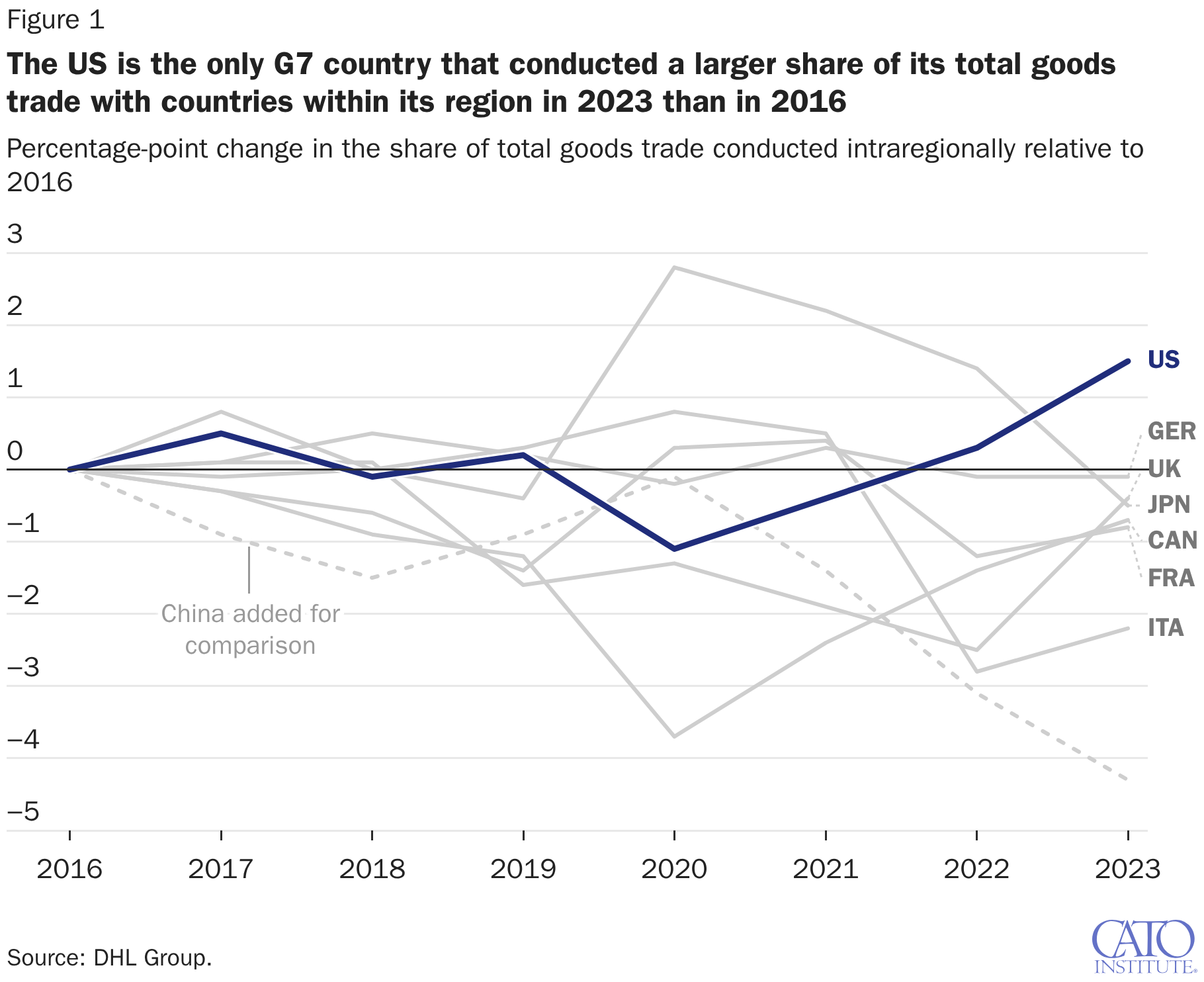
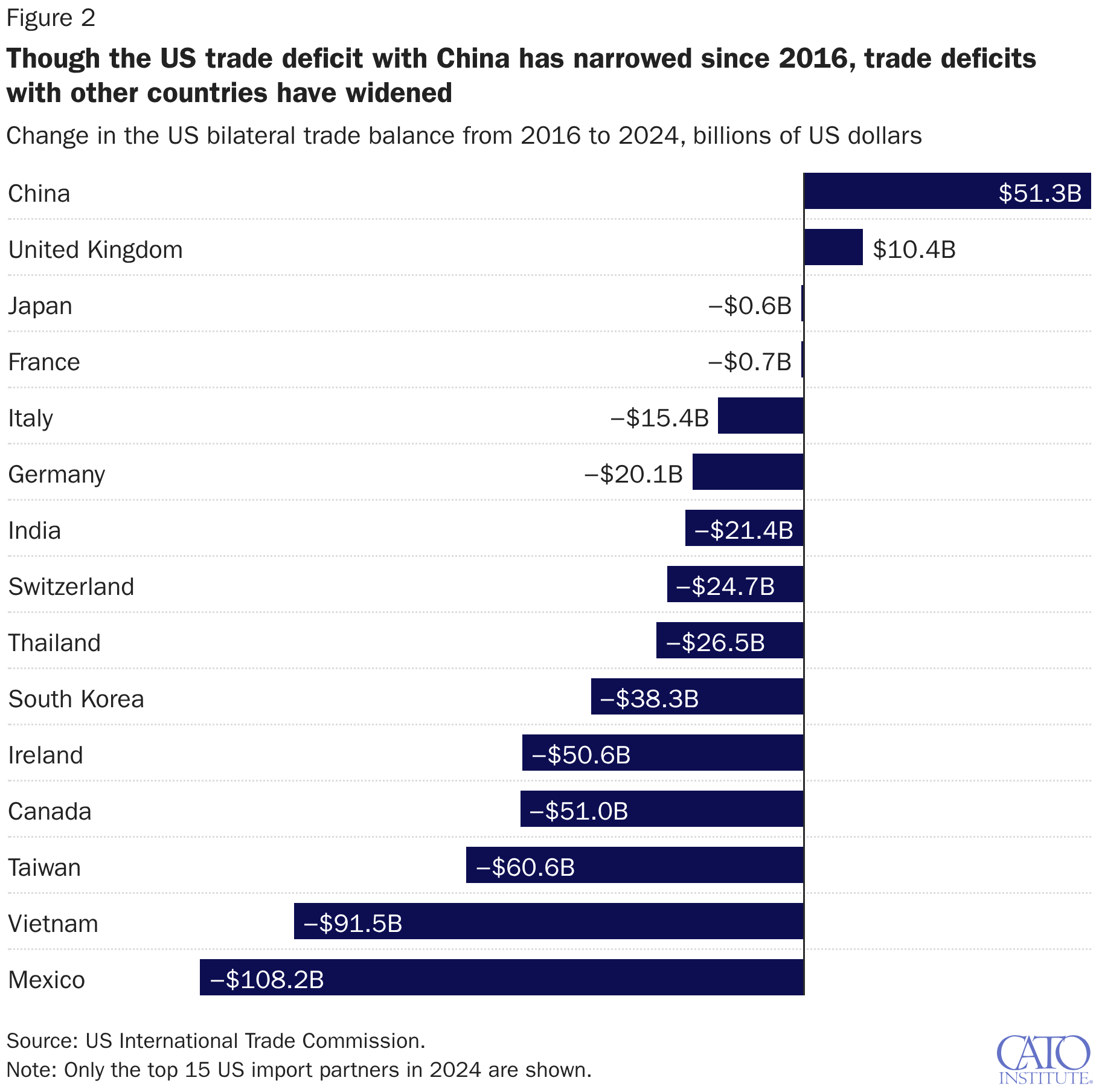
As Ruchir Sharma, chair of Rockefeller International, has explained, “Since 2017, Trump’s first year in office, trade has held more or less steady at just under 60 per cent of global GDP. But there’s been a decline in the US share of trade flows offset by an increase in other regions, particularly the nations of Asia, Europe and the Middle East. Trump 2.0 seems likely to bring more of the same: trade without America.”9 It can be debated whether the United States remains the necessary nation, indispensable to the rest of the world in global economic undertakings. But the notion that the United States is the automatic center of the world economy has been fraying at the edges for some time and is now being shredded by Donald Trump.
New trade directions are often coupled with new trade agreements. The Trump administration is not interested in concluding new trade agreements—except for bilateral mercantilist agreements reached on the president’s take-it-or-leave-it terms based on economic bullying and coercion. Nor was President Joe Biden’s administration interested in concluding new trade agreements. US leadership as it exists today—and this is true of both major political parties—has no real interest in advancing international economic cooperation, even though it is much in the American economic interest to do so. But other countries are interested, and they are showing it (Figure 3 and Table 1).10
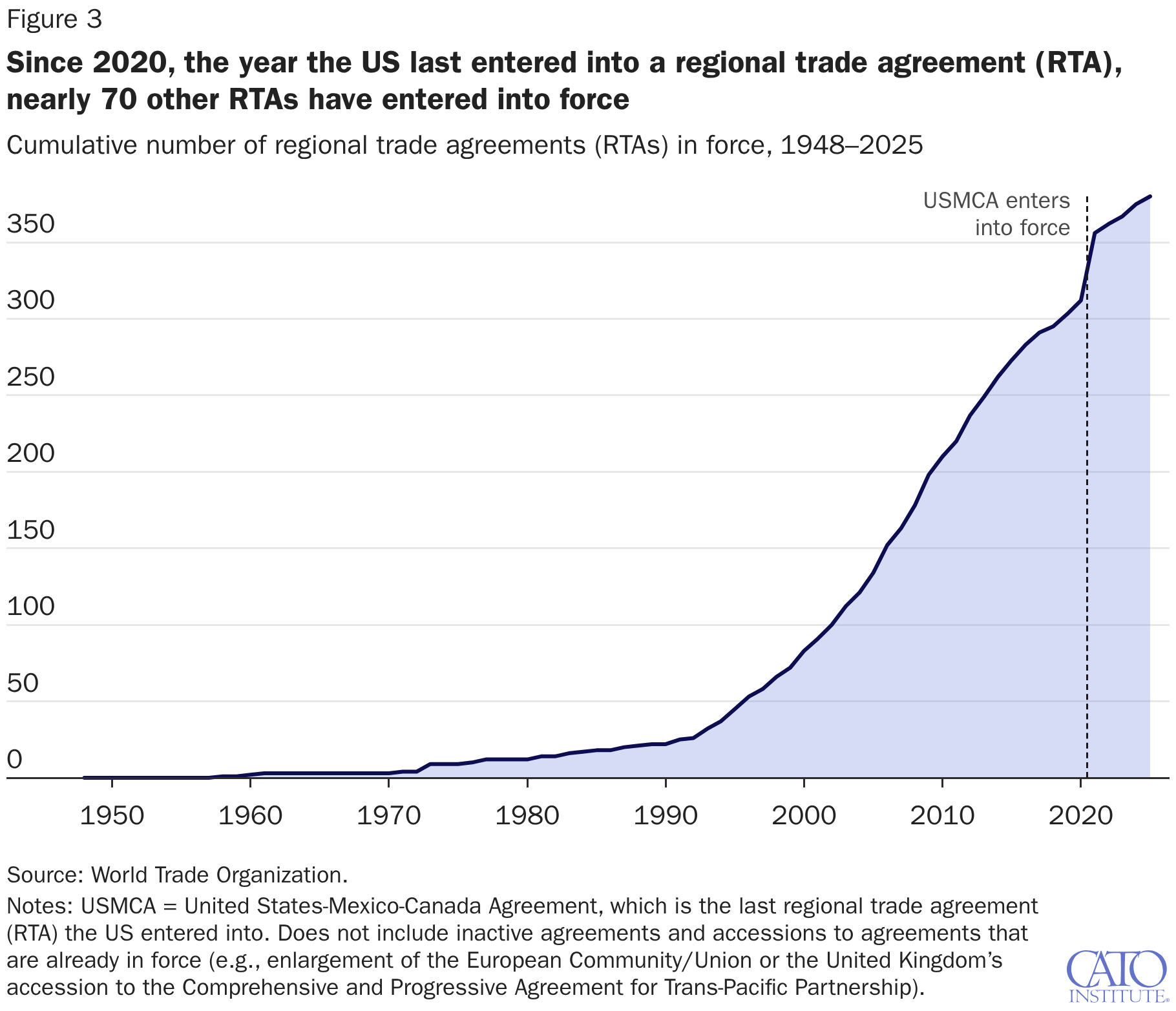
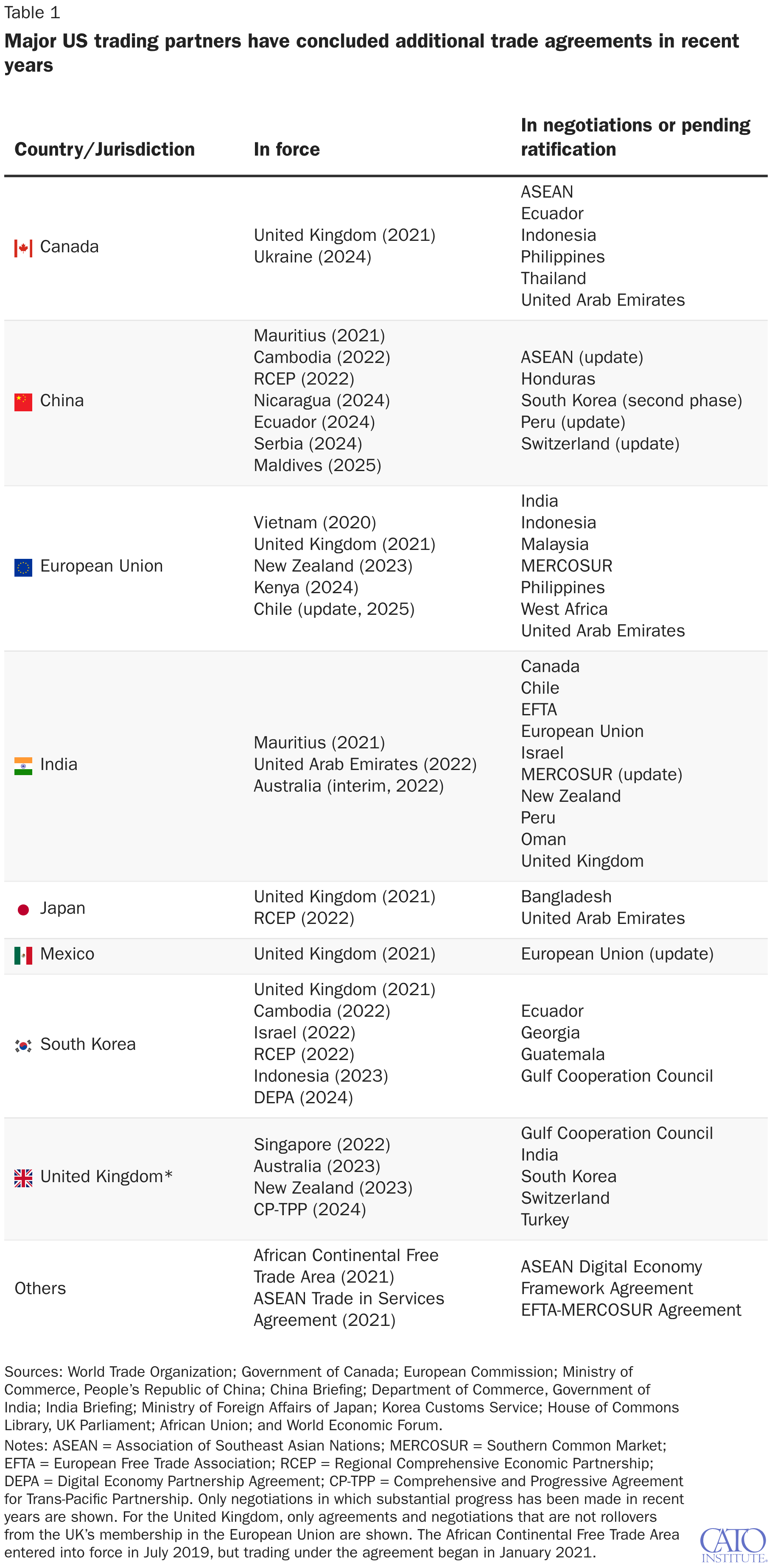
The Trump tariffs have been imposed on the imports of other countries not only without regard for basic WTO rules against trade discrimination, but also without regard for—India being one example—those countries’ historical or security ties to the US. As New York Times economic journalist Patricia Cohen writes, “By punishing longtime allies with tariffs, Mr. Trump is encouraging other nations to form trading blocs and networks that exclude the United States.”11 Bilateral and regional trade agreements have been proliferating for several decades, even as WTO members have largely failed to move forward on many pressing trade issues within the WTO negotiating framework. Now this trend has been given added impetus by the recent protectionist actions of the United States—and it is mostly happening without the United States’ participation.
The European Union has concluded several new trade agreements, with India, Switzerland, Mexico, and the MERCOSUR countries of South America (Brazil, Argentina, Uruguay, and Paraguay).12 MERCOSUR has resumed its negotiations with Canada on a proposed trade agreement, expects to conclude a deal soon with the United Arab Emirates (UAE), and is advancing negotiations with India, Indonesia, Japan, and Vietnam. The United Kingdom has joined the Comprehensive and Progressive Agreement for Trans-Pacific Partnership.13 Indonesia has joined Brazil, Russia, India, China, and South Africa in the BRICS group.14 The ASEAN countries of Southeast Asia are expanding trade ties to the countries of the Gulf Cooperation Council in the Middle East. India is strengthening its ties to ASEAN and throughout the rest of the world. Not surprisingly, given Trump’s exactions and insults, even Canada and Mexico are looking to diversify their trade away from the United States.
A new agreement between India and the European Free Trade Association recently entered into effect. India is also engaged in trade negotiations with Chile, Oman, and Peru and has launched talks with the Eurasian Economic Union (comprising Armenia, Belarus, Kazakhstan, the Kyrgyz Republic, and Russia). Meanwhile, the UAE is engaged in numerous trade negotiations. It has concluded new deals with Kenya, Malaysia, and New Zealand and is pursuing trade talks with the European Union, Japan, China, Korea, Australia, Pakistan, India, Turkey, and MERCOSUR. In Africa, 47 countries are busy implementing the African Continental Free Trade Area. Thus far, the major trading countries of East Asia, such as Japan and South Korea, have focused mainly on maintaining their bilateral trade relations with the United States, but, as prospects dim for freeing their trade from most of the Trump tariffs, they too are likely to look elsewhere for trade opportunities.15 And China is everywhere. Spurred by the incentive of the “trade war” waged since 2017 against Chinese trade—first by Trump, then by Biden, and now by Trump again—China has diversified its exports and is no longer as reliant on the US market as it was a decade ago. This is one reason Trump’s tariff pressures on China have continually failed to convince the Chinese to change their trade ways. China is expanding and deepening its trade relationships with the ASEAN countries, Brazil and other countries in Latin America, the Middle East, and many others. Many of these countries would prefer to trade with the United States, but China is buying what they want to sell and selling them what they want to buy, and Trump’s tariffs are pricing them out of the US market. So, it is not surprising that so many countries are reaching new trade agreements with China. More such trade deals not involving the United States can be expected.
As Trump and his collaborators overestimate the amount of economic leverage the US has over the rest of the world in this third decade of the 21st century and underestimate the ability of other countries to conduct their trade without the US, the United States is being left out. I have emphasized previously that “as the United States embarks upon fully asserting its economic leverage in world trade, it will become increasingly clear that American leverage is not as overpowering as is currently assumed inside the Beltway. An overestimation of the extent of American leverage is the mistaken premise not only of Trump’s trade policy, but also of the entirety of his foreign policy. Where the shape and composition of the world economy are concerned, today is not yesterday. The year 2025 is not 1955, or even 1995.”16 This is reflected in the rush by other countries to conclude new trade agreements that do not involve the United States. They are doing so to offset lost exports to the US and to create diversity among their suppliers to reduce their trade risks. In trade, countries are simply going around the United States.
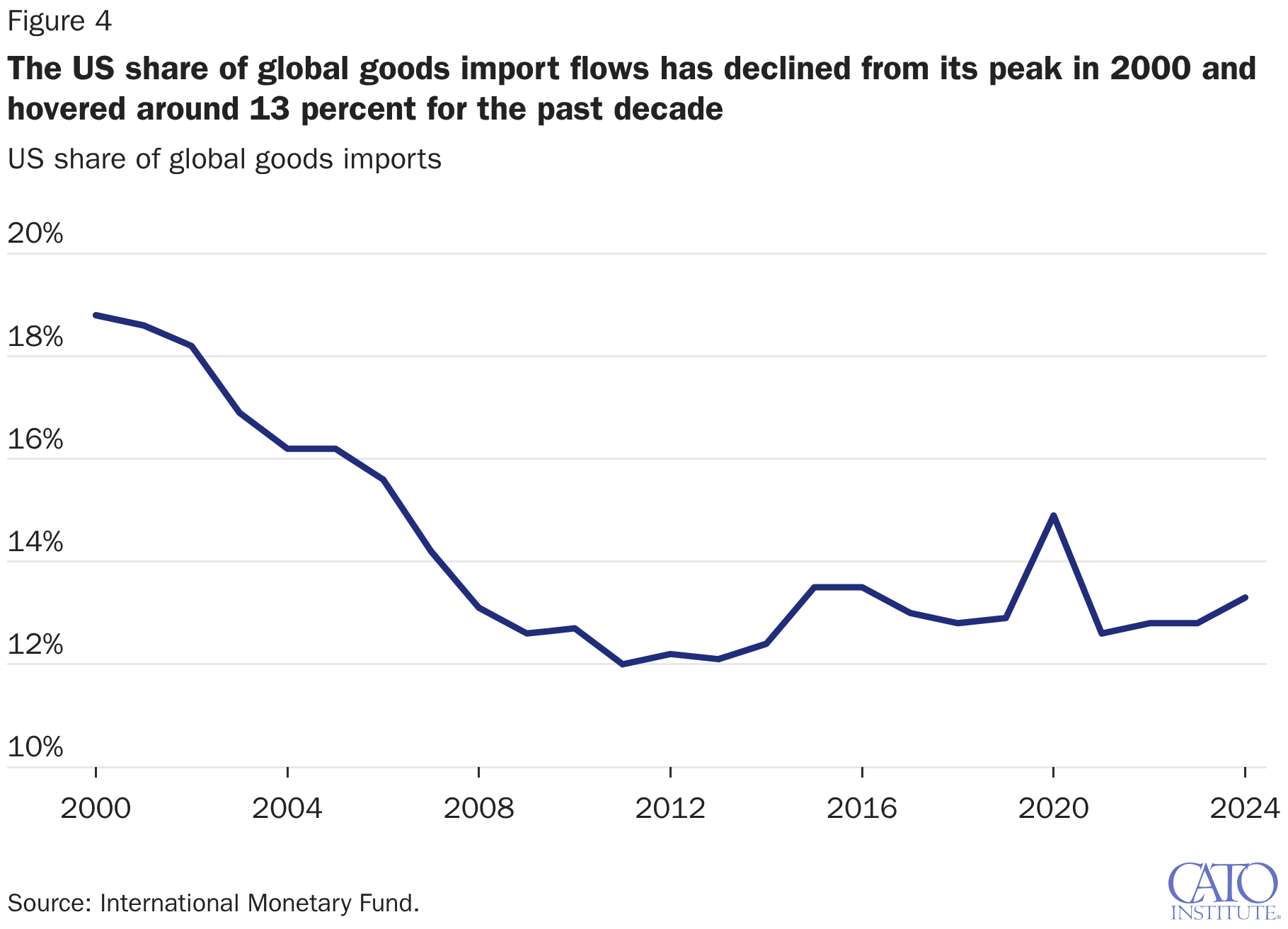
Other countries depend less on access to the US market than Trump and his allies believe. The United States remains the largest importer in the world. (China is second, despite its import restrictions.) However, the US accounts for only about 13 percent of world imports (Figure 4).17 This means that 87 percent of world imports occur elsewhere. Yes, the US market is important to other countries, but in most instances, there are other markets where they can sell their goods. Furthermore, other countries can make new international agreements to liberalize trade. At this time, politically, the United States is bent on managing trade and erecting more barriers to it, and remains rigidly unwilling to enter into new, genuine free trade agreements. The toxicity of new free trade agreements in the politics of both major political parties puts the United States at a distinct disadvantage in maintaining, much less increasing, its share of world trade. Republicans are thoroughly enfeebled by the disease of economic nationalism, and Democrats somehow have not yet figured out that one of the best ways to pursue “affordability” for the American people is by freeing trade.
Restrictive US trade actions are changing how the rest of the world is trading. Supply chains are shifting away from the United States, shipments from other countries are going elsewhere, and imports are arriving in those other countries from elsewhere. Necessarily, other countries are making new arrangements in response to the emerging new shape of global trade in the global economy. The rest of the world continues to turn, advancing trade to enhance economic prosperity, while the United States is not even standing still. It is going backward.
In contrast to what President Trump is unilaterally dealing out to America’s trading partners, with heaps of tariffs upon tariffs, the new bilateral and plurilateral trade agreements being concluded by other countries—without the United States—are lowering barriers to trade, but only among those countries that are part of those agreements. (Multilateral agreements, in contrast, are binding on all WTO members.) The conclusion of a trade agreement by other countries that does not include the United States is, in effect, a decision to discriminate against trade in US goods and services. Trump’s rising tariff wall is a wall that imprisons America and Americans economically.
At the same time, ideally, the rest of the WTO’s members should not be doing what they have mostly been doing: forging new trade arrangements that are outside the WTO. Understandably, given the years of frustration with trying to conclude new multilateral trade deals inside the WTO legal framework, the temptation everywhere is to go outside that framework to negotiate new and improved trade rules. The better course would be for the other 165 WTO members to redouble their efforts within the WTO framework while taking a different approach to concluding new WTO trade arrangements. That approach should be WTO-based plurilateralism that builds over time into multilateralism. But some may ask, what is the likelihood of success for this new approach, given the WTO’s long record of failure in negotiations?
Trading Within the WTO
The reality is, there is no such entity as “the WTO” that is to blame for years of failure to move forward multilaterally to lower trade barriers and make the multilateral trading system more purpose-built for the 21st-century global economy. What we call the WTO is only the members of the WTO working together in the guise of something they have chosen to call the WTO. The institution itself is fully member-driven; the institution can do nothing unless the members choose to do it. Thus, the failure of the WTO to move forward significantly in this century is not a failure of the so-called WTO: It is a failure of the member countries themselves. This failure has been caused by two major mistakes—one collectively by all members, the other individually (and shockingly) by one member.
The first mistake that has placed the WTO trading system in its current precarious position is the WTO members’ insistence on consensus decisionmaking. As WTO Director-General Ngozi Okonjo-Iweala recently said, “We need to reform some of the ways we do business, like our consensus decision-making system which is practiced as unanimity—everyone has to agree—so it really slows down decision making.”18 Yet some major traders among WTO members continue to insist that as a matter of principle, the WTO should only proceed by consensus. It is precisely this insistence that has, since the turn of the century, increasingly driven countries that wish to move forward on trade—particularly on its relation to other pressing issues of public concern—to conclude an ever-increasing proliferation of bilateral and plurilateral agreements outside the WTO’s multilateral system. The resulting agreements benefit some WTO members and discriminate against others—including those that are most insistent on adherence to consensus decisionmaking.
The trade discrimination inherent in bilateral and plurilateral trade agreements concluded outside the WTO is the reason the best approach to increasing world trade remains through multilateral trade agreements made within the WTO’s legal framework—agreements that include and therefore can benefit all 166 member countries. The second-best approach—and the one that will work best in the current global economic and geopolitical circumstances—is through the conclusion of plurilateral agreements among some WTO members within the WTO that can then be expanded over time to include all members. Indeed, this is how much of the WTO treaty was assembled in the first place, by taking “codes” that had applied only to those “contracting parties” of the GATT that had signed them and making them fully multilateral under the new WTO trading system established in 1995 as the GATT’s successor.
There is a significant commercial and geopolitical difference between negotiating plurilateral agreements inside the WTO and outside it. A plurilateral agreement made by some WTO members inside the WTO legal framework is automatically open to the inclusion of all other WTO members if they are willing to agree to and be bound by its terms. In contrast, a plurilateral agreement made by some WTO members outside the WTO legal framework is open to other countries only if the countries that conclude the agreement are willing to accept those additional countries into the non-WTO agreement.
However, WTO members, with some exceptions, have largely resisted concluding the plurilateral agreements that are permitted under the WTO treaty, and that were anticipated by the WTO’s founders to become a major part of the organization when the GATT was transformed into the WTO in 1995. Since then, despite those original expectations, WTO members have much preferred to make decisions within the WTO framework as they laboriously had done during prolonged multiyear negotiations under the GATT: by consensus rather than majority vote. As some WTO members have resisted addressing the need for new and improved WTO rules to respond to the new realities of world trade, consensus, which is supposed to be a tool for facilitating multilateralism, has been perverted into a tool for obstructing it.
Anyone who has participated in the governance of the multilateral trading system would agree that decisionmaking by consensus is ideal. In practice, though, requiring agreement by consensus means that no deal can be made unless and until every WTO member has agreed to every part of the deal. Long experience with consensus decisionmaking on updating and writing rules within the WTO has shown that some countries are unable to resist the temptation to use the consensus requirement not as a constructive tool for commercial international cooperation in accomplishing shared ends but as an obstructive instrument for furthering their own narrow and myopic goals.
The decline of the WTO’s capability to revise existing rules and write new ones for world trade can be traced to two sources. The first is the mistaken decision in 2001 to make the Doha Development Round a single undertaking in which the consensus rule would be employed. Although many WTO members have wished to move forward, the vast potpourri of complex and evolving 21st-century trade issues on the Doha agenda has made forging a consensus in multilateral trade negotiations impossible. This is aggravated by the current political context. The 2008 global financial crisis and the various backlashes in some countries against additional economic integration and globalization have made decisions to undertake further trade liberalization increasingly difficult in many parts of the world.
The other source of the current precarity of the WTO trading system is the United States’ shortsighted and self-defeating retreat from freer trade, which, it must be noted, began some time before Donald Trump’s first announcement of his candidacy for the presidency in 2015. President Trump did not begin this retreat; he has simply turned it into a chaotic rout. Here the United States is solely to blame. As I have explained previously, the US has benefited enormously from its membership in the WTO.19 (So too, to varying extents, have all other WTO members.) However, a combination of disinformation and demagoguery, plus the failure during the past generation and more by America’s political leaders to make certain that all Americans benefit from the considerable economic gains from trade, have led the American people to believe mistakenly that membership in the WTO has been a mistake. The result is the rampant and misguided trade protectionism that is a central manifestation of Trumpism.
While the US struggles to sort out its continuing quandary over trade and its policy toward trade domestically, the other members of the WTO have been watchfully awaiting the ultimate American political outcome. They should stop waiting. They should act now, and they should act within the WTO. In the absence of American leadership, they should go forward on their own with new WTO rulemaking and then later, when and if the United States shows up again at the table, ready once more to move forward, they should reenlist the United States in the cause of freeing trade and otherwise fashioning the trading system better to meet the urgent needs of the modern global economy. This should be done through the conclusion of new plurilateral agreements within the existing legal framework of the WTO. A plurilateral agreement can comprise up to 165 of 166 WTO members.
Some WTO members may be reluctant to go ahead without the United States, no doubt in part out of apprehension over possible retaliation from the Trump administration. This is understandable, as President Trump is not known for his forgiving nature. But these WTO members may be, like President Trump himself, overestimating US economic leverage and underestimating their own. Furthermore, their own leverage vis-à-vis the United States will be magnified to the extent that they cooperate and act collectively.
One reason President Trump prefers to act outside the legal constraints of the WTO is his assumption that he can coerce smaller countries into capitulating to his trade—and increasingly non-trade—demands in trade-related confrontations. This is what he has been doing to smaller countries all over the world through the economic coercion of what my Cato colleague Scott Lincicome has rightly described as take-it-or-leave-it “gunpoint deals.”20 The gunboat diplomacy of the darker days of the American past has returned to American foreign policy. Coming together within the WTO to forge new rules and new understandings, without the involvement of the United States, is one way other WTO members have of resisting and countering Trump’s gunboat diplomacy, his economic coercion, and his arbitrary and ever-changing trade dictates.
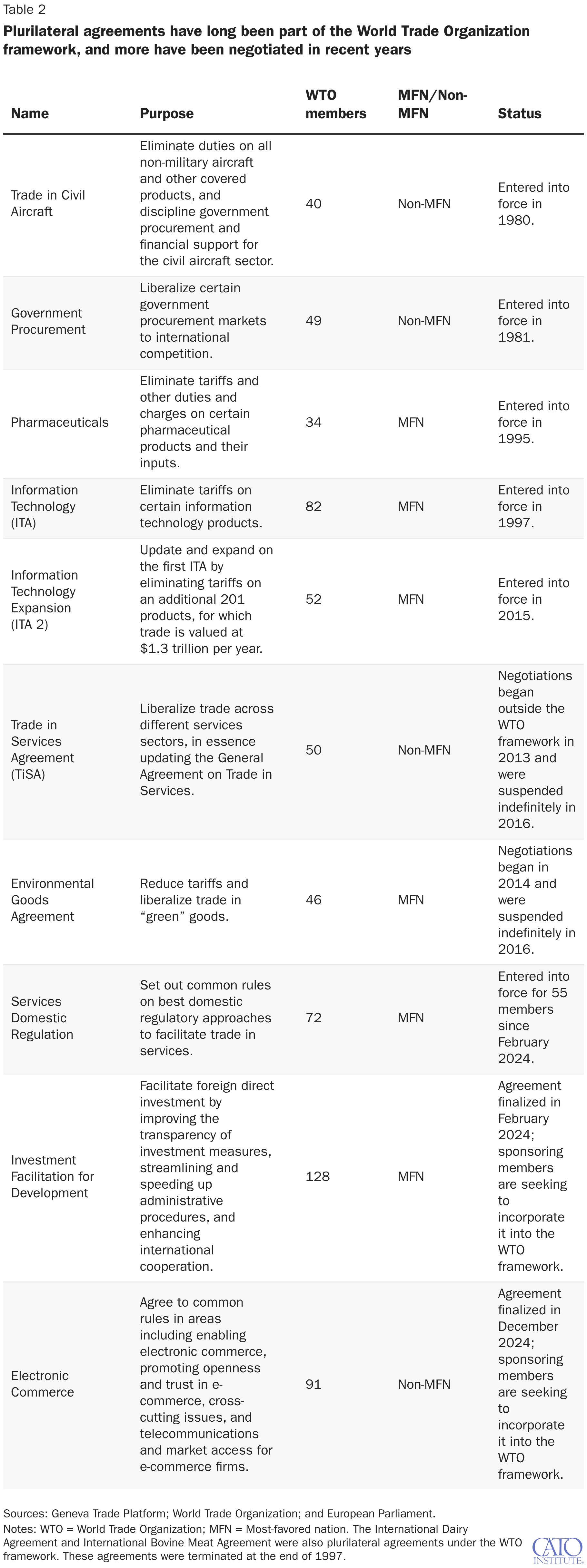
What kinds of plurilateral agreements should be concluded by the rest of the WTO membership while the United States tries to find its way back to the negotiating table in the WTO? The list is long, and much of it is inherited from the unfinished agenda of the Doha Development Round: Lower tariffs on manufactured goods. Lower tariffs on agricultural goods and fewer subsidies for agricultural production. Lower barriers to trade in services. Enhancements to rules on intellectual property rights through a proper balance between innovation and access to patented medicines, new technologies, and other intellectual property–protected areas of world commerce. Clarity on which countries truly are developing countries and the extent to which they should be accorded “special and differential treatment” in trade. And, generally, more and freer market access across all trading sectors. (Table 2 lists plurilateral agreements that have been previously negotiated at the WTO or for eventual inclusion under the WTO legal framework, as well as agreements that are currently being negotiated.)21
In addition, there is a need to renew efforts to address the issue of industrial subsidies, which is at the heart of so many trade disputes between China and the other WTO members. This situation has been made more difficult by the United States’ departure from WTO disciplines and by Trump’s “trade war” with China. As Chinese exports to the US have become more costly, the Chinese, rather than increase their domestic consumption, have begun to ship more of their (often subsidized) exports to other countries. As a result, those other countries have borne much of the economic burden of the US-China trade conflict. This situation must also be addressed by the rest of the WTO membership—including China—within the WTO legal framework.
There is also unfinished business within the WTO: on eliminating tariffs and other barriers to trade in environmental goods and services, on reducing barriers to trade in medical goods and services, on formally incorporating rules into the WTO treaty that will facilitate foreign direct investment, and on writing the first global rules for the digital trade that is now so much a part of the global economy. In the 21st century, how can an institution call itself the World Trade Organization when it has no rules on digital trade? As the global economy continues to evolve, more issues in need of attention will arise and will need to be addressed. One such issue is having better rules on the relationship between trade and the use of natural resources. Another such issue, and certainly not a new one, is the need to eliminate poverty globally—something that cannot be achieved without more and freer trade. Freeing trade is the surest path to global prosperity for all.
Some WTO members of course will continue to voice objections to plurilateral agreements within the legal framework of the WTO. Each such agreement needs to include a critical mass of trade coverage in a particular area or sector for it to be effective, but this has always been the case with plurilateral agreements, dating back to the GATT codes on subsidies, dumping, standards, and more. There will be interim periods—some of them no doubt lengthy—in which these agreements will remain plurilateral without yet becoming fully multilateral. This, too, has always been the case. And there will be struggles to conclude these plurilateral deals even though they will ostensibly include only coalitions of the supposedly willing. Alas, this, too, has always happened.
None of this will be easily accomplished within the WTO. But what other alternative is there? In the absence of anything approaching sufficient international political will to conclude more multilateral trade agreements within the WTO, the only other alternative is to go outside the WTO—as many countries are now doing. And while some progress, some added liberalization, can be accomplished in this non-WTO fashion, ultimately the continued proliferation of bilateral and plurilateral trade deals outside the legal framework of the WTO leads to economic fragmentation and balkanization, with unforeseeable geopolitical consequences.
Revitalizing WTO Dispute Settlement
Last but far from least, in addition to negotiating new plurilateral trade agreements inside the WTO, the 165 WTO members who are being bullied in various ways by the Trump administration must resolve to unite and stand together to defend their rights under the WTO treaty. Following on the mistaken course first undertaken by the administration of former President Barack Obama, then President Trump, and then former President Biden, the second Trump administration has set out, with a vengeance, to undermine the independent and impartial functioning of WTO dispute settlement. Notably, these successive American administrations, by refusing to join in a consensus to appoint new judges when terms end, have combined over time to empty the WTO Appellate Body of all its judges and thereby reduce that highest tribunal of appeal in WTO dispute settlement to its current on-paper-only existence.
This has been done for protectionist political reasons in the United States and not, despite the bipartisan “big lie” crowing otherwise, because of any failings of the Appellate Body as an institution. For nearly a quarter of a century, the Appellate Body rendered fair and objective judgments in dispute settlement that served the interests of all WTO members by upholding the rule of law in world trade and ensuring security and predictability in the world trading system. Other WTO members know this. Yet they have increasingly acquiesced to the bullying of the United States on this issue, and they have increasingly refrained from exercising their rights to recourse to WTO dispute settlement.
In particular, other members have failed to challenge the United States’ ever-multiplying number of tariff and other unilateral trade actions in violation of its legal obligations under the WTO treaty. An exception is Brazil, which has brought a case against the United States challenging Trump’s latest rounds of arbitrary tariffs.22 But where are the other countries supporting Brazil as third parties in this case? And why are other countries not emulating Brazil by bringing their own complaints against the illegal US tariffs and other trade restrictions that have been applied to their own trade by the Trump administration? Where is the collective courage that is needed to unite and stand up together against the bully?
Yes, the empty bench of the Appellate Body appears to prevent a final appeal in disputes involving the United States and thus a final adoption of a panel ruling against the United States. But is this truly so? Why has this assumption not been tested in dispute settlement? On the one hand, the absence of any members of the Appellate Body prevents an appeal, but what are we to make of the fact that it is because of the singular actions of the United States that an appeal is prevented? Has the United States been acting in good faith? And isn’t good faith the first requirement of treaty compliance under public international law? Why has this argument not been made?
It is past time for the 165 other members of the WTO to stop letting Donald Trump and his collaborators bully them. It is past time for them to come together to assert their treaty rights in defense of their own interests and in defense of the multilateral trading system. It is past time for them to stand together to fight for what they have spent nearly eight decades creating—a world trading system that is of enormous benefit to everyone in the world, including the people of the sadly misguided United States of America.
Conclusion
Of course, if the US were true to its longstanding principles, it would be cooperating with other visionary countries in leading the way toward the realization of these ambitious trade and trade-related goals within the WTO-based multilateral trading system. Unfortunately, at least for now, it is not. It therefore falls to other trading countries to do together what they would be doing alongside the United States if the United States were, at this time when cooperation is so badly needed in trade and so many other areas of global concern, heeding the better angels of America’s nature.
Yes, there are numerous and seemingly insurmountable hurdles to such cooperative action on trade without the US. But my message to the other 165 members of the WTO is this: You can do this. And you must. Start now. If need be, on each issue, start with only those few countries that are currently willing to act, then build from there. When the better angels at last prevail in America, as they will, the United States will return to where it always was and where it should be: building prosperity together through trade with the other 95 percent of the world’s people.
Citation
Bacchus, James. “World Trade Without the US,” Policy Analysis no. 1014, Cato Institute, Washington, DC, March 12, 2026.

About the Author


This work is licensed under a Creative Commons Attribution-NonCommercial-ShareAlike 4.0 International License.