
The federal tax code favors employer-sponsored health insurance (ESI) over other ways of financing and delivering medical care, and over other uses of income, by excluding ESI from income and payroll taxes that apply to cash compensation. This tax exclusion for ESI distorts labor markets, increases health care prices, suppresses wages, weakens insurance protection, creates inequities, and reduces economic performance. Economists have long urged Congress to limit or repeal the exclusion. Yet every major attempt has failed. Political resistance, fear of disruption, and the absence of identifiable, organizable beneficiaries have repeatedly thwarted reform.
This paper proposes Universal Health Accounts (UHAs) as a reform that would reduce the exclusion’s economic distortions and could overcome the political barriers that defeated prior efforts. UHAs would consolidate all federal health-related tax preferences into a single, capped exclusion for tax-free deposits into worker-owned “universal health accounts.” Labor markets would shift ESI spending to wages, which workers could deposit in UHAs and use to purchase medical care or health insurance from any source, including ESI and Exchange plans, tax-free. While maintaining a tax preference for health spending is not ideal, UHAs are the best politically feasible option for reforming the exclusion. They are more economically sound and politically feasible than past reform attempts. Relative to current law, they would reduce the exclusion’s distortions across economic sectors and eliminate nearly all its distortions within the health sector. They would preserve existing employer coverage for those who want it, reduce health care prices, and reduce inequities in the tax code and health sector.
UHAs would also produce identifiable beneficiaries. Economywide, 100 million workers would receive increases in cash wages totaling $1.2 trillion, or 4 percent of gross domestic product (GDP). Workers with family coverage would receive increases in cash wages on the order of $20,000. Households with high medical expenses would receive larger increases. Low-income workers would receive larger increases as a proportion of income.
Introduction
The federal tax code excludes employer-sponsored health insurance (ESI) from the income and payroll taxes that apply to cash compensation. The tax exclusion for ESI distorts labor markets, increases health care prices, suppresses wages, weakens insurance protection, creates inequities, and reduces economic performance. It creates or contributes to every problem in the US health sector. Now entering its second century, the exclusion may be the most harmful health policy Congress ever enacted.1
For half a century, economists have urged Congress to limit or repeal the exclusion. In 2019, a survey of health economists found that 65 percent believe Congress should not continue the current tax treatment of ESI.2 Economists broadly agree that limiting or repealing the exclusion would reduce medical prices, wasteful medical consumption, and health insurance premiums, while improving overall economic performance.3 Yet every major reform attempt has failed. Political resistance, fear of coverage disruption, and the absence of identifiable, organizable beneficiaries have repeatedly blocked change.
This paper proposes Universal Health Accounts (UHAs), a reform that would reduce the exclusion’s economic distortions relative to current law and could overcome the political barriers that defeated prior efforts. UHAs would consolidate all federal health-related tax preferences into a single, capped exclusion for tax-free deposits into worker-owned health accounts usable for medical care or health insurance from any source.
Admittedly, UHAs are not ideal health, tax, or economic policy. They would not eliminate the economic distortions that stem from the exclusion. Relative to repealing the exclusion—an economically preferable but politically infeasible approach—UHAs would preserve an incentive for greater health care consumption up to the deposit limit. The federal tax code would continue to encourage inefficiently high levels of health insurance and medical consumption.
UHAs are nonetheless both more economically sound and politically feasible than past efforts to limit the exclusion. Relative to current law, UHAs would reduce the exclusion’s distortions across economic sectors and eliminate nearly all tax distortions within the health sector. They would preserve existing employer coverage for those who want it, reduce health care prices, and reduce inequities in the tax code and health sector.
UHAs offer a unique array of features that could overcome political obstacles to reform. Where past efforts identified no constituencies that might organize to enact and protect reform, UHAs offer immediate, concrete benefits to more than 100 million workers in the form of large increases in cash wages—totaling $1.2 trillion, or 4 percent of GDP—with larger increases for workers with expensive medical needs and proportionally larger increases for lower-income workers. Where past reform efforts stirred fears of disruption, UHAs would minimize disruption. Where past efforts sparked opposition by increasing taxes and/or federal deficits, UHAs could be revenue- and budget-neutral. Where past efforts roused partisanship, UHAs would advance Republican and Democratic values in equal measure.
The next four sections briefly review the exclusion, its harmful effects, and the difficult politics of reform. Subsequent sections examine how Congress can design UHAs; how UHAs would create better incentives for workers, employers, consumers, and the health care industry; outcomes those incentives would produce; how workers would experience the transition to UHAs; how various features of UHAs affect political feasibility; and options for conforming changes to federal law.
The Tax Exclusion for ESI
In the 1920s, shortly after Congress enacted the current federal income tax but still before modern health insurance existed, US Treasury employees announced the federal government would exclude group insurance from the tax.4 In the 1930s, the Treasury excluded employee health benefits from the new Social Security payroll tax. In 1954, Congress codified the ESI exclusion.5 When Congress created the Medicare payroll tax in 1965, it excluded ESI from that tax base as well.
The exclusion has been the driving force behind the growth of ESI. When the federal government exempted employee health benefits from World War II–era wage ceilings, it encouraged employers to compete for scarce labor by offering health benefits.6 Robust growth in employer purchasing of health insurance did not begin, however, until after federal wage ceilings ended in 1953 and Congress codified the exclusion in 1954.7
Since 1954, Congress has expanded the exclusion. It has also created smaller exclusions, deductions, exemptions, and credits for health-related uses of income.8 Many of the additional health-related tax preferences that Congress has created have been attempts to offset the exclusion’s harmful distortions.
The Mechanics of the ESI Exclusion
Federal income and payroll taxes impose an average marginal tax rate on cash labor income of roughly 33 percent.9 On average, of every additional dollar of income a worker takes as cash, federal income and payroll taxes claim $0.33. The worker receives $0.67. If the worker instead receives that dollar in the form of ESI, Congress excludes it from both the payroll tax base and the income tax base.10 The worker gets $1 of health insurance; the IRS gets nothing.
The exclusion thus creates a tax differential that applies to every dollar of income that workers could take as either cash or ESI. One can describe that differential in three equally valid ways. On average:
- The exclusion reduces the after-tax price of the marginal dollar of ESI by 33 percent relative to other uses of that dollar.
- Due to the exclusion, the tax system increases the after-tax price of non-ESI uses of that dollar by 49 percent (1/[1 − 0.33] ≈ 1.49).
- Due to the exclusion, the tax system effectively penalizes workers $0.33 if they take that dollar as cash rather than ESI.
One can restate the third point. Due to the exclusion, the tax code creates the economic and functional equivalent of a mandate on workers to enroll in ESI. If workers do not, they must pay more to the government. Due to the exclusion, the tax code effectively mandates that workers take every dollar of compensation in the form of ESI. At the margin, workers pay an implicit penalty for every dollar of compensation they take as cash rather than ESI.
Whether a price distortion or a tax penalty, the effects are the same. The exclusion leads workers to demand more ESI than otherwise.11 In 2024, 54 percent of the US population enrolled in ESI.12 In 2025, the average premium for a family ESI plan was roughly $27,000.13 In 2026, workers will demand—and shield from taxation—$1.6 trillion of employee compensation in the form of ESI.14 The resulting $478 billion revenue loss to the federal treasury (due to forgone income and payroll tax collections) represents implicit but very real penalties that Congress threatens to impose on workers should they stop demanding ESI.15
Out of 175 “tax expenditures” that the Treasury Department counts in the federal tax code, the ESI exclusion is the largest in terms of static revenue loss.16 Its static revenue loss is three times larger than the second-largest tax expenditure, the tax exclusion for net imputed rental income from owner-occupied housing.17 In effect, the tax code implicitly threatens homeowners with $157 billion in additional taxes per year lest they all start renting their domiciles to others, and implicitly threatens workers with $478 billion in additional taxes lest they all disenroll from ESI.18
The exclusion’s distortions are sensitive to marginal tax rates. Every increase in marginal tax rates increases this differential and the exclusion’s economic distortions. Conversely, every reduction in marginal tax rates reduces the exclusion’s impact.19
Harmful Effects of the Exclusion
Since at least the 1970s, economists have warned that the exclusion is net harmful. It leads to inefficiently high levels of consumption of employer-sponsored health insurance and medical care, and excessive prices for both. Box 1 presents the consensus view among economists of the exclusion’s main harmful effects.
Box 1
The Congressional Budget Office and the Joint Committee on Taxation on the Tax Exclusion for ESI
Congressional Budget Office
“The exclusion of employers’ health contributions from taxable income generates higher medical spending, to the extent it brings about greater health insurance coverage. Coverage, in turn, tends to stimulate medical spending in at least three ways. First, because it lowers the out-of-pocket cost of health care, it encourages consumers to seek care. Second, it reduces patients’ awareness of and sensitivity to the difference in price among providers. Third, by lowering the risk of nonpayment, insurance promotes unconstrained use of costly forms of care. When insurance covers the full cost of care, as is true for inpatient hospital care under many current plans, doctors in particular have little incentive to restrain costs. On the contrary, they are encouraged to order more tests and use more services, because the gains from saving money are small.… The cumulative effect of these patterns, many analysts believe, contributes significantly to inflation in the medical sector.
“The employer exclusion is especially likely to raise medical spending, because it encourages employees to choose the most expensive type of coverage offered.
“Because the most expensive coverage generally eliminates all or most out-of-pocket medical payments, the effect of the exclusion on medical expenditures is invisible to many workers. Costs do emerge, however—often as higher prices or larger premiums. The resulting costs for medical care fall particularly hard on those least able to afford them, since persons with low to moderate incomes are the ones most likely to be uninsured. All persons, however, end up paying more by devoting larger shares of their incomes to medical care.”20
Joint Committee on Taxation
“The existence of the [exclusion] reduces the price of the consumption of health care, leading to overconsumption of health care relative to other goods and services for those taxpayers with qualifying plans, and very expensive health care for taxpayers in the individual market.
“The distortion in the market caused by the tax preference afforded health insurance arises from a two-part market response: 1) demand for medical care increases, increasing the price of health care services; and 2) increased prices draw additional resources into the medical services sector, and away from other less tax-favored sectors. Moving resources from one sector where they are more productive to another sector may result in less efficient production of additional medical services, thus resulting in generally higher medical costs.
“These market mechanisms affect all prices for health care services in the market, not only the extra services paid for through insurance. The market inefficiency arising from the tax-induced spending on health care versus other goods generates a loss to the economy referred to as ‘dead weight loss,’ because it results in a net loss of consumer welfare. Therefore, the impact on the economy materially exceeds the loss of tax revenues from subsidizing health care expenditures. The elimination of this distortion could lead the economy to function more efficiently and increase individuals’ collective welfare.”21
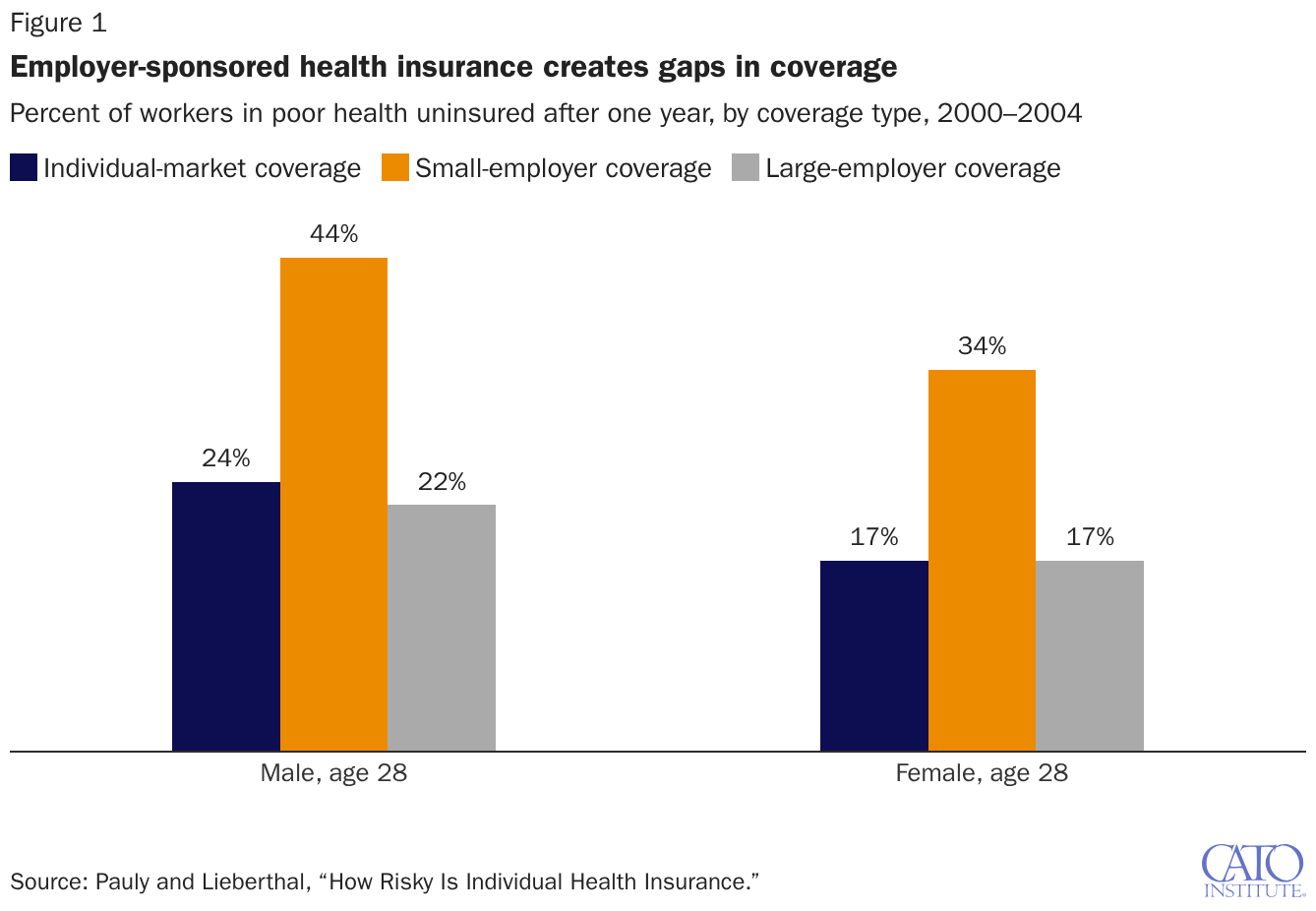
It is difficult, however, to enumerate or overstate all of the exclusion’s harmful incentives and the resulting effects. For one, the exclusion effectively penalizes workers if they choose portable, lifelong health insurance that stays with them across jobs. It thus discourages insurers from making long-term investments in preventive care. And it creates coverage gaps that increase the number of people with preexisting conditions.22 Figure 1 illustrates that from 2000 to 2004, individuals in poor health were more likely to suffer a gap in coverage if they had ESI versus health insurance they purchased directly from an insurance company.23
As a result of the exclusion, the tax system locks workers in jobs they would prefer to quit.24 Box 2 explains how the tax system creates a “spouse tax” averaging more than $20,000 for workers who decline ESI. The exclusion effectively obscures the value of employee compensation packages and makes income inequality appear worse.25 It implicitly penalizes workers who choose their own health insurance, which creates costly mismatches between workers and health plans.26 The implicit tax penalties and lack of consumer agility further suppress innovation in health insurance.27 Due to the exclusion, the tax system creates distortions that encourage excessive coverage.28 Since the tax system effectively penalizes savings relative to health insurance, the exclusion puts banks at a competitive disadvantage relative to insurance companies. The resulting excessive coverage encourages excessive consumption of low-value care that does not improve health.29 These distortions increase health care prices, often to unconscionable levels, and obscure medical prices behind high list charges and secret negotiations.30 The predictable effect of excessive coverage, excessive medical consumption, and excessive health care prices is that the exclusion also increases insurance premiums.31 Rising ESI premiums reduce employment and cash wages.32
The exclusion reduces social welfare by producing deadweight losses equivalent to 1 percent of GDP each year.33 It creates vertical inequities by denying low-income households control over a larger share of their earnings than higher-income households, and by structuring its implicit penalties in a manner that is harder for lower-income households to avoid. The exclusion also creates horizontal inequities, favoring and penalizing individuals based on their jobs, family structures, risk preferences, and disease burdens.34 Each of these negative effects creates continuous pressure for further government intervention, including higher taxes.35 What economists Martin Feldstein and Bernard Friedman wrote in 1977 is even more true today: “Because the growth of insurance has been the primary cause of the exceptional rise in health care prices, it can with justice be said that the tax [exclusion] has been responsible for much of the health care crisis.”36
Box 2
The Spouse Tax
The dynamics of the tax exclusion force workers who decline their employer’s ESI offer to suffer large economic losses. One can call this a “spouse tax” because such workers are typically spouses who enroll in coverage through a spouse’s employer.
The average family ESI plan premium in 2025 was roughly $27,000. The employer paid about $20,000; the employee paid about $7,000 directly.37 Both payments are generally income- and payroll-tax-excludable. An employee who declines ESI forgoes the $20,000 employer payment but still receives the $7,000 as taxable cash income.
In equilibrium, a competitive labor market pays workers according to their marginal productivity, or the additional output a worker creates for the firm. The offer of a $20,000 premium payment suggests the worker’s marginal productivity exceeds the worker’s other compensation by that amount.38 Economic theory predicts that when workers decline ESI, competitive labor markets would offer those workers additional cash wages—a compensating wage differential—of roughly that amount. Consistent with theory, employers who do not offer ESI compensate by offering additional cash wages roughly equal to the value of ESI.39
Yet contrary to what economic theory typically predicts, employers do not offer intrafirm compensating wage differentials to employees who decline ESI. The reason appears to be a federal prohibition.40 Employers may also fear adverse selection, where healthy workers take the cash, leaving only high-cost workers in the company health plan.
Either way, the result is that ESI decliners lose substantial income. Declining the average family plan means forgoing $20,000 of income (the employer premium payment). ESI decliners may lose a further $2,310 to taxes (33 percent of the remaining $7,000), for a total “spouse tax” of $22,310.41
Workers who decline ESI lose more to the spouse tax than workers with ESI would lose from taxing it. Repealing the exclusion would render taxable all of the $27,000 the employer and employee spend on a family ESI plan. At a 33 percent marginal rate, those workers would lose $9,000 to higher taxes. ESI decliners lose roughly 2.5 times that amount to the spouse tax. Research suggests spouses select jobs that do not offer health insurance (and therefore offer higher wages) to avoid the spouse tax.42
The spouse tax is substantial at an economywide level. One survey indicates that 29 million workers decline their employer’s ESI offer.43 Back-of-the-envelope calculations suggest that affected workers forgo income equivalent to 1.8 to 4.6 percent of total US payroll.44
A key feature of the exclusion is that it effectively requires workers to let employers control a large portion of their earnings. In 2025, employers paid an average of about $20,000 for each employee with family coverage; the employee paid the remaining $7,000 of the premium directly.45 That $20,000 is as much a part of the worker’s earnings as their salary. Economic theory holds, and economic research confirms, that were employers to stop offering ESI, employers would deliver that $20,000 to workers in the form of additional cash wages or other compensation.46 One study found, for example, that “male workers between the ages of 25 and 55 … who lose employer-sponsored health insurance are compensated with roughly a 10 to 11 percent increase in wages.”47 The CBO writes that when there occurs “a decline in offers of employment-based health insurance … in CBO and JCT’s estimation, employers that decide not to offer health insurance would still keep workers’ total compensation roughly unchanged.”48
Due to the exclusion, the tax system effectively penalizes workers if they demand that compensation in a form they control (i.e., cash). To avoid those implicit penalties, a worker must let their employer control an average of $20,000 of their income and use those funds to select, purchase, and control their health insurance. Economywide, employer payments toward ESI premiums total $1.2 trillion, or nearly 4 percent of GDP. The exclusion also lets the employer control a further $7,000 of the worker’s cash income—that is, the cash the worker must return to the employer to enroll in the company health plan. Economywide, workers’ direct payments toward ESI plans total roughly $400 billion—an additional 1 percent of GDP. All told, the exclusion lets employers control $1.6 trillion of workers’ earnings each year, for a grand total of 5 percent of US GDP.49
The Difficult Politics of Reform
Economists from diverse ideological perspectives have recommended limiting or eliminating the exclusion. Democratic and Republican lawmakers alike have repeatedly tried. The political forces that protect the exclusion have proven exceedingly difficult to overcome, however, and have successfully blocked all such efforts. Dooming every attempt has been some combination of special-interest opposition, fears of disruption (in labor markets and in access to health insurance), lack of immediate benefits for identifiable groups (who would organize to enact and protect reform), and the shifting sands of partisanship.50
Absent dramatic change in the political landscape, outright repeal of the exclusion is unlikely. The exclusion first emerged in the 1920s from rulings the Treasury Department issued while implementing the income tax Congress enacted in 1913.51 In 1954, Congress acted to codify the exclusion merely because administrative and court rulings had cast doubt on its scope.52 That is, Congress took action to bolster and protect the exclusion at a time when employer-sponsored health insurance was less prevalent, less entrenched, and its supporters less politically powerful than today. Members of Congress have introduced legislation to repeal the exclusion as part of a broad tax overhaul, but the furthest such legislation ever progressed was the committee-hearing stage—that is, no floor votes, committee votes, or even markups—and that was in 1995.53 Nevertheless, the economists persist.54
Likewise, all attempts merely to curtail the exclusion have failed. In 1983, President Ronald Reagan proposed placing a cap on the exclusion by taxing employer-sponsored health insurance premiums to the extent they exceeded certain thresholds.55 Bipartisan opposition in Congress scuttled the proposal.56 In 2005, President George W. Bush proposed capping the exclusion.57 Two years later, Bush proposed replacing the exclusion with a standard deduction for health insurance, which would have limited federal tax preferences for health care.58 In 2008, Republican presidential candidate John McCain unsuccessfully proposed replacing the exclusion with a universal tax credit.59 In 2009, Sens. Ron Wyden (D‑OR) and Robert Bennett (R‑UT) introduced bipartisan legislation proposing to replace the exclusion with a standard deduction for health insurance.60 Many similar proposals met with failure.
The closest Congress has come to limiting the exclusion was in 2010, when President Barack Obama enacted a 40 percent excise tax on ESI premiums in excess of certain thresholds. This “Cadillac tax” would have effectively capped the exclusion.61 Economists loved the tax.62 The health care industry and large employers hated it.63 Since it had no identifiable beneficiaries, when the health care industry and large employers campaigned to delay and repeal it (see below), there was no political constituency to defend it. Congress repeatedly delayed the Cadillac tax until 2019, when Democrats and Republicans joined in near unanimity to repeal it—by 419–6 in the House and 71–23 in the Senate.64 Nevertheless, the economists persist.65
The exclusion’s defenders include politically powerful interest groups wielding potent political tools. The health care industry and large employers reap windfall benefits from the exclusion. It channels hundreds of billions of dollars to the health sector by effectively penalizing workers for every dollar of wages they don’t spend on health care. It also gives large firms an advantage over smaller ones. Large firms have more predictable claims and can spread the administrative costs of ESI over a bigger pool of employees, which enables them to offer workers higher cash compensation than their smaller competitors.
These special interests typically stoke fear about the impact of limiting or reforming the exclusion. Partisans seeking political advantage do likewise. McCain’s opponent, Democratic presidential candidate Barack Obama, alleged McCain’s proposal would take away workers’ employer-sponsored health insurance and leave them with nothing.66
To date, the only successful reforms to the exclusion have reduced the distortions it creates within the health sector at the cost of increasing the distortions it creates across sectors—that is, between the health sector and other economic sectors. Tax-free flexible spending accounts (FSAs), medical savings accounts (MSAs), health reimbursement arrangements (HRAs), health savings accounts (HSAs), and individual coverage health reimbursement arrangements (ICHRAs; now “CHOICE Arrangements”) reduce tax distortions between ESI and other ways of paying for medical care (including saving for medical expenses).67 Because these reforms expanded the ways the tax code favors health care, they have not drawn the same level of health care industry opposition as proposals to limit the exclusion.
Designing Universal Health Accounts
Universal Health Accounts (UHAs) would reduce the exclusion’s economic distortions relative to current law while potentially overcoming the political barriers that defeated prior efforts. UHAs would consolidate all federal health-related tax preferences into a single, capped exclusion for tax-free deposits into worker-owned accounts. Workers could use tax-free UHA funds to purchase medical care or health insurance from any source, including an employer or a federal or state health insurance Exchange.
Three basic changes to the federal tax code constitute the core features of UHAs:
- Consolidate the tax exclusion for ESI, and all other health-related tax preferences, into a single exclusion for deposits into worker-owned, tax-free universal health accounts.68
- Allow UHA funds to purchase qualified medical expenses including any health insurance plans from any source, such as ESI and Exchange plans, likewise tax-free.
- Limit tax-free UHA deposits for individuals and families to whatever constant nominal levels the Joint Committee on Taxation (JCT) and the Congressional Budget Office (CBO) project would achieve revenue neutrality.
Additional minor changes would be necessary to conform other provisions of federal law to these three core changes (see below).
These changes would reduce the tax code’s economic distortions relative to current law. They would return $1.2 trillion each year to the workers who earned it, give them greater control over those funds, and improve economic performance.69 The current exclusion creates barriers to labor mobility by tying tax advantages and health insurance to employers; these changes would eliminate those barriers and free workers to take more productive jobs. The current exclusion also creates barriers to shifting resources away from health toward other consumption; these changes would free workers to reduce health insurance and health consumption without having to switch jobs, lose income, or forgo health insurance.
The tax code would continue to encourage workers to devote income to health care (equivalently, to penalize workers unless they devote income to health care) by depositing funds into a tax-free account for health insurance and medical expenses. Yet the average tax differential between what the exclusion favors and penalizes would be lower and would persist only up to the limit on tax-free deposits. Above that point, the differential would disappear. Below that point, UHAs would reallocate tax advantages within the health sector away from more distortionary items (health insurance) toward less distortionary items (health spending, savings).70
Revenue-neutral deposit limits would mathematically require that workers exclude more compensation during the first 10-year budget window than under the current exclusion. Setting deposit limits at constant nominal dollars would gradually cause that amount to fall below current-law levels. Lower deposit limits would reduce the aggregate amount of compensation workers exclude and would increase revenues. Since these changes would reduce the after-tax cost of saving for health expenses relative to health consumption, as taxpayers accumulate savings they could shift future income away from health care. Reducing taxes and penalties on nonmedical withdrawals, including bequests, would further reduce tax distortions that encourage inefficient health consumption.
Improving Incentives
The ideal approach to reducing the harmful economic incentives the exclusion introduces into the federal tax system is to repeal it. Repeal would treat a dollar of compensation the same way regardless of whether the worker allocates it to ESI or other uses, and would therefore fully eliminate, for all workers and at all income levels, the exclusion’s distortions favoring health consumption. Repeal would also effect the same shift of compensation from ESI to cash wages. It would go further to moderate health care prices and consumption than proposals that would preserve preferential tax treatment for health consumption (e.g., UHAs). Flat repeal would increase taxes on workers who use the exclusion, which has distributional, incentive, and political implications. (Were the federal budget to remain in deficit, such a tax increase would not expand government but merely shift the burden of federal spending from future to current taxpayers.)
While not ideal, UHAs would go further than any past reform effort to correct the exclusion’s inefficiencies and inequities relative to current law. Within the health sector, UHAs would reduce the distortions that encourage excessive prices, that let employers and private insurance companies control patient care, and that fuel the problem of patients with preexisting conditions lacking coverage. By capping the exclusion, UHAs would reduce distortions across economic sectors, including the tax distortions that encourage excessive medical prices. UHAs would make the tax code and health sector more equitable by providing equal treatment for similar workers, and by reducing the burdens the exclusion disproportionately imposes on workers with low incomes and/or expensive medical needs.
Relative to repealing the exclusion, UHAs bring economic disadvantages but political advantages. UHAs would allow smaller economic distortions to continue as the price of political achievability. And the political advantages are not minor. Revenue neutrality implies that far more workers would see themselves as net winners—and perhaps more important, fewer would see themselves as net losers—than under flat repeal (see “An Effective Tax Cut for All Workers,” below). UHAs would also shift $1.2 trillion from ESI to wages in a manner that is quicker and more transparent than full repeal (see immediately below and Box 3), and therefore less vulnerable to fearmongering.
Workers
Once the exclusion applies solely to UHA deposits, the tax system will create strong incentives for workers to demand, as cash wages, all of the $1.2 trillion that employers spend on ESI each year. Whether one calls the incentive that currently lets employers control those earnings a tax break or a mandate, UHAs would create an identical incentive for employers to give workers that income as cash. Policymakers can expect the new incentive to be as effective as the existing one. (See also “Employers,” below.)
Workers would demand that employers immediately add 100 percent of those funds to their cash wages. On average, that would mean increases in cash wages of $8,000 for employees with self-only coverage and $20,000 for employees with family coverage. Workers who currently decline ESI would see their cash wages rise by comparable amounts. The debate over enactment of UHAs, plus implementation efforts by the IRS, employers, and tax advisers, would educate workers that those funds are part of their compensation—that is, their money.
Labor-market dynamics would produce surprising and salutary outcomes. As a share of household income, low-income workers would receive proportionately larger increases because ESI comprises a larger share of their total compensation. Women, older workers, and workers with obesity, diabetes, or other expensive medical conditions would receive larger absolute increases in cash wages than otherwise similar workers. So would workers with above-average health insurance premiums, including union members and workers in high-cost areas.
Workers within a firm generally pay the same premium regardless of income level, in terms of both the portion of the premium workers pay directly and the share they pay indirectly via lower cash wages. As a result, ESI accounts for a larger share of total compensation for low-income households than higher-income households. In 2019, ESI comprised 50 percent of total compensation for workers in the lowest income decile but only 10 percent of total compensation for workers in the highest income decile.71 When labor markets return employer ESI premium payments to workers as cash wages, low-income workers would gain control over larger shares of their earnings than high-income earners: 50 percent versus 10 percent.
A strong implication of the economics literature is that workers in households with above-average medical expenses would receive larger wage increases than their otherwise-similar coworkers. Workers with relatively high household medical needs value ESI more than other workers. As a result, these employees accept greater reductions in cash wages than their otherwise-similar coworkers—that is, even further below their marginal productivity.72 Since competitive labor markets would push employers to “cash out” each individual worker according to their marginal productivity, markets would push employers to give such employees larger-than-average wage increases.
As a result, competitive labor markets would automatically “risk adjust” wage increases so that women, older workers, and workers with obesity, diabetes, and other expensive medical conditions would receive above-average increases. Indeed, labor markets already do so. One study suggests that the increase in cash wages obese workers receive when switching from firms that offer ESI to firms that do not is greater than the increase nonobese workers receive.73
As with employers adding those funds to workers’ cash wages generally, in competitive labor markets this outcome does not depend on the behavior of a worker’s current employer. If an employer does not give such workers above-average wage increases, other employers would.74 Workers’ self-interest would lead them to push employers to ensure that this shift occurs immediately. Workers with above-average household medical needs would monitor how employers respond especially closely—and discipline them quickly.
Workers in firms that offer ESI would see large benefits and scant inconvenience. Suppose UHAs were to take effect on January 1. In the preceding October, employers would announce that as of January 1, employees with self-only ESI coverage would receive increases in cash wages averaging nearly $8,000, while employees with family ESI coverage would receive increases averaging $20,000. Workers who currently decline ESI would see comparable increases. In November, employers would announce their health plan offerings. Workers would open UHAs and set up direct payroll deposits, often with the help of their employers.75 In December, workers would make their health plan selections for the following year and set up automatic bill payments from their UHAs to their health plans. On January 1, workers could keep using their employer plans and start the new year as if nothing had changed. Opening a new account and directing money in and out of it would be a small matter compared to the greater control workers would gain over their incomes, health decisions, and career decisions.
Eliminating the tax distortion between ESI and other sources of health insurance would end “job lock” and increase labor mobility. Workers who do not receive an ESI offer would not see wage increases but would gain access to the exclusion on the same terms as other workers. The tax savings would motivate many such workers to open UHAs and begin setting money aside for medical expenses. Since low-income households are disproportionately unlikely to have access to ESI, these tax savings would disproportionately benefit low-income workers. Such workers include those without access to the employer payroll deductions that are necessary to take advantage of the exclusion: the self-employed, part-time workers, gig workers, and the like. All workers would be able to access the exclusion no matter who their employer is or what choices their employer makes.
In the case of workers whose employers currently make payments toward their FSAs, HRAs, or HSAs, employers would likewise add those amounts to the workers’ cash compensation. These workers would gain greater control and flexibility in how they spend those funds. To the extent they currently fund these vehicles at lower levels than the new UHA deposit limits, they could enjoy greater tax savings.
After workers receive an increase in their cash wages, many or most could deposit that cash into a UHA without any adverse tax consequences. (See “Political Feasibility,” below.) Low-income workers without ESI or who currently exclude less than the new UHA deposit limits could exclude and save more of their income than under current law. Relative to current law, UHAs would limit the distortions the tax code creates between health and nonhealth uses of income by capping the exclusion and by making it easier for workers to move income across economic sectors.
Employers
UHAs would also change incentives for employers. Employers would face irresistible incentives to add to workers’ wages the $1.2 trillion that employers currently spend on ESI. Two important concerns are how quickly those incentives would lead employers to cash out workers, and whether employers would continue to offer ESI.
Employers currently withhold and control that $1.2 trillion because the tax exclusion creates incentives for workers to reduce tax liabilities (equivalently, to avoid implicit penalties), and the labor market transmits those incentives to employers. UHAs would create identical incentives for employers to add those funds to workers’ cash wages. Policymakers can expect the new incentive to influence employer behavior as much as the existing one currently does.
This outcome would not be up to individual employers. Labor markets would punish employers who did not give workers the full amount the employer spends on health insurance. What economists Greg Mankiw and Larry Summers wrote about the Cadillac tax would be true under UHAs:
Might companies … instead of increasing wages, simply pocket the savings? Some may try, but the success of this strategy would be fleeting. In the long run, the compensation of labor, like most prices in the economy, is governed by supply and demand. Any employer that tries to pay less than the market requires will struggle to recruit and retain workers.76
If a worker’s current employer does not return 100 percent of those funds to the worker, the next employer would.
Economic theory suggests labor markets would shift that compensation to wages in the long run. A key question is, how long would it take for that shift to occur? To the extent the economics literature sheds light on how long it would take wages to adjust, it suggests that for most workers, the cash-outs could be immediate. (See Box 3.)
Box 3
Cash-Outs Could Be Immediate
While few studies directly measure how long it takes wages to adjust to compensate for changes in ESI spending, some provide a window into timing.77
- In response to an incremental policy change, wages for middle-aged men adjusted to account for the cost of mandatory prostate-screening coverage by three years after implementation.78
- In response to a different incremental policy change, wages for women of child-bearing age fully adjusted to account for the cost of mandatory maternity coverage within two years.79
- Workers who lose (or gain) ESI entirely experienced wage increases (or decreases) roughly equal to the average cost of ESI, and the adjustments appear to have occurred within three months.80
These studies provided outer bounds but were unable to determine whether the adjustments had occurred even earlier.81
Still other studies have found immediate and even anticipatory adjustments. Within-market hospital mergers led to higher hospital prices and spending, and “an immediate reduction in wages, which slightly increases in magnitude in the first year following mergers.… [The] price and spending increases among privately insured patient populations … are similar in magnitude to the reduction in wages among workers who receive private insurance through an employer.”82 A government report on the Cadillac tax noted that “some employers negotiating multi-year, collective bargaining agreements might already be trying to price the effects of the tax into labor contracts prior to [the effective date of] 2018.”83
The closest analogue to UHAs may be the reforms Massachusetts enacted in April 2006. There, labor markets began to adjust wages before the policy change took effect. The law required workers to enroll in health insurance by July 2007. Enrolling their workers in ESI required employers to shift compensation from cash wages to ESI premiums. Using time-series data to “identify the compensating differential using variation in the entire cost of health insurance using reform-induced exogenous transitions,” one study found that wages began to adjust a full year before the penalties took effect, indeed almost immediately upon enactment. Labor markets produced near-complete compensating wage differentials by three months after the penalties took effect.84 These adjustments occurred despite supposedly greater downward wage rigidity.85
Such anticipatory responses to changes in tax law are consistent with the tax-avoidance literature. The economics literature offers a hierarchy of behavioral responses to tax changes: “Ranked from least to most responsive were real responses, avoidance responses, and timing responses.”86 A UHA-induced shift from ESI to cash wages would straddle the second and third categories.87 The tax-avoidance literature also finds that wealthier taxpayers are most likely to respond to changes in tax laws.88 Within each firm, the employees who would determine the timing and magnitude of cash-outs would be those with the highest incomes and marginal tax rates, and who would therefore pay the highest implicit tax penalties due to slow or incomplete cash-outs.
Relative to other proposals to equalize the tax treatment of ESI and non-ESI health insurance—all of which would lead employers to shift ESI payments to cash wages—UHAs would make this process more deliberate, transparent, and immediate. As with the 2006 Massachusetts law, UHAs would be a significant reform, with tax provisions that dramatically change workers’ demand for employer ESI payments relative to cash wages, and the legislative debate would educate the public about the coming changes. The debate would educate workers that the money their employer pays toward ESI is part of their earnings, and that there would soon be a vehicle (UHAs) where workers could take possession of those funds. Finally, the debate and implementation would alert workers that they would suffer avoidable pay cuts and/or tax liabilities if their employer does not add that money to their cash wages by a specific date. UHAs would therefore create an expectation among workers that employers will add those funds to the workers’ cash wages. In combination, these features would create a transparent process that could achieve a complete and accurate shifting of those funds to workers’ wages as quickly as or faster than wages adjusted in response to the Massachusetts law.
Congress could also consider features that might accelerate full wage adjustment. First, as in Massachusetts, reform should give firms sufficient time to adjust. Delaying implementation by up to two years, or staggering implementation according to when labor contracts expire or employers’ ESI plan years begin, would give employers and workers notice and time to adjust compensation.89 Second, Congress could require firms to report in advance how the firm would implement wage adjustments, including the overall range of cash-outs as well as how they would vary among workers (executives vs. nonexecutives, workers with family coverage vs. self-only coverage vs. ESI decliners, by tenure, etc.). Third, some would advocate penalizing employers who fail to cash out each worker immediately and in full. A mandate would be of questionable benefit. Determining what constitutes “full” shifting of ESI to wages is tantamount to having regulators set or arbitrate wages for any worker who raises a complaint.90 Enforcement of such a mandate would likely lag labor market adjustments.
In rare cases where employers’ incentives are insufficient to deliver full and immediate adjustment, labor-market dynamics would minimize the harm. Workers with expensive medical needs would apply the greatest scrutiny to these changes; they would be the first to complain if their cash-outs were incomplete and the first to restore that lost pay by switching jobs. Thus, workers who value that compensation most highly would reclaim it quickest.
Employers would face strong incentives to continue offering ESI. The tax preference is not the only reason employers and employees find ESI attractive. The CBO writes that “the employment-based market” has many advantages, including “significantly lower administrative costs and advantages in forming insurance pools with more predictable costs.”91 Economist Jonathan Gruber writes, “There are also the benefits of group purchase, the negotiating power obtained with group size, and ease of plan choice and administration” that “will still be present even if the ESI exclusion is ended. Indeed, virtually all medium size and large firms in the United States have offered health insurance continuously over the past thirty years, despite enormous swings in the effective tax price of health insurance.”92
Economists have long predicted that ESI will outlive the exclusion. In 2007, the CBO and JCT projected that, were Congress to replace the exclusion with a standard deduction for health insurance, employers would continue to offer ESI to 94 percent of covered workers. (The JCT further projected that 92 percent of the other 6 percent would obtain other coverage, and that the overall number with health insurance would increase.)93 In 2011, Gruber wrote that even if Congress eliminated the exclusion, “there is no reason to think that there will be a whole scale exit of medium and large firms from ESI” and “there [would] not appear to be much of a change in the health mix of those remaining on ESI.”94 Real-world experience has forced economists to admit they have underestimated the power of these factors. In 2017, the CBO and JCT had to revise their projections of ESI enrollment upward because “fewer employers have stopped offering insurance coverage in response to the ACA than the agencies had previously expected.”95
Competition for workers and concern for their employees would lead many employers to set up UHAs and direct deposits for their workers. Employers themselves could deposit those funds directly and could make UHA deposits and enrollment in the company’s ESI plan a condition of employment.
Consumers
UHAs would dramatically reduce the incentives the federal tax code creates for consumers to purchase health care they do not value, and would lead consumers to direct resources toward goods and services that bring them greater value. Once a dollar enters the worker’s UHA, the tax code would no longer distort whether the consumer devotes that dollar to ESI versus other health-related uses, including health insurance from another source, membership fees at a concierge or direct-primary-care practice, out-of-pocket medical spending, or savings. Consumers would base that allocation decision on the relative value they place on various health care and health insurance options, without the tax code distorting that decision.
UHAs would be more consumer-friendly than existing tax-free health accounts in numerous ways:
- UHAs would be portable savings accounts in the worker’s name. Workers would own, control, and could invest those funds, just as they do the funds in other tax-free investment accounts. UHA funds would not be subject to “use it or lose it” incentives at the end of the year or when workers leave their jobs.
- Workers could make UHA deposits themselves or through their employers via payroll deduction.
- Taxpayers could roll balances from other tax-free health accounts into a UHA, also tax-free.96
- Deposits, growth, and withdrawals for qualified medical expenses would always be tax-free.97
- Workers could use tax-free UHA funds to purchase health insurance from any source, including their current employer plan or any plan available in their state.
- UHAs would not require workers to enroll in a particular health plan, such as high-deductible health plans. Taxpayers could combine UHAs with whatever health plan they prefer.98
- As with existing tax-free health accounts, withdrawals for nonmedical expenses would be taxable and subject to a 20 percent penalty, with the latter disappearing after the account holder reaches age 65. To the extent Congress reduces these levies, UHAs would further reduce the exclusion’s distortions and excessive health spending relative to current law.
UHAs would thus retain the best features of current tax-advantaged health spending and savings vehicles, while discarding the worst.
Health Sector
Economists across all ideological perspectives agree that limiting the exclusion’s distortions would reduce health care prices, wasteful medical spending, health insurance premiums, and national health expenditures.99 Reforming the exclusion would therefore make health care more efficient, equitable, and universal. By eliminating nearly all tax-based distortions within the health sector, particularly relative to current law, UHAs would create more pressure than other reforms for the health care industry to reduce prices, eliminate wasteful consumption, and offer higher-value health insurance.
This is likely not a minor effect. The JCT explains that the exclusion puts upward pressure on “all prices for health care services in the market, not only the extra services paid for through insurance.”100 The exclusion implicitly penalizes self-insurance (i.e., saving for medical expenses), direct payment for medical care, and the premium savings that come from choosing economical health insurance plans.
UHAs would significantly increase workers’ incentives to choose more economical health plans with greater cost-reducing features and innovative plan designs. Consider a worker who enrolls in a $28,000 family ESI plan with the option of choosing a more economical $27,000 plan.101 Under current law, the worker sees perhaps $500–$667 of benefit from switching to the more economical plan.102 Yet under UHAs, switching to the more economical plan would benefit the worker by at least $667 and in many cases $1,000.103 Workers would therefore face much greater incentives to avoid low-value ESI. More generally, under the current exclusion, $1 of economizing on ESI benefits the worker by $0.67, and often less. (In the short run or in uncompetitive labor markets, it can benefit them by as little as $0.)104 Under UHAs, $1 of economizing on ESI below the deposit limit benefits the worker by at least $0.67, and often more. Above the deposit limit, $1 of economizing on ESI benefits the worker by $1.
Eliminating nearly all tax distortions within the health sector, reducing them across economic sectors, and making health care consumers more price-sensitive at every margin relative to current law would put downward pressure on health care prices across the board. Ceteris paribus, falling prices make all access problems smaller.
Eliminating tax distortions between ESI and other sources of health insurance would remove barriers to high-value insurance products, including portable health insurance and plans with innovative payment models.105 Removing the implicit tax penalties on portable health insurance would reduce coverage gaps and disruptions in care that come from switching health plans mid-treatment. Those plan designs and greater consumer price-sensitivity would put downward pressure on both medical prices and health insurance premiums.
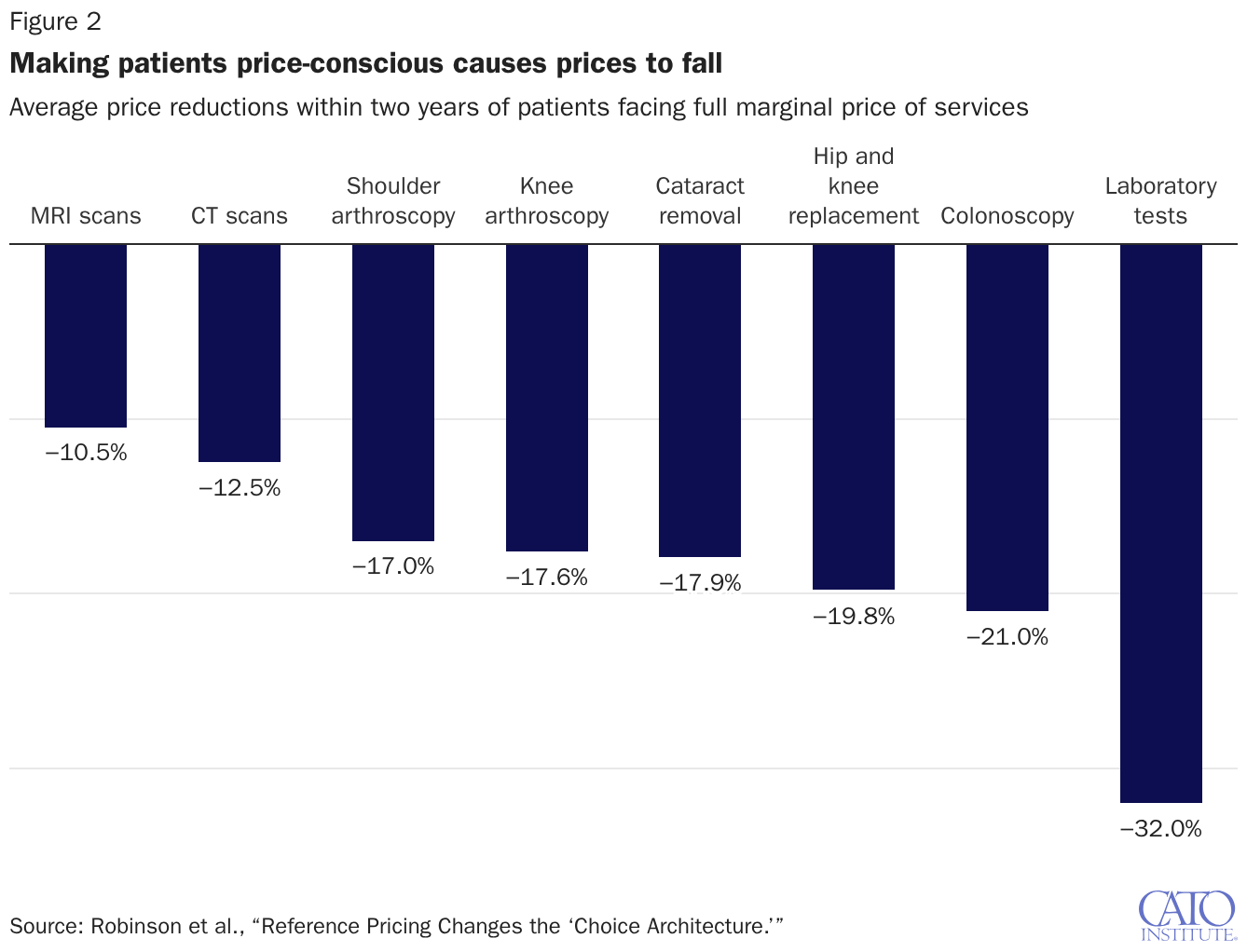
Analyses of other reforms, and of experiments with innovative plan designs, provide a baseline of how much UHAs could reduce health care prices and spending. One study estimated the Cadillac tax would reduce health care prices by 1.3 percent and overall health spending by 2.2 to 3.2 percent.106 Experiments with “reverse deductibles” suggest larger potential savings. In those experiments, insurers set and offered to pay flat rates for select medical services, leaving patients to pay any overage out of pocket. Once patients became fully price-sensitive (i.e., when patients got to keep 100 percent of the savings), they switched to lower-price providers. The resulting price competition caused prices to fall by up to 32 percent across a range of items, without denying anyone any services.107 (Figure 2.108) One study estimated that broader use of this one innovation could reduce total medical spending among privately insured patients by up to 12 percent.109 If so, broad use of reverse deductibles could reduce health insurance premiums by nearly that amount. Countless other innovations, including more than one dozen recommendations from the 1% Steps for Health Care Reform project, could make health care and health insurance more affordable.110
UHAs would remove the implicit penalties the tax code imposes on these and all other cost-containment tools. These estimates thus offer a reasonable baseline for how much prices and spending could fall. Under UHAs, workers could see their wages rise by $20,000 and save money on their health insurance. Each effect is progressive, because each represents a larger share of income for workers with low incomes and/or expensive illnesses.
Political Feasibility
UHAs offer a unique array of features and immediate benefits. These features and benefits could attract a political coalition broad enough to enact and preserve reform. It is difficult to imagine a reform of the exclusion that offers more immediate political benefits or less disruption.
Public Opinion
Major features of UHAs already enjoy broad political support. The freedom to choose one’s health plan, including portable health plans, enjoys 70 percent support among voters of both major political parties.111 That freedom implies the freedom not to enroll in high-deductible health plans. UHAs would free taxpayers from the requirement that they enroll in a high-deductible plan if they wish to save money tax-free for medical expenses.
UHAs would also preserve desirable features of existing tax-free health accounts that voters already know and support. Tax-free health accounts enjoy widespread bipartisan participation and approval. Large majorities of Democrats (73 percent), Republicans (74 percent), and independents (65 percent) view HSAs favorably. Significant shares of Democrats (16 percent), Republicans (14 percent), and independents (11 percent) report already having one.112
Key reforms that UHAs would introduce also enjoy bipartisan support, including reforms that deviate from rules for existing tax-free health accounts. Two-thirds (69 percent) of US adults favor eliminating the additional tax workers must pay if they want to control their health care dollars, as UHAs would do. Four-fifths (80 percent) oppose higher taxes for workers whose employers do not offer health insurance; UHAs would eliminate those implicit penalties.113 Large majorities of Democrats, Republicans, and independents—76 percent, 80 percent, and 72 percent, respectively—support letting workers put the entire amount their employers pay toward health premiums into a tax‐free account the worker owns.114 Among many arguments for these changes, the two that US adults found most persuasive are that “workers have a right to choose their health insurance plan” and that “workers would be free to buy plans that would not disappear whenever a big change happens in their life.”115
Immediate Benefits to Identifiable Constituencies
The most durable reforms to the exclusion have been those that provided immediate benefits to identifiable groups. The creation and expansion of tax-free FSAs has enjoyed bipartisan support.116 Republicans extended the exclusion to income that workers or their employers deposit into HSAs and to income that employers provide to workers through various HRAs. Attempts to limit the exclusion, by contrast, have failed because they offered small and/or uncertain benefits.
UHAs offer an immediate benefit to an identifiable constituency that no other reform has—or perhaps can. They would immediately increase household cash wages for 165 million ESI enrollees, plus additional workers who decline ESI offers. The former group includes 84 million workers who enroll in ESI through their employers, plus household members who also enroll in those workers’ ESI plans. The latter group includes tens of millions who decline their own employer’s ESI offer but may have coverage through another source (e.g., another household member’s ESI, the individual market, or a government program), plus many workers with no coverage.117
The magnitude of these wage increases would be sizeable. The average worker with self-only ESI coverage would receive an increase of nearly $8,000, and the average worker with family ESI coverage would receive an increase of $20,000.118 Again, households with women, older workers, union members, obesity, diabetes, other expensive medical conditions, or that are simply in high-premium areas would receive above-average increases in cash wages.
Economywide, UHAs would shift to cash wages the entire $1.2 trillion of workers’ incomes that employers currently pay toward ESI premiums. Workers would likewise gain greater control over the $400 billion that currently goes into their cash wages but that they must pay toward an ESI plan to avoid the exclusion’s implicit penalties. In total, UHAs would give workers greater control of $1.6 trillion of their income each year—an amount equivalent to 5 percent of US GDP.119
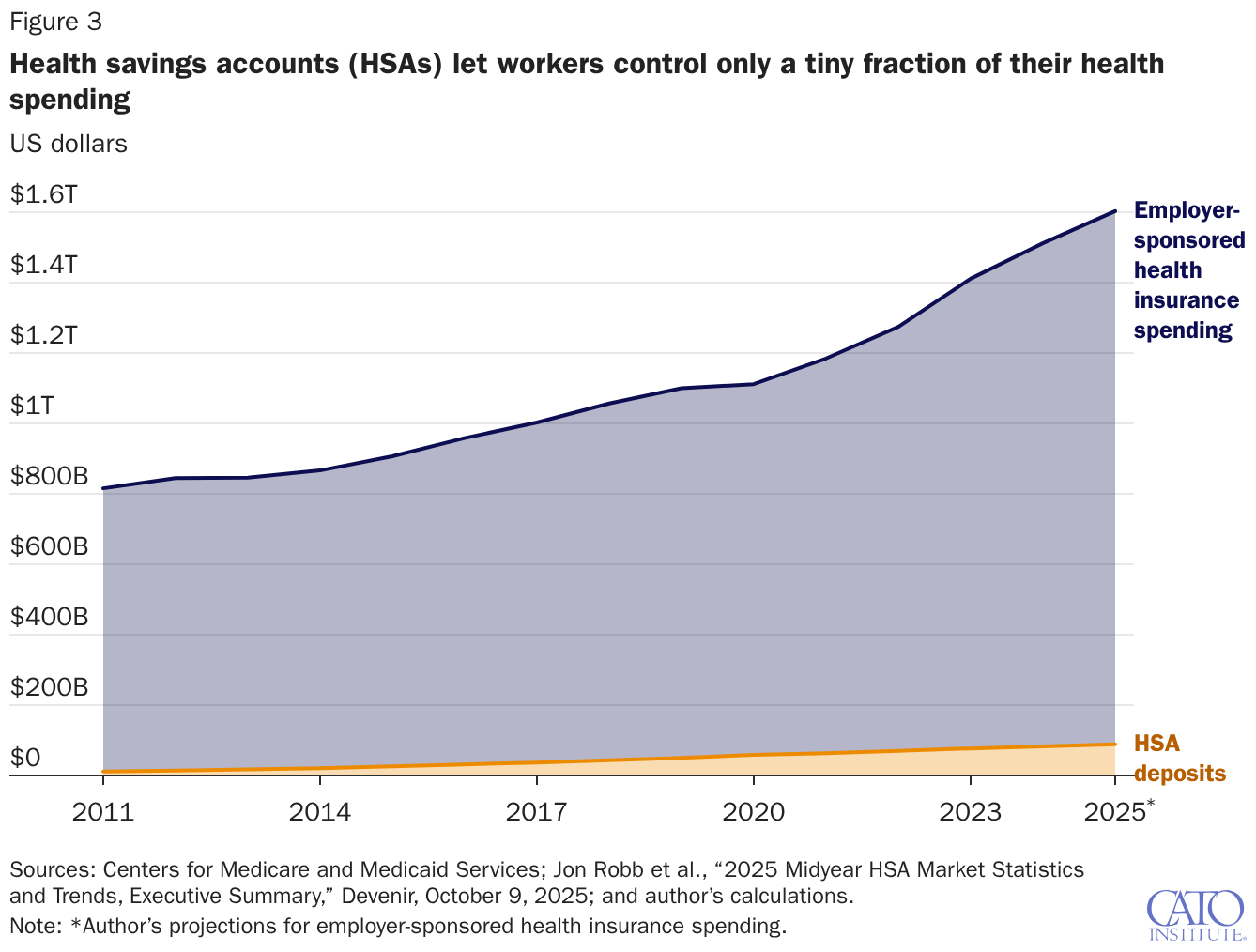
As a result, UHAs could attract the support of organized interest groups to advocate, enact, and protect reform. Anti-tax activists would see benefits in giving workers greater control over their earnings (see below). Organizations representing small businesses would see UHAs as removing an impediment to small firms competing in labor markets. Existing tax-free health accounts allow financial institutions to compete for only a tiny fraction of that $1.6 trillion (Figure 3120). Banks and other financial institutions would see UHAs as freeing them to compete to help workers manage 5 percent of US GDP.
Past attempts to reform the exclusion foundered for predictable reasons.121 Some offered nothing but higher taxes (e.g., the Cadillac tax). All of them fed workers’ fears and uncertainty by not resolving the question of what would become of that 5 percent of GDP. Unlike those attempts and even fundamental tax reform, UHAs would provide an impetus, a moment, and a vehicle for workers to take immediate ownership of that $1.2 trillion.
An Effective Tax Cut for All Workers
Shifting $1.2 trillion to cash wages, and giving workers greater control over both those funds and $400 billion of their current cash wages, constitutes an effective tax cut. The fact that the exclusion allows employers to control $20,000 of a typical worker’s earnings is not a tax in the traditional sense; workers do not send those funds to the government.122 It is nevertheless true that this feature of federal tax law results in workers losing control of $1.6 trillion of their earnings, and that UHAs would give workers far greater control over those earnings.
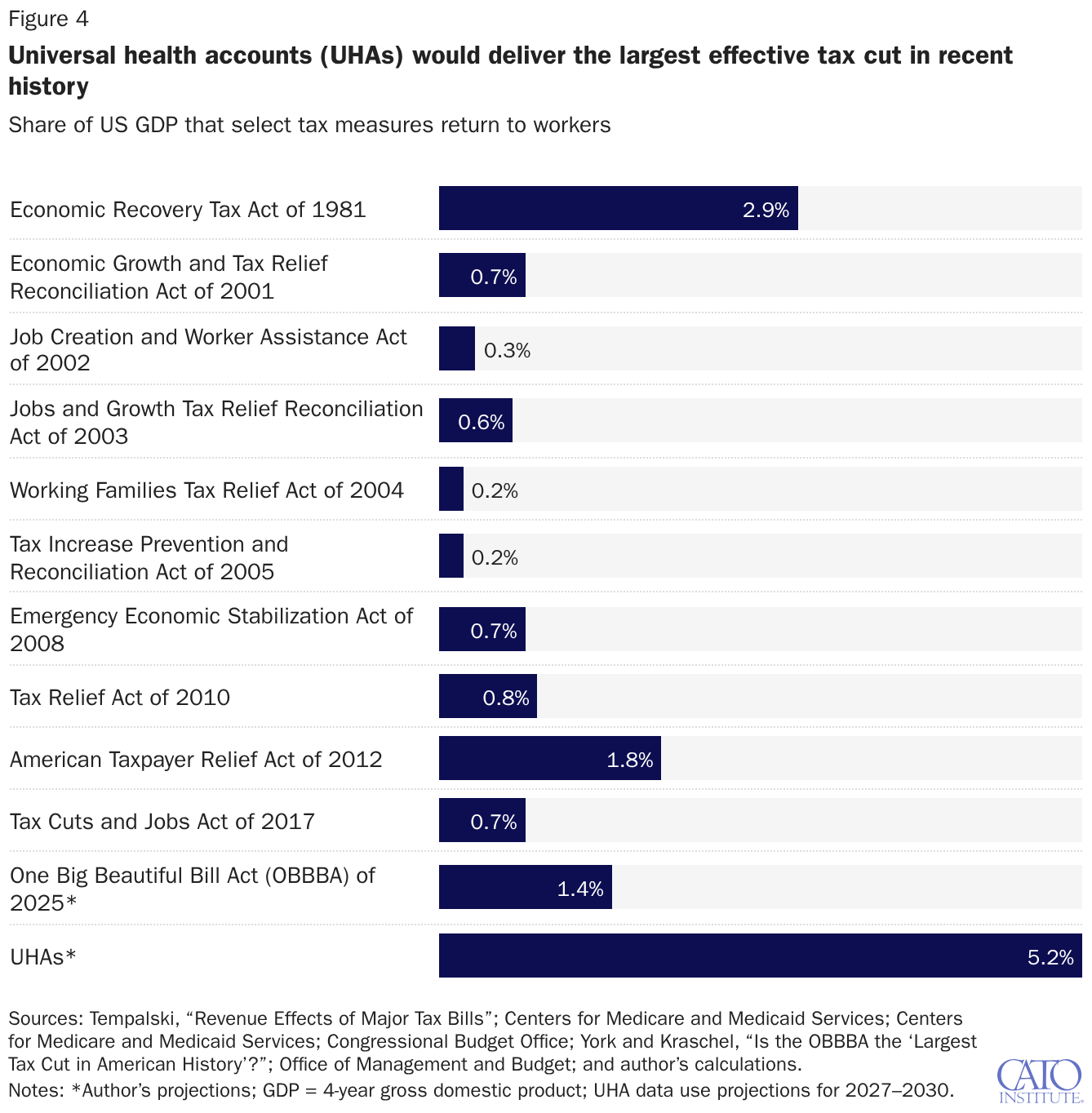
As a share of GDP, the effective tax cut that UHAs would generate is 79 percent larger than the 1981 tax cuts and nearly four times larger than the One Big Beautiful Bill Act’s tax cuts.123 (Figure 4.124) Past reform proposals faltered by not making use of this potential political asset.
All workers would receive a net effective tax cut. Workers who do not enroll in ESI would gain access to the exclusion; UHAs would lift the spouse tax from workers who decline ESI; and workers with ESI who currently exclude less than UHA deposit limits could exclude more.
Even workers who would face higher explicit tax liabilities would receive a net effective tax cut. While annual limits on UHA deposits would effectively cap the exclusion, and workers whose ESI premiums exceed the limits on tax-free UHA deposits would therefore have to pay income and payroll taxes on the overage, even those workers would gain control over so much more of their income that the gains would exceed the income they would lose to the IRS. Consider these hypotheticals:
Single mother with one child. Cash income: $37,000.125 Combined federal marginal tax rate: 27.3 percent.126 Annual employer payment toward ESI premium: $18,000.127
- Following the switch to UHAs, her employer would add that $18,000 to her salary, increasing her cash wages by 49 percent, to $55,000. She could avoid any additional tax liability by depositing $18,000 into her UHA, tax-free. And she could avoid any disruption in coverage by sending that money right back to her employer plan.
- If Congress set the deposit limit for families at $20,000, she could deposit another $2,000 into her UHA, again tax-free, for additional tax savings of $546. She would gain control—control she previously did not have—over $18,546 of her income.
- If Congress set the deposit limit for families at $10,000, she would deposit $10,000 tax-free into her UHA. She would lose $2,184 of the remaining $8,000 to taxes. Even with the higher tax liability, she would gain control of $15,816 of her income—$18,000 minus the $2,184 tax liability—control she previously did not have.
- If she previously declined the ESI offer, UHAs would free her from the spouse tax. Her cash wages—and, in this case, her total compensation—would rise by roughly $18,000. If she deposits all $18,000 into a UHA, her income would increase by $18,000. If she deposits less than $18,000, her income would increase by the amount she deposits plus 72.7 percent of the remainder.
Married, two-earner couple. Two children. Cash income: $224,600 per year. Combined federal marginal tax rate: 39.3 percent.128 Annual employer payment toward ESI premium: $40,000.
- Following the switch to UHAs, the primary earner’s employer adds that $40,000 to their salary, increasing the household’s cash income by 18 percent, to $264,600.
- If they max out their UHA at $20,000, they would pay $7,860 in taxes on the remaining $20,000. Even after taxes, they would still gain control of $32,140 of their income that they previously did not control ($40,000 minus the $7,860 tax liability).
- Were Congress to set the maximum UHA deposit for families at $10,000, then after taxes they would still gain control of $28,210 of their income—$40,000 minus a $11,790 tax liability—that they previously did not control.
- If the second earner had been declining his employer’s offer of the average family ESI plan, it would indicate the family had been incurring a spouse tax of some $20,000. UHAs would increase his cash wages—and his total compensation—by roughly that amount. The household’s after-tax income would rise a further $12,140 (i.e., a $20,000 increase in taxable cash compensation minus an additional $7,860 tax liability).129
These examples show that while UHAs would leave higher-income workers with higher explicit tax liabilities, even those workers would receive large effective net tax cuts. The calculations are similar for workers with self-only coverage or who face different total premiums, tax rates, and maximum deposit limits. Taxpayers who pay state income taxes would see even greater tax savings and gain control over even more of their earnings.
A Progressive Tax Cut
These tax cuts would be progressive. Every time UHAs produce a conventional tax cut, price reduction, premium reduction, or another type of relief, that relief would benefit households with low incomes and/or expensive medical needs more than other households. The fact that UHAs would result in such households receiving relatively more resources and greater relief than other households could enhance political feasibility relative to other reforms of the exclusion.
Both horizontal and vertical equity would improve. UHAs would improve horizontal equity by providing tax relief to millions of low-income workers who currently cannot access the exclusion. Low-income workers, younger workers, part-time workers, gig workers, retail workers, and workers in firms where employees are disproportionately young or low-income all have less access to ESI and the exclusion.130 In 2024, 80 percent of nonelderly people above 400 percent of the federal poverty level enrolled in ESI versus only 28 percent of people between 100 and 200 percent of the poverty level.131 Low-wage workers are increasingly declining ESI.132 These workers incur the spouse tax, depriving them of significant income, and pay higher taxes on their remaining incomes. UHAs would allow millions of these workers who currently cannot access the exclusion to access it on the same basis as other workers. These workers would receive the same tax relief as other workers, regardless of where they work or what their employer chooses.
UHAs would also improve vertical equity. Additional millions of low- and moderate-income workers who currently access the exclusion would receive greater tax relief than they do today. The exclusion currently limits each worker’s tax relief to however much ESI their employer offers. Workers with particularly high medical needs might prefer to purchase more health insurance, or to set aside more tax-free health savings, than their employer allows. UHAs would expand tax relief for these workers, allowing them to exclude more of their compensation. Some workers might prefer to reallocate some of their income from health insurance to retirement savings. UHAs would allow them to use a UHA for that purpose, expanding retirement-savings opportunities for middle- and low-income workers while still allowing them to access those funds for medical expenses if necessary.133
The effective tax cuts that UHAs deliver would be progressive in several senses. The hypothetical households above illustrate that increases in cash wages (including elimination of the spouse tax) would be progressive in the conventional sense. Within firms, ESI premiums account for a larger share of income for low-income households than higher-income households.134 As a result, the increases in cash wages that UHAs deliver would be proportionally larger for low-income households than for higher-income households, regardless of the number of household earners or whether household members previously enrolled in ESI. Shifting those funds to cash wages would allow low-wage workers to reclaim larger shares of their incomes than higher-income workers.135
Labor markets would further increase progressivity by delivering larger increases in cash wages for workers with higher health spending. Again, UHAs would produce a natural form of “risk adjustment.” Women, older workers, union members, workers in high-cost areas, and workers with diabetes and other expensive medical conditions would receive larger absolute cash-wage increases than otherwise similar workers.
In a more controversial sense, UHAs would also limit the amount of compensation higher-income workers could shield from taxation via the exclusion. If Congress sets deposit limits to achieve revenue neutrality (see “Budgetary Impact,” below), then UHAs would effectively redistribute the same amount of tax relief down the income scale, shifting the federal tax burden up the income scale. While this is not necessarily a desirable outcome on its own, even workers who currently exclude more compensation than UHA deposit limits would allow, and who would therefore have to pay additional income and payroll taxes on the overage, would see a large effective net tax cut because they would control more of their income.
Finally, falling prices are progressive. Whether UHAs reduce health insurance premiums and medical prices by 1 percent or 10 percent (or more), every reduction in prices provides more meaningful relief to low-income households than higher-income households. All the harms of the exclusion—loss of control over one’s earnings, high prices, coverage gaps—fall hardest on households with low incomes and/or expensive medical needs. When UHAs reverse these effects, such households would benefit most.
Lowest Potential for Disruption
An important concern is the impact of UHAs on the availability of ESI plans. If ending the tax differential between ESI and other forms of insurance causes some ESI plans to unravel, some patients could lose their current health insurance. This possibility is likely small, less concerning than it was when policymakers last rejected a serious proposal to reform the exclusion, and less of a concern under UHAs than alternative reforms. Indeed, Congress should enact UHAs to protect workers who lose ESI.
As the “Employers” section discusses, economists generally believe ESI will outlive that tax differential. If employers do drop ESI, it would be less of a concern than in the past. Gruber further observed, “If the tax exclusion were removed in the context of a larger reform that moved the insurance system toward community rating, these concerns would be minimized.”136 Congress has since created such a system. Government-run health insurance Exchanges now guarantee health insurance to any worker, regardless of health status, whose employer stops (or chooses not to start) offering coverage. Health insurance Exchanges provide a safety net that was not available in 2008, when concerns about workers losing ESI stoked fear about proposals to replace the exclusion with a universal tax credit for health insurance.137
UHAs would minimize this concern further still. The “Workers” section above discusses why UHAs are especially unlikely to disrupt existing health insurance arrangements. Workers and employers who want to maintain their current ESI plans could do so as if nothing had happened.
UHAs would create an unambiguously better state of affairs than what currently happens to workers. When employers drop coverage today, whether wholesale or for groups of workers (by changing eligibility rules, moving jobs to part-time status, etc.), workers don’t just lose coverage.138 They also lose access to the exclusion and thus face higher taxes. UHAs would better protect such workers by giving them portable access to tax relief regardless of the reason their employer dropped coverage.
In addition, UHAs would tend to reduce adverse selection against employer plans. Greater worker price-sensitivity below and above the cap on the exclusion would lead employers to offer less comprehensive health plans.139 When employer plans have lower premiums, low-risk workers have less of an incentive to seek coverage elsewhere.
In cases where employers do cease to offer health insurance, UHAs would help ensure that workers and dependents with expensive illnesses get the medical care they need. As the “Health Sector” section explains, UHAs would put downward pressure on health care prices. Ceteris paribus, falling prices make health care more universal. They are not a cure-all, but every little bit helps.
If UHAs produce adverse selection that causes some employers to drop coverage, that effectively implies that labor markets have already led employers to increase workers’ cash wages. Average increases in cash wages on the order of $8,000 or $20,000 (and larger increases for households with expensive medical needs) would help those workers weather those changes. UHAs would enable those workers to use that income to purchase health insurance tax-free, from whatever source. Alternatively, such workers could pay taxes on that income, then claim a premium subsidy through a health insurance Exchange. (See “A Firewall Between UHAs and Exchange Subsidies,” below.) The availability of both options would allow workers to choose whichever option provides the highest level of consumption.
Two final points merit mentioning. First, a firewall between UHAs and Exchange subsidies (see “Policy Levers and Conforming Changes,” below) would reduce worker incentives to leave ESI plans. Second, to the extent employees depart ESI pools for the individual market, some effects would be positive. “The non-group market might function much better,” Gruber writes, “if its scale were dramatically increased by individuals leaving employer-sponsored insurance.”140 In particular, to the extent that UHAs encourage workers to purchase portable coverage, they would reduce the problem of preexisting conditions and the frequency of seriously ill patients losing coverage mid-treatment.
Budgetary Impact
UHA deposit limits would effectively cap the exclusion. Where Congress chooses to set those limits would determine how much income workers could continue to exclude from income and payroll taxes and would thus determine the impact on federal revenues.
The necessity of setting deposit limits would give Congress a simple tool for reducing health-related tax distortions to the maximum politically feasible extent. The lower the deposit limits, the less economic distortion. On the other hand, reducing deposit limits could affect political feasibility: the lower the limits, the greater the number of taxpayers who might conclude that the benefits of controlling more of their wages are not worth losing some of those additional wages to taxes.
Another set of trade-offs with political implications involves the impact on federal revenues. Past efforts to reform the exclusion have sparked opposition by increasing taxes and/or federal deficits. Congress could avoid both outcomes and minimize political obstacles by aiming for revenue neutrality. Somewhere, waiting to emerge from the JCT’s economic models, are the precise UHA deposit limits that the JCT will certify as yielding the same 10-year revenue loss as existing health-related tax preferences (roughly $7 trillion).141 If revenue neutrality is essential to political feasibility, Congress should adopt those limits.
Figure 5 illustrates the implications of UHAs for federal revenues.142 Workers’ ESI premiums roughly represent how much compensation each worker excludes from income and payroll taxes (Figure 5). The horizontal line illustrates the revenue implications of a hypothetical UHA deposit limit. A limit of $18,000 for families would require workers whose ESI compensation exceeds that amount to pay taxes on the overage. At the same time, workers whose family ESI premiums fall below $18,000 could continue to exclude their entire premium. They could even exclude more compensation from income and payroll taxes than before by depositing additional income, up to the $18,000 limit, into their UHA.
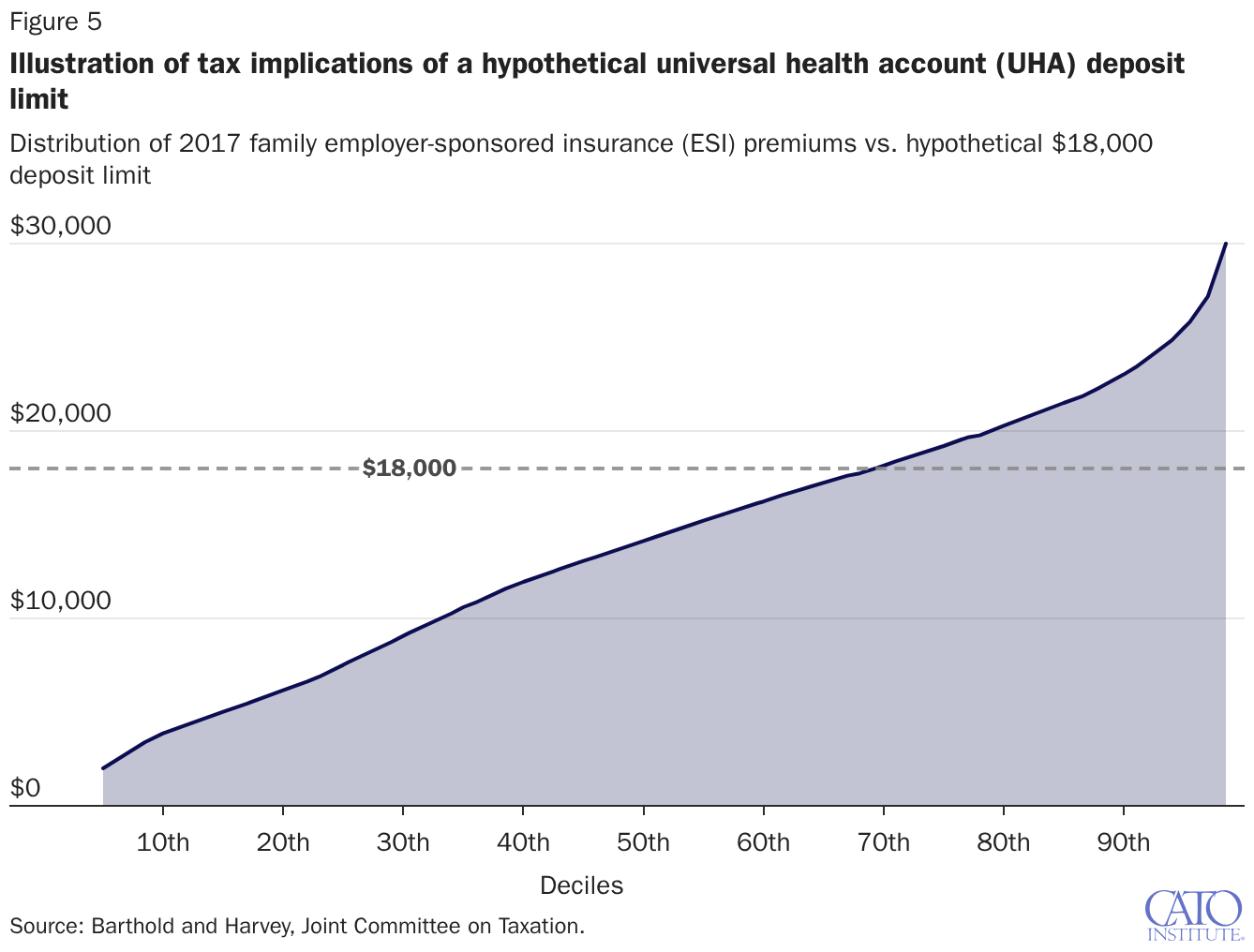
UHAs’ impact on federal revenues would be the net effect of (a) workers who currently exclude more than the deposit limit paying additional taxes on the overage, and (b) workers who currently exclude less than the deposit limit reducing their tax liabilities by excluding more income. The gray triangle above the deposit limit and the white triangle below it crudely represent those effects.143 To the extent workers in group B exclude more compensation than they do under current law, revenue neutrality will require lower deposit limits.
Alternatively, other revenue targets could enhance feasibility. If Congress is looking for novel ways to achieve deficit reduction by limiting the exclusion, then including revenue-positive UHAs in a “reconciliation” bill could enable reform of the exclusion with just 51 votes in the Senate rather than 60. Policymakers also must weigh the indirect effects UHAs would have on federal outlays. (See “Policy Levers and Conforming Changes,” below.)
Access to UHAs
One question potentially affecting political feasibility will be whether Congress conditions access to UHAs on health insurance enrollment. Ideally, Congress would not require UHA holders to enroll in health insurance. Granting taxpayers access to UHAs regardless of where or whether they enroll in health insurance would improve health sector performance. Requiring the health sector to compete with nonconsumption creates additional downward pressure on prices and is a crucial part of making health care more universal.144 The risk that not requiring UHA holders to enroll in health insurance would lead some taxpayers to drop coverage is small, less of a concern than it would be today, and would ultimately correct itself. An insurance requirement could create more problems than it solves.
Granting UHA access regardless of coverage status could have little impact on the number of uninsured. Insured workers who do not place a high value on health insurance might purchase less coverage. They are unlikely to drop insurance, however, and any that do would soon purchase it again for two reasons. First, for the most part, workers who value health insurance so little that they prefer cash have already made that trade. They are already working at jobs that offer higher cash wages in lieu of ESI. The second reason is that the only way that UHAs would change the relevant incentives would be by giving workers the opportunity to save money tax-free for future medical expenses rather than purchase health insurance. Thus, the only currently insured individuals whom UHAs would encourage to drop coverage would be those who do so to put the resulting savings into a UHA—in other words, savers. To the extent that UHAs encourage people to drop coverage, then, they also contain a built-in incentive for those workers to reverse course and purchase health insurance. Those individuals will want to purchase health insurance to prevent an expensive episode of care from wiping out the large UHA balances they accumulate. In theory, UHAs could even induce current marginal nonconsumers of health insurance (workers who currently neither enroll in health insurance nor save for medical expenses) to accumulate enough health savings that they would want to purchase insurance to protect it.
Any increase in the number of uninsured is therefore unlikely to be a significant concern. Workers who drop coverage would be saving for their medical expenses. Moreover, health insurance would become less necessary, thanks to the downward pressure that 180 million price-sensitive consumers would exert on health care prices.145 Any increase in the number of uninsured would therefore be less of a concern than it is today.
Requiring UHA holders to enroll in health insurance, on the other hand, would necessitate that the federal government define minimum acceptable coverage. Any such requirement would reduce innovation and competition in health insurance. It would cordon off up to 5 percent of GDP for private health insurance companies, reducing their incentive to compete to offer consumers greater value. It would also lead insurers and health care providers to lobby, year after year, to increase the amount of coverage UHA holders must purchase, thereby increasing premiums. The additional mandatory coverage would make consumers less price-sensitive, increasing health care prices.
Alternatively, an insurance requirement could empower advocates of catastrophic health insurance to turn a minimum requirement into a maximum requirement. There is precedent. Current law requires taxpayers who wish to make tax-free HSA deposits to enroll in coverage no more comprehensive than a high-deductible health plan. This requirement is a source of dissatisfaction among workers who would prefer more comprehensive coverage.146
If political feasibility dictates that Congress must include an insurance requirement, there would be options. Congress should make any such requirement as minimal as possible. Enrollment in any health insurance plan or risk-pooling arrangement available in any state or US territory should satisfy it.
Policy Levers and Conforming Changes
Additional changes would be necessary to adapt federal law to UHAs. These include adjustments to eligibility for Exchange premium subsidies, adjustments to requirements that employers offer ESI, creating parity for workers without access to payroll deductions, and preventing anti-discrimination laws from unintentionally discriminating against workers with expensive medical conditions. With guidance from the CBO, Congress can calibrate these changes to ensure revenue neutrality (as well as outlay and budget neutrality), or to meet other budget targets.
A Better, More Equitable “Affordability Test”
Federal law bars Exchange premium subsidies for otherwise eligible enrollees if those enrollees have an offer of “affordable” coverage from their employer. The federal government considers ESI to be affordable if, for the employer’s lowest-cost plan, the portion of the premium that workers pay directly is less than 9.96 percent of a worker’s household income.147 This so-called affordability test curbs federal outlays by limiting incentives for workers to leave employer plans to enroll in government-subsidized Exchange plans.
Under UHAs, the share of employer-plan premiums that workers pay directly would increase, from an average of 16 percent of the premium for self-only coverage and 26 percent for family coverage, to 100 percent of the premium in all cases.148 The amount workers pay directly would increase by average factors of six and four, respectively. Many more workers would have to pay more than 9.96 percent of household income directly toward their employer’s lowest-cost plan. The number of workers eligible for Exchange-plan subsidies, and thus federal spending, would increase significantly.
Congress can remedy this effect, and improve the affordability test, by basing subsidy eligibility on whether the total premium for the lowest-cost ESI plan exceeds a specified percentage of household income. The share of the premium that the worker pays directly has little bearing on affordability. (It is closer to being a measure of how much control over her income the exclusion deprives her.) The actual cost to workers is the total premium; that is what Congress should use. Congress could calibrate the new affordability-test percentage at whatever level is necessary to ensure outlay neutrality.
A Firewall Between UHAs and Exchange Subsidies
Another consideration is whether taxpayers could be simultaneously eligible to make tax-free UHA deposits and to receive a premium subsidy through a health insurance Exchange. To ensure outlay neutrality, Congress should prevent taxpayers from simultaneously taking advantage of both. Doing otherwise could cause federal spending and deficits to increase significantly.
Even if Congress set UHA deposit limits to ensure revenue neutrality, UHAs could increase outlays. UHAs would reduce many taxpayers’ modified adjusted gross income. They would therefore make more individuals eligible for Exchange premium subsidies and make those already receiving subsidies eligible for larger subsidies. To ensure outlay and budget neutrality, Congress should prohibit taxpayers who receive Exchange premium subsidies from also making UHA deposits. If a taxpayer receives an Exchange premium subsidy of even $1, any UHA deposits the taxpayer made within the same tax year would be subject to income taxes, payroll taxes, and an excise tax.149 Taxpayers could take advantage of whichever mechanism they calculate would provide them the greatest benefit—but not both.150
Eliminate the Employer-Mandate Tax on Workers
Federal law creates an employer mandate that threatens certain employers with tax penalties unless they offer health insurance to workers. Congress would need to determine how UHAs interact with this mandate. UHAs provide an opportunity for eliminating it; Congress should do so if consistent with outlay neutrality.
The employer mandate has two prongs. Under the first, if an employer with 50 or more full-time employees does not offer “minimum essential coverage” to at least 95 percent of employees and dependents, and one of those employees receives an Exchange premium subsidy, the employer must pay a penalty of $3,340 per employee (on every employee beyond the first 30). Under the second prong, even if the employer offers minimum essential coverage to 95 percent of employees, the employer must pay a penalty of $5,010 for each employee who qualifies for and receives an Exchange premium subsidy (e.g., because the portion of the premium that the employee must pay toward the employer’s lowest-cost plan exceeds 9.96 percent of the employee’s household income), not to exceed the total penalty the employer would pay under the first prong.151
The employer-mandate tax’s penalties fall on workers, not employers. Just as workers bear 100 percent of the cost of employer-sponsored health insurance, they bear 100 percent of the cost of these penalties.152 In effect, an employer mandate requires employers to take control of their workers’ earnings and spend them how the government wants. It is a requirement that employers give workers less control over their earnings.
Employer-mandate penalties are also inequitable. In effect, if employers do not obey the government’s commands, the employer mandate penalizes employees—who, by the government’s admission, are already struggling to afford health insurance. Worst of all, this tax falls disproportionately on low-wage workers.153
Ideally, Congress would eliminate the employer mandate. Leaving it in place would continue to deny struggling workers thousands of dollars of income. Workers should be free to receive those funds as income that they could contribute to a UHA to pay their health insurance premiums and medical bills.
Granted, there is uncertainty about whether and to what extent adding employer-mandate repeal to the foregoing reforms would increase Exchange subsidy outlays. On the one hand, it is possible that the CBO would score employer-mandate repeal as increasing outlays. If repeal leads employers to stop offering coverage, additional workers could become eligible for premium subsidies toward Exchange plans. If those workers value the premium subsidies more than the tax advantages of UHAs, spending on Exchange subsidies could increase, potentially threatening outlay neutrality.
On the other hand, repeal might not make much difference. When workers gain greater control over $1.6 trillion of their earnings, many would still demand ESI, employers would continue to offer it, and ESI plans would become more affordable. The existence of a better affordability test and firewall between UHAs and Exchange subsidies may be enough to prevent any significant shift from ESI to Exchange coverage. Again, experience has shown that ESI is more resilient than even economists believed. The affordability test also offers a lever Congress could use to ensure outlay neutrality while repealing the employer mandate.
Whether repeal can be part of an outlay-neutral UHA package will ultimately depend on CBO projections. If Congress can repeal the employer mandate’s tax on workers while maintaining outlay neutrality, it should. If repeal would require Congress to adjust other parameters of the package to achieve outlay neutrality, Congress should make those adjustments.
Equal Treatment for Nonpayroll UHA Deposits
Nonpayroll UHA deposits would not automatically receive the same tax treatment as payroll-deduction deposits. Self-employed workers cannot make payroll-deduction UHA deposits, some employers would not arrange them, and many workers who could make such UHA deposits would nevertheless make deposits outside those arrangements.
Providing equal treatment to these workers would therefore require additional conforming changes to the tax code. Those additional mechanisms must mirror the effects of the exclusion and related provisions of federal law when other workers make UHA deposits. With such changes, UHAs would finally provide full tax parity to all workers—including the self-employed, workers without ESI, and workers who make nonpayroll deposits to existing tax-free health accounts.
To produce fully equal treatment, such mechanisms must first create full tax parity. Second, they must make the tax savings immediately apparent to workers. Third, they must prevent any indirect reductions in workers’ incomes. Finally, they must ensure that nonpayroll UHA deposits interact with Social Security and Medicare in the same manner as payroll-deduction deposits. Congress could create full and immediate parity without indirectly reducing workers’ incomes, through either a tax-deduction- or tax-credit-based approach. (See Box 4.)
Box 4
Parity for Nonpayroll UHA Deposits: Deductions vs. Credits
For self-employed workers, Congress could provide tax parity, through the existing self-employment tax filing system, with an above-the-line income-tax deduction plus a self-employment-tax deduction for UHA deposits up to the applicable deposit limits.154 For wage employees, Congress could grant access to the same above-the-line income-tax deduction and create a distinct payroll-tax deduction for nonpayroll UHA deposits. These deductions, which would provide full parity for nonpayroll UHA deposits, would operate similarly in some ways and differently in others.
These deductions would be akin to the above-the-line income-tax deduction that now exists for health insurance purchases by self-employed individuals. The new deductions would be different in three respects. First, they would be available solely for UHA deposits. Second, they would end at the deposit limits. Third, UHA deposits would be deductible against both income and payroll taxes.
For both types of worker, the tax savings would be immediately apparent. Self-employed workers would adjust their quarterly estimated tax payments to account for the tax savings. Wage employees could immediately adjust their income-tax withholding. Congress could give wage employees immediate access to the tax benefits of the payroll-tax deduction by adding verified nonpayroll UHA deposits to the reasons employers must make payroll-tax overpayment adjustments (and request refunds), and by requiring employers to reduce payroll-tax payments for employees who make regular UHA deposits.155
Self-employed workers pay federal self-employment and income taxes directly, thus there is no risk of these mechanisms indirectly reducing those workers’ incomes. For wage workers, the complexity of the tax system means that a payroll-tax deduction could indirectly reduce their earnings.156 Congress could prevent that outcome by requiring employers to split the tax savings evenly between the employer and employee portions of payroll-tax payments, and to add both amounts to the employee’s paycheck (but not their taxable income).
Achieving parity via tax deductions would add complexity to the tax system, particularly for employers who are trying to limit complexity (by not offering to facilitate UHA deposits). Using a tax-credit approach to create payroll-tax parity for wage employees, by contrast, could create additional complexity for both workers and employers.157 Under this approach, employees would receive a nonrefundable tax credit equal to the amount of payroll tax they already paid on any nonpayroll UHA deposits. The tax savings would exactly equal what the employee would have received under either the exclusion or paired deductions. As there is currently no payroll-tax filing/reconciliation system for individual taxpayers, Congress would either have to create one or administer a payroll-tax credit through the income-tax filing system. Making the credit advanceable would involve complexities for employers similar to those of a deduction.
Ensuring a level playing field for all workers would further require that nonpayroll UHA deposits interact with Social Security and Medicare in the same manner as payroll-deduction deposits.158 First, Congress should structure whatever parity mechanisms it creates so that UHA deposits have the same impact on these workers’ future Social Security subsidies. As with ESI premiums today, employer-arranged UHA deposits would not count toward either a worker’s Social Security earnings or the worker’s accrual of future Social Security subsidies. When workers make nonpayroll UHA deposits, Congress should reduce these workers’ Social Security–taxable earnings by the amount of the deposits and adjust their subsidy accrual accordingly.
Second, Congress should structure these parity mechanisms to have the same impact on Social Security and Medicare revenues. To the extent that a worker makes nonpayroll UHA deposits, Congress should deduct the resulting payroll-tax relief from the respective program’s “trust fund” revenues. Without these changes, different UHA deposits would have different effects on the longevity of the Social Security and Medicare programs’ automatic spending authority (colloquially, the exhaustion dates of those programs’ trust funds).
Avoiding Unintended Consequences of Anti-Discrimination Laws
When UHAs lead employers to shift compensation to wages, anti-discrimination laws could ironically encourage discrimination against workers with expensive medical conditions. A temporary liability shield could block those perverse incentives. In addition, a temporary liability shield could provide further impetus for employers to make those cash-outs immediate.
Preventing discrimination against workers with expensive medical conditions would require that sicker workers receive larger wage increases than healthier workers.159 Fully avoiding such discrimination would require that each worker’s cash-out correspond to the wages that worker forgoes in order to obtain ESI. (Technically, wage increases would correspond to each worker’s compensating wage differential, or the difference between that worker’s non-ESI compensation and marginal productivity.) If an employer were to provide a uniform cash-out to all employees, or even if the wage increases merely exhibited less variation than employees’ compensating wage differentials, such would constitute a pay cut for the sickest employees—and only the sickest employees.
Even if employers completely avoid such discrimination, however, they could still face liability. Compensating wage differentials are unobservable and essentially unknowable. As a result, reasonable disagreements could lead to employee complaints and liability even where there is no actual discrimination. If employees and courts believe (erroneously, but understandably) that nondiscrimination requires uniform wage increases, employers could face liability precisely because they did not discriminate against sicker employees. In each scenario, anti-discrimination laws could inadvertently encourage discrimination against the sick by leading employers to cut the pay of their sickest workers to avoid litigation and liability.
A temporary, one-time liability shield for activities surrounding the calibration and implementation of wage increases in response to UHAs could encourage employers to make those wage increases immediate and would prevent anti-discrimination laws from harming the sick. Once again, regardless of the cause, to the extent that wage increases fail to correspond to workers’ marginal productivity, competitive labor markets would soon correct those errors.
Conclusion
The tax exclusion for ESI is the chief obstacle to more efficient, equitable, and universal health care. It is time that Congress fix it. UHAs are not ideal health, tax, or economic policy. They would maintain a tax preference for health spending over nonhealth uses of income and could increase incentives for special interests to lobby to expand the tax code’s list of medical expenses taxpayers may purchase with tax-free UHA funds.
Even so, UHAs may be the best politically feasible reform option. They would vastly simplify and improve the tax code by neutralizing or reducing the most perverse incentives of the tax exclusion for ESI. Relative to current law, they would remove countless tax-based distortions from workers’ and firms’ economic decisions. They would lead to a labor market that better meets the needs of workers, and a health sector that better meets the needs of patients. They would produce 180 million price-sensitive consumers who would punish unconscionable medical prices and other business practices in a way that consumers cannot when employers make their health plan decisions. Even if special interests were to convince Congress to expand the definition of tax-free “qualified medical expenses” to include gym memberships and exercise equipment, UHA holders could simply decline to purchase those items. The freedom not to spend money on tax-favored items—especially health insurance—reduces the incentive for such rent-seeking in the first place.
The combination of greater efficiency, greater equity, and immediate benefits to identifiable constituencies makes UHAs perhaps the most politically feasible and sustainable way to reform the exclusion. Where past efforts roused partisanship by favoring one party’s ideology over another’s, UHAs would advance Republican and Democratic values in equal measure. UHAs’ selling points—giving workers greater control over $1.6 trillion of their earnings each year, proportionally greater gains for low-income workers, and a quicker, smoother transition than any other reform offers—are valuable. So is the fact that UHAs could garner the support of groups that would push back against the inevitable opposition.
Citation
Cannon, Michael F. “Universal Health Accounts: A Politically Feasible Way to Reduce Health-Related Tax Distortions,” Policy Analysis no. 1025, Cato Institute, Washington, DC, November 17, 2026.

About the Author


This work is licensed under a Creative Commons Attribution-NonCommercial-ShareAlike 4.0 International License.