Live Now
Cato at Liberty
Cato at Liberty
Cato at Liberty
Cato at Liberty
Topics
July 11, 2013 10:47AM
Perhaps the “New” Farm Bill Wouldn’t Be So “New” After All
It appears that I spoke too soon. According to a news article from Chris Clayton, one of America’s best agriculture reporters, the new House farm bill, due to be voted on today, will not necessarily be the gift to reformers I thought it might. The key paragraph of Chris’s story:
The bill would keep the same commodity, conservation, crop insurance and rural development provisions that were developed by the House Agriculture Committee and amended on the floor before the full farm bill failed to pass June 20. A key difference, however, is that the legislation also would repeal the 1938 and 1949 permanent farm law. The new Title I would become permanent law moving forward. [emphasis added]
That’s not good news at all. And it has been suggested that all of this “bill splitting” is just a vehicle for getting the bill done in pieces, to be reconciled back to its former self in conference. I guess that explains why Heritage Action for America and the Club for Growth, both organisations that one would expect to support this sort of move, have issued key vote alerts urging a “no” vote.
Back to the drawing board.
July 11, 2013 10:44AM
Hurricane Bluster
Global Science Report is a weekly feature from the Center for the Study of Science, where we highlight one or two important new items in the scientific literature or the popular media. For broader and more technical perspectives, consult our monthly “Current Wisdom.”
When it comes down to scaring people into accepting onerous reductions in carbon dioxide emissions, it’s always a good idea to trot out the specter of increased hurricanes, despite the lack of backing for this in the science literature.
“Bluster” isn’t the name of an Atlantic hurricane (although it would be a good one*), but rather our description of the stories about new research out of the Massachusetts Institute of Technology projecting an increase in the frequency and magnitude of hurricanes as a result of anthropogenic climate change.
Publishing in the Proceedings of the National Academy of Science, M.I.T.’s Kerry Emanuel projects a rather large increase in the global frequency of tropical cyclones as well as their intensity over the course of the 21st century.
Emanuel is the first to admit that the changes he found were largely of a different character to those in the generally accepted literature, which projects little change in the frequency of tropical systems (with perhaps even a slight decline) and only a slight increase in the future intensity.
The difference between Emanuel’s results and those from the bulk of other studies arises primarily for two reasons; 1) the future emissions scenario used to drive the global climate models; and, 2) the method of downscaling coarse climate model output to the finer scale necessary to model tropical cyclones.
When it comes to emission scenarios, Emanuel chooses to use the most extreme scenario, which more than triples the effective atmospheric carbon dioxide concentration by the end of the century, while most other studies have used a more modest scenario which leads only to about a doubling. With new technologies opening up vast abundances of lower CO2-emitting natural gas available for power generation, the extreme emissions scenario used by Emanuel seems unlikely.
(This might also prompt the question as to why it was necessary to use the extreme scenarios in the draft “National Assessment” of climate change released in January by federal climatologists. See our voluminous comments here).
With regard to the downscaling methodology, another paper, to be published later this year, uses a different procedure and arrives at nearly the opposite result. In the North Atlantic basin—the area in which the bulk of tropical cyclones which effect the United States occur—Thomas Knutson (of the Geophysical Fluid Dynamics Laboratory) and colleagues find a decline of hurricane frequency of nearly 25 percent with an intensity increase of only about 6 percent.
It’s worth noting that, according to research by Wang et al. (2011) and Murakami et al. (2012), future storms are actually more likely to remain at sea rather than striking the U.S.
Emanuel, on the other hand, finds increases in both frequency and intensity of storms in the North Atlantic. Emanuel notes that further research into the difference produced with his model compared with Knutson’s “may prove enlightening.”
We concur.
The bottom line is that the significance of the results of Emanuel’s new study depends on an extreme emissions/warming scenario and a methodology which needs further evaluation. And even so, the changes reported by Emanuel in the North Atlantic, the area or primary concern for U.S. interests, do not rise above the noise of natural variability for many decades into the future.
Contrary to the media bluster being generated by the new study, the true bluster of future hurricanes impacting the U.S. will likely be little different in the coming century than it was during the last—with any impact of anthropogenic climate change lost in the noise of the natural system.
As with most global warming scare stories, cocksure stories about increased hurricane activity are a bit blustery.
References:
Emanuel, K., 2013. Downscaling CMIP5 climate models shows increased tropical cyclone activity over the 21st century. Proceedings of the National Academy of Sciences, do:10.1073/pnas.1301293110
Knutson, T., et al., 2013. Dynamical Downscaling Projections of Twenty-First-Century Atlantic Hurricane Activity: CMIP3 and CMIP5 Model-Based Scenarios. Journal of Climate, doi:10.1175/JCLI-D-12–00539.1, in press.
Murakami, H., et al., 2012. Future Changes in Tropical Cyclone Activity Projected by the New High-Resolution MRI-AGCM. Journal of Climate, 25, 3237–3260. doi: 10.1175/JCLI-D-11–00415.1.
Wang, C., L. Hailong, S‑K. Lee, and R. Atlas, 2011. Impact of the Atlantic warm pool on United States landfalling hurricanes. Geophysical Research Letters, 38, L19702, doi:10.1029/2011GL049265.
div* Back when it was OK to be funny about politicians, Australia named its tropical cyclones for sitting senators. Those were the days.
Related Tags
July 11, 2013 10:16AM
Can Egyptian Democracy Arrive on the Back of Tanks?
U.S. foreign policy has resulted in many grand failures. Egypt has joined the pantheon.
That nation long has been a national wreck. Washington emphasized “stability” since Cairo backed U.S. policy and preserved peace with Israel.
Two years ago the people of Egypt finally had enough. Unfortunately, Hosni Mubarak’s fall loosed Islamist forces. The Muslim Brotherhood’s Mohamed Morsi was elected president and won approval of an Islamist-oriented constitution.
But President Morsi failed politically and economically. After just one year, millions of demonstrators demanded his ouster. Neither side was much interested in compromise, so the generals staged a coup.
The Obama administration stands helplessly in the middle, denounced by the Brotherhood and anti-Morsi protestors. Yet the administration still refuses to follow the law, which mandates an end to foreign aid in the event of a coup.
Although Morsi was responsible for his failures, he was obstructed at many turns. The opposition behaved little better, failing to organize effective political parties and develop political leaders.
As I write in my latest American Spectator article:
The military’s coup cannot be disguised as something else. Imagine U.S. army units invading the Oval Office, arresting President Barack Obama and his senior aides, detaining hundreds of top Democratic Party officials, closing down MSNBC and other Democratic-leaning media, appointing Chief Justice John Roberts as caretaker president, and shooting pro-Obama protestors. Americans would call it a coup. Even conservatives would call it a coup.
Unfortunately, coups rarely yield democratic results, especially when staged against freely elected officials. A coup is by definition force and necessarily relies on repression. The result is more often extended dictatorship—Spain 1936, Iran 1953, Chile 1973, and Greece 1967, for instance—than renewed democracy.
Electoral defeat would have discredited the Brotherhood, but political martyrdom may revive the organization. And if the Brotherhood does not receive credible assurances that it will be allowed to fairly compete in the future, political Islam in Egypt and elsewhere may turn sharply against democracy. The nightmare scenario is Algeria, where a decade of civil war followed the suppression of Islamists who were poised to win a parliamentary election.
In any case, the military is no friend of secular liberals and the freedoms they hold dear. Nor are the generals likely to slink into the background after having been handed the keys to the kingdom. Indeed, the coup precedent will remain, ready for use against the next president who expands his powers, fails to fix the economy, and offends well-organized groups.
There is no good answer. Egypt likely faces more short-term violence and certainly faces long-term instability. Washington can do little. The administration should follow the law and cut off aid. Then, having long underwritten autocracy, the U.S. government should get out of the way.
Related Tags
July 11, 2013 9:45AM
“Crisis” Averted on Backs of Poor?
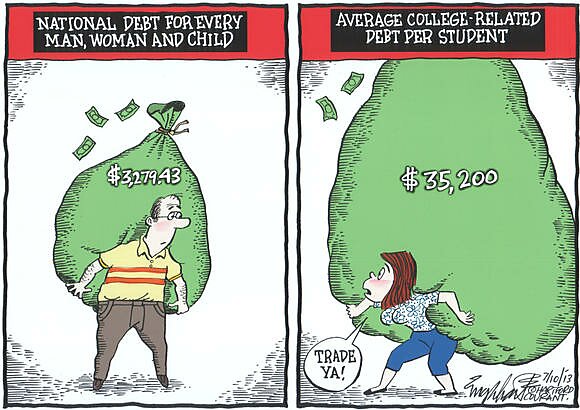
This morning, I was greeted with the news that the Senate has reached a compromise on student loan rates, likely averting the “crisis” of having rates on “subsidized” loans — those most targeted toward low-income students — double from 3.4 percent to 6.8 percent. Of course this wasn’t really a crisis. The increase would only have affected new loans, would have just added about $6 to monthly payments based on the average yearly subsidized loan, and might even have been slightly useful because the primary problems in higher ed are massive over-consumption and price inflation driven by cheap aid. If we want to fix those things, we should be phasing out price and consumption-distorting aid programs.
Suppose, though, you think federal aid is necessary to make sure college is affordable for the truly needy. I assume that most aid supporters — including those who voted for the compromise in the Senate — would say that that is the top goal. So why, then, does the compromise set the same interest rates for subsidized loans as unsubsidized, the latter being accessible to anyone regardless of income? Wouldn’t a top priority be to keep the subsidized rates lower? (Subsidized loans would, importantly, still have interest covered by the government while students are in school.)
Maybe information explaining this will come out as more news breaks, but it seems quite possible that the main objective is not, actually, to help the most needy, but to appear to help anyone who wants to go to college, regardless of income or need. Maybe it is to curry favor with as many voters as possible. That hypothesis not only seems to fit the current case, but overall federal involvement in higher education, which involves not just Pell Grants or subsidized loans largely focused on the poor, but unsubsidized loans that have no income cap; tax credit programs skewed toward the well-to-do; and a whole perverse aid process that favors those people who know when to buy homes, time raises, and other savvy tactics to maximize what they get from schools and taxpayers.
If the goal were really to help the truly needy, it seems the Feds would have a single grant or loan program aimed squarely at people earning, say, 200 percent of the poverty line. But, as this compromise seems to further confirm, that’s probably not the primary goal. Maximizing votes is, which is exactly what we should expect from politicians who, like all of us, want first and foremost to get what’s best for themselves. It’s also why, for everyone’s sake, we should demand that the Feds stay completely out of student aid.
Related Tags
July 10, 2013 4:59PM
Economic Development Administration Goes ‘Rambo’ on Itself
There exists in the Department of Commerce an irrelevant Great Society relic called the Economic Development Administration. With a relatively small budget of around $400 million, the EDA acts as a slush fund for Congress to shovel subsidies to their districts for projects that should be funded locally or privately.
That’s why it’s been hard to kill. Indeed, last year 175 Democrats and 104 Republicans teamed up to defeat an amendment introduced by Rep. Mike Pompeo (R‑KS) that would have finally put the EDA out of its misery.
Around the same time that the EDA came under attack from Rep. Pompeo, the agency believed that it had also suffered a cyber attack on its IT infrastructure. National Review Online’s Kevin Williamson has the story, which has to be one of the all-time greatest examples of bureaucratic ineptitude:
The trouble began in December 2011, when the Department of Homeland Security alerted Commerce that it had discovered a possible malware infection in the department, specifically within the network located within the Hoover Building. The EDA’s immediate reaction — based on absolutely nothing — was: cyberwar! According to the [Dept. of Commerce inspector general] audit, the main concern among the EDA’s top brass was that the agency was under attack by a nation-state actor. There was no evidence to support that fear, and a good deal of evidence to the contrary, but the EDA basically went to whatever is the Commerce Department’s version of DEFCON 1.
As Kevin deftly wise-cracks, “If the Chi-Coms wanted to hurt the U.S. economy, they wouldn’t attack EDA; they’d hire a lobbyist to increase its funding.” But, after all, we’re talking about an agency that has an amazingly inflated sense of self-worth. And so the EDA decided that it wasn’t taking any chances – the agency’s entire IT infrastructure had to go:
Rather than acknowledge the fact that the malware was almost certainly the result of somebody’s clicking on a link to an infected funny-cat video on a department computer, EDA proceeded as though it were facing the tip of the spear in a cyberwar attack by a foreign power. First it cut its computers off from the rest of the network in an effort to keep the malware from spreading, a defensible decision if one that was overcautious in light of the evidence, which pointed to nothing more than a common infection. What happened next, though, demonstrated fascinating ineptitude: Rather than simply identifying the infected computers and fixing them, the agency set about physically destroying its IT hardware — not just computers, but keyboards, printers, digital cameras, and other equipment entirely unrelated to the problem.
This being the federal government, contractors made a killing: EDA spent a mere $4,300 on the process of physically destroying $170,500 worth of computers and equipment, but spent another $1.4 million on advice from contractors, and another $1 million on temporary computers to use while it was destroying the ones it already had.
The only thing that stopped EDA from destroying its entire IT infrastructure was that it ran out of money to fund the demolition.
As the inspector general put it, there was “no evidence of a widespread malware infection,” while Commerce “propagated inaccurate information” and “did not follow the department’s incident-response procedures,” and the man in charge “did not have the requisite experience or qualifications.” The head of the EDA is one Matt Erskine, a Democratic time-server and campaign donor, veteran of the Warner administration in Virginia, and, hilariously enough, formerly “a principal in the Advanced Technology-Telecom and Professional Services practices of the management consulting firm Korn-Ferry International.”
Were it not for the wasted tax dollars and the fact that this bumbling agency will continue to exist thanks to both Republicans and Democrats, the entire episode would be downright hilarious. Attempting to stop a cyber attack by destroying keyboards and digital cameras?! That must have been a sight to behold. For me, it brings to mind this scene from the end of the second Rambo movie:
At least Rambo had a legitimate reason to clean house.
Related Tags
July 10, 2013 4:21PM
Japan Confronts China: Will the United States Get Caught in the Middle?
Evidence continues to mount that Japan is adopting a more assertive role in international affairs, especially toward China. Just this week, Japan’s defense ministry issued a report charging that the country faced increasing threats from both China and North Korea. More notably, officials warned Beijing to stop trying to change its position in the region through intimidation or force.
In one sense, it may be beneficial to the United States if Japan begins to act like a normal major power in the international system. Tokyo has behaved for far too long as a quasi-pacifist country, heavily relying on the United States to manage East Asia’s security problems—and even expecting Washington to protect Japan’s own vital economic and security interests while Tokyo barely deigned to lend a helping hand. Japan’s long-standing, self-imposed limit of spending no more than one percent of the country’s gross domestic product on defense is just one sign of that unhealthy dependence. Whatever the wisdom of the United States playing the role East Asia’s security blanket in previous decades, when Japan and other democratic countries in the region were poor and weak, that strategy long ago outlived any usefulness it might have had. Today, it makes little sense for America to borrow money from foreign creditors, including China, to continue subsidizing the defense of such allies as Japan, which should be fully capable of providing for their own defense.
If Washington can off-load obsolete and risky security obligations onto Japan, Tokyo’s greater assertiveness is a welcome development. But if Prime Minister Shinzo Abe and other leaders merely want the United States to backstop a more aggressive policy in pursuit of parochial Japanese interests in the region, that is a worrisome, dangerous development. And there are signs that Tokyo is seeking such backing, especially regarding its territorial dispute with China over a chain of small, uninhabited islands (called Diaoyu in China and Senkaku in Japan).
As I wrote in the pages of the National Interest Online last year, the Senkaku/Diaoyu quarrel is potentially dangerous to the United States. Secretary of State Hillary Clinton stated in 2010 that Washington’s 1960 defense pact with Japan covers the Senkakus. Assistant Secretary of State for East Asia, Kurt Campbell, was equally definitive in September 2012, stating bluntly that the disputed islands were “clearly” covered by the treaty, which obliges the United States to come to Japan’s aid if attacked.
The Japanese government is doing its utmost to strengthen that attitude on the part of its American protector. The United States needs to take immediate steps to reduce its risk exposure. President Obama should overrule the State Department’s interpretation of the 1960 defense pact, and make it clear to Tokyo that, regardless of any previous positions Washington may have taken over the years regarding the islands, the United States is not about to risk going to war over some uninhabited rocks. It is also important to take that step before a crisis erupts.