Some political elites hold the longstanding view that pursuing a protectionist trade policy could help bolster the American working class. For instance, as Katherine Tai, Biden’s US trade representative, put it: “Tariffs and trade can—and in our view must—be used as part of a strategy for growing the middle class and empowering the working class.” The Trump administration has a similar perspective and has pursued a trade and tariff policy that it claims will help American workers.
However, recent polls from the Cato Institute/Morning Consult in March of 2,002 registered voters and in August of 4,150 registered voters found that tariffs have not been well received among working-class American voters.
Working-Class Americans Think Tariffs Have Raised Prices
More than 7 in 10 working-class Americans (71 percent) say that tariffs enacted by the Trump administration increased the prices of items they buy at the store. A little more than half (51 percent) believe that these tariffs have weakened the economy, and nearly half (48 percent) say that they have worsened quality of life.
Working-Class Americans Think Tariffs Have Raised Their Taxes
More than half (52 percent) of working-class Americans consider tariffs to be a tax on Americans. This includes 26 percent who think tariffs are a tax increase primarily on Americans and 26 percent who think they are a tax on both Americans and foreign countries equally. Only 20 percent view tariffs as a tax on foreign countries; 9 percent don’t believe tariffs are tax increases; and nearly a quarter (19 percent) don’t know either way.
Working-Class Americans Worry Tariffs Have Harmed US Manufacturing
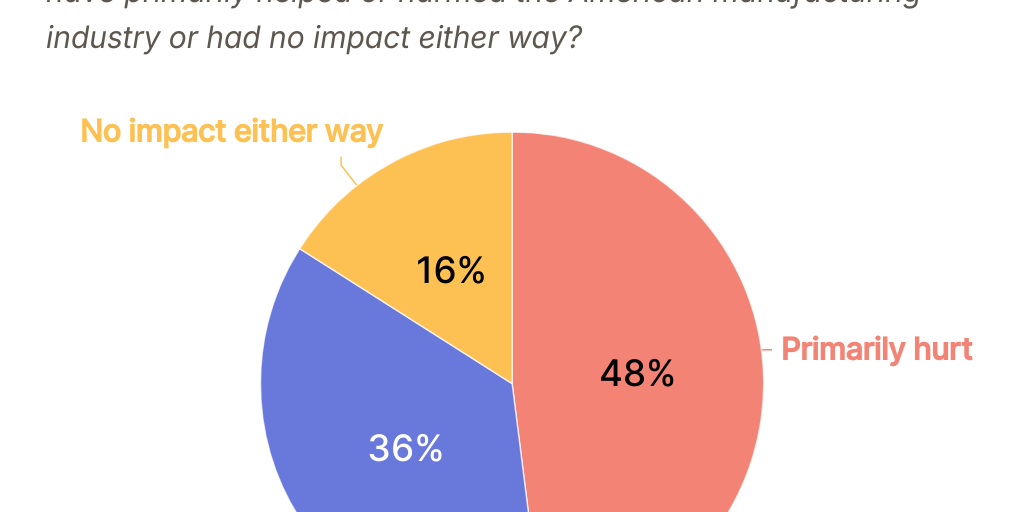
Most working-class Americans (70 percent) think the country would be better off with more manufacturing jobs. However, few believe recent trade policies have achieved this goal. More working-class voters think tariffs have harmed American manufacturing (48 percent) than helped (36 percent), and 16 percent think the tariffs have had no impact at all.
Working-Class Americans Aren’t Willing to Pay Higher Prices to Boost American Manufacturing
At first, a plurality (45 percent) of working-class Americans favor placing tariffs on most products brought into the US, in efforts to encourage more companies to create more jobs and make more products in America, while 40 percent oppose and 16 percent don’t have an opinion either way.
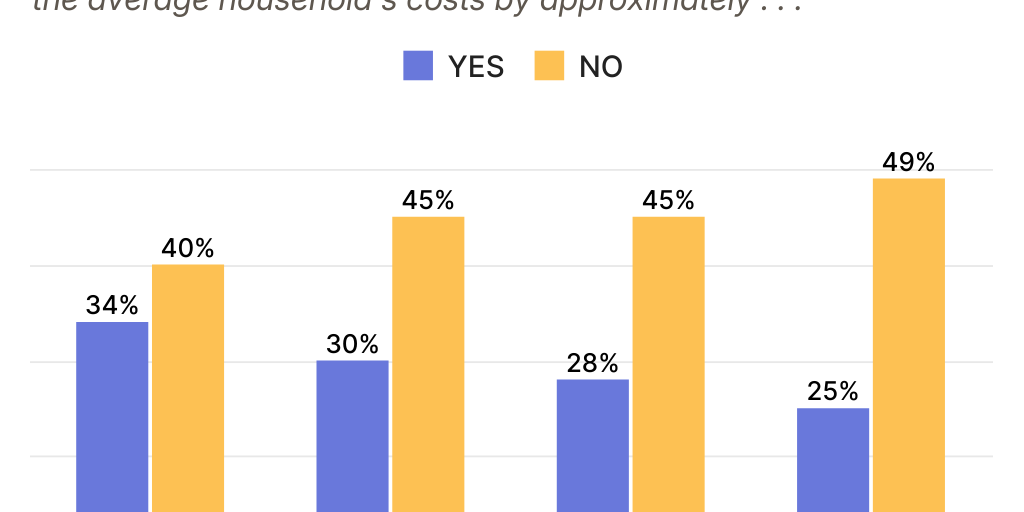
However, only 34 percent of Americans without college degrees would be willing to pay even $100 more a year in higher household costs as a consequence of tariffs, while 40 percent would not be willing and 26 percent aren’t sure. President Trump envisions tariffs bringing manufacturing back to provide jobs for working-class Americans, but this subset of Americans is less able to withstand the higher prices they believe are associated with higher tariffs.
Research findings from the Yale Budget Lab and the Tax Foundation estimate that the likely impact of tariffs on household costs in 2026 has been $820–$1,100 for the average household, which suggests that many working-class Americans have faced at least a $100 increase, if not more, in higher household costs.
The financial fragility of many working-class Americans provides important context for these results. In our survey, nearly two-thirds (62 percent) of respondents without a college degree report incomes under $50,000 a year, compared to 23 percent among college graduates. Furthermore, among working-class Americans, 25 percent have incomes less than $20,000 a year, and 46 percent have incomes less than $35,000 a year. A majority (65 percent) have been worried about paying their bills sometime during the last year, with half (50 percent) believing they could not cover an unexpected expense of $500.
Working-Class Americans Are Skeptical Tariffs Achieve Their Objectives
When asked what effects tariffs have, the most likely response working-class Americans give is “they raise prices” (60 percent). After that, most say that they disrupt supply chains (42 percent) and risk retaliation from other countries (42 percent). Fewer think that tariffs have achieved their intended goals of generating revenue for the US government (34 percent), boosted American manufacturing (29 percent), reduced dependence on imports from other countries (28 percent), or improved US national security (15 percent).
Blue-Collar Workers Disapprove of President Trump’s Trade Policies
These results may help explain why a majority of working-class Americans have an unfavorable view of President Trump’s trade policies (56 percent) and disapprove of his work as president more generally (53 percent).
Working-Class Americans Say Tariffs Will Be Important to Their Midterm Vote
Perceptions that tariffs are raising prices, raising taxes, and failing to achieve their purported goals provide important context going into the midterms. Nearly three-fourths (74 percent) of Americans without college degrees say that tariffs will be important to their midterm vote; of these, 52 percent plan to vote Democrat compared to 38 percent planning to vote Republican.
Perceptions Among the Working Class Differ Little from College Graduates
Perceptions of tariffs among Americans without college degrees varies little from those with college degrees. Although the working class may be slightly less critical, both feel tariffs have increased prices of items they buy at the store (71 percent non-college, 79 percent college), have weakened the economy (51 percent non-college, 55 percent college), and worsened their quality of life (48 percent non-college, 49 percent college). Both groups perceive tariffs to be a tax on Americans (52 percent non-college, 63 percent college) and to have primarily harmed rather than helped manufacturing (48 percent non-college, 50 percent college). Both also have similarly unfavorable views of Trump’s handling of trade policy (56 percent non-college, 58 percent college).
Implications
Whatever one concludes about the economic effects of tariffs, advocates of protectionist policies face a significant challenged in public opinion. Although tariffs are often promoted as a way to protect and strengthen the working class, Americans without college degrees remain unconvinced that current trade policies are helping them. Instead, they believe tariffs are raising their prices and taxes while failing to deliver the promised benefits in manufacturing jobs and economic security. For a policy often sold as a way to strengthen the working class, this represents a striking disconnect between the policy’s promises and how its intended beneficiaries say they are experiencing the effects.
