Cato at Liberty
Cato at Liberty
Topics
General
Obama’s Health Care Speech
In his speech to the American Medical Association today, President Obama repeatedly denied that he supports “socialized medicine” or “government-run” health care.
But what is important is not the terminology, but under the proposal supported by the president, government would control more and more of our health care decisions. Government would compel Americans to purchase health insurance, controlling its content, how much we pay, and the relationships between insurers, doctors, and patients. Government bureaucrats would determine whether Americans receive certain medical services.
There may be no better salesman than Barack Obama, but his product is deeply flawed. The so-called “Public Option,” or government-run plan, that President Obama supports would slowly but inexorably lead to the destruction of the private insurance market and the imposition of a government-controlled single-payer system.
But the problems with Obamacare go well beyond the Public Option, which the AMA opposes. The mandates on businesses and individuals, taxpayer subsidies, insurance regulation, and government interference in private medical decisions pose serious threats to American businesses, taxpayers, and most importantly patients.
That’s bad medicine, no matter what you call it.
Related Tags
Week in Review: Health Care Battles, Pay Caps and North Korean Prisoners
Will Obama Raise Middle-Class Taxes to Fund Health Care?
President Obama is promoting an expansion in federal health care spending, and Democratic leaders are scrambling to find ways to pay for it. The plan is expected to cost about $1.5 trillion over the next decade, but the administration has promised that health care legislation won’t add to already huge federal budget deficits. In a new paper, Cato scholars Michael D. Tanner and Chris Edwards argue that expanding government health care will likely involve huge tax increases on the middle class.
Tanner warns of “Obamacare” to come, saying that Obama’s new health care plan will give “government control over one-sixth of the U.S. economy, and over some of the most important, personal, and private decisions in Americans’ lives.” Don’t miss Tanner’s in-depth analysis of the new health care plan that is making its way through Congress, which “would dramatically transform the American health care system in a way that would harm taxpayers, health care providers, and — most importantly — the quality and range of care given to patients.”
A part of the plan would include “public option” (read: government-run) health care, which would allow the government to compete against private health care providers. Tanner says it would be the first step toward wiping out the private insurance market as we know it:
Regardless of how it is structured or administered, such a plan would have an inherent advantage in the marketplace because it would ultimately be subsidized by taxpayers. It could, for instance, keep its premiums artificially low or offer extra benefits, then turn to the U.S. Treasury to cover any shortfalls. Consumers would naturally be attracted to the lower-cost, higher-benefit government program.
…It is unlikely that any significant private insurance market could continue to exist under such circumstances. America would be firmly on the road to a single-payer health care system with all the dangers that presents. That would be a disaster for American taxpayers, physicians, and—most importantly—patients.
Treasury Seeks to Control Executive Pay Across the Private Sector
Fox Business reports, “The Treasury Department on Wednesday took new steps to rein in executive compensation, saying the Obama Administration would introduce legislation that could create stricter limits on pay; it also appointed an official to head up efforts on the issue.”
In a 2008 Policy Analysis Ira T. Kay and Steven Van Putten explain the misconceptions many people have about executive pay, and why the market is a better arbiter than any bureaucrat in Washington:
Such populist sentiments are often based on misunderstandings about the role of corporate executives in the economy and the vigorous competition that exists for these highly skilled leaders. In the past, federal regulatory efforts based on such misunderstandings have generated unintended consequences, which have damaged the economy and hurt the ability of the market for executives to self-regulate over time.
The labor market for executives and the associated pay levels are already subject to high levels of regulation. Indeed, U.S. corporations are subject to more stringent executive pay disclosure requirements than corporations anywhere else in the world. Before additional regulatory and legislative efforts are unleashed, policymakers should examine the rationale for current pay structures and the strong links between executive pay and corporate performance.
In a Washington Times op-ed, Alan Reynolds says efforts to cap executive pay are wholly misguided:
Congressional hearings to barbecue Wall Street executives are as fun as a circus, but with more clowns. Presidential politics is now taking such political distractions to a lower level.
…Most top executives who were actually in charge during the craze of overinvestment in mortgage-backed securities have been fired. Executives who are fired are not in a position to be “giving themselves” anything.
In reality, top executives are mainly paid by accumulating a big stockpile of company stock and stock options. Estimates of annual CEO pay that Congress and the press have been focusing on look as high as they do only because of the high value of restricted stock or stock options at the time.
Writing in 2007 (before the first round of major bailouts), Cato scholars Jerry Taylor and Jagadeesh Gokhale took it a step further: “Pay Bosses More!”:
Excessive executive compensation harms no one but perhaps the stockholders who put up with it. And stockholders put up with it because there’s good reason to believe that sizable CEO compensation packages help — not harm — corporate performance, which redounds to their benefit, and that of the firms’ workers.
Companies pay workers what they must to deliver their products and services to the market, and supply and demand establishes executive compensation packages the same way it establishes consumer prices. Any overcompensation comes out of the firm’s bottom line — at a loss to the shareholders, not the workers.
North Korea Sentences Two U.S. Journalists to 12 Years Hard Labor
Two American journalists were convicted of entering North Korea illegally while on assignment, and exhibiting “hostility toward the Korean people.” This week, a North Korean court sentenced them to 12 years in a labor prison.
Cato scholar Doug Bandow comments:
Washington should publicly downplay the controversy and present the issue to the Kim regime as a humanitarian matter. The Obama administration should indicate its willingness to open a broader dialogue with North Korea, but indicate that positive results will be possible only if Pyongyang responds with cooperation instead of confrontation. Releasing the two journalists obviously would provide evidence of the former.
Regrettably, Laura Ling and Euna Lee are political pawns. As such, Washington’s best strategy to achieve their release is to simultaneously reduce their perceived value to Pyongyang and ease tensions between the U.S. and North Korea. Patience may be the Obama administration’s highest virtue and Ling’s and Lee’s greatest hope.
In a Cato Daily Podcast, Bandow discusses what can be done for the American prisoners, and how the U.S. government should react.
Related Tags
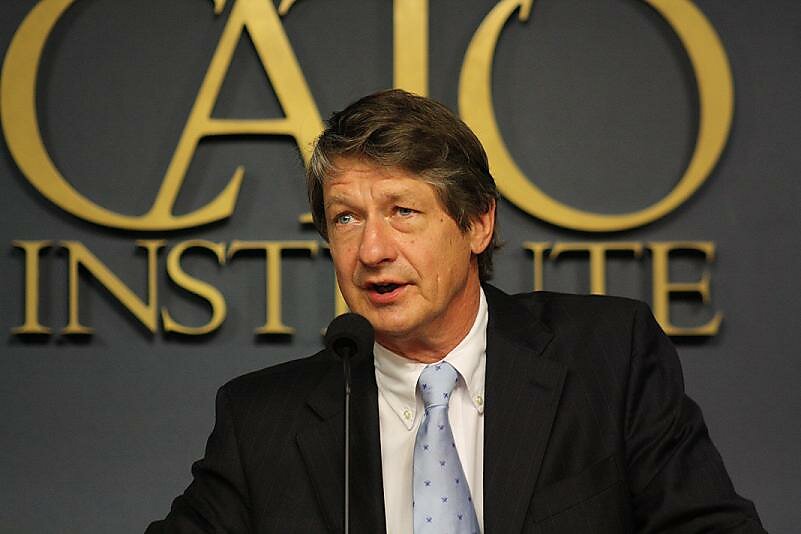
P.J. O’Rourke, Driving Like Crazy
What do automobiles and American founding principles have in common?
At a Cato forum Tuesday, P.J. O’Rourke, author of the new book Driving Like Crazy, said well, plenty.
“Cars fulfilled the Americans’ founding fathers’ dream and ideal,” said O’Rourke. “Of all the truths that we hold to be self evident, of all the unalienable rights with which we are endowed, what is the most important to the American dream? It is right there, front and center…freedom to leave…freedom to get the hell out of town.”
Indeed, the American automobile as many have known it is fading fast. After years of government incentives to build certain types of cars, tax credits to buy smaller ones, higher gasoline tax proposals, and the government takeover of General Motors, the cars that so represented American freedom and individualism won’t last long, he said.
“Pity the poor American car when Congress and the White House get through with it,” he said. “A light-weight vehicle with a small carbon footprint using alternative energy and renewable resources to operate in a sustainable way– When I was a kid, we called it a Schwinn.”
O’Rourke said that going after the automobile is just a way for bureaucrats in Washington to take control over another part of Americans’ lives.
“I’m old enough to realize that freedom is always under attack,” he said. “This is a never ending struggle.”
You can watch his entire speech, or listen in on a Cato special podcast below.
Photo credit: Kelly Anne Creazzo
Related Tags
Week in Review: A Speech in Cairo, an Anniversary in China and a U.S. Bankruptcy
Obama Speaks to the Muslim World
In Cairo on Thursday, President Obama asked for a “new beginning between the United States and Muslims around the world,” and spoke at some length on the Israeli-Palestinian conflict, Iran, Iraq, and Afghanistan. Cato scholar Christopher Preble comments, “At times, it sounded like a state of the union address, with a litany of promises intended to appeal to particular interest groups. …That said, I thought the president hit the essential points without overpromising.”
Preble goes on to say:
He did not ignore that which divides the United States from the world at large, and many Muslims in particular, nor was he afraid to address squarely the lies and distortions — including the implication that 9/11 never happened, or was not the product of al Qaeda — that have made the situation worse than it should be. He stressed the common interests that should draw people to support U.S. policies rather than oppose them: these include our opposition to the use of violence against innocents; our support for democracy and self-government; and our hostility toward racial, ethnic or religious intolerance. All good.
David Boaz contends that there are a number of other nations the president could have chosen to deliver his address:
Americans forget that the Muslim world and the Arab world are not synonymous. In fact, only 15 to 20 percent of Muslims live in Arab countries, barely more than the number in Indonesia alone and far fewer than the number in the Indian subcontinent. It seems to me that Obama would be better off delivering his message to the Muslim world somewhere closer to where most Muslims live. Perhaps even in his own childhood home of Indonesia.
Not only are there more Muslims in Asia than in the Middle East, the Muslim countries of south and southeast Asia have done a better job of integrating Islam and modern democratic capitalism…. Egypt is a fine place for a speech on the Arab-Israeli conflict. But in Indonesia, Malaysia, India, or Pakistan he could give a speech on America and the Muslim world surrounded by rival political leaders in a democratic country and by internationally recognized business leaders. It would be good for the president to draw attention to this more moderate version of Islam.
Tiananmen Square: 20 Years Later
It has been 20 years since the tragic deaths of pro-democracy protesters in Tiananmen Square in June 1989, and 30 years since Deng Xiaoping embarked on economic reform in China. Cato scholar James A. Dorn comments, “After 20 years China has made substantial economic progress, but the ghosts of Tiananmen are restless and will continue to be so until the Goddess of Liberty is restored.”
In Thursday’s Cato Daily Podcast, Dorn discusses the perception of human rights in China since the Tiananmen Square massacre, saying that many young people are beginning to accept the existence of human rights independent of the state.
A few days before the anniversary, social media Web sites like Twitter and YouTube were blocked in China. Cato scholar Jim Harper says that it’s going to take a lot more than tanks to shut down the message of freedom in today’s online world:
In 1989, when a nascent pro-democracy movement wanted to communicate its vitality and prepare to take on the state, meeting en masse was vital. But that made it fairly easy for the CCP to roll in and crush the dream of democracy.
Twenty years later, the Internet is the place where mass movements for liberty can take root. While the CCP is attempting to use the electronic equivalent of an armored division to prevent change, reform today is a question of when, not if. Shutting down open dialogue will only slow the democratic transition to freedom, which the Chinese government cannot ultimately prevent.
Taxpayers Acquire Failing Auto Company
After billions of dollars were spent over the course of two presidential administrations to keep General Motors afloat, the American car company filed for bankruptcy this week anyway.
Last year Cato trade expert Daniel J. Ikenson appeared on dozens of radio and television programs and wrote op-eds in newspapers and magazines explaining why automakers should file for bankruptcy—before spending billions in taxpayer dollars.
Which leaves Ikenson asking one very important question: “What was the point of that?”
In November, GM turned to the federal government for a bailout loan — the one final alternative to bankruptcy. After a lot of discussion and some rich debate, Congress voted against a bailout, seemingly foreclosing all options except bankruptcy. But before GM could avail itself of bankruptcy protection, President Bush took the fateful decision of circumventing Congress and diverting $15.4 billion from Troubled Asset Relief Program funds to GM (in the chummy spirit of avoiding tough news around the holidays).
That was the original sin. George W. Bush is very much complicit in the nationalization of GM and the cascade of similar interventions that may follow. Had Bush not funded GM in December (under questionable authority, no less), the company probably would have filed for bankruptcy on Jan. 1, at which point prospective buyers, both foreign and domestic, would have surfaced and made bids for spin-off assets or equity stakes in the “New GM,” just as is happening now.
Meanwhile, the government takeover of GM puts the fate of Ford Motors, a company that didn’t take any bailout money, into question:
Thus, what’s going to happen to Ford? With the public aware that the administration will go to bat for GM, who will want to own Ford stock? Who will lend Ford money (particularly in light of the way GM’s and Chrysler’s bondholders were treated). Who wants to compete against an entity backed by an unrestrained national treasury?
Ultimately, if I’m a member of Ford management or a large shareholder, I’m thinking that my biggest competitors, who’ve made terrible business decisions over the years, just got their debts erased and their downsides covered. Thus, even if my balance sheet is healthy enough to go it alone, why bother? And that calculation presents the specter of another taxpayer bailout to the tunes of tens of billions of dollars, and another government-run auto company.
America’s Power Problem
Numerous polls show that Americans want to reduce our military presence abroad, allowing our allies and other nations to assume greater responsibility both for their own defense and for enforcing security in their respective regions.
But why haven’t we done so?
In his new book, The Power Problem, Christopher A. Preble contends that the vast military strength of the United States has induced policymakers in Washington to broaden the perception of the “national interest,” and ultimately to commit ourselves to the impossible task of maintaining global order.
Preble holds that the core national interest — preserving American security — is easily defined and largely immutable. In his view, military power is purely instrumental: if it advances U.S. security, then it is fulfilling its essential role.
Preble spoke at Cato about what we views as the proper role of the United States in the world.
Related Tags
The GOP Is Not Serious about Cutting Down Spending
A month ago, President Obama issued a list of proposed spending cuts that I dismissed as “unserious” due to the fact that they were trivial when compared to his proposed spending and debt increases. Today, the House Republican leadership released a list of proposed spending cuts.
I’d love to say I’m impressed, but I can’t.
Both proposals indicate that neither side of the aisle grasps the severity of the country’s ugly fiscal situation, or at least has the guts to do anything concrete about it.
The GOP proposal claims savings of more than $375 billion over five years, the bulk of which ($317 billion) would come from holding non-defense discretionary spending increases to no more than inflation over the next five years.
First, it should be cut — period. Second, non-defense discretionary spending only amounts to about 17% of all the money the federal government spends in a year, so singling out this pot of money misses the bigger picture. At least, defense spending, which is almost entirely discretionary, should be included in any cap. But it has become an article of faith in the Republican Party that reining in defense spending is tantamount to putting a white flag in the Statue of Liberty’s hand.
The second biggest chunk of savings would come from directing $45 billion in repaid TARP funds to deficit reduction instead of allowing the money to be used for further bailing out. That’s a sound idea as far it goes, but I can’t help but point out that the signatories to the document, House Republican Leader John Boehner and Minority Whip Eric Cantor, voted for the original $700 billion TARP bailout. Proposing to rescind the Treasury’s power to release the remaining funds, about $300 billion I believe, should have been included.
According to the proposal, the rest of the cuts and savings comes out to around $25 billion over five years. Like the specific cuts in the president’s proposal, they’re all good cuts. But the president detailed $17 billion in cuts for one year and I generously called it “measly.” What am I to call the House Republican leadership specifying $5 billion a year in cuts?
Take for example, proposed cuts to the Department of Housing and Urban Development (HUD), which is likely to spend around $65 billion this year. Having recently spent a couple months analyzing HUD’s past and present, I can state unequivocally that it’s one of the sorriest bureaucracies the world has ever seen. Yet, the House Republican leadership comes up with only one proposed elimination: a $300,000 a year program that gives “$25,000 stipends for 12 students completing their doctoral dissertation on issues related to housing and urban development.” The only other proposed cut to HUD would be $1.7 billion over five years to the Community Development Block Grant (CDBG) program. This notoriously wasteful program is projected to spend over $8 billion this year alone. Eliminate it!
The spending cuts the country needs must be substantial, serious, and put forward in the spirit of recognizing that the federal government’s role in our lives must be downsized. Half-measures are not enough, and from the Republican House leadership, wholly insufficient for winning back the support of limited-government voters who have come to associate the GOP with runaway spending and debt. For a more substantive guide to cutting federal spending, policymakers should start with Cato’s Handbook chapter on the subject.