Senior fellow Jeffrey Miron discusses some common myths about capitalism in this video by the Institute for Humane Studies’ Learn Liberty project. Learn more at LearnLiberty.org.
Cato at Liberty
Cato at Liberty
Topics
General
In the Grip of Regime Uncertainty, Again
The first chapter in Robert Higgs’ anthology Depression, War, and Cold War: Studies in Political Economy (Oxford University Press, 2006) is titled “Regime Uncertainty: Why the Great Depression Lasted So Long and Why Prosperity Resumed after the War.” This is a fitting title for a piece penned by the scholar who first nailed down the regime uncertainty idea and who rigorously dealt with it. According to Higgs:
“…regime uncertainty pertains above all to a pervasive uncertainty about the property-rights regime—about what private owners can reliably expect the government to do in its actions that affect private owners’ ability to control the use of their property, to reap the income it yields, and to transfer it to others on voluntarily acceptable terms. Will the government simply take over private property? Will it leave titles in private hands, but strip the owners of real control and profitable use of their properties? These questions fall under the rubric of regime uncertainty.”
Higgs explains why the New Deal policies embraced by President Roosevelt generated regime uncertainty and why the Great Depression lasted so long and was transformed into the Great Duration.
Treasury Secretary Henry Morgenthau knew that FDR was turning off businessmen, private investment and the economy. The Treasury Secretary repeatedly attempted to persuade FDR to back off. Indeed, in a cabinet meeting in 1937, Morgenthau was forced to put the matter to the President and put it to him in clear terms: “What business wants to know is: are we headed toward Socialism or are we going to continue on a capitalist basis?”
The Treasury Secretary was no match for the President, however. FDR didn’t back off and the country staggered into WWII.
We are staggering again under the weight of regime uncertainty. The Wall Street Journal’s editorial “How Not to Grow the Economy” contains data that amply support that conclusion.
It’s time for a powerful insider to present President Obama with the “Morgenthau Question.”
Related Tags
Logo Contest for Libertarianism.org
Cato’s new project, Libertarianism.org, is having a logo contest with a $300 prize for the winner. Enter your design in the next 5 days for a chance to win!
Related Tags
Anarchists for Big Government
Three months ago I wrote a long, thoughtful (ahem) critique of the Washington Post’s use of the word “anarchists” to describe people outraged at the possibility that governments might finally be forced “to cut social benefits and slash public payrolls.”
“Odd anarchists,” I harrumphed, who “object to the state reducing its size, scope, and power.”
Today, Michael Cannon made the same point to many more people in a few pithy sentences on the Post’s letters page:
Anne Applebaum informed us that “the anarchists in Athens wanted more government spending” [“The smartphone riots?” op-ed, Aug. 11]. Which is it? Were they anarchists, who want no government? Or were they statists, who want more government?
The lesson? Write letters to the editor. People read them.
Meanwhile, two other letter-writers on the same page complain that the Post should not reveal how our tax dollars are spent, lest the masses turn against Washington. I disagree.
Related Tags
Why Is the Tappan Zee Bridge in the Wrong Place?
David Kestenbaum of NPR Planet Money reports this morning:
You would never look at a map of the Hudson River, point to the spot where the Tappan Zee Bridge is, and say, “Put the bridge here!”
The Tappan Zee crosses one of the widest points on the Hudson — the bridge is more than three miles long. And if you go just a few miles south, the river gets much narrower. As you might expect, it would have been cheaper and easier to build the bridge across the narrower spot on the river.
Was there in fact a good engineering reason to put the bridge there, one that escaped the notice of the NPR reporter? Was there a good economic reason, perhaps avoiding expensive property confiscations?
Well, it won’t surprise readers of Cato-at-Liberty to discover that the bridge is in the wrong place because it made money for the State of New York:
If the bridge had been built just a bit south of its current location — that is, if it had been built across a narrower stretch of the river — it would have been in the territory that belonged to the Port Authority.
As a result, the Port Authority — not the State of New York — would have gotten the revenue from tolls on the bridge. And [Gov. Thomas E.] Dewey needed that toll revenue to fund the rest of the Thruway.
Now the bridge needs repairs, which will cost more because the bridge is three miles long, instead of one mile long as it could have been. In Libertarianism: A Primer (page 199), I cited the work of the Italian fiscal theorist Amilcare Puviani, who asked, If a government were trying to squeeze as much money as possible out of its population, what would it do? He came up with 11 tactics, from inflation and borrowing to extraordinary budget complexity. I wonder if “placing a bridge in an inefficient place so that we get the tolls instead of another government” is covered by one of his strategies.
Related Tags
Slate.com vs. Tea-Party/Christians/Bachmann
Slate worked itself into a lather yesterday over the insidious education policy implications of Michele Bachmann’s Iowa Straw Poll victory:
As recently as a decade ago, Republicans like George W. Bush, John McCain, and John Boehner embraced bipartisan, standards-and-accountability education reform.… Now we are seeing the GOP acquiesce to the anti-government, Christian-right view of education epitomized by Bachmann.… Against a backdrop of Tea Party calls to abolish the Department of Education and drastically cut the federal government’s role in local public schools.…”
To support this narrative, Slate asked Bachmann what the federal government’s role was in education, to which she replied, “There is none; Education is a matter reserved for the states.”
Oh, whoops, sorry. Got that last quote wrong. That wasn’t Bachmann’s answer, it was the answer of the FDR administration.
This answer rests squarely on the Tenth Amendment, which reserves to the states and the people powers not expressly enumerated and delegated to Congress by the Constitution. It was published by the federal government in 1943, under the oversight of the president, the vice president, and the speaker of the House.
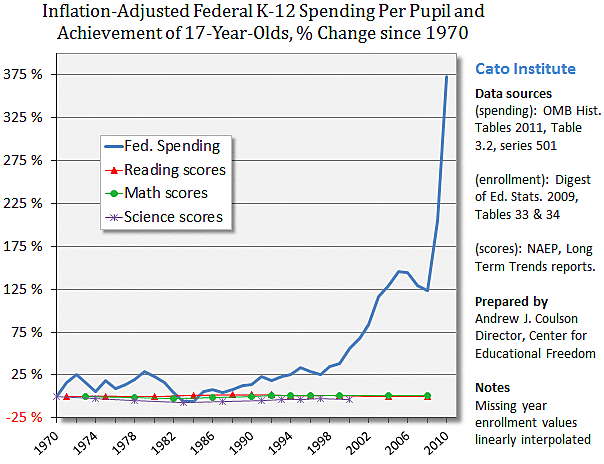
Though it might come as a surprise to Slate’s writers, our nation was not founded on state-run schooling. And, until very recently in historical terms, the idea that the federal government had a role to play in the classroom was unthinkable. It may have required some theorizing to evaluate the merits of Congress-as-schoolmarm prior to the feds getting involved in a big way in 1965, but now… now we can just look in the rear-view mirror (see chart below).
With nearly half a century of hindsight, advocating a federal withdrawal from America’s schools does not seem “anti-government.” Just anti-crazy.
Related Tags
Stossel Thursday
I’ll be on “Stossel” Thursday night, along with Nick Gillespie, George Mason University economists Robin Hanson and Alex Tabarrok, and, um, Dog the Bounty Hunter. The topic is “Defending the Indefensible” (!), and we’ll talk about such putatively difficult issues as insider trading, private money, bounty hunting, and gay marriage.
“Stossel” is on Fox Business Network on Thursday at 10 pm ET, and again at 10 pm Pacific Time (1 a.m. ET). It is rebroadcast on Saturday and Sunday nights. But watch it Thursday night, so you won’t be embarrassed when everybody’s talking about it at the water cooler Friday morning.
If you can’t wait till Thursday night, watch me take questions on “Stossel” from the 500 students at the International Students for Liberty Conference.