Why doesn’t David Axelrod get it? Let Americans purchase health insurance licensed by other states. From CNN…
Cato at Liberty
Cato at Liberty
Topics
Health Care
That Costly Mandate
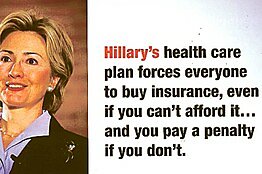
The Wall Street Journal notes that Sen. Max Baucus’s allegedly moderate health care plan “would increase the cost of insurance and then force people to buy it, requiring subsidies. Those subsidies would be paid for by taxes that make health care and thus insurance even more expensive, requiring even more subsidies and still higher taxes.” Other than that, it’s not so bad. The Journal also digs up a great graphic produced by the 2008 presidential campaign of a little-known Illinois senator named Barack Obama:
And speaking of health care mandates and how much they’re going to cost young people, as the Washington Post was yesterday, I just had lunch with Clark Ruper, program manager for Students for Liberty, who told me he’d be on the Newshour with Jim Lehrer on PBS tonight. In the interview he told them that as a young healthy person he has voluntarily chosen not to purchase health insurance and instead invests in his own savings. And he thinks a lot of young people make such choices and don’t want a government mandate requiring them to buy government-approved insurance. Check it out tonight on PBS.
Related Tags
‘Behind the Headlines’? Despite the Headlines!
STRATFOR—a group I hadn’t heard of before—provides, in their words, “geopolitical intelligence — independent, non-ideological and non-partisan analysis and perspective that is unavailable anywhere else in the world.” They also say they provide the “intelligence behind the headlines.”
Well, I was struck—delighted, really—to see them outright contradict the headlines in a report of theirs that mercilessly skewers H1N1 (swine) flu fears:
It has been five months since the A(H1N1) influenza virus — aka the swine flu — climbed to the top of the global media heap, and with the start of the Northern Hemisphere’s annual flu season just around the corner, the topic is worth revisiting.
If you take only one fact away from this analysis, take this: The U.S. Centers for Disease Control and Prevention (CDC) believes that hospitalization rates and mortality rates for A(H1N1) are similar to or lower than they are for more traditional influenza strains. And if you take two facts away, consider this as well: Influenza data are incomplete at best and rarely cross-comparable, so any assertions of the likelihood of mass deaths are little more than scaremongering bereft of any real analysis or, more important, any actual evidence.
One would expect “intelligence” reporting firms to have the same incentives as politicians and other media: drum up fear to drum up business. But there is value in providing actual facts and sound strategies for responding to world events. As a non-expert, I’m not able to evaluate the substance of the STRATFOR report or its conclusions, but I give it credibility as a statement against interest.
After the early ineptitude shown by the Obama Administration, I was beginning to think that the steady drumbeat of news about preparation for flu season was appropriate societal girding for what could be a notable disease outbreak. I am more inclined now to believe that we are flushing more money down the drain because of fears the administration generated.
Overreaction harms the country, and it is the responsibility of governments—if they take a role—to quell impulses toward overreaction when incidents of national significance occur.
Related Tags
Have the Democrats Outsmarted the Republicans on Health Care?
In their attempt to defeat Obamacare, Republicans have focused their criticism on the public option, painting it as the most objectionable feature of existing proposals. Senator Max Baucus, (D‑Mont.), has now proposed a plan without the public option. This leaves the Republicans in an awkward position, especially since Baucus’s plan is projected to cost less than earlier proposals.
If Republicans oppose the Baucus plan, they surely risk the ire of voters who will be told during the mid-term elections, “The Republicans blocked a plan that would have covered the uninsured and reduced the deficit.”
The problem is, the public option was never the crucial issue; instead, it was the mandate to purchase insurance. Once government mandates insurance coverage, it gets to define what constitutes insurance, which means it can ban pre-existing condition clauses and the like. The mandate also“justifies” large subsidies for insurance, to avoid non-compliance with the mandate. So, an individual mandate, which the Baucus plan includes, implies a rapid takeover of the entire health care system by the federal government.
Something like the Baucus plan will pass. It will either cost far more than existing projections, if government administrators fail to impose the restrictions on reimbursements that generate the projected cost savings, or it will involve massive rationing of care.
The Democrats played it perfectly. The Republicans got sucker-punched.
Related Tags
20-somethings Will Pay for Big Government
A front-page Washington Post story today notes that the cost of Obama-style health care reform will fall disproportionately on young adults.
Younger workers are typically more healthy than the population at large, and a significant share of them quite rationally choose not to buy health insurance, as my colleague Mike Tanner explains in a recent op-ed. The major health care plans on the table in Washington would force them to buy coverage. As the Post story explains:
Drafting young adults into any health-care reform package is crucial to paying for it. As low-cost additions to insurance pools, young adults would help dilute the expense of covering older, sicker people. Depending on how Congress requires insurers to price their policies, this group could even wind up paying disproportionately hefty premiums—effectively subsidizing coverage for their parents.
I’m beginning to see a pattern. Those same young workers will be forced to pay the bills for soaring Social Security and Medicare expenditures when the Baby Boomers begin retiring en masse a decade from now. And of course, they will be the ones paying off the $9 trillion in additional federal debt expected to be wracked up from the current explosion in federal spending.
I always thought parents were supposed to support their kids, not saddle them with bigger bills and huge debts.
Related Tags
Govt Bureaucrats Already Interfere in Medical Decisions
Among the many whoppers President Obama packed into his recent address to Congress, he declared that once he creates “a publicly-sponsored insurance option, administered by the government just like Medicaid or Medicare…I will make sure that no government bureaucrat or insurance company bureaucrat gets between you and the care that you need.”
Just like Medicaid and Medicare? Medicaid and Medicare don’t get in between patients and the care that they need? Really??
That was too much for a correspondent of mine, a government bureaucrat who oversees other government bureaucrats who come in between patients and the care that they need. He writes:
I am government bureaucrat…and I just happen to be reviewing cases, albeit involving Medicare and Medicaid, where the government has inserted itself between the patient and the care prescribed by the physician.
Some time ago the Center for Medicare and Medicaid Services contracted with a consulting firm…to audit Medicare and Medicaid providers. Pursuant to this contract, [the firm] audited certain hospital records. In the cases I am reviewing, [the firm] would perform a computer analysis looking for situations where a hospital admitted a patient only to discharge the patient the next day. (This is just one of the many things they audited for; e.g., the use of intense care rehabilitation in joint replacement cases).
[The firm] then reviewed the hospital’s justification for the admission and, when [it] “determined” that the admission was not appropriate, the hospital would be required to repay the money it had already been paid – the audit dated back to 2003. The cases proceed through a reconsideration process and if it’s still determined that the hospital admission was improper, the case ends up on my desk for adjudication.
I happen to have six of those cases now, from three different hospitals. In all six cases the patients had significant chronic health problems and all were having acute episodes at the time of admission. Of the six, five were senior citizens, and one was having problems with a pregnancy. In each case a “panel of experts” determined that, based on the medical evidence, the hospital’s admitting doctor was unjustified.
Setting aside the medical issues, which in each case were significant, you and I both know that a large factor in the admitting doctor’s decision is the potential liability for the hospital. I am sure in each case the doctor considered just what would happen if he sent the patient home they died. Even if liability would not ultimately attach to the hospital, the cost of fighting such a lawsuit would be considerable. Of course, the so-called panel of experts does not have to worry about medical malpractice, so that issue does not figure into their consideration.
It is extremely rare for the patient to be held financially liable in such cases. So, one could argue that they got the treatment they needed and didn’t even have to pay for it. But, how long will it be before hospitals become so “gun-shy” that they refuse to admit patients for care, fearing that they will not be reimbursed by Medicare?
By the way, [that] contract was just a trial run. CMS has contracted with a number of audit firms to conduct a similar and on-going program review nationwide. So we will be seeing these “20–20 hindsight” reviews of doctor’s decisions for a long time.
Of course, the president’s IMAC proposal would make those powers much more explicit and sweeping.
If the president thinks it’s a good idea to give the federal government more power to ration medical care, he should say so. It’s a defensible position.
But to claim that’s not what he’s proposing, or that the government doesn’t do that already, is a … oh, what’s the word … ?
Related Tags
Don’t Leave Room for Desert
Duncan “Atrios” Black sums up and amplifies on a much longer post by Salon’s Glenn Greenwald as follows:
Just adding on to Glenn’s post, much opposition to the government actually doing anything decent for people comes from the idea that the government is going to take my tax money and give it to people who don’t deserve it. The problem is that for decades the Dems have tried to get around this by making sure policies and programs were relatively small and incremental, everything targeted and means tested. But doing that effectively confirmed the critics’ point. The big (giant) government programs which are most popular are the ones which are universal — Social Security and Medicare — and other less controversial government programs, like highway spending, are also perceived to benefit people across the board.
There’s a couple of interesting things going on here that seem worth unpacking. The first is actually a legitimate point about how valid arguments against various kinds of redistribution tend, with unsettling ease, to shade into unsavory demonization of the folks on the receiving end of the transfer. Suppose someone suggests that the government should, either by regulation or direct subsidy, ensure that the indigent are provided with health care or that insolvent homeowners are protected from foreclosure. Now, there are a few types of objections people might raise. There’s an argument from efficiency and incentives: To the extent that the risks associated with individual financial or lifestyle choices are borne by the public, there’s a familiar problem of “moral hazard” reducing incentives for prudence. And there’s an argument from property and autonomy, to the effect that even if people ought to help others in need, each person is entitled to decide whether and how to do so without compulsion. Neither of these implies any blanket judgment about the folks who find themselves in need of aid. The first argument does suggest that redistributive policy will make it rational for people to take more risks at the margin, but it does not follow from either that people who are having trouble meeting their mortgage payments, or people who get sick and cannot afford care, are bad or foolish or irresponsible or otherwise deserving of their fate. And it is a good thing for these arguments that no such conclusion follows, because it’s clearly not true.
Yet in popular political rhetoric, it’s disturbingly easy to find just such a leap being made. Think of Rick Santelli’s jeremiad against “losers” under foreclosure getting bailed out by government. Is it just that people are inherently spiteful or unkind? In fact, the tendency to assume that people who are badly off must deserve it may be a result of what social psychologists call the Just World Hypothesis. In brief, faced with evidence that the world is often arbitrary and unfair, and that bad things often happen to good people, many of us prefer to preserve our faith in a basically fair and benevolent universe by assuming that the badly off must somehow deserve their fates—which is a stronger and (I think) rather morally uglier proposition than the more plausible notion that people are often significantly responsible for their fates.
There are at least three reasons to take some care to avoid this implication, given how easily human beings fall into it. The first is just that it’s an ugly and callous attitude to have toward people who will often deserve our compassion whether or not they ought to receive government aid. The second is that people will readily—and sometimes intentionally—misconstrue an argument about incentives as an argument about the moral worthiness or personal virtue of the proposed recipients, which does not make for a particularly fruitful conversation. Finally, there’s a paradoxically quite authoritarian implicit premise lurking behind this sort of argument—to wit, that it’s the job of the government to determine who is or is not morally deserving of its largess, and that the central question is whether this or that particular class of prospective recipients qualifies. That’s a frame people across the spectrum ought to be uncomfortable with.
As Atrios points out, strategic response to this on the part of progressives has been to embed what are essentially welfare programs within an elaborate—and functionally, if not politically, superfluous—superstructure of universal social insurance. My colleague Will Wilkinson has pressed this point cogently in the context of Social Security. The rationale for the program is ultimately that we hope it will prevent people from being mired in poverty in old age. There is no sane reason, on this rationale, for cutting Bill Gates a check when he reaches the age of eligibility—but we do it this way because progressives believe, perhaps correctly, that a means-tested aid program for the indigent elderly would be more politically vulnerable to cuts. Which, I think, underscores the perverse effect of thinking in terms of the desert of the recipients, since there’s no actually-valid argument on which a universal need-blind benefit makes more sense than a narrow means-tested one. So one more reason to eschew desert-centered political discourse: It gives rise to policy that’s less intelligent whether your underlying commitments are progressive or libertarian.