Law professor Jonathan Adler — who first brought to my attention this latest glitch in ObamaCare — has his own take here.
Cato at Liberty
Cato at Liberty
Health Care
The Fourth Circuit’s rulings today in no way affect any other case and should only speed up the Supreme Court’s ultimate consideration of the issues raised in all these challenges.
The dismissal of Virginia’s lawsuit on standing grounds merely removes one particular plaintiff from consideration, even as 26 states and numerous non-state plaintiffs remain in separate suits. Similarly, the dismissal of Liberty University’s lawsuit, while interesting in that it marks the first-ever finding that the individual mandate is a tax (not for constitutional purposes, but statutorily in a way that cannot be challenged before it’s enforced), doesn’t change the jurisprudential calculus because there was already a split between the Sixth and Eleventh Circuits on the mandate’s constitutionality.
All of the constitutional issues attending the individual mandate have now been exhaustively ruled upon by three federal appellate courts in four separate cases. While the D.C. Circuit will hear argument in yet another suit later this month, there’s no reason for the Supreme Court to delay its review.
As President Obama unveils yet another plan to stimulate job creation, it’s time to finally end the uncertainty over the fate of his most economically damaging piece of legislation.
Investors Business Daily reports on the latest glitch found in ObamaCare’s 2,000-plus pages:
Because of a quirk in ObamaCare, people who buy health insurance through a federally run exchange may not be eligible for premium subsidies.
Government-created exchanges are places for individuals to shop and purchase health insurance. ObamaCare will require individuals and families to buy insurance, starting in 2014.
Those with incomes at 100% to 400% of the federal poverty level will be eligible for taxpayer funded subsidies — a tax credit to help pay for the premium.
It turns out that the legislation isn’t so clear, the latest example of what analysts predicted would be a stream of surprises from the mammoth health law.
Section 1311 of ObamaCare instructs state governments to set up an exchange. If a state refuses, Section 1321 lets the federal government establish an exchange in the state.
Yet ObamaCare states that the tax credit is available to people who are enrolled in an “an exchange established by the state under (Section) 1311.” It makes no mention of people enrolled in federal exchanges being eligible for the tax credit.
“There is this technical problem in the law,” said James Blumstein, a professor at Vanderbilt Law School. “I don’t see how you get around that.”
I guess the folks who chanted, “Read the bill!” seem a little less crazy now.
Regrettably, the IRS has tried to “get around” the clear meaning of the law. In a proposed rule, the IRS writes that taxpayers will be eligible for ObamaCare’s “tax credits” — which are more government spending than — if they are enrolled in a health plan “established under section 1311 or 1321″ [emphasis added]. But that’s not what the law says. As I told IBD:
“Congress did not delegate this discretion to the IRS,” Cannon said. “Congress created a tax credit for A, and the IRS is saying it applies to A and B. If the IRS offers this tax credit to federally run exchanges, the IRS will be assuming powers the Constitution vests only in Congress to alter the tax code and spend money.”
Citizens have until October 31 to share with the IRS their thoughts about the agency’s overly broad interpretation of its powers (see here).
More broadly, this bug feature means that states can block ObamaCare’s new entitlement spending, and possibly the entire law, just by refusing to create an Exchange:
“The whole structure of the law collapses without a state-run exchange,” said Michael Cannon, director of health policy studies at the libertarian Cato Institute. “That forces Congress to either repeal ObamaCare or significantly alter it.”
Yesterday, Rep. Michael Burgess (R‑Texas) helpfully suggested that the so-called “Super Committee” should meet its target of $1.5 trillion in spending reductions by cutting ObamaCare’s new entitlement spending:
The Select Committee is getting to work, and I encourage both parties, all 12 members, to put the Affordable Care Act on the table, alongside other entitlements in need of reform…The easiest money to save is money you haven’t yet spent…This new select committee could easily achieve almost their entire target of reducing the nation’s deficit, and…almost every dollar would come from benefits that do not yet exist.
The wonderful thing about this newly discovered feature of ObamaCare is that states don’t have to wait for Congress to act. They can reduce federal spending simply by not creating a health insurance Exchange.
Related Tags
Over the last year and a half, I’ve blogged many times about Berkeley law professor Goodwin Liu, the controversial nominee to the Ninth Circuit, the federal appellate court with jurisdiction over the western states and territories. Here’s an op-ed I published in the wake of that nomination — which happened to coincide with Obamacare’s enactment. And here’s a taste of what I wrote when Republicans filibustered Liu, which ultimately led him to withdraw:
I’m not going to weigh in here on the issue of whether judicial nominees ought to be filibustered in general … but if ever there were an “extraordinary circumstance” fitting into the Gang of 14 agreement that broke the judicial logjam under President Bush, this is it.
As I blogged last year, Liu is, without exaggeration, the most radical nominee to any position that President Obama has made. He believes in constitutional positive rights — not that the welfare state and all its accompanying entitlements (and then some) are a good idea, but that they are constitutionally required.
Well, today Liu finally reached the bench, being confirmed to the California Supreme Court. This is an unfortunate development for the citizens of California, to be sure, but, as I tweeted earlier today, at least Liu’s damage will be limited to that irredeemable state.
Of course, a state supreme court justice may be an attractive choice for appointment to the U.S. Supreme Court, particularly given that we haven’t had a state jurist appointed since President Reagan tapped Sandra Day O’Connor in 1981. And Liu would be the first Asian-American on the highest court in the land, which could further tempt Barack Obama or a future Democratic president to select him. Such are the stakes for every presidential election until the 40-year-old Liu is deemed too old for elevation.
Here are a few takeaways from the Kaiser Family Foundation’s most recent monthly poll.
1. Nearly Two Thirds of ObamaCare’s Supposed Beneficiaries Think It Won’t Help Them.
ObamaCare’s actual beneficiaries are politicians, government bureaucrats, insurance companies, drug manufacturers, etc.—but that’s another blog post for another time.
The law’s supposed beneficiaries are the uninsured. Yet 61 percent of them think the law will either not help them or will hurt them (see pie chart below). The main takeaway: Congress can repeal ObamaCare and its supposed beneficiaries won’t even care.
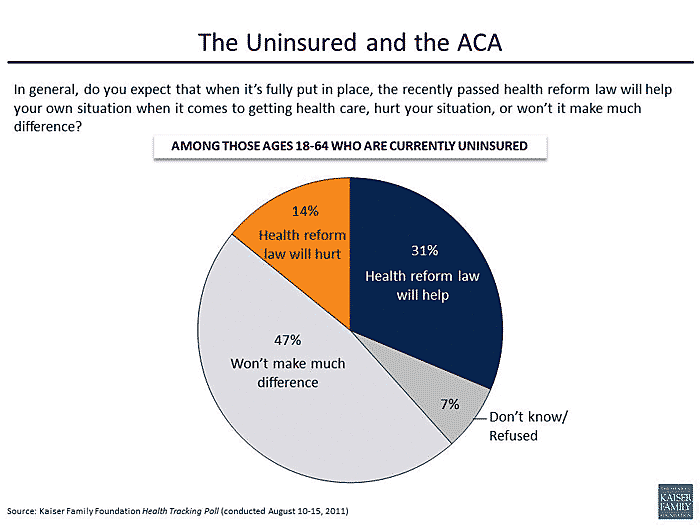
2. Some of the Uninsured Who Think ObamaCare Will Help Them Are Wrong.
One respondent said that under ObamaCare, you “can go to the doctor with no problems, unlike now you have to worry about insurance and bills.” Yeah. Good luck with that.
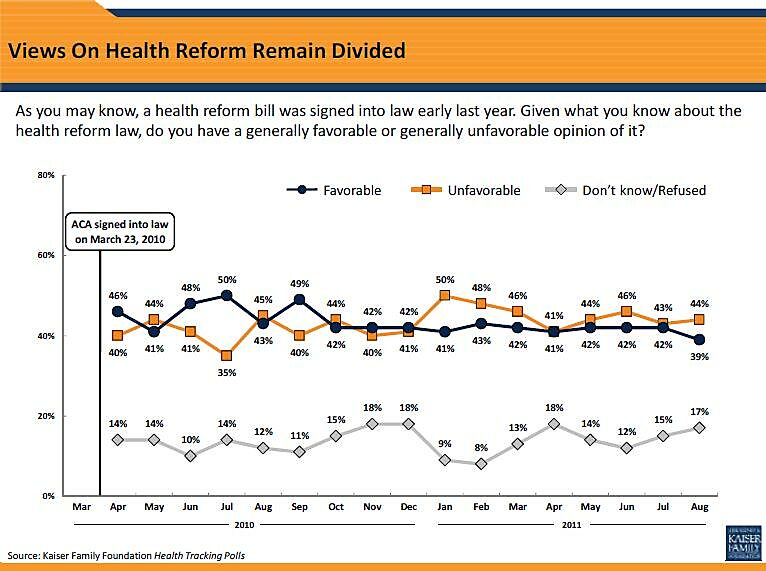
3. ObamaCare Is Less Popular than Ever.
In August 2011, support for ObamaCare hit an all-time low in the KFF poll:
Related Tags
From time to time, I’ve posted Pollster.com’s trend estimate of all polls gauging public opinion on ObamaCare. It’s a great little tool. But recently, I noticed something.
The Kaiser Family Foundation’s monthly tracking poll not only finds the most support for ObamaCare, but it also gets disproportionate weight in the Pollster.com trend estimate, simply because KFF polls the public on ObamaCare more frequently than others. Since President Obama signed the law on March 23, 2010, KFF has polled this question more often than the next two most frequent polls combined. That makes the gap between opposition and support smaller than it would be if KFF conducted its poll as frequently as other groups conduct theirs (or vice versa).
To illustrate, here’s what the trend estimate looks like incorporating all polls. As of this month, opposition leads support by 7.3 percent (45.3 percent opposed to ObamaCare vs. 38 percent in favor).

Here’s what the same graph looks like when we exclude the KFF polls. The margin of opposition nearly doubles to 13.9 percent (49.9 percent opposed vs. 36 percent in favor).

Of course, this graph gives the KFF poll zero weight, which is unfair. But it shows that if all polls received equal weight, opposition to ObamaCare could easily lead support by 10 percentage points or more.
Related Tags
USA Today reports that the Obama administration’s efforts may yield an 85 percent rise in federal fraud prosecutions. Yawn.
Fraud expert Malcolm Sparrow:
By taking the fraud and abuse problem seriously this administration might be able to save 10 percent or even 20 percent from Medicare and Medicaid budgets. But to do that, one would have to spend 1 percent or maybe 2 percent (as opposed to the prevailing 0.1 percent) in order to check that the other 98 percent or 99 percent of the funds were well spent. But please realize what a massive departure that would be from the status quo. This would mean increasing the budgets for control operations by a factor of 10 or 20. Not by 10 percent or 20 percent, but by a factor of 10 or 20. [emphasis added]
That’s not going to happen, as I explain here and in this video: