Cato at Liberty
Cato at Liberty
Government and Politics

Related Tags
Some smart folks have drawn strongly on the Fraser Institute’s Economic Freedom of the World Annual Report to put together a short video extolling the virtues of economic freedom. Enjoy!
The Fraser Institute report is published in the United States by the Cato Institute.
Related Tags
President Obama went to Puerto Rico two weeks ago. If you missed it, that might be because the trip was so brief—a mere four hours. Observing how the president “SEAL-Team-Sixed” it, Jon Stewart speculated that the president was not motivated by love of the island or a campaign promise to revisit it, but by courting Puerto Rican voters in important electoral states. It could be all of the above, of course.
It all reminded me of the president’s “Sunlight Before Signing” promise to post bills Congress sends him online for five days before signing them.
After the president’s dismal start with the promise at the beginning of his term, I speculated once or twice that he would focus on fulfilling campaign promises like Sunlight Before Signing after the mid-term election, when focus turned back to the presidential election coming up in 2012.
Well, the mid-term is behind us, and thoughts are turning to the next presidential election. Has that renewed the White House’s focus on Sunlight Before Signing?
No!
Of the twenty bills sent him by the 112th Congress so far, President Obama has posted only eight online for five days—under half. In fact, the poor numbers so far this year drive his overall tally down to exactly 50 percent compliance (counting in his favor the emergency bill that didn’t require posting). Fifty percent is a threshold he topped with some good Sunlight Before Signing compliance in December.
| Number of Bills | Emergency Bills | Bills Posted Five Days | |
|---|---|---|---|
| 2009 | 124 | 0 | 6 |
| 2010 | 258 | 1 | 186 |
| 2011 | 20 | 0 | 8 |
| Overall | 402 | 1 | 200 |
As I’ve explored before, the bills that get sunlight lean toward the unimportant—post office renamings, Smithsonian appointments, and such—though a few substantive bills have gotten five days of exposure.
One can only speculate about the thinking in the White House, but there are two likely possibilities:
- It may not have crossed anyone’s mind that this clearly stated, measurable promise will have a bearing on the election. But the president’s low compliance with a transparency promise may hand his Republican challenger an issue.
- If it has come up, the president and his political advisers may have determined that Sunlight Before Signing is not a big enough issue compared to other political priorities. Getting legislation signed and off the table comes first. Sunlight Before Signing goes under the bus.
We’ll continue to follow the Sunlight Before Signing promise here, calling it the way we see it. It’s up to the president’s challengers and America to decide if this transparency promise is important, or if it’s roadkill.
Related Tags
Here we have the spectacle of a former Republican Health and Human Services secretary getting rich by helping states implement ObamaCare. Leavitt Partners (among other consultants) is helping states create the law’s health insurance “Exchanges.” Or the non-ObamaCare-compliant health insurance Exchanges that will by law become ObamaCare-compliant Exchanges. Via Politico:
More than $300 million in exchange grants has already flowed into the states since the Affordable Care Act passed. That number will grow exponentially in the coming months, as states move from the initial steps of passing exchange legislation to the more lucrative task of setting them up.
For health consultants and information technology vendors, it’s already shaping up to be a gold mine…
The opportunity is, seemingly, everywhere. Even in states that have used executive orders and heated rhetoric to push back against implementation of the reform law, vendors still see possible contracts.
“There is a group that feels as though they don’t want to be associated with the Affordable Care Act,” said Leavitt Partners CEO Michael Leavitt, who was Health and Human Services secretary under President George W. Bush. “Privately, though, it’s clear that several of those are planning behind the scenes, because they don’t want to have a federal exchange.”
These Exchanges—there is no such thing as a state-run Exchange—are the government bureaucracies that will make health insurance more expensive, induce employers to drop coverage, entrench ObamaCare, and dole out hundreds billions of debt-financed government subsidies to insurance companies.
Related Tags
It appears that American taxpayers are about to subsidize another Greek bailout (via the Keystone Cops at the IMF). This is way beyond economically foolish. It is also morally offensive.
To turn Winston Churchill’s famous quote upside down, “Never have so many paid so much to subsidize such an undeserving few.”
Let’s start with a few facts:
- Greece’s GDP is roughly equal to the GDP of Maryland.
- Greece’s population is roughly equal to the population of Ohio.
- Despite that small size, in both terms of population and economic output, Greece already has received a bailout of about $150 billion (actual amount fluctuates with the exchange rate).
- Don’t forget the indirect bailout resulting from purchases of Greek government bonds by the European Central Bank.
- Now Greece is angling for another bailout of about $150 billion.
Is there any possible justification for throwing good money after bad with another bailout? Well, if you’re a politician from Germany or France and your big banks (i.e., some of your major campaign contributors) foolishly bought lots of government bonds from Greece, the answer might be yes. After all, screwing taxpayers to benefit insiders is a longstanding tradition in Europe.
But from a taxpayer perspective, either in Europe or the United States, the answer is no. Or, to be more technical and scientific, the answer is “Heck no, are you friggin’ out of your mind?!”
Consider these fun facts from a recent column by John Lott and then decide whether the corrupt politicians of Greece (and the special interest groups that receive handouts and subsidies from the Greek government) deserve to have their hands in the pockets of American taxpayers:
Despite Greece’s promises, government spending is up over last year’s already bloated levels, the deficit is bigger than ever, and it has utterly failed to meet the promised sell-off of some government assets. Not a single public bureaucrat has been laid off so far. …Greece can pay off €300 of the €347 billion debt by selling off shares the government owns in publicly traded companies and much of its real estate holdings. The government owns stock in casinos, hotels, resorts, railways, docks, as well as utilities providing electricity and water. But Greek unions fiercely oppose even partial privatizations. Rolling blackouts are promised this week to dissuade the government from selling of even 17 percent of its stake in the Public Power Corporation. …Greeks apparently believe that they have Europe and the world over a barrel, that they can make the rest of the world pay their bills by threatening to default. Greece’s default would be painful for everyone, but for Europe and the United States, indeed for the world, the alternative would be even worse. If politicians in Ireland, Portugal, Spain, Italy, and other countries think that their bills will be picked up by taxpayers in other countries, they won’t control their spending and they won’t sell off assets to pay off these debts. Countries such as Greece have to be convinced that they will bear a real cost if they don’t fix their financial houses while they still have the assets to cover their debts. …The real problem is the incentives we are giving to other countries. We have to make sure that “Kicking the can down the road” isn’t an option.
Just for good measure, here are a few more interesting factoids in a Wall Street Journal column by Holman Jenkins.
[Greece is] one of the most corrupt, crony-ridden, patronage-ridden, inefficient, silly economies in Christendom. …The state railroad maintains a payroll four times larger than its ticket sales. When a military officer dies, his pension continues for his unwed daughter as long as she remains unwed. Various workers are allowed to retire with a full state pension at age 45.
To be blunt, Greek politicians have miserably failed. Wait, that’s not right. You can’t say someone has failed when they haven’t even tried. Let’s be more accurate and say that Greek politicians have succeeded. They have scammed money from taxpayers in other nations to prop up a venal and corrupt system of patronage and spoils. Sure, they’ve made a few cosmetic changes and trimmed around the edges, but handouts from abroad have enabled them to perpetuate a bloated state. And now they’re using a perverse form of blackmail (aided and abetted by big banks) to seek even more money.
Let’s now re-ask the earlier question: Should American taxpayer finance the corrupt big-government policies of Greece?
- Or perhaps we should think like economists, so let’s rephrase the question: Should we misallocate capital so that funds are diverted from private investment to corrupt Greek politicians?
- Or maybe we should think like parents who have to worry about spoiling a child and the signal that sends to the other kids, so let’s ask the question this way: Should we encourage bad behavior in Spain, Italy, Portugal, etc, by giving another bailout to Greece’s corrupt politicians?
- Or should we think about this issue from the perspective of addiction counselors and rephrase the question: Should we reward self-destructive behavior by providing more money to corrupt political elites in Greece?
- Or how about we think like moral human beings, and ask the real question: Should we take money from people who earned it and give it to people who think they are entitled to live at the expense of others?
Since we paraphrased Churchill earlier, let’s answer these questions by butchering Shakespeare: “A bailout from every angle would smell to high Heaven.”
I wrote back in February of 2010 that a Greek bailout would be a mistake and every development since that time has confirmed that initial commentary.
But that doesn’t matter. Politicians have a different way of looking at things. They look at a policy and wonder whether it increases their power and generates campaign contributions. And when you understand their motives, you begin to realize why they will answer yes to the previous set of questions.
Related Tags
That’s the subject of my latest Kaiser Health News column:
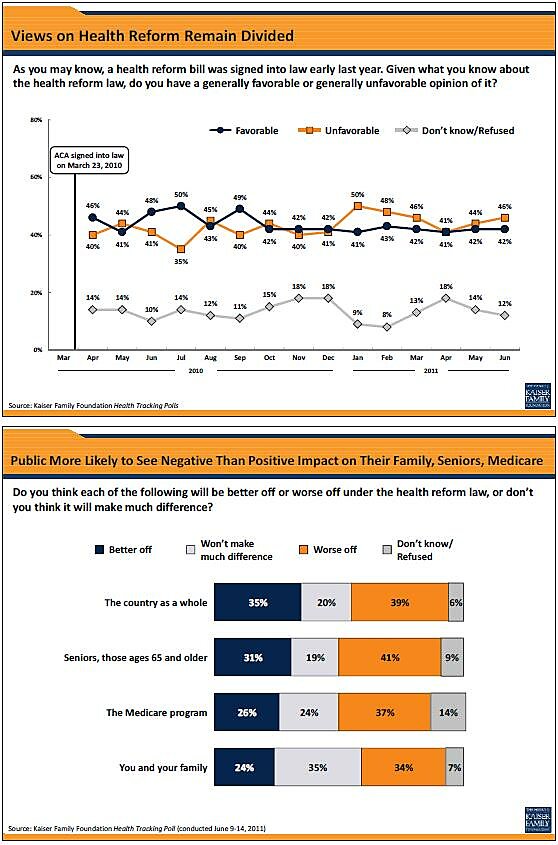
Obamacare passes two milestones this month. It has been exactly two years since the first version of the legislation appeared in Congress. And it has now enjoyed exactly two years of solid public opposition. Yet this month has been harsher than most.
It is almost enough to make you feel sorry for ObamaCare. Almost.