Cato at Liberty
Cato at Liberty
Government and Politics
There is a case study being written right now about the absurdity of government. Basically, both parties are trying to outdo each other politically in order to pass a bit of pandering that they actually agree on: freezing at rock-bottom levels interest rates on subsidized federal student loans.
Republicans, at least, are taking some political risk by trying to pay for the lost revenue a freeze would create by digging into a fund that sure seems pretty slushy, but which nonetheless opens them to the accusation that they don’t care about Americans’ health. It’s a small risk — at the very least, what they’re doing likely plays well to their base — but a risk nonetheless.
The Democrats, for their part, are driving home their theme that the rich don’t pay “their fair share” by proposing that taxes be raised on “S corporations,” a legal designation few Americans likely know anything about. Of course, that makes it easier to say such corporations are really just rich people (apparently, these corporations really are people) who, well, don’t pay their fair share.
The really crazy part, though, is that all this political bickering is occurring ultimately to do something that will do no short-term good but real long-term harm.
In the short term, a rate freeze will help no student. The rate will only apply to people taking out subsidized loans next year, and probably only save the average recipient about $7 per month over the life of the loan. And those savings won’t start for at least a year-and-a-half for most students (next year’s college seniors, who also get a six-month repayment grace period after graduation, will be the first). So let’s not hear about this being necessary given the current economy.
The far bigger problem, however, is the long term effect of cheap federal aid. Both overwhelming evidence and logic make it clear that the main effects of federal aid are rampant tuition inflation and millions of people taking on debt for schooling they either cannot handle or aren’t all that motivated to complete. In other words, huge, self-defeating waste.
If members of either party were to take the time to look at the evidence and make policy based on it, we wouldn’t be debating how to pay for a rate freeze at all. We’d be seeing both sides rush legislation to the floor to phase out federal student aid and help return college prices — and consumption — to much more rational levels. But that’s just not how pandering works.
Related Tags
Earlier this year, the Georgetown Journal of Law & Public Policy hosted a symposium on “Hyper-Partisanship and the Law.” The journal editors graciously invited me to join an august panel on partisanship in the judiciary that included George Mason University Law School’s Todd Zywicki and the U.S. Chamber of Commerce’s Rachel Brand. (Brand ran the DOJ’s Office of Legal Policy, which is responsible for vetting and advising the president on judicial nominees, from 2005 to 2007.)
The symposium video isn’t available online, but the participants were invited to publish their presentations in this summer’s issue of the GJLPP. Zywicki has already blogged about his paper, “The Senate and Hyper-Partisanship: Would the Constitution Look Different if the Framers Had Known that Senators Would Be Elected in Partisan Elections?”
My (short) article is entitled “Big Government Causes Partisanship in Judicial Nominations.” Here’s an excerpt:
In 1962, Byron White’s hearing lasted 15 minutes and consisted of three questions. Can you imagine that happening now? Most district court nominees would take that deal. Is it because of TV and the media and the instant sound bite and the new media with the Internet and social networking and all the rest of it? Is it because the issues have gotten more ideologically divisive? I think the answer isn’t really any of these. It isn’t that there’s been a corruption of the confirmation process, the nomination process, presidential or senatorial rhetoric, or the use of filibusters. It’s a relatively new development but one that’s part and parcel of a much larger problem: constitutional corruption.
As government has grown, so have the laws and regulations over which the Court has power. The Court’s power has grown commensurate with the power of Congress, because all of a sudden it’s declaring what Congress can do with its great powers and what kind of new rights will be recognized. As we have gone down the wrong jurisprudential track since the New Deal, judges all of a sudden have more power behind them and the opportunity to really change the direction of public policy more than they ever did.
Read the whole thing (not yet in the final format). My presentation largely tracked some of the points Roger Pilon made in his seminal (and now decade-old) paper, “How Constitutional Corruption Has Led to Ideological Litmus Tests for Judicial Nominees.” You should read that too.
With both France and Greece deciding to jump out of the left-wing frying pan into the even-more-left-wing fire, European fiscal policy has become quite a controversial topic.
But I find this debate and discussion rather tedious and unrewarding, largely because it pits advocates of Keynesian spending (the so-called “growth” camp) against supporters of higher taxes (the “austerity” camp).
Since I’m a big fan of nations lowering taxes and reducing the burden of government spending, I would like to see the pro-tax hike and the pro-spending sides both lose (wasn’t that Kissinger’s attitude about the Iran-Iraq war?). Indeed, this is why I put together this matrix, to show that there is an alternative approach.
One of my many frustrations with this debate (Veronique de Rugy is similarly irritated) is that many observers make the absurd claim that Europe has implemented “spending cuts” and that this approach hasn’t worked.
Here is what Prof. Krugman just wrote about France.
The French are revolting. …Mr. Hollande’s victory means the end of “Merkozy,” the Franco-German axis that has enforced the austerity regime of the past two years. This would be a “dangerous” development if that strategy were working, or even had a reasonable chance of working. But it isn’t and doesn’t; it’s time to move on. …What’s wrong with the prescription of spending cuts as the remedy for Europe’s ills? One answer is that the confidence fairy doesn’t exist — that is, claims that slashing government spending would somehow encourage consumers and businesses to spend more have been overwhelmingly refuted by the experience of the past two years. So spending cuts in a depressed economy just make the depression deeper.
And he’s made similar assertions about the United Kingdom, complaining that, “the government of Prime Minister David Cameron chose instead to move to immediate, unforced austerity, in the belief that private spending would more than make up for the government’s pullback.”
So let’s take a look at the actual data and see how much “slashing” has been implemented in France and the United Kingdom. Here’s a chart with the latest data from the European Union.
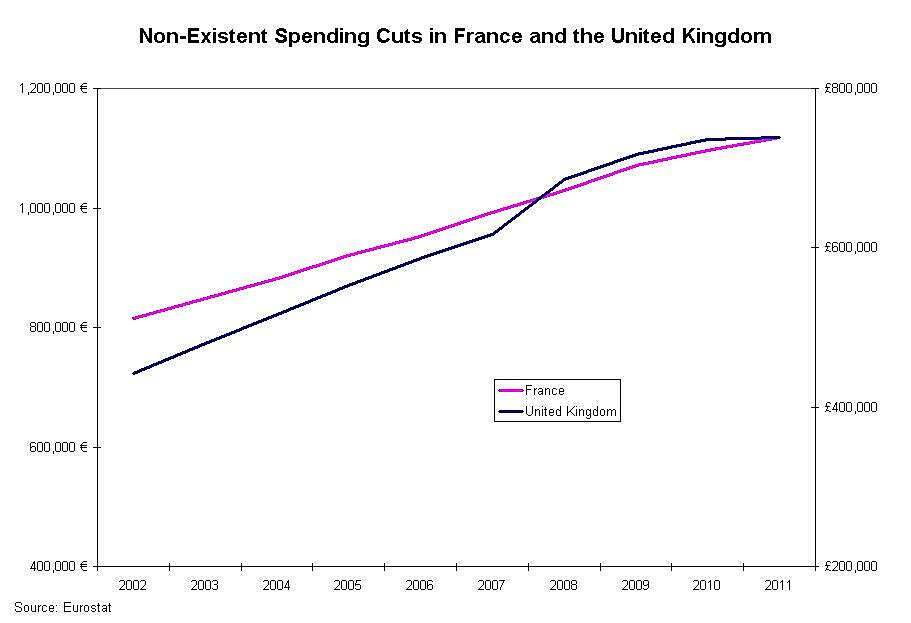
I’m not sure how Krugman defines austerity, but it certainly doesn’t look like there’s been a lot of “slashing” in these two nations.
To be fair, government spending in the United Kingdom has grown a bit slower than inflation in the past couple of years, so one could say that there’s been a very modest bit of trimming.
There’s been no fiscal restraint in France, however, even if one uses that more relaxed definition of a cut. The only accurate claim that can be made about France is that the burden of government spending hasn’t been growing quite as fast since the crisis began as it was growing in the preceding years.
This doesn’t mean there haven’t been any spending cuts in Europe. The Greek and Spanish governments actually cut spending in 2010 and 2011, and Portugal reduced outlays in 2011.
But you can see from this chart, which looks at all the PIIGS (Portugal, Italy, Ireland, Greece, and Spain), that the spending cuts have been very modest, and only came after years of profligacy. Indeed, Greece is the only nation to actually cut spending over the 3‑year period since the crisis began.

Krugman would argue, of course, that the PIIGS are suffering because of the spending cuts. And since there actually have been spending cuts in the last year or two in these nations, does that justify his claims?
Yes and no. I don’t agree with the Keynesian theory, but that doesn’t mean it is easy or painless to shrink the burden of government. As I wrote earlier this year, “…the economy does hit a short-run speed bump when the public sector is pruned. Simply stated, there will be transitional costs when the burden of public spending is reduced. Only in economics textbooks is it possible to seamlessly and immediately reallocate resources.”
What I would argue, though, is that these nations have no choice but to bite the bullet and reduce the burden of government. The only other alternative is to somehow convince taxpayers in other nations to make the debt bubble even bigger with more bailouts and transfers. But that just makes the eventual day of reckoning that much more painful.
Additionally, I think much of the economic pain in these nations is the result of the large tax increases that have been imposed, including higher income tax rates, higher value-added taxes, and various other levies that reduce the incentive to engage in productive behavior.
So what’s the best path going forward? The best approach is to implement deep and meaningful spending cuts, and I think the Baltic nations of Estonia, Lithuania, and Latvia are positive role models in this regard. Let’s look at what they’ve done in recent years.
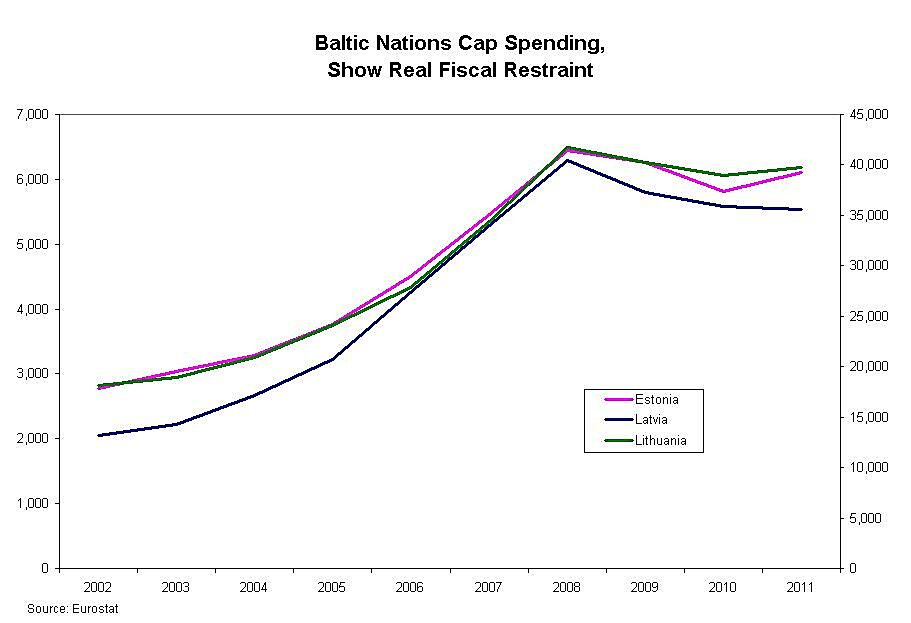
As you can see from the chart, the burden of government spending was rising at a reckless rate before the crisis. But once the crisis hit, the Baltic nations hit the brakes and imposed genuine spending cuts.
The Baltic nations went through a rough patch when this happened, particularly since they also had their versions of a real estate bubble. But, as I’ve already argued, I think the “cold turkey” or “take the band-aid off quickly” approach has paid dividends.
The key question is whether nations can maintain spending restraint, particularly when (if?) the economy begins to grow again.
Even a basket case like Greece can put itself on a good path if it follows Mitchell’s Golden Rule and simply makes sure that government spending, in the long run, grows slower than the private economy.
The way to make that happen is to implement something similar to the Swiss Debt Brake, which effectively acts as an annual cap on the growth of government.
In the long run, of course, the goal should be to shrink the overall burden of government to its growth-maximizing level.
Related Tags
This blogpost was co-authored by Cato legal associate Kathleen Hunker.
Any prizefighter worth betting on knows that the worst thing you can do in a tough match is succumb to frustration. House Democrats should heed that wisdom. Frustrated by the Constitution’s interference in their efforts to muzzle certain kinds of political speech, Rep. Jim McGovern (D‑MA), House Minority Leader Nancy Pelosi (D‑CA), and 27 other congressmen have proposed a constitutional amendment that would overturn the Supreme Court’s holding in Citizens United.
Unfortunately, in their haste to deliver a blow against evil corporations, these lawmakers have exposed the Constitution’s flank in a way that would lead to debilitating blows against individual civil rights were this measure ever adopted.
The proposed change, absurdly titled the People’s Rights Amendment, asserts that the Constitution protects only the rights of “natural persons” and that Congress retains the ability to subject “all corporate entities” to any regulation or restriction Congress deems “reasonable.” Its supporters contend that the Amendment is necessary to reduce the role of money in politics and ensure that elections represent the voice of the people. As several commentators have already observed, however, the amendment does far more than subject corporations to new campaign finance regulations.
Although the People’s Rights Amendment says that it shall not be construed “to limit the people’s rights of freedom of speech, freedom of the press, free exercise of religion, freedom of association and all such other rights of the people,” it radically contracts those and other rights entrenched in America’s political tradition.
George Will’s latest column explains this very point. In addition to denying “natural persons” the right to associate and speak in concert,
McGovern stresses that his amendment decrees that “all corporate entities — for-profit and nonprofit alike” — have no constitutional rights. So Congress — and state legislatures and local governments — could regulate to the point of proscription political speech, or any other speech, by the Sierra Club, the National Rifle Association, NARAL Pro-Choice America or any of the other tens of thousands of nonprofit corporate advocacy groups, including political parties and campaign committees.
Newspapers, magazines, broadcasting entities, online journalism operations — and most religious institutions — are corporate entities. McGovern’s amendment would strip them of all constitutional rights.
Instead of removing corporate money — which goes much more to lobbyists (petitioning for redress of grievances) than electioneering anyway — the amendment grants Congress the power to strip think tanks, advocacy groups, charities, newspapers, political parties, and even a candidate’s campaign of the right to criticize and oppose the government. Any political speech more complex than standing on a park bench at an Occupy rally becomes subject to the whims of federal bureaucrats. Even books don’t escape the amendment’s long reach, as the government lawyer admitted would be the case under the pre-Citizens United law that the amendment hopes to reinstate.
McGovern and Pelosi haven’t answered how the People’s Rights Amendment ensures that elections represent the voice of the people when it takes away the very venues on which the people stand to have their voice heard.
George Will makes a second foreboding observation. He notes that, by stripping corporations of all constitutional protections, the amendment would empower the government to do much more than proscribe speech:
[G]overnment, unleashed by McGovern’s amendment, could regulate religious practices at most houses of worship, conduct whatever searches it wants, reasonable or not, of corporate entities, and seize corporate-owned property for whatever it deems public uses — without paying compensation. Yes, McGovern’s scythe would mow down the Fourth and Fifth Amendments, as well as the First.
For more on these dangers, see here and here. Of course corporations aren’t human beings, but that brilliant insight is legally irrelevant. Corporations are formed by individuals as a means of exercising their constitutionally protected rights, and those individuals do not lose the protection of the Constitution by choosing to exercise their right to associate and pool their resources.
Thus, while a corporation does not enjoy the full breadth of constitutional rights (i.e., sexual privacy), it warrants whatever degree of protection is necessary for its members to exist as free and rational beings. These rights certainly extend to the ability to publicize and support political initiatives.
Before the supporters of People’s Rights Amendment make that massive lunge against what they view as constitutional frustrations, they should take a step back and reassess whether the satisfaction they derive from sticking it to corporations is worth the potential collapse of our political system’s commitment to a free society.
In the Wall Street Journal, Peter Berkowitz says you probably didn’t. And it shows:
It would be difficult to overstate the significance of The Federalist for understanding the principles of American government and the challenges that liberal democracies confront early in the second decade of the 21st century. Yet despite the lip service they pay to liberal education, our leading universities can’t be bothered to require students to study The Federalist—or, worse, they oppose such requirements on moral, political or pedagogical grounds. Small wonder it took so long for progressives to realize that arguments about the constitutionality of ObamaCare are indeed serious.
Explains a lot, really.
There’s an internal contradiction in the way that Keynesian-oriented economists and policymakers address the federal budget situation. I’ve noticed it over and over. A passage in a Washington Post op-ed today by Mohamed El-Erian of Pimco captures it perfectly:
[T]he U.S. fiscal situation requires a carefully designed and well-timed overhaul to make government finances more efficient and fairer—among other things, combining immediate stimulus with a credible set of medium-term tax and entitlement reforms and a sustainable effort to reduce the deficit over time.
El-Erian seems to want more deficit-fueled “stimulus” now, combined with a “credible” plan that would reduce the deficit later on. We hear similar things from administration economists and centrist and liberal budget experts all the time.
Yet how can a Keynesian administration or Keynesians in Congress ever make a “credible” medium- or long-term commitment to deficit reduction? As soon as the next recession hits, they will demand ripping up any previous deficit-reduction deal so that they can stimulate aggregate demand some more.
To Keynesians, the short run is always more important than the long run, so it’s impossible for them to have a “credible” long-run commitment to deficit reduction. Even today, prominent Keynesian economists are demanding more “stimulus,” but the economy is not in recession and the budget deficit (which is “stimulus” to Keynesians) is already over $1 trillion. What happens if the economy slips into recession in 2013 or 2014? The Keynesians would surely break any budget deal and push for a $2 trillion deficit.
Everybody knows that federal policymakers usually break prior deals on discretionary budget caps and agreed-to entitlement cuts. The dominance of Keynesian-minded policymakers and advisers in Washington these days further reduces the believability of any long-term budget deal that policymakers may come up with.
Thus, the best way for policymakers to be truly “credible” on deficit reduction is to start cutting spending right now. Then cut spending more next year, and chop it further the year after that, and then keep on going.