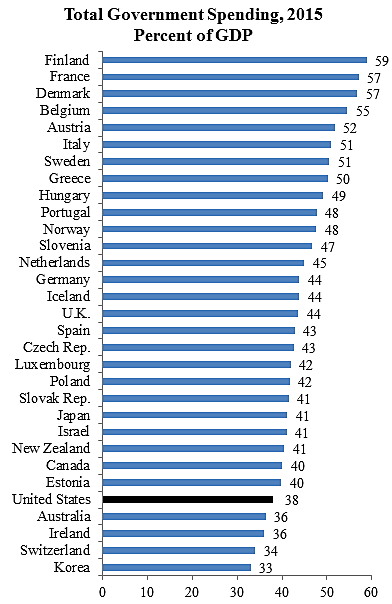
One measure of the government’s size is government spending as a share of gross domestic product. The OECD has released new data (Table 25) on this measure for 31 member countries, which I chart here for 2015. The spending includes all levels government: federal, state, and local.
Cato at Liberty
Cato at Liberty
Topics
Government and Politics
DHS Computer Project: A Record Cost Overrun?
Politics and bureaucratic mismanagement drive up costs and generate failure in the federal government. More evidence comes from a Washington Post report today on a botched computer project at the Department of Homeland Security:
Heaving under mountains of paperwork, the government has spent more than $1 billion trying to replace its antiquated approach to managing immigration with a system of digitized records, online applications and a full suite of nearly 100 electronic forms.
A decade in, all that officials have to show for the effort is a single form that’s now available for online applications and a single type of fee that immigrants pay electronically. The 94 other forms can be filed only with paper.
This project, run by U.S. Citizenship and Immigration Services, was originally supposed to cost a half-billion dollars and be finished in 2013. Instead, it’s now projected to reach up to $3.1 billion, and be done nearly four years from now.
A six times cost overrun! That is epic. I’ve described Edwards law of Cost Doubling in government, but this DHS project rises to an elite screw-up category reached by the Big Dig, the San Francisco-Oakland Bay Bridge, and a veterans hospital in Denver, which all more than quadrupled in cost.
Other than “shoddy planning” and mismanagement, what else contributed to the latest DHS screw-up? The Post reports on the role of politics:
By 2012, officials at the Department of Homeland Security, which includes USCIS, were aware that the project was riddled with hundreds of critical software and other defects. But the agency nonetheless began to roll it out, in part because of pressure from Obama administration officials who considered it vital for their plans to overhaul the nation’s immigration policies, according to the internal documents and interviews.
… By 2012, the system’s fundamental flaws — including frequent computer crashes and bad software code — were apparent to officials involved with the project and, according to one of them, and it was clear that “it wasn’t going to work.”
But killing the project wasn’t really an option, according to officials involved at the time. President Obama was running for reelection and was intent on pushing an ambitious immigration reform program in his second term. A workable electronic system would be vital.
“There was incredible pressure over immigration reform,” a second former official said. “No one wanted to hear the system wasn’t going to work. It was like, ‘We got some points on the board, we can go back and fix it.’ ”
For more, see the new Downsizing Government essays Federal Government Cost Overruns and Bureaucratic Failure in the Federal Government.
Rush Limbaugh Is Half-Right: Liberals Offer Poorly Thought Out, Emotional Solutions. And So Do Conservatives
Friday afternoon Rush Limbaugh took a call from a conservative teenager who wanted to know how to help his generation “realize what’s happening in our nation.” Rush offered some thoughts, beginning with this:
Liberalism is so easy. All you have to do is see some suffering and tell everybody that you see it, and that it really bothers you. Right there, you are given great credit for having great compassion, and people will say great things about you. All you have to do is notice it. You don’t have to offer a solution. If you do offer a solution, say, “The government ought to do something,” then they’ll really, really love you. Liberalism’s easy.
That’s why a lot of people end up going there, is no resistance to it. It doesn’t take any kind of thought because it’s all based in emotion, and thinking is harder than feeling. Thinking’s an applied process.
That’s a good point. It is indeed easy to see a problem and say “the government ought to do something.” People don’t make enough money? Raise the minimum wage. Don’t think about what the effects of that might be. Or just increase welfare. And again, don’t think through the long-term effects. IBM is too big? Break it up, even as new competition is about to leave IBM in the dust. Part of the problem here is taking a snapshot view of the world — which at any point will be full of inefficiencies and inequalities— rather than a dynamic view. The world is constantly changing. Economic growth is a process. Things that are first bought only by the rich become cheaper and more available to the middle class and then to everyone. And centralized, compulsory “solutions” to immediate problems may impede growth, improvement, and progress.
But Rush might have mentioned that sometimes “conservatism” is easy, too. All you have to do is see a problem and demand a government program. Some people get in trouble with drugs? Ban ’em. The Middle East is in chaos? Bomb some more countries. Russia is assertive? Stand up to ’em! “It doesn’t take any kind of thought because it’s all based in emotion, and thinking is harder than feeling. Thinking’s an applied process.” And when you think about it, you might realize that prohibition introduces all sorts of new problems, that the United States can’t control the whole world any more than it can control the American economy, that threatening war with a nuclear-armed Russia might have disastrous consequences.
Yes, thinking is harder than feeling. It’s easy to say, “The government ought to do something.” And both liberals and conservatives default too easily to such easy answers.
Related Tags
Whatever Happened to the Left’s Love of Free Speech?
There was a time in America when the Left could be counted on to defend free speech. But as countless examples today demonstrate, those days are long gone. From campus speech codes to campaign finance to prosecutorial threats against climate change critics and more, the evidence is as fresh as this morning’s newspapers.
Campus assaults have been so well documented by the Foundation for Individual Rights in Education (FIRE) that they need no elaboration here. But the latest campaign finance “reform”—“until the court reverses its decision in Citizens United”—can be found championed in an op-ed in this morning’s Washington Post by such stalwarts of the Left as Yale Law School’s Bruce Ackerman and Ian Ayers. On Tuesday last, it seems, Seattle voters approved a measure that would “give” each registered voter a $100 “democracy voucher” that could be spent “for only one purpose—to support their favorite candidates for municipal office.” The city can of course “give” that $100 voucher only if it first “takes” the $100 from its taxpayers, which it will do in all the unequal ways that modern tax systems exhibit. Thus is the political speech of private individuals reduced by forcing the funds they might otherwise direct to candidates of their choice to be redirected through this public funding scheme to candidates they may oppose.
But that inroad on free speech pales in comparison to recent attacks on what most Americans would have thought were the free speech rights of climate skeptics, the RICO-ing of whom my colleague Walter Olson has been covering—along with the machinations of New York Attorney General Eric Schneiderman. The latest from the latter is all over the papers today, the Post’s headline reading “Exxon investigated over climate change research.” The Left has already browbeaten Exxon Mobil into ending its funding for think tanks and advocacy organizations that express climate change skepticism. Now, however, it’s getting more serious, with Schneiderman issuing a subpoena that focuses, we’re told, “on whether Exxon Mobil intentionally clouded public debate about science and hid from investors the risks that climate change could pose to its business.” “Clouded?” What, a debate that is crystal clear? That of course is what the environmental establishment would like as to believe.
And circling back to the academy, so too, apparently, would one Naomi Oreskes, a professor of the history of science at Harvard University and a critic of Exxon who laments that we haven’t yet implemented a carbon tax. There are many reasons we haven’t, she tells the Post, but a significant one “is the role of Exxon Mobil and others in fomenting disinformation, undermining public support for such initiatives, and lobbying against policies that would have begun to decrease our fossil fuel dependency.” And this from a professor of the history of science, the annals of which are littered with the corpses of “settled science.” Clearly, if we don’t stop this speaking and lobbying, we could have one more corpse.
Related Tags
Paid Patriotism, Sports and War
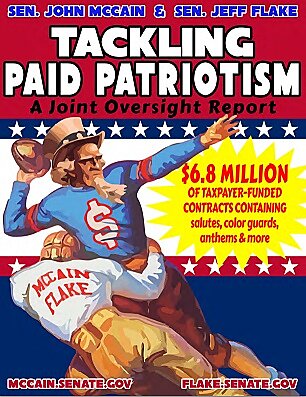
Arizona Senators John McCain and Jeff Flake made a splash yesterday with their report on “paid patriotism.” The report shows that the National Guard and military services, in the name of marketing themselves to potential recruits, paid millions over the last several years to professional sports teams and a couple universities for on-field tributes to military personnel, which appeared to fans as unpaid expressions of affection. According the report:
These paid tributes included on-field color guard, enlistment and reenlistment ceremonies, performances of the national anthem, full-field flag details, ceremonial first pitches͕ and puck drops. The National Guard paid teams for the “opportunity” to sponsor military appreciation nights and to recognize its birthday. It paid the Buffalo Bills to sponsor its Salute to the Service game. DOD even paid teams for the “opportunity” to perform surprise welcome home promotions for troops returning from deployments and to recognize wounded warriors.
In other cases, it seems that a military marketing or promotional contract paid for a lot of personnel to attend games without doing much of marketing value. They just wanted tickets.
Letters from Pentagon officials, appended to the report, ban these practices. A letter from Commissioner Roger Goodell of the National Football League, says that its teams will better differentiate what is and isn’t advertising and refund “inappropriate payments,” though what that includes is unclear. The NFL also included for the report a lengthy list of the unpaid troop tributes and pro-military acts of the NFL and its teams. Major League Baseball and the National Basketball Association also say they’ll avoid paid tributes.
Besides the leagues, the major culprits here, in both ticket abuse and fake tributes, are the U.S. Air Force and Army National Guard from various states. The report never mentions the regular Army or the Marine Corps. The Navy comes up only once, due to the $24,000 that the Naval Supply Systems Command’s spent on Phillies tickets in both 2012 and 2014. It’s not clear why that purchase is in the report, given that the online contract says the goal is “social and recreational” purposes, not recruiting or promotions. Maybe that’s too much recreation on the taxpayer dime, but there is no misdirection, which seems to be report’s concern.
Some might wonder why paid tributes are so bad. As the Pentagon’s responses to Flake’s inquiries all note, advertising is a legitimate way for the military to recruit volunteers. Plus, it’s not as if fans received some sacred promise from the profit-making entertainment corporations—the teams— that they support not to blur the line between performance and advertising.
Still, there are a couple good reasons to be annoyed by paid tributes. First, it’s unclear that advertising during sports events, even the traditional, non-scandalous sort, is an efficient way to reach recruits. A Pentagon document appended to the report notes, reasonably, that professional sports broadcasts, especially football, reach much of the target audience for recruiting. But, as the report notes, the Pentagon didn’t offer evidence that buying sports advertising or sponsorships to reach this audience is more cost-effective than alternative marketing strategies in generating recruits.
One likely reason for the military’s limited interest in the ostensible goal of this advertising is that it serves additional ends. Like the Air Force’s Thunderbirds and Navy’s Blue Angels air show units, the goal of military advertising arguably is public support or even awe. That’s conducive not only recruits but also to budgetary support and organizational health, sometimes at the expense of other public organizations. Because those aren’t necessarily kosher uses of tax dollars, it’s safer to say it’s all for recruiting.
If that misdirection is a problem, it’s a far more costly one than the one the report highlights. The press is mostly using the $6.8 million figure on the report’s cover as an estimate of spending on paid troop tributes from 2012 until 2015. Actually, it is unclear what the report means by that figure. But whatever the right amount, it’s a fraction of the $53 million that the Pentagon reports spending on marketing and advertising deals with sports teams over those three years. And that’s a drop in the bucket of the total marketing budget. Maybe the Senators should broaden their scope.
The bigger reason to be offended by paid tributes is their particular brand of phoniness. Sneaky product placement is annoying. Getting paid to display your regard for military service is a more unseemly trick, a point Senator Flake made in interviews yesterday.
But weren’t these displays a bit unseemly already? Uncompensated ballpark tributes do not lack for pretension. It is easy for public announcers to make fans stand and cheer by saying “heroes” during the seventh inning stretch or before kickoff, but hard to make them do so for the public reasons. The social patriotism produced for quick display in stadiums might not be much more legitimate than the paid kind. Maybe ballparks are a bad place to commemorate wars.
Related Tags
Curb Your Enthusiasm: Down with the “Joyful Campaign”
I have a piece running in the Federalist this week on the notion that presidential candidates should campaign “joyfully,” as Jeb Bush ever more desperately insists that he is. It’s not clear why we’re supposed to want joyful candidates, but that seems to be the prevailing norm. Hardly a week goes by without reporters needling the contestants: are you having fun yet? I wrote the column before former Senator Fred Thompson passed away on Sunday, but it occurred to me that his failed 2008 run is a perfect illustration of how perverse the cult of campaign-trail positivity has become.
By almost any measure, Thompson had a full life: a Watergate Committee counsel whose questioning revealed the existence of the White House tapes; U.S. senator from Tennessee; “Law and Order,” “The Hunt for Red October,” “Die Hard 2.” But his short-lived presidential campaign isn’t part of the highlight reel. The Tenneseean put it gently in their obituary: “Mr. Thompson underwhelmed” in his 2008 bid. The press was harsher when Thompson dropped out of the race. “You must show an interest in running for the most powerful office in the world to gain that office,” John Dickerson scolded in Slate, but “The press copies of his daily schedule always looked like they’d been handed out with a couple of the pages missing. The candidate seemed like he might just show up for events in
sweatpants.” “As his hopes cratered,” Politico chided, “the former Tennessee senator increasingly voiced his displeasure with a process he plainly loathed. Thompson’s stump speech became mostly a bitter expression of grievance against what was expected of him or any White House hopeful.” Ha: what a weird old grouch! I mean, the guy’s an actor, and he still couldn’t fake it! What’s wrong with him?
And yet, earlier generations of Americans would have viewed Thompson’s reticence as reassuring. As the political scientist Richard J. Ellis explained in an insightful 2003 article, “The Joy of Power: Changing Conceptions of the Presidential Office,” early American political culture took it as self-evident that anyone who seemed to relish the idea of wielding power over others couldn’t be trusted with it. “Presidential candidates largely stayed home in dignified silence,” he wrote, “ready to serve if called by the people.…Distrusting demagoguery and tyranny, the dutiful presidency demanded dignity, reserve and self-denial from its presidents.”
By the mid-20th century, those cultural expectations had been upended, replaced with a demand for happy warriors with fire in their bellies and joy in their hearts. Changes in the nomination process reinforced the new norms, increasingly favoring boundless ambition and stamina. Campaigning for president “was something I didn’t do well,” Thompson himself reflected in 2014, “You have to about want it more than you want life itself.” But it’s worth asking: what sort of person wants the job that badly? And, are we sure we want that sort of person for the job?
As I wrote in the Federalist:
A latter-day Cincinnatus might put down his plow in the hour of his country’s need; he’s not going to sign up for a two-year ultramarathon of pleading with high-dollar donors, glad-handing his way through primary states, and saying things no intelligent person could possibly believe. Instead, we get the sort of person who wants presidential power badly enough to do what it takes to get it, 16 hours a day, feigning joy all the while.
At least, we should hope it’s feigned. Anyone who approaches “the process” with genuine joy in his heart is a maniac who should be kept as far away from “kill lists” and nuclear weapons as possible.
Years later, one of Thompson’s former aides said he’d have been “a great president, if he didn’t have to campaign for it.” I don’t know about the “great president” bit. I’m increasingly unsure that such a creature is possible. But Thompson’s inability to feign enthusiasm for the process spoke well of him. It suggested that he was psychologically healthy and normal. Those qualities are ruthlessly winnowed out by the modern presidential race, which rewards those with an unhealthy appetite for presidential power and glory. You’ve got to want it to win it, and they want it more.