Cato at Liberty
Cato at Liberty
Tax and Budget Policy
It appears that I spoke too soon. According to a news article from Chris Clayton, one of America’s best agriculture reporters, the new House farm bill, due to be voted on today, will not necessarily be the gift to reformers I thought it might. The key paragraph of Chris’s story:
The bill would keep the same commodity, conservation, crop insurance and rural development provisions that were developed by the House Agriculture Committee and amended on the floor before the full farm bill failed to pass June 20. A key difference, however, is that the legislation also would repeal the 1938 and 1949 permanent farm law. The new Title I would become permanent law moving forward. [emphasis added]
That’s not good news at all. And it has been suggested that all of this “bill splitting” is just a vehicle for getting the bill done in pieces, to be reconciled back to its former self in conference. I guess that explains why Heritage Action for America and the Club for Growth, both organisations that one would expect to support this sort of move, have issued key vote alerts urging a “no” vote.
Back to the drawing board.
There exists in the Department of Commerce an irrelevant Great Society relic called the Economic Development Administration. With a relatively small budget of around $400 million, the EDA acts as a slush fund for Congress to shovel subsidies to their districts for projects that should be funded locally or privately.
That’s why it’s been hard to kill. Indeed, last year 175 Democrats and 104 Republicans teamed up to defeat an amendment introduced by Rep. Mike Pompeo (R‑KS) that would have finally put the EDA out of its misery.
Around the same time that the EDA came under attack from Rep. Pompeo, the agency believed that it had also suffered a cyber attack on its IT infrastructure. National Review Online’s Kevin Williamson has the story, which has to be one of the all-time greatest examples of bureaucratic ineptitude:
The trouble began in December 2011, when the Department of Homeland Security alerted Commerce that it had discovered a possible malware infection in the department, specifically within the network located within the Hoover Building. The EDA’s immediate reaction — based on absolutely nothing — was: cyberwar! According to the [Dept. of Commerce inspector general] audit, the main concern among the EDA’s top brass was that the agency was under attack by a nation-state actor. There was no evidence to support that fear, and a good deal of evidence to the contrary, but the EDA basically went to whatever is the Commerce Department’s version of DEFCON 1.
As Kevin deftly wise-cracks, “If the Chi-Coms wanted to hurt the U.S. economy, they wouldn’t attack EDA; they’d hire a lobbyist to increase its funding.” But, after all, we’re talking about an agency that has an amazingly inflated sense of self-worth. And so the EDA decided that it wasn’t taking any chances – the agency’s entire IT infrastructure had to go:
Rather than acknowledge the fact that the malware was almost certainly the result of somebody’s clicking on a link to an infected funny-cat video on a department computer, EDA proceeded as though it were facing the tip of the spear in a cyberwar attack by a foreign power. First it cut its computers off from the rest of the network in an effort to keep the malware from spreading, a defensible decision if one that was overcautious in light of the evidence, which pointed to nothing more than a common infection. What happened next, though, demonstrated fascinating ineptitude: Rather than simply identifying the infected computers and fixing them, the agency set about physically destroying its IT hardware — not just computers, but keyboards, printers, digital cameras, and other equipment entirely unrelated to the problem.
This being the federal government, contractors made a killing: EDA spent a mere $4,300 on the process of physically destroying $170,500 worth of computers and equipment, but spent another $1.4 million on advice from contractors, and another $1 million on temporary computers to use while it was destroying the ones it already had.
The only thing that stopped EDA from destroying its entire IT infrastructure was that it ran out of money to fund the demolition.
As the inspector general put it, there was “no evidence of a widespread malware infection,” while Commerce “propagated inaccurate information” and “did not follow the department’s incident-response procedures,” and the man in charge “did not have the requisite experience or qualifications.” The head of the EDA is one Matt Erskine, a Democratic time-server and campaign donor, veteran of the Warner administration in Virginia, and, hilariously enough, formerly “a principal in the Advanced Technology-Telecom and Professional Services practices of the management consulting firm Korn-Ferry International.”
Were it not for the wasted tax dollars and the fact that this bumbling agency will continue to exist thanks to both Republicans and Democrats, the entire episode would be downright hilarious. Attempting to stop a cyber attack by destroying keyboards and digital cameras?! That must have been a sight to behold. For me, it brings to mind this scene from the end of the second Rambo movie:
At least Rambo had a legitimate reason to clean house.
Related Tags
The Roll Call blog has just broken news that the GOP House leadership has decided to drop food stamps from the farm bill, in an attempt to get the farm subsidies passed by the House, presumably with Republican votes alone. Nutrition is quite an “appendage” to jettison, by the way: it usually accounts for about 80 percent of all “farm bill” spending. Here’s a great infographic on food stamp usage from the Wall Street Journal online.
I think this development could be very good news: I have long called for splitting the food welfare (or “nutrition”, as it is euphemistically called) portion of the farm bill from the subsidies part. Legislators should be forced to vote on all of these programs on their individual merits, not as part of some logrolling extravaganza. The costs and benefits of programs to feed poor people deserve to be considered separately from farm subsidies, and ideally belong at the state or, even better, local community level anyway. Do we really need the federal government specifying that our kids eat greek yogurt? But I digress.
The problem is that farmers just don’t have the political or demographic clout that they used to (and in any case are starting to squabble amongst themselves) so it has long been believed that you need to load up farm subsidies with other, somewhat related programs more palatable in urban and suburban districts. That’s why energy, environmental, and food stamps are included in the “farm bill”. If you include enough goodies for diverse special interests, you’ll cobble together the votes.
That cynicism was turned on its head, though, when the farm bill failed last month because the Republicans thought food stamp spending was too high (even after some cuts and tightening of eligibility criteria). The Democrats, on the other hand, thought the cuts were too severe. Votes were lost on both sides of the aisle.
So, by dropping food stamps, GOP leaders think that enough Republicans will vote for this new bill to pass, even without Democrats’ support. They might be correct: clearly, powerful people in Congress think that all of these hippy issues are distracting attention from more deserving welfare programs, like farm subsidies. But I am not too sure: without sufficient Democratic votes on a subsidies-alone bill, they would need every R vote they could get, and some of the Republicans aren’t too keen on farm subsidies, either.
Another, promising development in this new farm bill is the repeal of the 1949 Agriculture Act. I said in a blog post a few weeks ago (and, indeed, on many other occasions before) that the key to reforming U.S. agricultural policy is to repeal the permanent legislative infrastructure—of which the 1949 Act is an important part—that lies behind the deplorable farm bill circus to which the American body politic is subjected every five years. By taking this law off of the books, farmers and their political supporters couldn’t threaten us with dairy cliffs and other elements of farmageddon if we don’t pass farm bills.
A huge, important caveat to all of this hopeful thinking: the GOP leadership may be splitting the bills only so they can pass them piecemeal with the hope of rejoining farm subsidies and food stamps in conference with Senate Democrats (the Senate passed their bill, logrolling intact, already), then have the conference report pass the House with Democrats’ support. Certainly Majority Leader Eric Cantor (R‑VA) is by all accounts disappointed that the farm bill failed to pass and is looking for another vehicle, or several vehicles, to push this puppy through. That’s not something to get excited about: death by a thousand drips of poison is still death.
The other problem, which is theoretically fixable, is that the new GOP bill doesn’t repeal the 1938 Act, which includes several commodity titles that aren’t covered by the Agricultural Act of 1949, including price supports and marketing quotas, and the establishment of the Federal Crop Insurance Corporation. So the 1938 Act has to go, too, if we are to be fully threat-free.
I am sure that others will disagree with my analysis of how the votes will break down, and my analysis of parliamentary procedure regarding conference, etc. I’m really not too interested in that, anyway. My main concern is to get American agricultural policy on the road to reform/elimination, and in my eyes these two developments could be helpful toward that end.
I periodically cite new academic research about tax policy and economic activity. I sometimes even publicize research from international bureaucracies showing the link between taxes and growth.

I’m not naive enough to think that any particular study will change minds, but when the bulk of the research unambiguously tells us that lower tax rates are better for economic performance, I think (or at least hope) that it may have some impact on government officials.
That’s why I’m particularly interested in some new research by Cornell University’s Karel Mertens.
Here are some key findings from Mertens’ study, beginning with some observations on existing research.
To what extent do marginal tax rates matter for individual decisions to work and invest? The answer is essential for public policy and its role in shaping economic growth. The strand of the empirical literature that uses tax return data, surveyed in Saez, Slemrod and Giertz (2012), finds that incomes before taxes react only modestly to marginal tax rates and that the response is mostly situated at the very top of the income distribution.
So what does this mean? A lot depends on how one defines “modestly,” though it’s worth noting that even very small changes in growth—if sustained over time—can have big impacts on prosperity. That, in turn, has a significant effect on government finances.
And I have no objection to the assertion that upper-income taxpayers are most sensitive to changes in tax rates. After all, people like me who rely on wage and salary income don’t have much opportunity to alter our compensation in response to changes in tax rates.
But upper-income taxpayers get most of their compensation in the form of business profits and investment returns, and this gives them substantial control over the timing, level, and composition of their income. So it’s quite understandable that their taxable income is quite sensitive to changes in tax rates.
That being said, Mertens’ research suggests that conventional analysis has underestimated the impact of tax rates on the general population.
This paper adopts a macro-time series approach that addresses the endogeneity of average marginal tax rates in novel ways and permits insight into dynamics. Based on this approach, I find large income responses to marginal tax rates that extend across the income distribution. … The empirical results in this paper are relevant for several important debates. First, they reinforce the findings by a number of recent macro studies of large effects of aggregate tax changes on real GDP both in the U.S. and internationally. The results imply that raising marginal tax rates to resolve budget deficits comes at a high price and that a proportional across-the-board tax cut provides successful stimulus that does not necessarily lead to greater income concentration at the top.
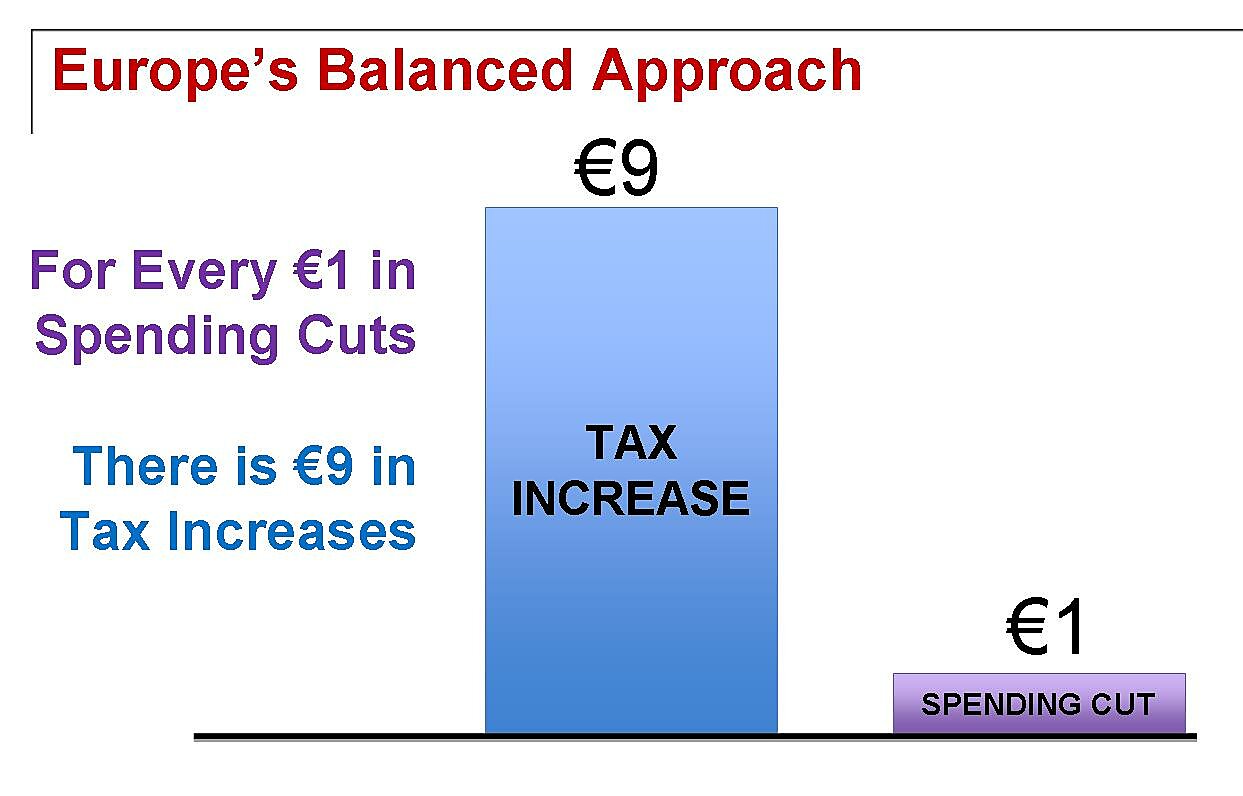
Interestingly, the first part of the last sentence helps to explain the very poor results of tax-heavy “austerity” packages in places like Greece, Spain, Ireland, the United Kingdom, and Portugal. Politicians in those countries are squeezing the private sector in hopes of minimizing the restraint imposed on bloated public sectors. But that doesn’t generate good results. The Baltic nations took a much better approach, imposing genuine spending cuts the moment the crisis hit. Now their finances are in stronger shape and they’re enjoying renewed growth.
But I’m digressing. Let’s return to Mertens’ research. He also produced some interesting results about tax rates and high-income taxpayers.
Many of the postwar tax reforms have made particularly large changes in top marginal tax rates. This variation in top statutory rates may be used to estimate the effects of a hypothetical tax reform that only alters marginal tax rates for the top 1%. … The specification … displays the response to a 1 percent rise in the net-of-tax rate of the top 1% in the income distribution. … The tax cut leads to significant increases in average top 1% incomes, which rise on impact by 0.52 percent and by 0.97 and 1.02 percent in the following two years, after which there is a gradual decline. …[T]he cut in top 1% tax rates leads to a statistically significant increase in real GDP of up to 0.34 percent in the third year. … There are also spillover effects to incomes outside of the top 1%. Average incomes of the bottom 99% rise by 0.15 percent on impact and by up to 0.35 percent in the third year.
So we learn that lower tax rates for the “rich” are good for the economy and also benefit the general population’s living standard.
Why, then, would anybody want to impose higher tax rates? Here’s a hint from the study:
Despite the spillover effects, a top marginal rate cut unambiguously leads to greater inequality in pre-tax income.
In other words, the rich get richer faster than the non-rich get richer when the top tax rate is reduced. So if you’re driven by class-warfare animus, you may decide that you’re willing to hurt poor and middle-class people in order to prevent upper-income taxpayers from realizing a bigger share of the economy’s increased output.
That doesn’t make much sense. Iif you watch this video on class-warfare tax policy, there’s no logical reason to support higher tax rates on more successful taxpayers.
Unfortunately, politicians generally are motivated by a desire to maximize votes and power, not by what’s logical.
That’s why, when I’m doing educational outreach on Capitol Hill, I often make an extra effort to explain that a bigger economy—enabled by small government and free markets—is fiscally the same as a bigger tax base.
That’s far from a pure libertarian argument, to be sure, but it’s not easy when you’re trying to convince the foxes that it doesn’t make long-run sense to deplete the henhouse.
P.S.: Notwithstanding all the academic evidence, there’s a group of people in Washington who deliberately assume that tax policy has no impact on economic output.
Related Tags
On a drive back from a visit to Monticello yesterday, I listened to Jon Meacham’s biography of Thomas Jefferson. In 1784 Jefferson was interested in a project to improve trade routes to the West from the Potomac River. In a March 15 letter to George Washington, he wondered whether it might be a (state) government-supported project, but admitted one problem with that idea:
But a most powerful objection always arises to propositions of this kind. It is that public undertakings are carelessly managed and much money spent to little purpose.
So as small as the government was back then, it was already commonly known that government projects are often screw-ups. By the way, if you look at the history of the oldest federal agencies—such as the Bureau of Indian Affairs and the Corps of Engineers—you will find scandals, mismanagement, and cost overruns from the the beginning.
Today, the parade of failures and mismanagement continues. Back from Monticello, I caught up on the Washington Post and found an article by Walter Pincus describing the “explosive costs of nuclear weapons disposal.”
Costs have skyrocketed for the Mixed Oxide Fuel Fabrication Facility at the Savannah River plant in South Carolina … When the National Nuclear Security Administration (NNSA) originated this MOX program in 2002, design and construction were to cost $1 billion. By 2005, the estimate was $3.5 billion. When project construction began in 2007, it was three years behind schedule with a $4.8 billion price tag. According to NNSA’s fiscal 2014 budget request, construction will hit $7.78 billion. The annual cost to run the facility has also exploded. NNSA estimated in 2002 that it would cost $100.5 million a year to operate the MOX plant. Annual operating costs are now expected to be $543 million.
Regarding the Hanford Nuclear site in Washington state, Pincus notes:
To handle treatment of the millions of gallons of highly radioactive liquid waste, much of which dates to the 1940s, the Energy Department decided in 2000 to build a Waste Treatment and Immobilization Plant. The cost was estimated at $4.3 billion with a 2011 completion date. A December 2012 GAO audit said the cost has tripled, to $13.4 billion. Completion is not expected until 2019.
I discuss the huge cost of nuclear site cleanup in this essay and the problem of government cost overruns in this piece.
Governments have always been inefficient in handling spending projects, and will probably always be so. Of course, there are things we need governments to do, such as defending the nation. But the poor management record of government is one good reason to keep it out of all those activities that the private sector can and should be doing for itself.
P.S.: The story of early navigation improvements on the Potomac is a long and complicated one, and the efforts included both public and private financing. Here is one summary.
Related Tags
Regular readers know that one of my main goals is to preserve and promote tax competition as a means of restraining the greed of the political class. Heck, I almost wound up in a Mexican jail because of my work defending low-tax jurisdictions.
As you can imagine, it’s difficult to persuade politicians. After all, why would they support policies such as fiscal sovereignty and financial privacy that hinder their ability to extract more revenue? So I try to educate them about the link between taxes and growth in hopes that they will understand that a vibrant economy also means a large tax base. And I specifically tell them that so-called tax havens play a very valuable role since they are an alternative source of investment capital for nations that have undermined domestic investment with bad tax policy.
I also explain to them that low-tax jurisdictions give companies some much-needed flexibility to maintain operations in an otherwise hostile fiscal environment. Let’s look at that specific issue by reviewing some of the findings from a study by two Canadian economists about tax havens and business activity. In the introduction to their study, they describe the general concern (among politicians) that competition between governments will lead to lower tax rates:
Increased mobility of goods and services is apt to give rise to an erosion of corporate tax bases in high-tax industrialized countries, a decline in tax revenues and a rise in competition among governments. Countries seeking to attract and retain mobile investment and the associated tax revenues may be induced to reduce tax rates below the levels that would obtain in the absence of mobility. In the view of some commentators, indeed, increased mobility can lead to a “race to the bottom” driving business tax rates to minimal levels, due to the fiscal externalities that mobility creates.
It certainly is true that tax competition has pressured politicians to lower tax rates, and the academic research shows that this is a good thing, notwithstanding complaints by leftists economists such as Jeffrey Sachs.

What folks on the left don’t understand is that there is a big difference between tax rates and tax revenue. Thanks in large part to Laffer-Curve effects, the big decline in tax rates in the past three decades has not led to a decline in tax revenues. Indeed, taxes on income and profit, measured as a share of GDP, have increased as tax rates have declined.
But I’m getting distracted. The purpose of this post is to analyze the findings of the two Canadian economists. Here are their major conclusions, which show that tax havens actually help high-tax nations by allowing companies to engage in “real economic activities” in spite of punitive tax policies:
Financial mobility is manifested in the decisions of multinational enterprises to separate research and development and capital financing activities from production and sales of outputs, and so to engage in “tax planning” to realize income from intellectual property and from capital in jurisdictions different from those where real economic activities are located. … While tax planning may reduce revenues of high-tax jurisdictions, therefore, it may have offsetting effects on real investment that are attractive to governments. In principle, then, the presence of international tax planning opportunities may allow countries to maintain or even increase high business tax rates, while preventing an outflow of foreign direct investment. …[T]he investment-enhancing effects of international tax planning can dominate the revenue-erosion effects. The implications of this view are strong: an increase in international tax avoidance can lead to … an increase in the welfare of citizens of high-tax countries. …[C]onsistent with our model, governments may be reluctant to close such “loopholes,” because of fears of losses in multinational employment and, in particular, expatriations of ownership and headquarters operations to low-tax countries. …[R]evenue losses due to tax planning are irrelevant, and what matters is the effect of tax planning on the level of multinational investment in high-tax countries and its deadweight costs for the economy, if any.
In other words, tax havens make it possible for companies to indirectly reduce their overall tax burden, thus making it economically feasible to continue operating—and retaining jobs—in nations with bad tax policy. Other economists have reached similar conclusions. At about the 7:20 mark of this video, I cite research by Mihir Desai, Fritz Foley, and James Hines that also found that tax havens facilitate greater economic activity in high-tax nations.
P.S.: I’ve done lots of debates about tax havens (on American TV, British TV, and French TV) and those of you attending FreedomFest can see me cross rhetorical swords with James Henry of the Tax Justice Network. As you can see from the agenda, I’ll also be moderating a panel on tax reform and introducing Charles Murray’s talk on how to limit the state.
P.S.S.: There’s something about tax havens that causes statists to become even more irrational than they usually are. Some of them actually advocate military action against these peaceful jurisdictions! I’m wondering if this is their way of compensating for the guilt that they feel since many well-known leftists invest their money in these low-tax jurisdictions.