Both reason (the human faculty) and Reason.TV (the Web network) say no:
Cato at Liberty
Cato at Liberty
Education
…President Obama and Congress were doling out tens-of-billions of dollars to the education status quo while doing little of meaningful, reform‑y substance. Now we see the payoff: President Obama has gotten bipartisan accolades for supposedly being a different kind of Democrat on education — one willing to take on teacher unions — while he’s fully kept union allegiances.
Reports the Washington Post about National Education Association plans to spend $15 million on largely Dem-friendly, midterm-election advertisements:
Karen M. White, the NEA’s political director, said the 3.2 million-member union is in sync with Obama more often than not. As an example, she pointed to his support for a $10 billion education funding bill that the Democratic-led Congress passed in August over Republican opposition.
“That education jobs bill got so many of our members engaged,” White said. “It was a turning point for us.”
She played down controversy over Obama’s school reform agenda as “bumps in the road,” adding, “we share the same goals as this administration.”
It really wasn’t hard to see the politics at play here: Talk a lot about reform, expend riches to protect the status quo, win good will from all sides. And heck, who gets hurt? Only taxpayers and students, that’s all.
Related Tags
Yesterday, President Obama hosted the White House Summit on Community Colleges, and in-your-face love was in the air. President Obama and Second Lady Jill Biden, a community college professor, couldn’t keep their hands off their signficant other, lavishing all sorts of praise on their favorite little schools.
Swooned Dr. Biden about the dreamy things community colleges do for their students:
They are students like the mother who shared her experience with us on the White House website of working towards a degree while raising three children and straddling financial challenges. Now employed and the holder of a Bachelor’s and a Master’s degree, she wrote, “Community colleges didn’t just change my life, they gave me my life.”
Community colleges do that every day.
Ick!
The President, too, couldn’t hide his affection:
So I think it’s clear why I asked Jill to travel the country visiting community colleges -– because, as she knows personally, these colleges are the unsung heroes of America’s education system. They may not get the credit they deserve. They may not get the same resources as other schools. But they provide a gateway to millions of Americans to good jobs and a better life.
Like the guy with the locker next to Mr. and Mrs. Lovebird, all I can say is “oh, come on!”
Community colleges might be a good option for some people, but they are hardly paragons of educational success. Quite the opposite: According to the U.S. Department of Education, they have the worst graduation rates of any two-year sector of higher education. Only around 22 percent of public, two-year college students graduate within three years, versus roughly 49 percent of private, not-for-profit attendees and about 59 percent of private, for-profit students.
Wait! What’s that? Private, for-profit institutions outperform super-cute community colleges…by a lot? But they’re the ugliest, meanest, least popular kids in school! Nobody likes them!
Oh, I know what’s going on here! For-profit schools cost a lot more than community colleges, right? That’s why they’re so disliked.
That’s true if you look at tuition prices. But community colleges get big subsidies from government, especially state and local taxpayers. So they might actually cost a lot, it’s just that they sneak the money out of your back pocket and then congratulate themselves for charging students so little.
When you look at government expenditures per-pupil, including aid to schools and students, it becomes clear that community colleges are, in fact, just as mean and greedy as for-profits. Indeed, former Clinton administration economist Robert Shapiro has calculated that they are actually more costly to taxpayers than for-profit schools (see table 24). According to his calculations, two-year public schools cost taxpayers $6,919 per student, while private, for-profits cost just $3,628.
No wonder the summit turned my stomach! At the same time the administration and its allies in Congress are bashing for-profit schools, the President has a love fest with community colleges that are generally much worse. Unfortunately, it leaves you concluding that for-profits could walk on water and it wouldn’t matter: As long as they’re honest about trying to make a buck, they’ll be beaten up in the parking lot and never invited to any of the cool summits.
Related Tags
The trendy thinking might be that you’re loopy if you call for ending the U.S. Department of Education, or if you think the Constitution should actually have some bearing on federal education policy. Reality, however, strongly suggests that you’d be crazy not to think that way. If you have doubts, I urge you to read Pork 101: How Education Earmarks School Taxpayers, a new report on federal education “help” from the office of Sen. Tom Coburn (R‑OK).
To start things off, the report succinctly summarizes the role the Constitution gives the feds in education: “The U.S. Constitution provides no role to the federal government in education.”
That’s not entirely accurate—the 14th Amendment empowers Washington to prohibit state and local discrimination in the provision of schooling, and the feds can control education in DC—but otherwise Washington really has zero constitutional authority to meddle in education.
Right after stating this, the report lays out the big ball of nothin’ we’ve gotten from decades of federal meddlin’ and spendin’. Some of the charts might be familiar…
Finally, the paper shines a light on the root problem with federal involvement: It ultimately serves the interests of politicians and special interests, not children or the public. Indeed, by focusing on education pork—legislative earmarks that go directly to favored constituencies—the report highlights politicians literally glorifying themselves with “education” dough.
There’s $1 million, for instance, to establish the Howard Baker School of Government at the University of Tennessee. Another $6 million for the William F. Goodling Institute for Research and Family Literacy at Penn State. There’s $5 million for the Daniel Patrick Moynihan Global Affairs Institute at Syracuse University. $1 million for the Paul Simon Public Policy Institute at Southern Illinois University. $2 million to the City College of New York for the now-infamous Charles B. Rangel Center for Public Service. And tens-of-millions for “Harkin Grants,” which are named after Senate Health, Education, Labor, and Pensions Committee chairman Tom Harkin. That’s the same Tom Harkin who has been raking for-profit colleges over the coals for, basically, serving themselves with taxpayer dollars.
Maybe they learned it by watching you, Senator Harkin.
There are many more examples of taxpayer-funded politician-aggrandizement in the report, as well as lots of other cuts of pig. Take it all in if you can stand it, then give some thought to who’s really nutty when it comes to federal education policy. The answer should be pretty clear.
Related Tags
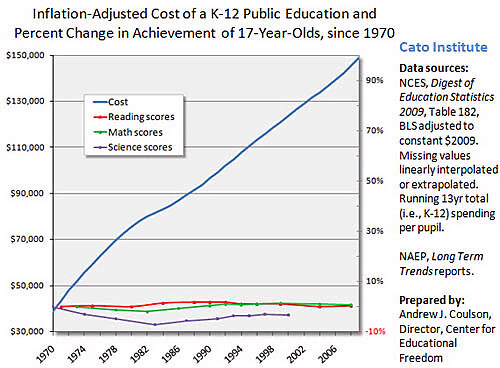
This week, President Obama called for the hiring of 10,000 new teachers to beef up math and science achievement. Meanwhile, in America, Earth, Sol-System, public school employment has grown 10 times faster than enrollment for 40 years (see chart), while achievement at the end of high school has stagnated in math and declined in science (see other chart).
Either the president is badly misinformed about our education system or he thinks that promising to hire another 10,000 teachers union members is politically advantageous–in which case he would seem to be badly misinformed about the present political climate. Or he lives in an alternate universe in which Kirk and Spock have facial hair and government monopolies are efficient. It’s hard to say.

Related Tags
To help kick off “Education Nation” — what NBC is calling an education-intensive week of news programming — Matt Lauer sat down with President Obama on this morning’s Today show. As expected, it was all talk, no real reform.
The interview started with a discussion of “Race to the Top,” the President’s $4.35 billion mechanical rabbit designed to make states run to implement “reforms” the President likes. Lift caps on charter schools. Adopt national curriculum standards. Things like that. As his administration has done for months, the President spared no superlative prasing the thing, saying it is “the most powerful tool for reform that we’ve seen in decades.”
Uggh. RTTT did very little of substance, and even if the reforms seemed promising in theory we have absolutely no evidence of actual, positive effects on learning.
But the reforms don’t seem promising. Sure, RTTT got some states to lift caps on charter schools and eliminate some barriers to evaluating teachers using student test scores. For the most part, though, RTTT just prodded states to promise to plan to make reforms, and even things like lifting charter caps do little good when the problems go much deeper. Indeed, the only thing of real substance RTTT has done is coerce states into adopting national curriculum standards, pushing us a big step closer to complete federal domination of our schools. That’s especially problematic because special interests like teacher unions love nothing more than one-stop shopping.
But isn’t the President taking on the unions?
Hardly. While he has lightly scolded unions for protecting bad teachers, he has given them huge money-hugs to sooth their hurt feelings. Moreover, perhaps to further heal their emotional ouchies, on Today he offered union-hack rhetoric about teachers, going on about how they should be “honored” above almost all other professions, and how selfless and hard working they are.
Now, lots of teachers work hard and care very much about kids, but shouldn’t individual Americans get to decide how much they want to honor a profession, and how much they are willing to pay for the services of a given professional? Of course they should — who’s to say definitively whether a good teacher is more valuable than, say, a good architect? — but when government controls education, it decides what teachers “should” get paid.
Unfortunately, the President chose to seriously inflate how long and intensively teachers work, saying they work so hard they are downright “heroic.” No doubt many do work very long hours, but research shows that the average teacher does not. A recent “time diary” study found that during the school year teachers work only only about 7.3 hours on weekdays– including work on and off campus — and 2 hours on weekends. That’s 18 fewer minutes per day than the average person in a less “heroic” professional job. Oh, and on an hourly basis teachers get paid more than accountants, nurses, and insurance unerwriters.
Most troubling in the Today interview, though, was the President’s failure to even mention school choice — giving parents, not politicians, control of education money — as even a potential means for reforming education. He did, though, fully embrace his own educational freedom: When asked whether the DC public schools were good enough for his kids, he said no. That’s why they go to private school.
Here’s where we see the injustice of Obama’s and other like-minded people’s “reform” offerings. Rather than giving real power to the parents and kids public education is supposed to serve, they insist on keeping them subject to the authority of politicians and politically potent special interests. They refuse to let all parents make the same choice the President has made, and they continue to force all Americans to hand huge sums of money over to government schools. Indeed, at the same time the President’s kids were heading off to private school, he was letting die an effective, popular, school-choice program in DC, a program that enabled poor families to make the same kinds of choices the President did.
But educational freedom isn’t just — or even mainly — about equality. It is the key to unleashing systemic accountability and innovation, two essential things the President at least says he likes. Unfortunately, he has embraced at best a third-measure for getting these critical things, throwing his support behind charter schools.
The root problems with charter schools are that they are still public schools, and they are largely under the control of the districts with which they want to compete. So if they ever start taking big chunks of kids from the traditional public schools — if they ever impose real accountability by providing real competition — they’ll just be crippled or crushed.
The President suggested, though, that the main value of charters is not accountability, but that they can test new things. But letting a few government schools be a little different from the others won’t produce meaningful, constant, powerful innovation, especially if charters are kept from truly competing for students. Let parents take their education dollars to any school they wish, with no government thumbs on the scale, in contrast, and soon all schools will either have to get better, or go out of business.
Unfortunately, it seems that freeing all parents to pursue the education that’s best for their kids is a reform much too far for this President. Nothing, it appears, can be allowed to truly challenge the government schools.
Related Tags

A sophisticated study released this week finds that merit pay for public school teachers doesn’t seem to improve student achievement. Why not?
Ask almost anyone—even Fidel Castro—and they’ll acknowledge that the free enterprise system results in higher quality and greater efficiency than government monopolies. As a result, it has long been argued that we should introduce this or that aspect of free markets into the public school system. And that’s the problem. The free enterprise system is a system. It is not a smorgasbord from which we can pick an isolated incentive here and a particular freedom there, and expect to get the same results we’ve come to expect from full-fledged markets.
Offering merit pay to teachers does nothing to liberate principals from the shackles of union contracts and state licensing requirements that determine whom they can hire and fire. Neither does it give principals the incentives enjoyed by private sector managers to hire and retain the most effective employees they can find. Nor does it break the government funding monopoly of public schooling, which pressures parents to stick with public schools even when there are better and more efficient private alternatives. It also fails to provide the freedoms and incentives to would-be education entrepreneurs that are responsible for the scale-up of top providers and effective new innovations in every other field.
In the end, public school merit pay lashes a few feathers to a brick. Why be surprised when it doesn’t fly?
Create a truly free education marketplace in which all families are active consumers and all schools have to compete to serve them, in which public schools no longer enjoy a monopoly on $600 billion in annual k‑12 spending, and we will get the results we all seek. Short of that, expect continued stagnation or decline in quality coupled with rising spending.