There has been debate this week about how many libertarians there are. The answer is: it depends on how you measure it and how you define libertarian. The overwhelming body of literature, however, using a variety of different methods and different definitions, suggests that libertarians comprise about 10–20% of the population, but may range from 7–22%.

Furthermore, if one imposes the same level of ideological consistency on liberals, conservatives, and communitarians/populists that many do on libertarians, these groups too comprise similar shares of the population.
In this post I provide a brief overview of different methods academics have used to identify libertarians and what they found. Most methods start from the premise that libertarians are economically conservative and socially liberal. Despite this, different studies find fairly different results. What accounts for the difference?
1) First, people use different definitions of libertarians
2) Second, they use different questions in their analysis to identify libertarians
3) Third, they use very different statistical methods.
Let’s start with a few questions: How do you define a libertarian? Is there one concrete libertarian position on every policy issue?
What is the “libertarian position” on abortion? Is there one? What is the “libertarian position” on Social Security? Must a libertarian support abolishing the program, or might a libertarian support private accounts, or means testing, or sending it to the states instead? A researcher will find fewer libertarians in the electorate if they demand that libertarians support abolishing Social Security rather than means testing or privatizing it.
Further, why are libertarians expected to conform to an ideological litmus test but conservatives and liberals are not? For instance, what is the “conservative position” on Social Security? Is there one? When researchers use rigid ideological definitions of liberals and conservatives, they too make up similar shares of the population as libertarians. Thus, as political scientist Jason Weeden has noted, researchers have to make fairly arbitrary decisions about where the cut-off points should be for the “libertarian,” “liberal,” or “conservative” position. This pre-judgement strongly determines how many libertarians researchers will find.
Next, did researchers simply ask people if they identify as libertarian, or did they ask them public policy questions (a better method)? If the latter, how many issue questions did they ask? Then, what questions did they ask?
For instance, what questions are used to determine if someone is “liberal on social issues”? Did the researcher ask survey takers about legalizing marijuana or did the researcher ask about affirmative action for women in the workplace instead? Libertarians will answer these questions very differently and that will impact the number of libertarians researchers find.
While there is no perfect method, the fact that academics using a variety of different questions, definitions, and statistical techniques still find that the number is somewhere between 7–22% gives us some idea that the number of libertarians is considerably larger than 0.
Next, I give a brief overview of the scholarly research on the estimated share of libertarians, conservatives, liberals, and communitarians in the American electorate. I organize their findings by methods used starting with most empirically rigorous:
Ask people to answer a series of questions on a variety of policy topics and input their responses into a statistical algorithm
In theses studies, researchers ask survey respondents a variety of issue questions on economic and social/cultural issues. Then, they input people’s answers into a statistical clustering technique and allow an algorithm to find the number of libertarians. This is arguably the strongest method to identify libertarians.
- Political scientists Stanley Feldman and Christopher Johnson use a sophisticated statistical method to find ideological groups in the electorate (latent class analysis). They find six ideological groups based on answers to a variety of questions on economic and social issues. Feldman and Johnson’s results indicate that about:
- 15% are likely libertarians (conservative on economics and liberal on social issues)
- 23% are likely liberals
- 17% are likely conservatives
- 8% are communitarians/populists (liberal on economics and very conservative on social issues)
- 13% are economic centrists but social liberals
- 24% are economic centrists but lean socially conservative.
Ask people to answer a series of questions on a variety of policy topics and plot their average responses on a 2‑dimensional plot
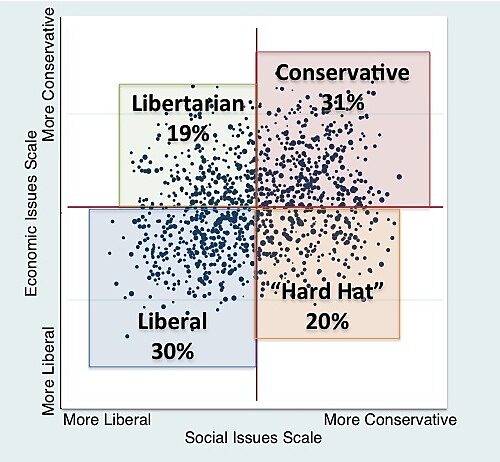
In these studies, researchers 1) average responses to multiple questions on economics and then 2) average responses to multiple questions on social/cultural/identity/lifestyle issues. They then take the two averaged scores to plot respondents on a 2‑dimensional graph (Economic Issues by Social Issues).
- Political scientist Jason Weeden averages people’s responses to questions on economics (income redistribution and government assistance to the poor) and on social issues (abortion, marijuana legalization, the morality of premarital sex) found in the General Social Survey. He finds:
- 11% of Americans are libertarian
- 11% are conservative
- 14% are liberal
- 9% are communitarian/populist
- Remaining people are roughly evenly distributed between these groups

- Political Scientists William Clagget, Par Jason Engle, and Byron Shafer use answers to a variety of questions on economics and the “culture” issues from the American National Election Studies from 1992–2008 to determine that:
- 10% of the population is libertarian
- 11% is populist
- 30% is conservative
- 30% is liberal
- (Their methods are unclear and their “culture” index may include questions about spending on crime and support for affirmative action for women.)
- Political scientists William Maddox and Stuart Lilie average responses to three questions on government economic intervention and three questions about personal freedom from the American National Election Studies and find that:
- 18% of the population is libertarian
- 24% is liberal
- 17% is conservative
- 26% is communitarian
- The Public Religion Research Institute added (rather than averaged) responses to 9 questions on social and economic issues and made a decision that cumulative scores of 9–25 would be coded as libertarian. Doing this they find that:
- 7% of Americans are libertarian
- 15% lean libertarian
- 17% lean communalist
- 7% are communalist
- 54% have mixed attitudes
- For a previous Cato blog post, I conducted a similar analysis and created three separate estimations of libertarians. Each used averaged responses on economic questions, but were plotted alongside their average answers to either 1) social issues questions, 2) race/identity questions, and 3) criminal justice and racial equality questions.
- Using economic and social issues I find:
- 19% Libertarian
- 20% Communitarian
- 31% Conservative
- 30% liberal
- Using economic and race issues, I find:
- 19% Libertarian
- 15% Communitarian
- 33% Conservative
- 33% Liberal
- Using economic and criminal justice issue positions I find:
- 24% Libertarian
- 15% Communitarian
- 28% Conservative
- 33% Liberal
Ask people to answer a question about economic policy and a question about social policy
While not as rigorous as asking people multiple questions, this is another quick way to observe the diversity of ideological opinion in surveys.
- Nate Silver of FiveThirtyEight using two questions from the General Social Survey: support for same-sex marriage and whether government ought to reduce income inequality with high taxes on the rich and income assistance to the poor, finds
- 22% are libertarian
- 25% conservative
- 34% liberal
- 20% communitarian
- David Kirby and David Boaz use answers to 3 survey questions and find that 15% of the population are libertarians (agree that less government is better, and that free markets can better solve economic problems, and that we should be tolerant of different lifestyles)
Ask people if they identify as libertarian and know what the word means
The Pew Research Center found that 11% of Americans agree that the word “libertarian describes me well” and know libertarians “emphasize individual freedom by limiting the role of government.”
Ask people if they identify as socially liberal and fiscally conservative, an oft-used definition of libertarianism
A 2011 Reason-Rupe poll found that 8% of Americans said they were “conservative” on economic issues and also “liberal” on social issues. But the same method found 9% identified as “liberal” on both social and economic issues, 2% identified as liberal on economic issues and conservative on social issues, and 31% identified as conservative on both social and economic issues. They remaining respondents were somewhere in the middle. These results are consistent with polls from Rasmussen, and Gallup which finds a public preference for the word “conservative” over “liberal.” This means many people who endorse liberal policy are inclined to self-identify as moderate or conservative.
Conclusions
In sum, the overwhelming body of empirical evidence suggests that libertarians’ share of the electorate is likely somewhere between 10–20% and the conservative and liberal shares’ aren’t that much greater. Libertarians exist, quite a lot, but you have to know what you’re looking for.
David Kemp contributed to this post.
