
On May 26, we submitted comments on a proposed rule by the Department of Labor (DOL) intended to increase the mandatory minimum wage—known as the prevailing wage—for employer-sponsored immigrants and H‑1B nonimmigrants. Our comments were unique in demonstrating that the rule change is unlawful and unnecessary.
DOL claims that H‑1B and other employer-sponsored foreign workers are paid “below market” wages and that its rule fixes this problem. But the proposed rule only inflates wages to restrict the supply of skilled foreign workers beyond what the law allows and will force existing H‑1B workers to leave the country. H‑1B workers are objectively among the highest paid in America, earning wages in the top 10 percent nationally. It would be disastrous to exclude them.
Background
DOL’s proposed rule:
- provides no empirical basis for raising the prevailing wage;
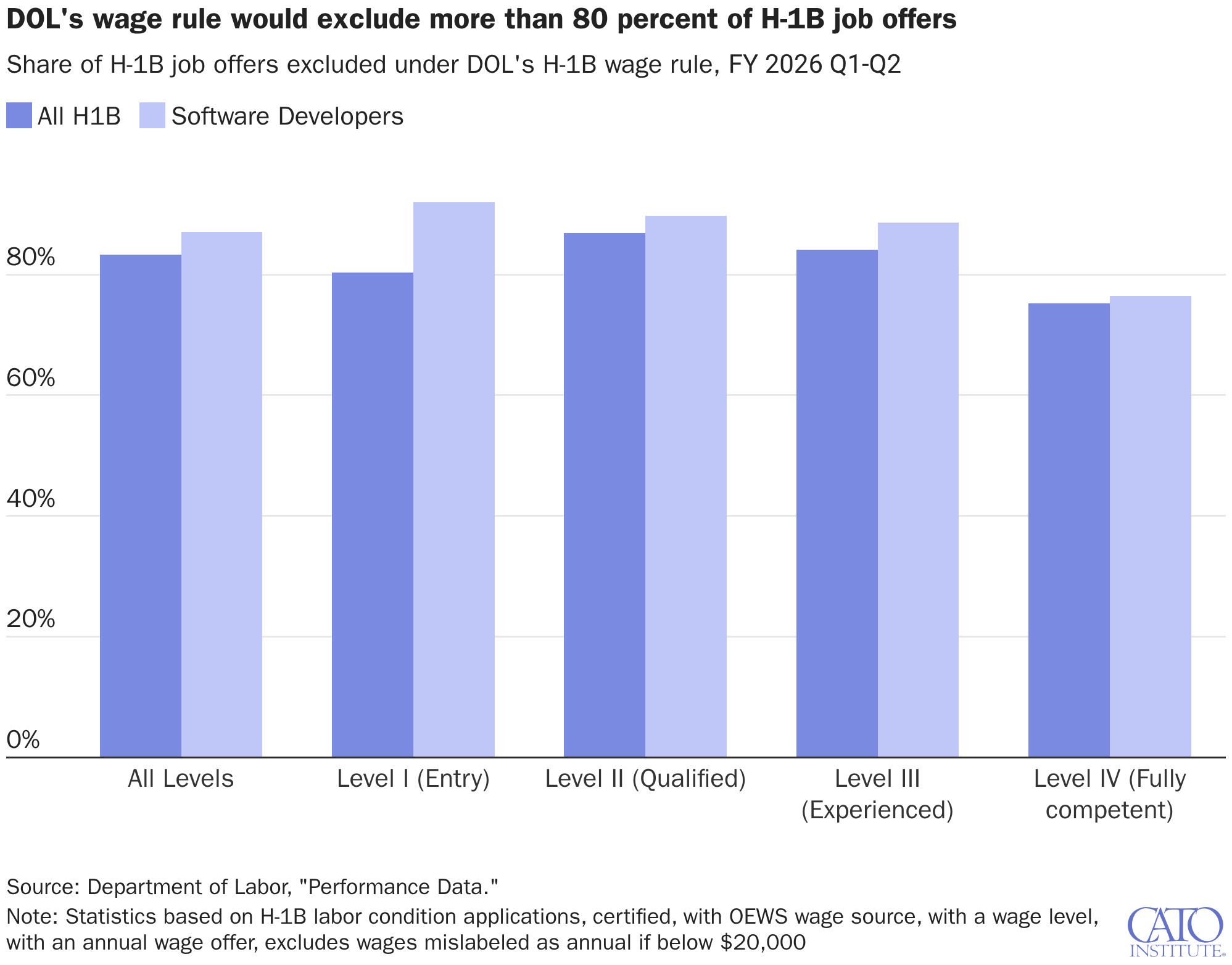
- rejects 80 percent of current wage offers to H‑1B and other skilled foreign workers, even among the highest skill level;
- forces out hundreds of thousands of H‑1B workers who have lived and worked in the United States under the current system for many years; and
- cuts visa issuances, particularly for researchers, professors, scientists, and workers in health care and universities because these workers are commonly not subject to the cap.
The upshot of reducing the number of H‑1B workers is less business investment, less US job growth, less innovation, and more outsourcing.
The current prevailing wage is usually calculated using the Occupational Employment and Wage Statistics (OEWS) survey, which surveys employers to collect information on employee wages. The law (Immigration and Nationality Act 212(p), 8 U.S.C. 1182(p)) requires DOL to take those survey results and create at least four wage levels for each occupational classification “commensurate with experience, education, and the level of supervision.” Jobs with higher requirements must pay higher wages.
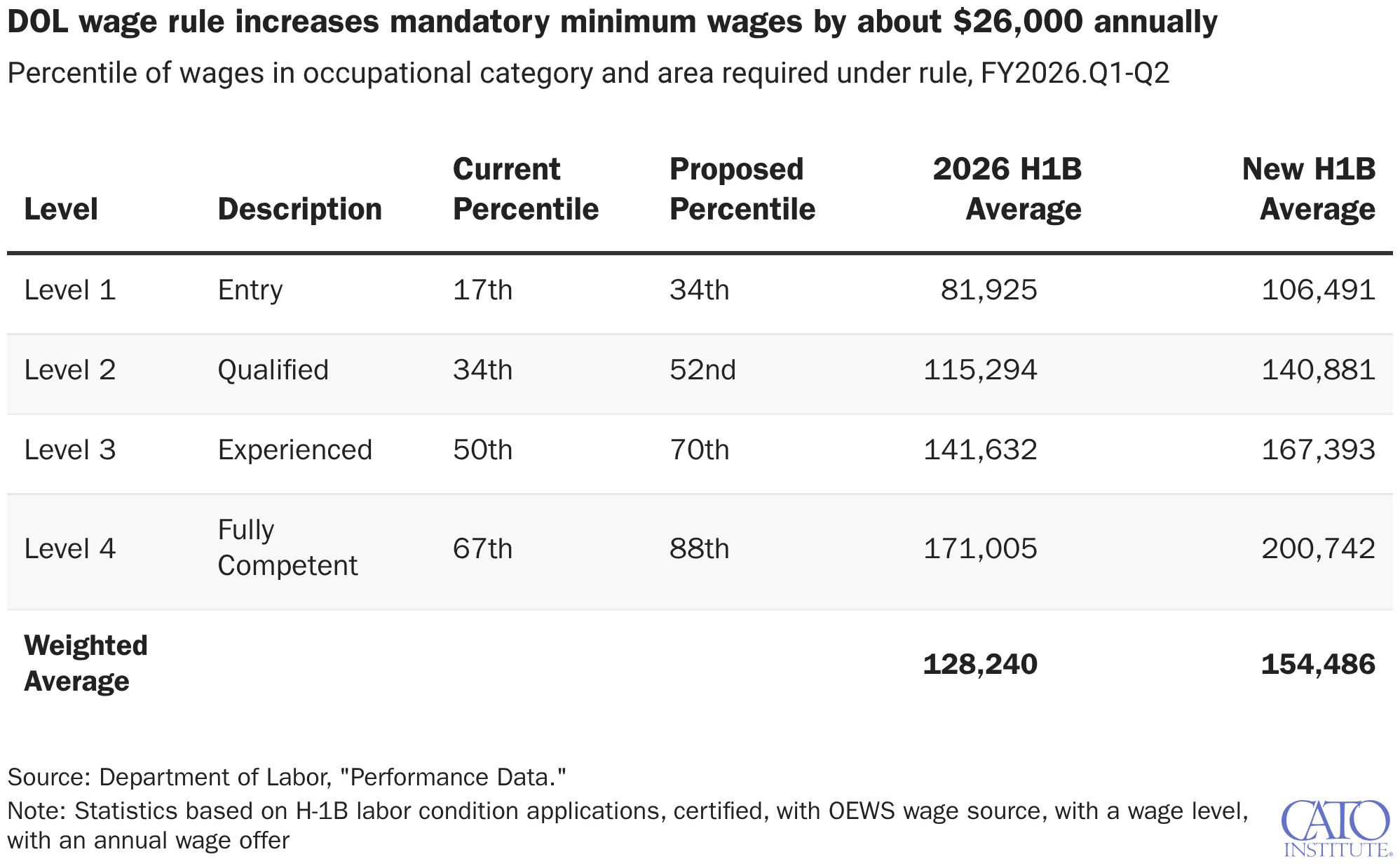
DOL plans to raise the four wage levels from the 17th to 34th percentile for level 1 (entry-level workers), from the 34th to 52nd percentile for level 2, from the 50th to 70th percentile for level 3, and from the 67th to 88th percentile for level 4, the highest wage level for “fully competent” workers. The average H‑1B prevailing wage would rise about $26,000 annually.
As seen below, over 80 percent of H‑1B job offers would be disqualified under the proposed rule, including the vast majority of the highest-skilled workers (level 4). The same is true for, by far, the most common H‑1B occupation: software developers.
DOL’s Rule Is Based on a Statistical Fantasy
DOL never even offers a theoretical basis for an increase in the prevailing wage. The market sets wages based on marginal productivity. If an H‑1B worker is offered less than their productivity and market wage, they can refuse that job offer, take another job, or change employers, which H‑1B workers have done more than 1.1 million times in the United States alone since 2003. DOL does not even argue, let alone establish, that this high rate of H‑1B job change is insufficient to keep the market competitive.[1]
Not only does DOL fail to show that competitive market forces do not apply to employer-sponsored immigrants, DOL’s data show the opposite: that H‑1B workers are paid a $10,191 premium over the current prevailing wage level. If the market were uncompetitive, H‑1B workers would all receive the exact minimum wage. This reflects that H‑1B workers are paid higher wages than US workers in similar roles because they are more productive than those workers.
DOL never empirically estimates what the wage levels should be. Instead, it simply asserts that the average foreign worker should receive the average wage for the occupational category. The levels are placed arbitrarily at wages necessary to meet the arbitrary target—not based on the wages of workers in similar roles. The statute explicitly rejects the idea of an overall target wage in favor of a wage targeted at each experience-education level.
The Current Prevailing Wage Properly Establishes the Entry-Level Wage
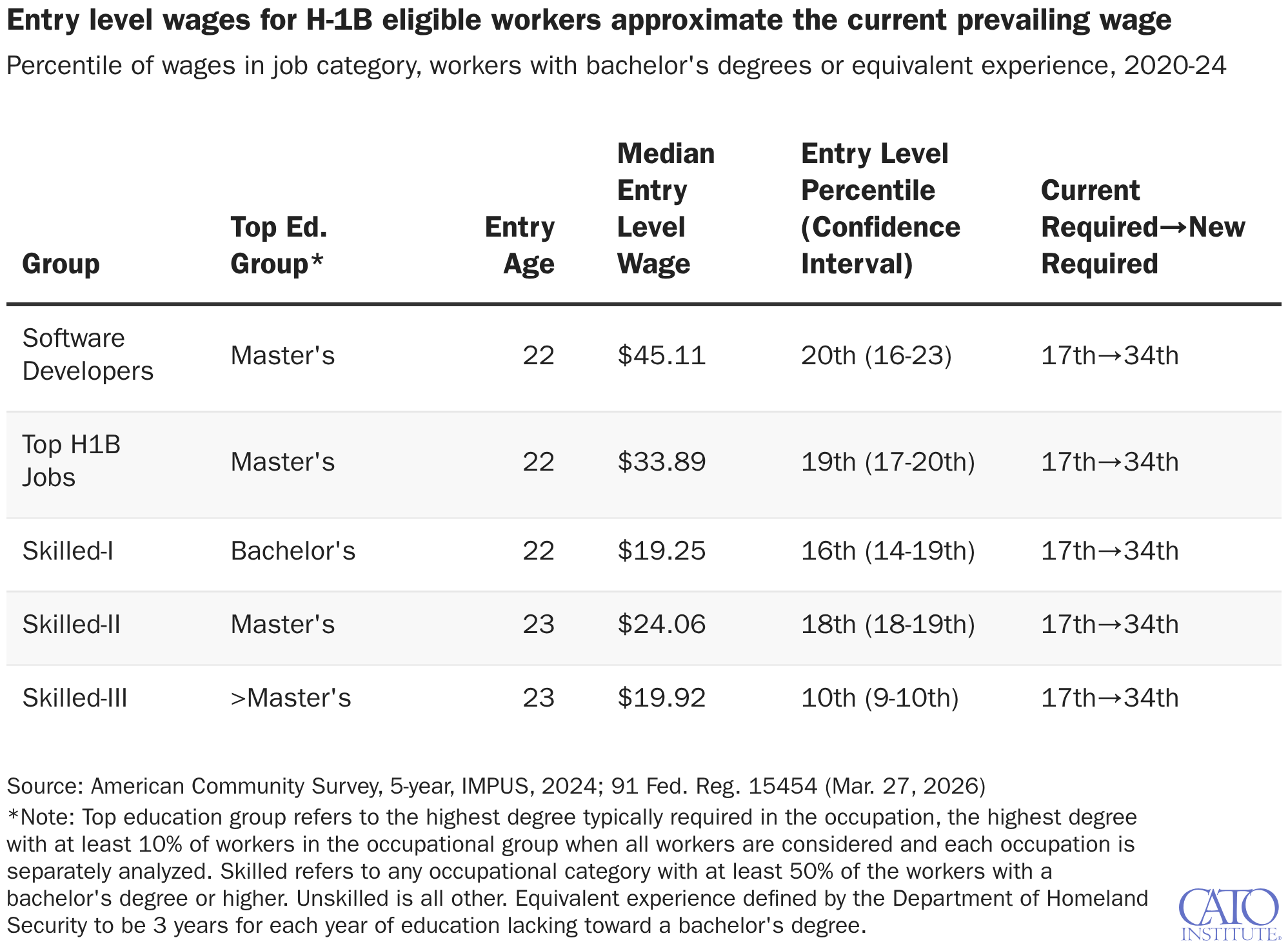
Using the American Community Survey (ACS) five-year sample of 2024, we calculated the median hourly wage for an entry-level worker by looking at the wages of young workers—specifically, the median wage for workers with ages at or below the 1st percentile for ages in the occupation. This is the only group we can be certain is, in fact, “entry-level” without prior experience. Samples of older age groups would be contaminated with at least some experienced workers.
In the top H‑1B occupations, the median entry-level worker earns wages at about the 9th percentile—well below the 17th percentile currently required. When we remove workers without a bachelor’s degree or equivalent experience required for an H‑1B visa, the median entry-level wage percentile rises to the 19th percentile for the top H‑1B occupations. The 19th percentile is slightly above the 17th, but the 17th percentile is within the 95 percent confidence interval for the estimate. There is no basis for changing the prevailing wage methodology for entry-level wages at all.
The Current Prevailing Wage Properly Establishes the Top Wage Level
To estimate the top wage level, we define “fully competent” workers as those with ages in the top third for the occupation who have the highest level of education typically required in that occupation. That’s because, at that point, wages stop rising with more experience. You can see how far DOL’s wage levels are from the median worker.
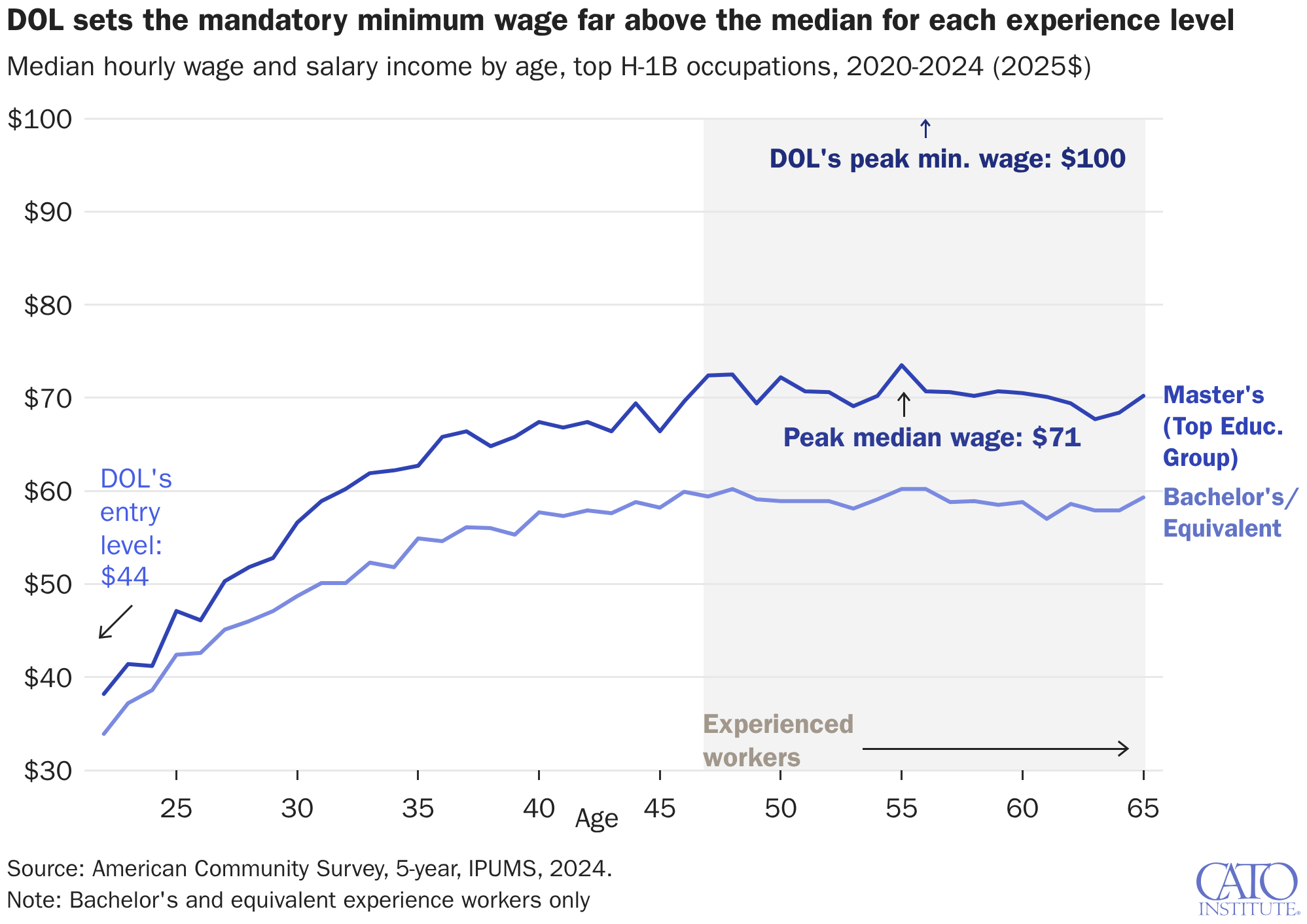
These experienced workers with the highest education required earn wages in the 70th percentile. For other skilled workers with H‑1B qualifications, the percentiles are the 70th, 66th, and 63rd, depending on the top skill level. While these values are not close to the proposed 88th percentile, they nearly match the currently required 67th percentile. This conclusion is logical. Of course, some workers will make far above the median for experienced workers, but those wages will be based on their individual characteristics—their unique productivity that is not a result of the statutory factors.
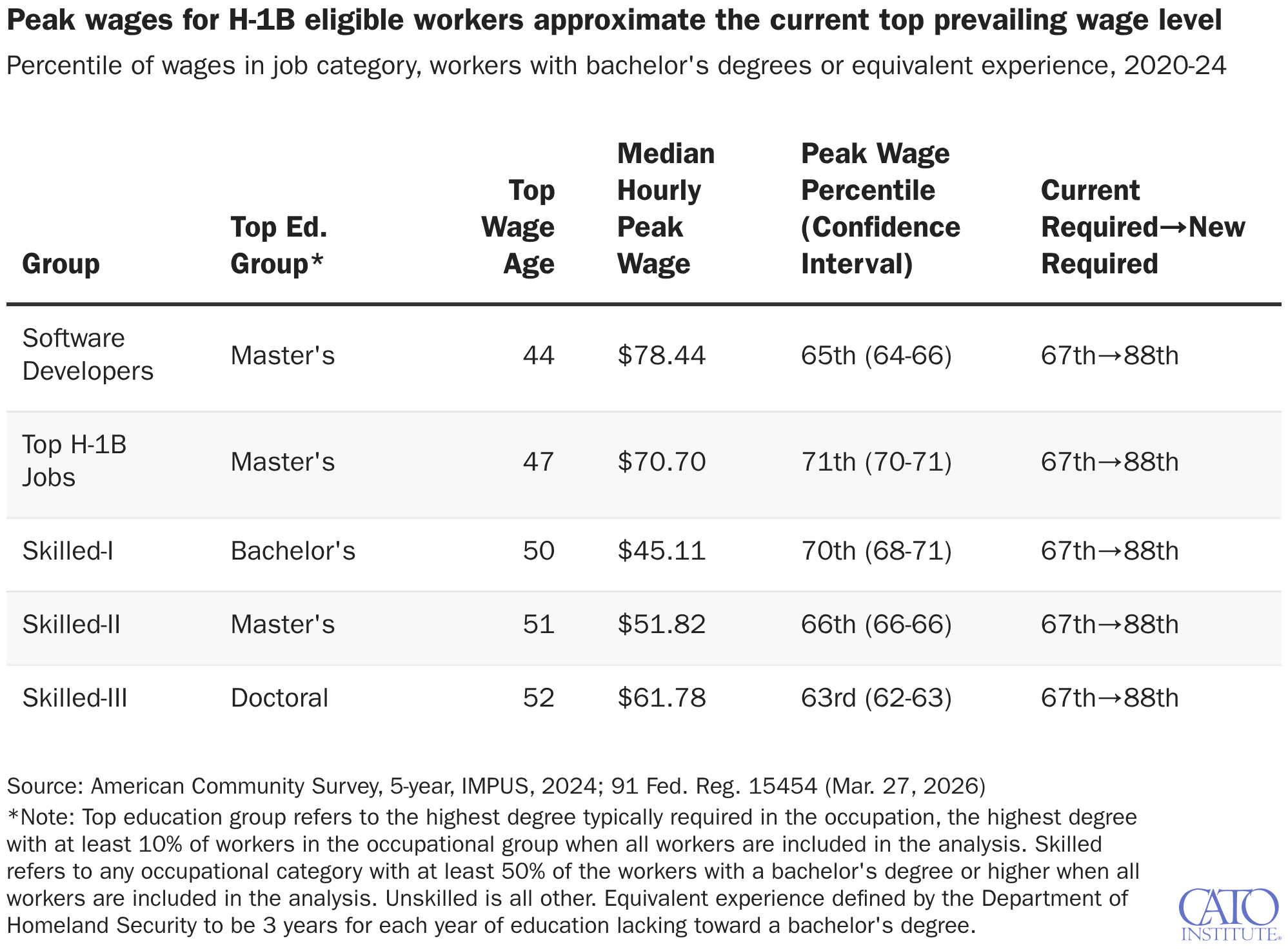
There is no basis for changing the entry or top wage levels, and as the statute sets level 2 and level 3 at equal distances between level 1 and level 4, that means there is no basis for the rule at all.
DOL’s Alternative “Experience Benchmarking” Proposal Is as Problematic as Its Main Proposal
Perhaps sensing that its main methodology is illogical and illegal, DOL separately proposes an alternative methodology for estimating the prevailing wage that is partially based on the ACS. DOL inaccurately calls this method “experience benchmarking,” even though it does not directly estimate relevant work experience.
This proposal would use a Mincer regression to estimate the ratio of nationwide wages for a specific age–occupation–degree combination (30-year-old software developers with a bachelor’s) to the median wage for the occupation nationwide. It would then multiply that ratio against the OEWS median wage, effectively adjusting the OEWS to account for differences in workers. Only after it sets this new minimum wage for each experience level would DOL create the four wage levels required by statute, based on the estimated “level of supervision” required for the job. The top wage level would take the same ratio and multiply it by the 90th percentile of the OEWS, rather than the median.
According to the Institute for Progress (IFP), experience benchmarking would disqualify the wages of at least half of recent H‑1B workers using only the level 1 wage, but IFP’s analysis was limited to the level 1 wage (the lowest minimum wage level). Rerunning the IFP analysis assigning level 2 through level 4 wages shows that the DOL experience benchmarking proposal would also exclude over 80 percent of H‑1B workers—nearly as many workers as its main proposal.
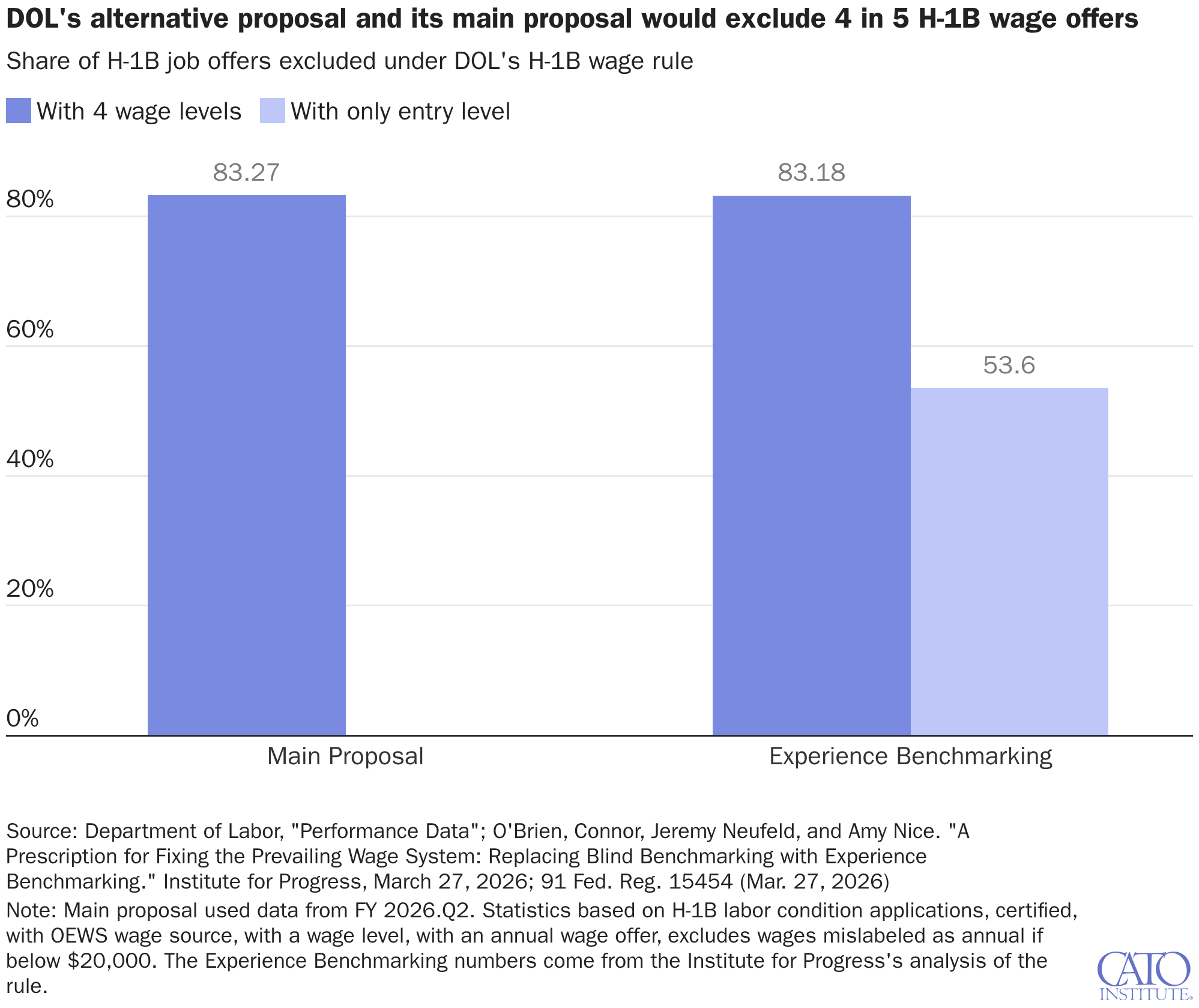
To be fair to IFP, there is ambiguity about exactly when these higher wage levels would apply. The rulemaking states that only level 1 would apply in the permanent labor certification context but not if the worker is an H‑1B worker. H‑1B workers would still have four wage levels. The law (Immigration and Nationality Act 212(n) and (p)) defines wage level as the minimum wage required for the occupation, and it would likely be illegal for DOL to say that the higher wages are the prevailing wages commensurate with the level of supervision but then not require those wages. Regardless, this new method has numerous problems.
The ACS surveys do not provide sufficient sample sizes to reliably estimate wages for detailed occupations within specific metropolitan areas.
Even at the national level, our sample only exceeded 100 observations for 23 of the 530 detailed occupational categories. At the subnational level, nearly all the samples are unusable. Using nationwide data, aggregating occupations, or grouping multiple years would each independently violate the statute. DOL knows the samples are insufficient, so it is proposing to use old data, different years, imprecise occupational groupings, and national data to estimate local wage rates for detailed occupations in a specific year—all of which is unlawful and inaccurate. But even after performing all these maneuvers, the error would be so large as to render the estimate unreliable.
IFP’s estimates are problematic. For one, IFP does not quantify uncertainty. This is particularly important because the IFP’s results rely on the ACS five-year and the OEWS. Both are surveys, each with their own source of sampling variability. IFP never quantifies this variability, so we are unable to evaluate the reliability of their estimates. Moreover, IFP does not evaluate its model for fit. As such, we do not actually know how accurate IFP’s methodology is at predicting actual wages.
DOL arbitrarily and inaccurately sets the wage levels.
DOL’s proposal first estimates the age-education specific wage and then assigns the four wage levels based on level of supervision. The highest wage level is arbitrarily set at the 90th percentile for the occupation. DOL presents no data or argument that the 90th percentile represents the wages of US workers with jobs requiring similar levels of supervision. This arbitrary threshold results in about 16 percent of wages being set above the estimated 100th percentile (the highest wage) for the occupation.[2]
Part of the problem is that DOL refuses to set any wages below the age-education median, even though workers in jobs requiring the most supervision are precisely those with below-median wages. Even in its main proposal, level 1 wage is set below the median based on this insight, but for experience benchmarking, it arbitrarily decides to exclude all wages below the median and, therefore, disconnects the wages from the level of supervision.
DOL’s alternative proposal would disconnect prevailing wages from the requirements of the job.
According to the law, the required wage must be based on the “specific employment” and the “occupational classification”—that is, the type of employment, not the type of worker. Employers won’t be able to know what wage to advertise or offer before they find the precise foreign worker since this proposal works backward from the conclusion of the recruitment process. Economic theory does not support an age-education–based wage system. In a market, wages are based on productivity, which will be based on the type of work performed, not the résumé of the worker.
Age is an unreliable proxy for relevant experience for H‑1B and other foreign workers.
By design, the immigration system delays the entry of foreign workers into the US labor market. Immigrants graduate later, and then the immigration requirements delay their entry into and advancement in the labor market, resulting in less experience at any given age than other US workers. Indeed, noncitizens are much more likely to stay in school after the Mincer equation assumes that their work experience started, overstating their work experience. During a person’s early career, ACS data suggest that each year of delayed entry into the labor market reduces H‑1B wages by between $3,000 and $5,000, depending on the type of worker.
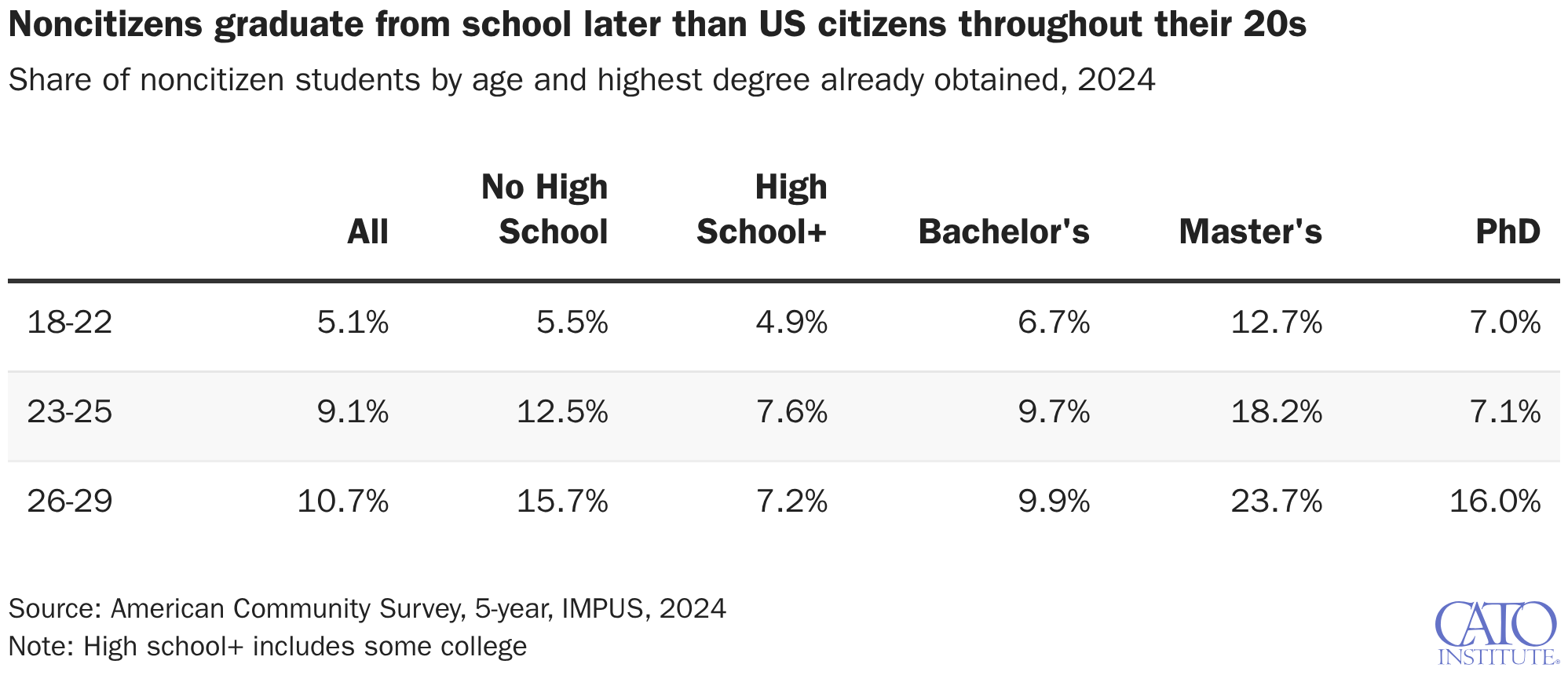
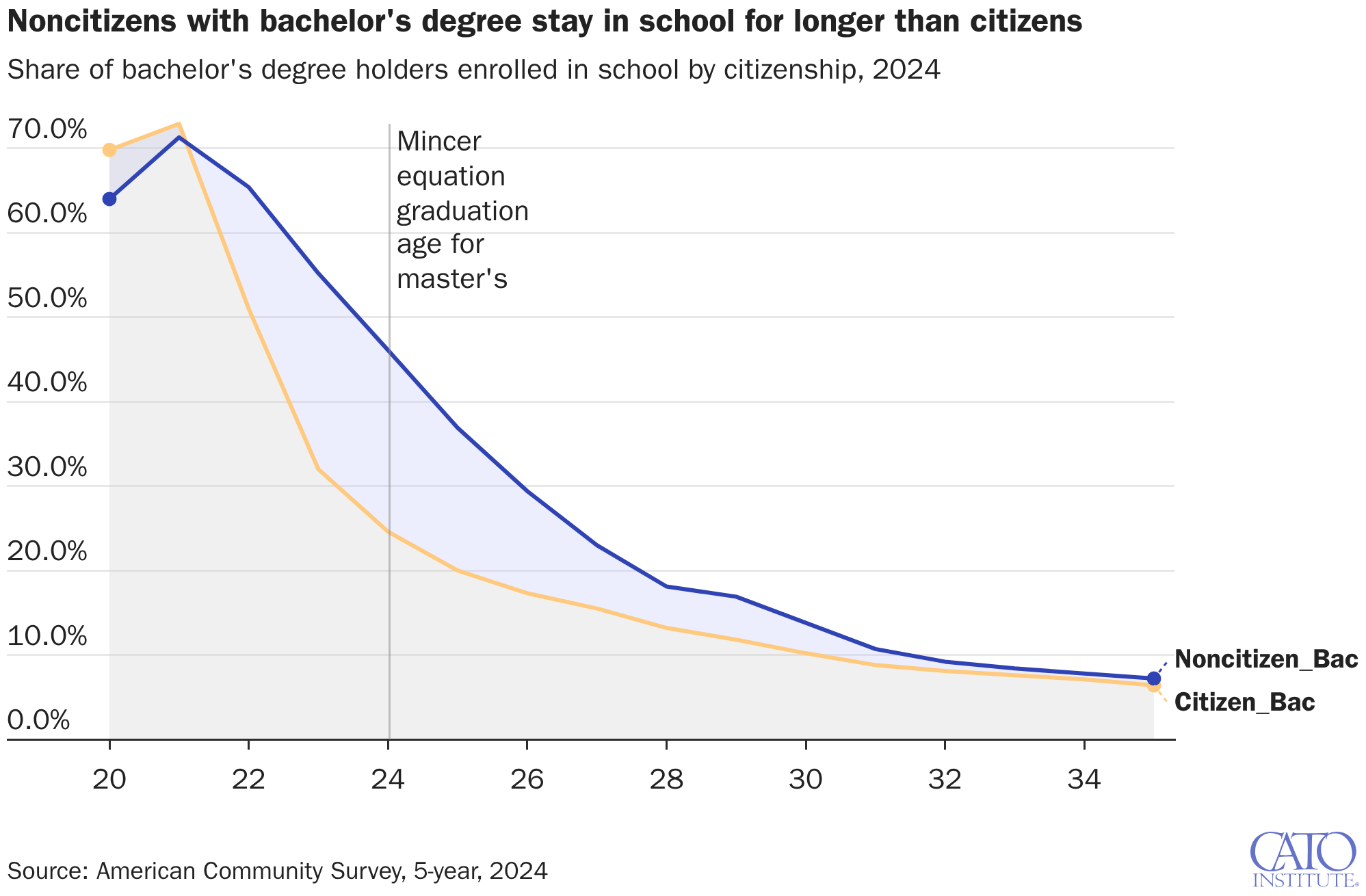
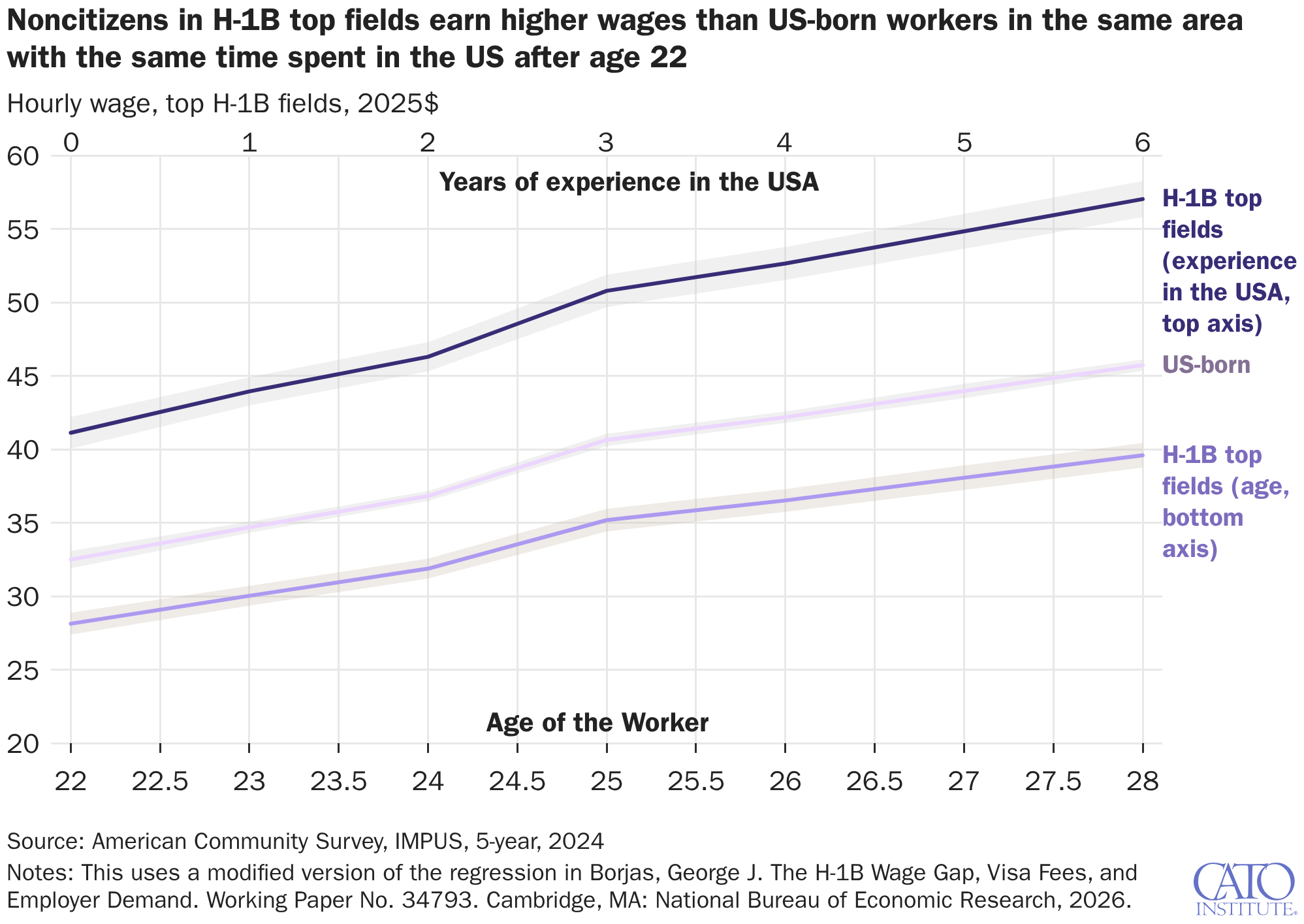
Using ACS data, we can see that in top H‑1B fields, noncitizens earn lower wages than individuals in the same area with the same educational characteristics controlling for age but higher wages controlling for time spent in the United States—suggesting that age is not the best proxy for experience for foreign workers. Noncitizen workers enter the US labor market at entry-level wages, but because they are more productive than the average entry-level worker, those entry-level wages are much higher than the entry-level wage for US workers—exactly what Congress intended. Age is not a defensible basis for estimating relevant experience for new H‑1B workers.
The rulemaking contradicts congressional intent.
In 2002, DOL proposed codifying the OEWS prevailing wages with two wage levels. This was heavily contested by those who thought only the average wage should be used. Congress intervened in 2004 to mandate that DOL expand that division to two additional wage levels. DOL stated at the time that “evaluation of these comments is rendered unnecessary by enactment of the Consolidated Appropriations Act of 2005.” It is impossible to assert 22 years later that the very provision through which Congress intended to ratify the existing wage structure and expand it to benefit employers requires DOL to impose a wage structure that bans most job offers. DOL can’t disregard what Congress understood the technical term “wage levels” to mean in 2005.
Conclusion
The rule rests on no identified market failure. DOL’s own data show that H‑1B workers receive wages averaging $10,191 above the current prevailing wage—evidence that competitive market forces are already working as intended, not evidence that the floor must be raised. The rule would disqualify over 80 percent of current wage offers without producing even the average wage DOL claims is appropriate.
The alternative proposal would also exclude over 80 percent of wage offers, and its procedures set wages at levels no comparable US workers are paid. DOL has offered the regulated community an arbitrary benchmark, reverse-engineered percentiles, and a self-defeating methodology in place of the reasoned analysis the statute requires and the Administrative Procedure Act demands. The current prevailing wage methodology, grounded in decades of administrative experience and confirmed by independent empirical analysis, should be retained.
[1] Even if H‑1B workers are less likely to change jobs overall, this fails to establish that the market is uncompetitive, as employers face uncertainty over who will change jobs and must set pay based on the marginal H‑1B worker, not the average—just as wages for all workers in the market are set based on the marginal worker’s productivity and enforced by the marginal worker’s willingness to move to a better offer, not the average worker’s productivity or the average worker’s willingness to accept their current terms.
[2] To extrapolate the OEWS 100th percentile, we first convert the 90th and 75th percentiles to a logarithmic scale, assuming that log incomes follow a symmetric distribution. We then calculate the log difference between these two percentiles, scale it proportionally (by a factor of 10/15), and add it to the log 90th percentile before converting back from the log scale.
