Dear Mr. Pasternak:
My colleagues at the Cato Institute and I (David J. Bier) submit the following comments in response to the above-referenced notice and request for comments published by the Department of Labor (Department or DOL) in the Federal Register on March 27, 2026 (the Proposed Rule or the Rule).1 The notice solicits comments on the Proposed Rule which would revise the DOL Office of Foreign Labor Certification’s (OFLC) prevailing wage methodology in the H‑1B, H‑1B1, and E‑3 nonimmigrant processes and the Program Electronic Review Management (PERM) process for legal permanent residence.
The Cato Institute is a nonpartisan, nonprofit, public policy research organization in Washington, D.C. It has conducted original research on immigration policy for nearly half a century. Cato scholars submit comments on proposed rules, submit amicus briefs in federal courts, and are regularly invited to testify before Congress. This background in quantitative economic research gives Cato a unique perspective on the proposed rule.
The proposed rule increases the mandatory minimum wage—known as the prevailing wage—for employer-sponsored immigrants and H‑1B nonimmigrants. DOL claims that H‑1B and other employer-sponsored foreign workers are paid “below market” wages, and its rule fixes this problem. But the proposed rule just inflates wages to restrict the supply of skilled foreign workers beyond what the law allows.
Introduction
DOL’s proposed rule:
- provides no empirical basis for raising the prevailing wage;
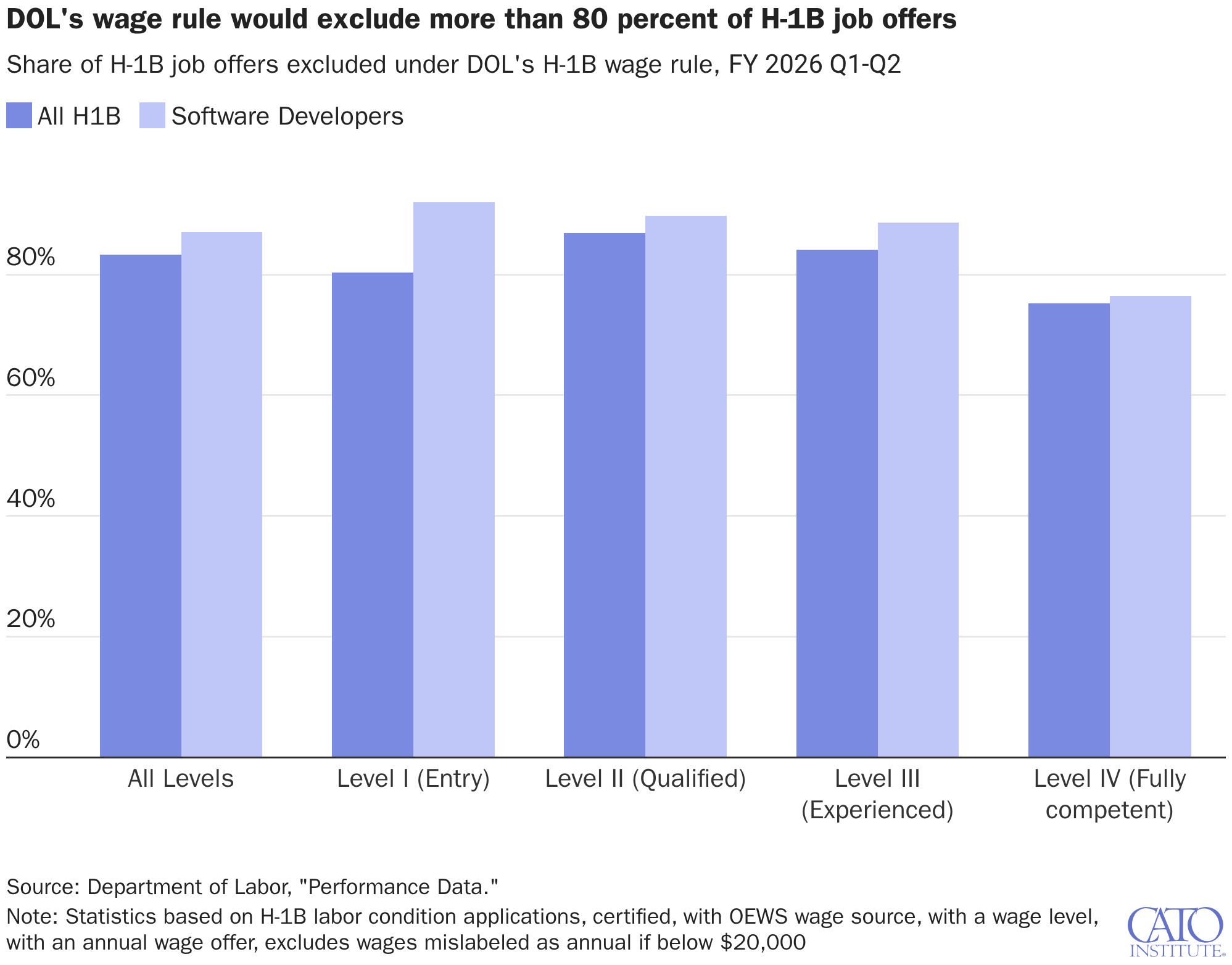
- rejects 80 percent of current wage offers to H‑1B and other skilled foreign workers, even among the highest skill level;
- forces out hundreds of thousands of H‑1B workers who have lived and worked in the United States under the current system for many years; and
- cuts visa issuances, particularly for researchers, professors, scientists, and workers in health care and universities because they commonly are not subject to the cap.
The upshot of reducing the number of H‑1B workers is less business investment, less US job growth, less innovation, and more outsourcing.
The current prevailing wage is usually calculated using the Occupational Employment and Wage Statistics (OEWS) survey, which surveys employers to ask for information on employee wages. The law (Immigration and Nationality Act 212(p), 8 U.S.C. 1182(p)) requires DOL to take those survey results and create at least four wage levels for each occupational classification “commensurate with experience, education, and the level of supervision.” Jobs with higher requirements must pay higher wages.
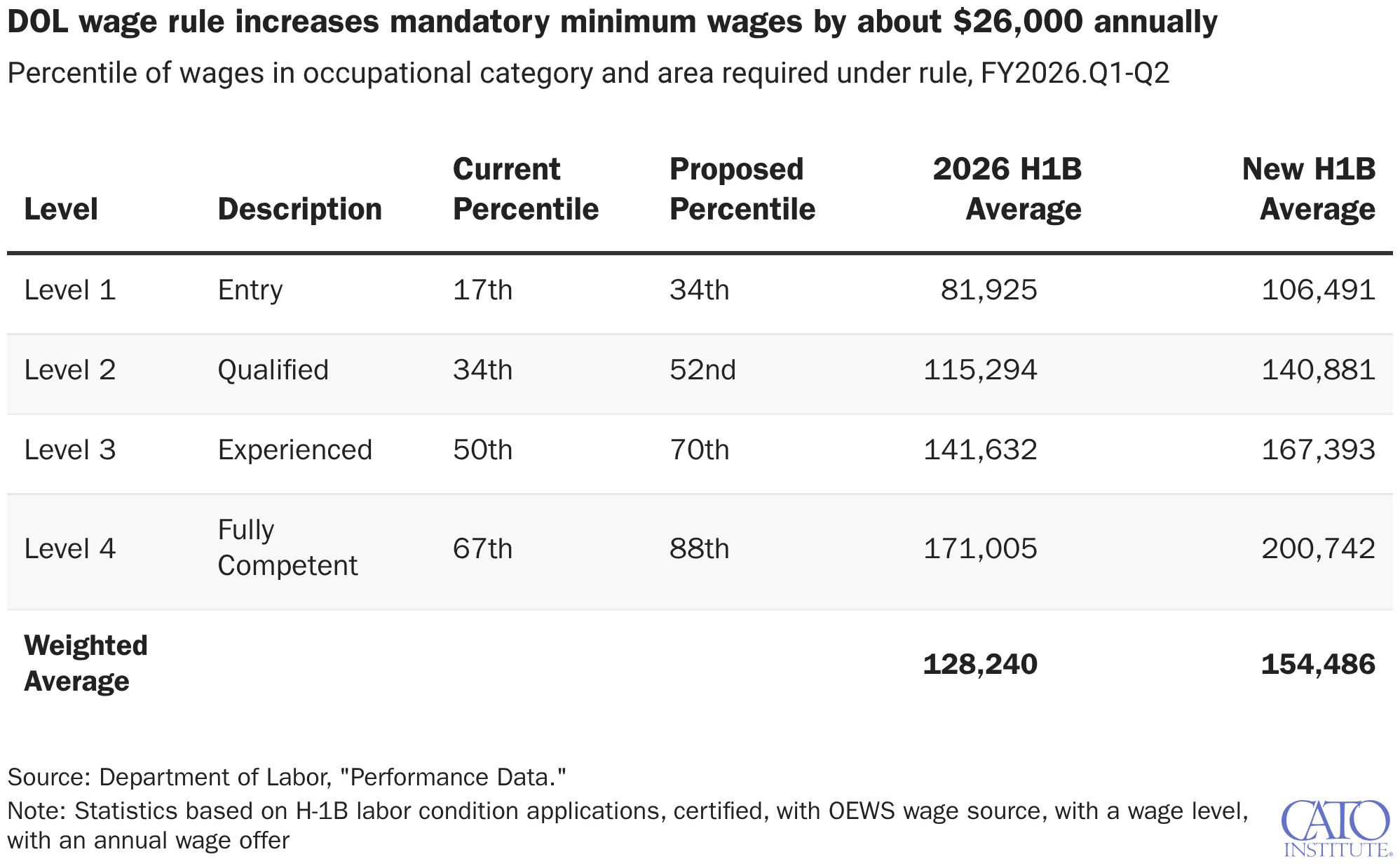
DOL currently sets the prevailing wage for entry level workers at about the 17th percentile for all wages in the occupation in that area. In other words, employers can never offer foreign workers wages the same as 17 percent of the area’s workers. DOL plans to raise the four wage levels:
- from 17th to 34th percentile for Level 1 (entry);
- from 34th to 52nd for Level 2 (qualified);
- from 50th to 70th percentile for Level 3 (experienced); and
- from 67th to 88th percentile for Level 4 (fully competent).
The average H‑1B prevailing wage would rise about $26,000 annually (based on H‑1B labor condition application filings in the first and second quarters of FY 2026).
Based on DOL application data from FY 2026, quarters 1 and 2, over 80 percent of H‑1B workers’ wage offers would be disqualified under the new wage rules. Even most wage offers for the most senior, most skilled workers—Level 4 workers—would be excluded. Since the law establishes that the Level 2 and Level 3 wages are calculated mathematically at equal distances between the Level 1 and Level 4 wage, we arrive at a straightforward empirical question: are wages of entry level and fully experienced workers closer to the current rule or the proposed rule?
DOL’s Rule Is Based on a Statistical Fantasy
- DOL never argues a theoretical basis for an increase in the prevailing wage. The market sets wages based on marginal productivity. The reason more experienced workers earn higher wages than entry level workers is that they are more productive than entry level ones. There is no incentive to hire lower-paid workers over higher-paid workers because a decrease in productivity will absorb any wage savings. If an H‑1B worker is offered less than their productivity and market wage, they can refuse that job offer, take another job, or change from their current employers to receive that wage—which H‑1B workers have done more than 1.1 million times in the United States alone since 2003.2
- Over the last decade, about one third of H‑1B petitions to start new jobs were for H‑1B workers changing employers. H‑1B workers are more constrained in their job mobility than other workers, but DOL does not even argue—let alone establish—that this high rate of H‑1B job change is insufficient to keep the market competitive. Even if H‑1B workers are less likely to change jobs overall, this fails to establish that the market is uncompetitive since employers face uncertainty over who will change jobs and must set pay based on the marginal H‑1B worker, not the average—just as wages for all workers in the market are set based on the marginal worker’s productivity and enforced by the marginal worker’s willingness to move to a better offer, not the average worker’s productivity or the average worker’s willingness to accept their current terms.
- DOL’s evidence shows the prevailing wage increase is unnecessary. Not only does DOL fail to show that competitive market forces do not apply to employer-sponsored immigrants, DOL’s data show the opposite: DOL finds that H‑1B workers are paid a $10,191 premium over the current prevailing wage level, which, DOL asserts, shows that “the prevailing wage is set below the market value of comparable U.S. workers.”
- But this is just DOL assuming its conclusion. Instead, it reflects that H‑1B workers are paid higher wages than US workers in similar roles because they are more productive than those workers.
- Moreover, this fact proves that an increase in the prevailing wage is not necessary since H‑1B workers already receive what DOL calls “the market value” for their work, even when the prevailing wage is not binding. In other words, DOL’s own analysis shows that the H‑1B job market is competitive. If it were uncompetitive, H‑1B workers would all receive the exact minimum wage. In fact, half of H‑1B workers receive wage offers more than the prevailing wage, based on the most recent FY 2026 labor condition application data, which is exactly what we would expect if the prevailing wage cut off the bottom half of the wage distribution for each wage level (that is, that the prevailing wage is about the median for entry level workers, qualified, experienced, and fully competent workers).
- DOL’s current rule is based on decades of DOL’s experience setting wages. DOL claims that when it originally adopted the 17th and 67th percentiles as level 1 and level 4 wages, it did not explain its reasons for adopting these percentiles as the top and bottom wage levels. But prior to the adoption of these percentiles, the Department had decades of experience with directly crafting even more precise wage surveys using the Dictionary of Occupational Titles. DOL was able to draw on those decades of experience to arrive at valid conclusions on where the wage levels should be set in the OEWS. It is DOL’s new approach that lacks any reasoned basis.
- DOL never estimates the entry or top wage rates. DOL neglects to answer the question that the law demands. Instead, it simply asserts that the average foreign worker should receive the average wage for the occupational category. But since it must create four wage levels, it positions the wage levels at percentiles where wages of recently approved H‑1B workers—at all levels—are at the average for the occupational category. In other words, the entry and top levels are placed arbitrarily at wages necessary to meet the arbitrary target—not based on the wages of similar workers.
- DOL’s wage rule is contrary to the purpose of the law. The statute explicitly rejects the idea of an overall target wage rather than a wage targeted at each experience level. DOL’s rule overturns the wage scheme Congress imposed on DOL in 2004 through the Consolidated Appropriations Act of 2005, codified at 8 U.S.C. 1182(p)(4), which assumed the use of the current OEWS wage levels.
DOL’s Current Prevailing Wage Properly Establishes the Entry Level Wage
DOL notes that it cannot use the OEWS—at least as it is currently administered—to estimate the entry level wage directly because the OEWS does not record the relevant information on experience. On the other hand, the Census Bureau’s American Community Survey (ACS) provides the best available, albeit imperfect insight into the relevant questions because it records the wage, age, and educational attainment of workers.
Using the ACS 5‑year sample of 2024 (which uses years 2020 to 2024) to increase the sample size and adjusting for inflation, we calculated the median hourly wage for an entry-level worker by looking at the wages of young workers—specifically, the median wage for workers with ages at or below the 1st percentile for ages in the occupation.3 Typically, employment in the United States in the last 25 years has grown at an annual rate of less than 1 percent, so it makes sense to base the wage on the first percentile.4 We then determined where this wage fits in the overall distribution of wages in the occupation.
The results of this exercise are displayed below. In the top H‑1B occupations, the median entry level worker earns wages at about the 9th percentile for wages in those occupations—well below the 17th percentile currently required.5 The same is true for other skilled occupations. At the 16th percentile, only unskilled occupations approximate the 17th percentile for entry level wages.
DHS suggests that any analysis should exclude all immigrant workers from estimating the entry level wage percentile, but doing so only increases the confidence intervals for the results rather than substantively changing the conclusions and would violate the law, which requires looking at all workers.6
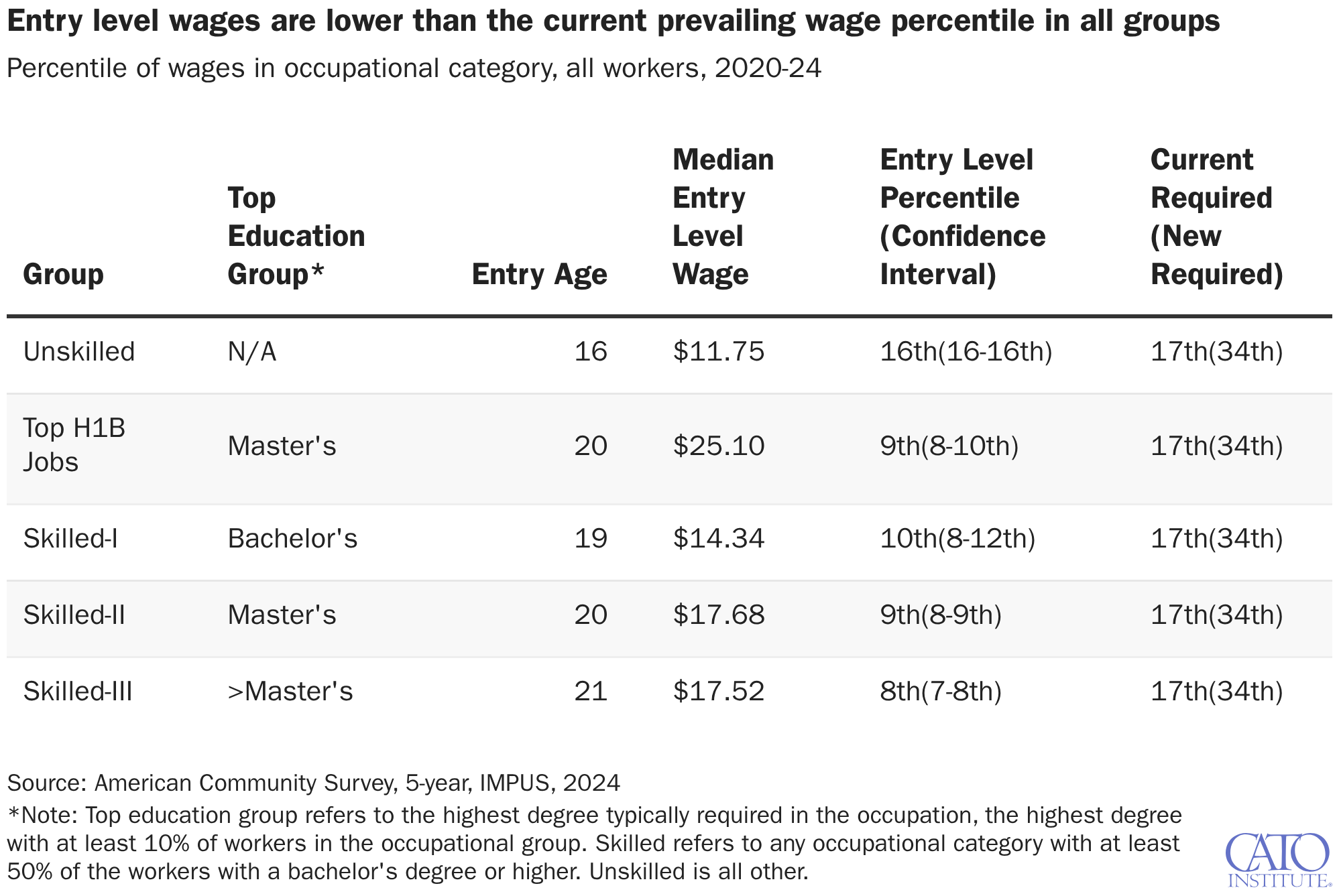
DOL also states that any estimate that includes all workers in an occupation would be biased by including the wages of some workers without a bachelor’s degree or equivalent experience who are ineligible for an H‑1B visa. But the overall wage should ground DOL’s analysis. DOL assumes throughout its rulemaking the 17th percentile is the entry level wage when H‑1B ineligible workers are included and that the entry wage level would rise above the 17th percentile if H‑1B ineligible workers were excluded from the analysis, but DOL’s premise is incorrect: the entry level wage is below the 17th percentile with all workers included.
In any case, the prevailing wage also governs the wage levels for EB‑3 visa for skilled and unskilled workers—classifications that do not require a bachelor’s degree. DOL dismisses this concern by claiming that the wages for EB‑3 skilled and unskilled visa categories would vary insignificantly by experience and education. The ACS data still show significant variation in wages over the course of a lower-skilled worker career. It would be baseless to use only the wages of bachelor’s degree holders to establish the wages of EB‑3 workers.
Nonetheless, in our second specification, we remove workers without a bachelor’s degree or equivalent experience (estimated using the definition used by Department of Homeland Security (DHS) of three years for each year of education lacking toward a bachelor’s degree). Limiting the sample increases the median entry level wage percentile to the 19th percentile for the top H‑1B occupations and between the 10th and 18th percentiles for other skilled occupations, depending on the highest education typically seen in those jobs. The 19th percentile is slightly above the 17th, but within the 95 percent confidence interval for the estimate. This was also true for software developers—the top H‑1B occupation.
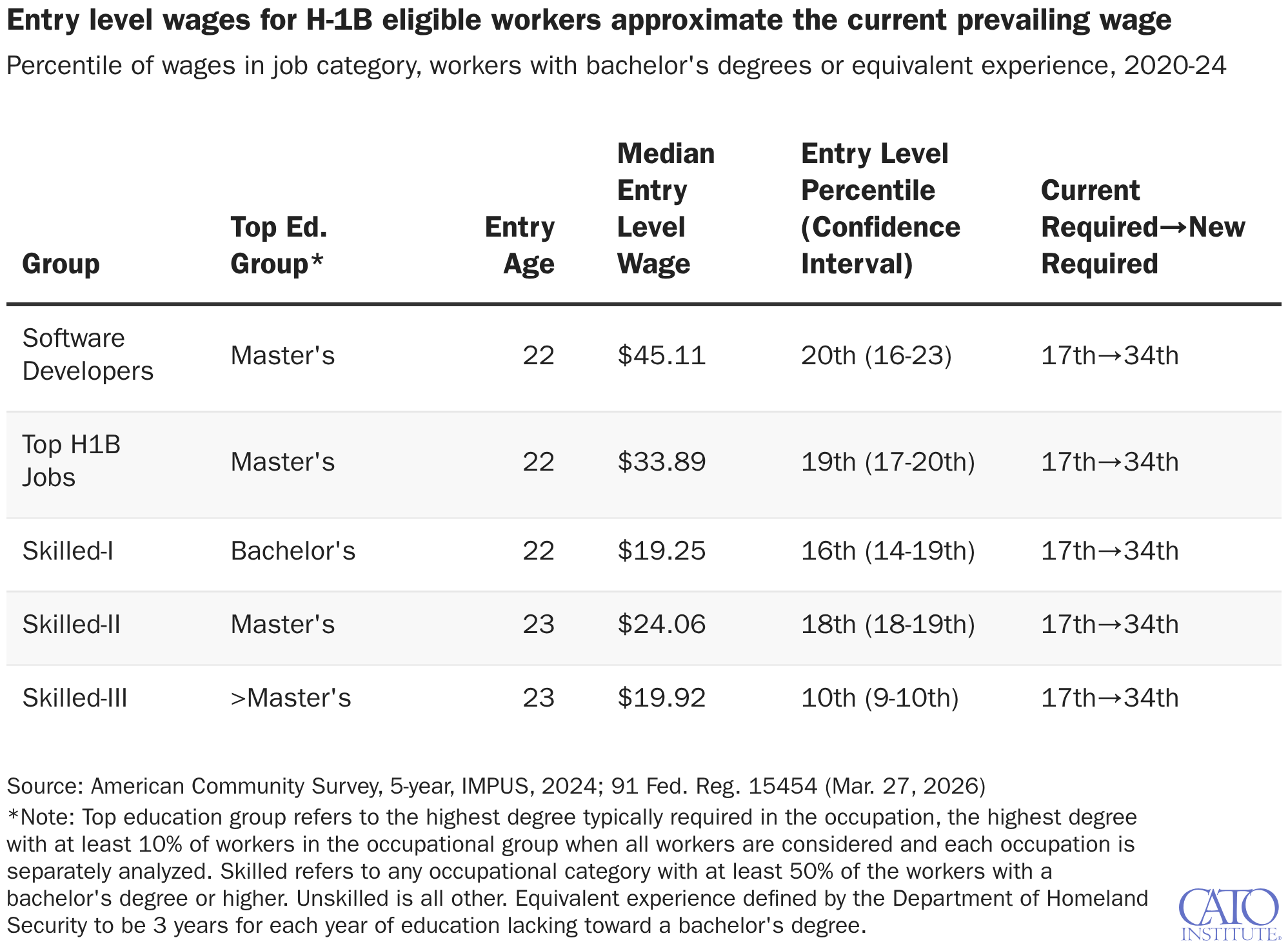
The ACS data is clear: DOL’s current prevailing wages for entry level wages are close approximations of the actual wages for entry level workers—both high- and low-skilled. This empirical conclusion comports with common sense. Workers with no experience are going to command wages at the low-end of the distribution, not near the middle of the distribution as DOL proposes. There is no basis for changing the prevailing wage methodology for entry level wages at all.
DOL’s Current Prevailing Wage Properly Establishes the Top Wage Level
DOL proposes to raise the top wage level for “fully competent” workers from about the 67th percentile to the 88th percentile for wages in the occupation. It never defines what constitutes a “fully competent” worker or provides any statistical analysis showing that US workers in jobs with the highest level of experience, education, and supervision requirements in an occupation earn wages at the 88th percentile.
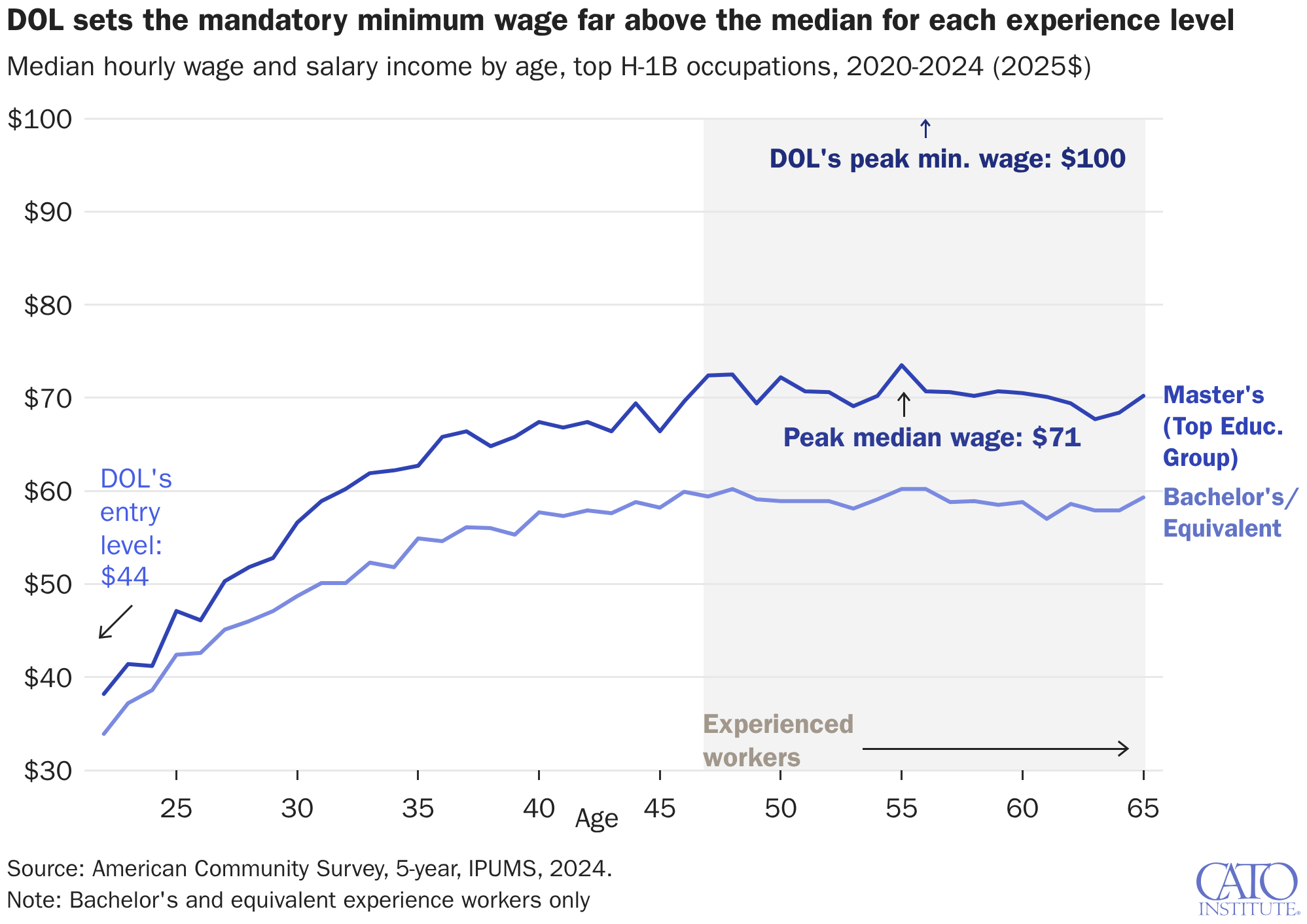
Although DOL provides no definition, we base our estimates on the workers with the highest level of education in an occupation who have reached an age where experience no longer corresponds to increases in salaries. The graph below shows that experience stops corresponding to increases in salaries at about the midpoint of the typical person’s career. Therefore, we define “fully competent” workers to be those with ages in the top third for the occupation who have the highest level of education typically required in that occupation (the highest education group with at least 10 percent of workers represented).
The figure below shows how experience and education interact with wages in the top H‑1B occupations. Eventually, there is no further return to experience and education. Nonetheless, DOL’s new peak minimum wage (88th percentile) is nowhere close to the peak median wage for experienced workers with a master’s degree.
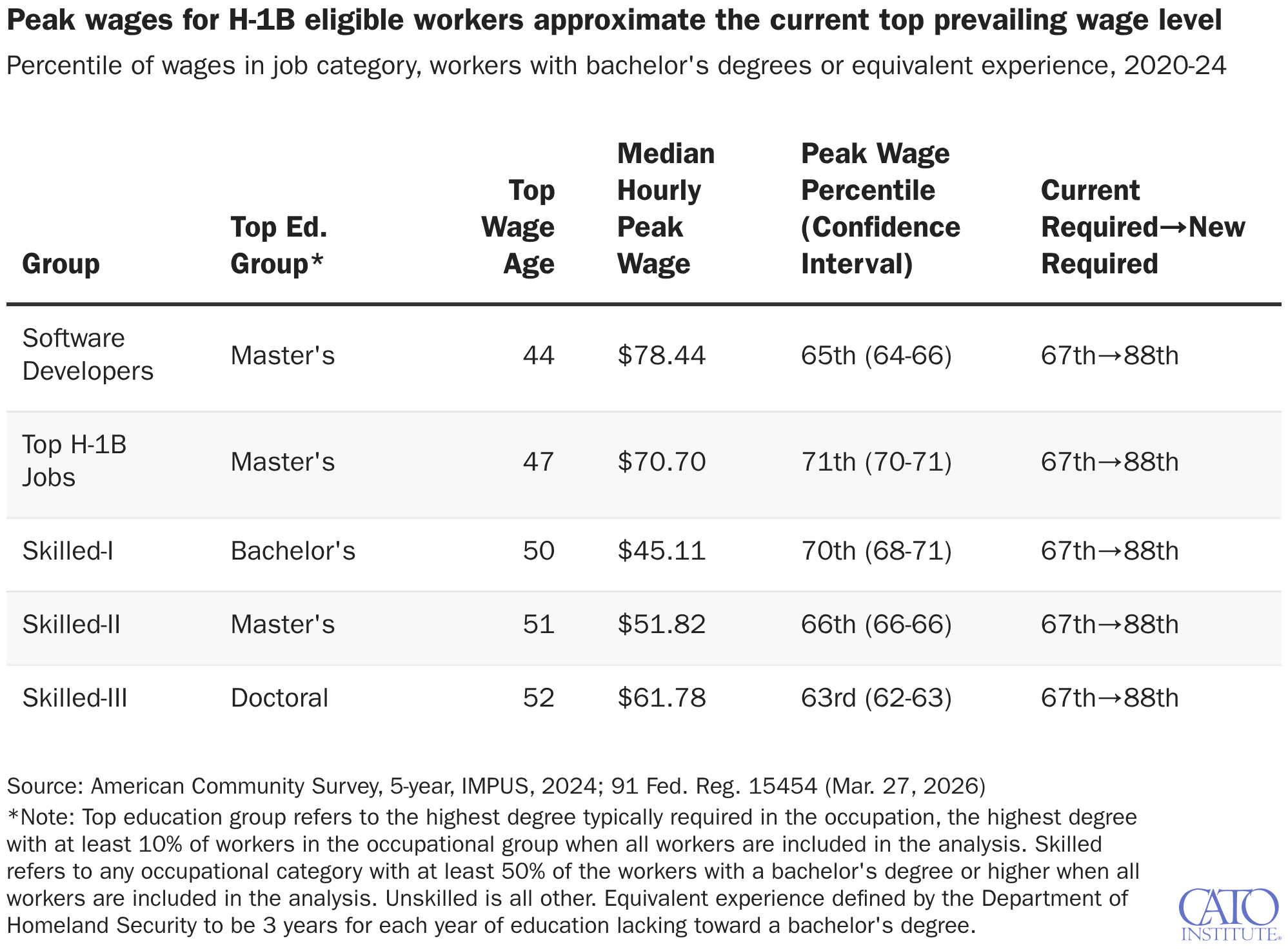
As the table below shows, the top education grouping for workers in the top H‑1B occupations is master’s degree holders, and the median age is 40. These experienced workers with the highest education required earn wages at the 70th percentile, excluding workers who would not qualify for the H‑1B visa. For other skilled workers with H‑1B qualifications, the percentiles are the 70th, 66th, and 63rd percentiles depending on the top skill level. While these values are not close to the proposed 88th percentile, they nearly match the currently required 67th percentile.
The ACS data cannot account directly for “level of supervision,” but the amount of supervision required clearly correlates closely with experience. Indeed, the reason wages rise with experience is that workers transition into higher job levels in which they are more productive with less supervision.7
Once again, this conclusion is logical. Of course, some workers will make far above the median for experienced workers, but those wages will be based on their individual characteristics—their unique productivity that is not a result of the statutory factors. There is no basis to alter the methodology for calculating the top wage level for prevailing wages.
DOL’s Alternative “Experience Benchmarking” Proposal Is as Problematic as Its Main Proposal
Perhaps sensing that its methodology is illogical and illegal, DOL separately proposes an alternative methodology for estimating the prevailing wage that is partially based on the American Community Survey. Rather than improving its methodology, however, DOL again violates the law and baselessly inflates the wages in ways that will be as damaging to employer-sponsored immigration.
Currently, DOL uses the Occupational Employment and Wage Statistics (OEWS) to estimate the prevailing wage. This measures wages directly from employers by occupation. But the statute requires DOL to create four prevailing wage levels “commensurate with experience, education, and the level of supervision” required for the job. The OEWS has no details about workers or job requirements, so DOL currently sets the wage levels at about the 17th, 34th, 50th, and 67th percentiles for the occupation on the assumption that skills and experience broadly track this distribution.
We have already shown that this assumption is generally correct. Using the American Community Survey (ACS), which has details on age and education of workers, we show that the entry level and peak median wages for the main H‑1B jobs are about the current OEWS percentiles. But DOL’s main proposal just arbitrarily raised the wage levels without any empirical basis. Sensing that this main proposal is arbitrary and illegal, it proposes an alternative framework using the ACS (“experience benchmarking”).
This proposal would use a Mincer regression to estimate the ratio of nationwide wages for a specific age-occupation-degree combination (30-year-old software developers with a bachelor’s) to the wages for the occupation nationwide. It would then multiply that ratio against the OEWS median wage, effectively adjusting the OEWS to account for differences in workers. Only after it sets this new minimum wage for each experience level would DOL create the four wage levels required by statute, based on the estimated “level of supervision” required for the job. The top wage level would take the same ratio and multiply it by the 90th percentile of the OEWS, rather than the median.
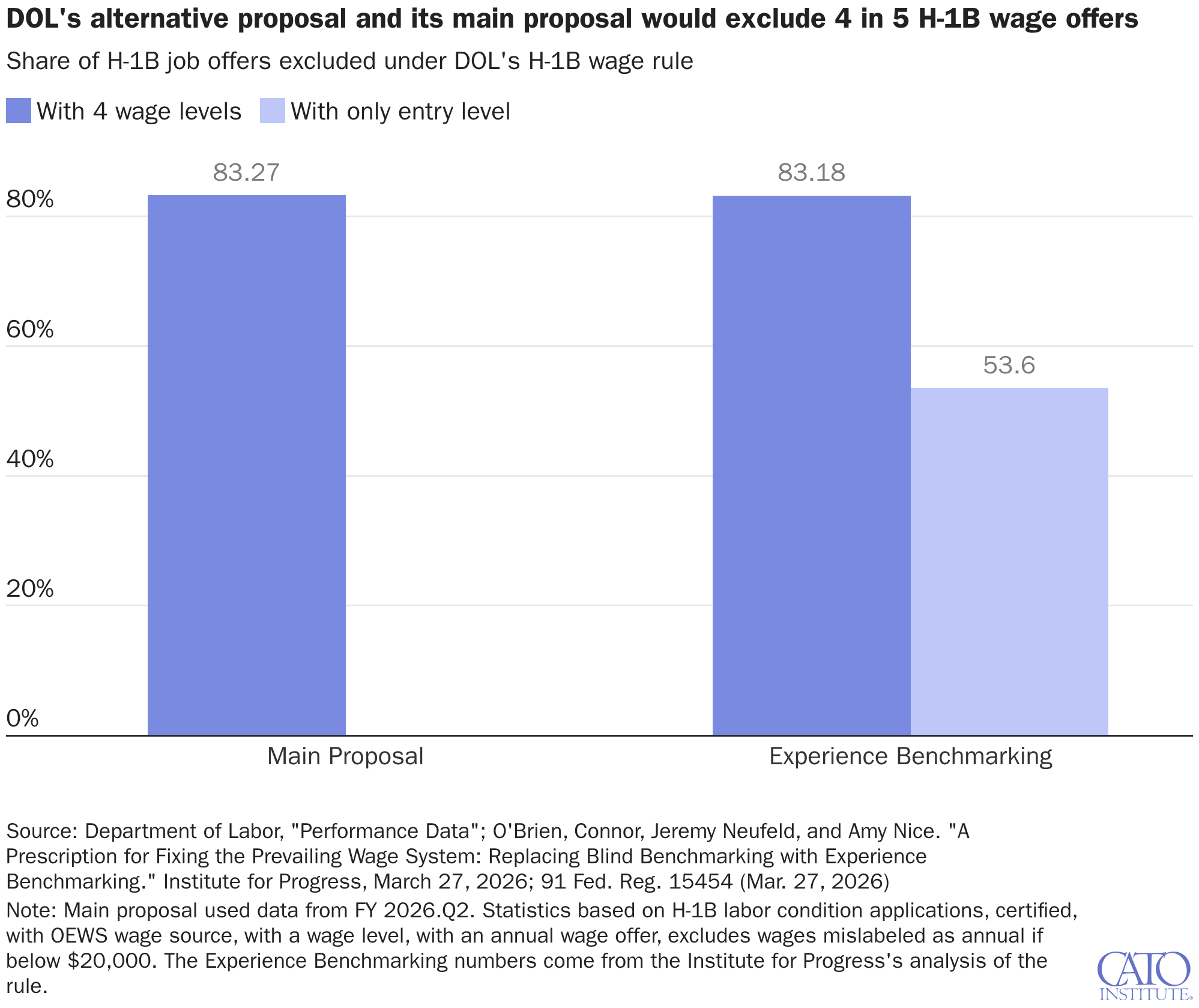
According to the Institute for Progress (IFP), which conducted the first analysis of this experience benchmarking proposal, it would disqualify the wages of at least half of recent H‑1B workers.8 Even if IFP’s analysis is correct, and we have identified numerous problems with it, IFP only used the level 1 wage.
There is no way to know exactly which workers will be given which levels under this new system because the four wage levels are based on “level of supervision,” which the ACS does not measure, and the wage level would be assigned subjectively after the fact. But there is no reason to believe that the distribution of wage levels would differ materially from the current system. Therefore, rerunning the IFP analysis assigning level 2 through level 4 wages shows that the DOL experience benchmarking proposal would also exclude over 80 percent of H‑1B workers—nearly as many workers as its main proposal.
Nonetheless, DOL relegates this proposal to an alternative because it would unnecessarily impose bureaucratic complexity, because the ACS lacks sufficient sample sizes in many occupation-area combinations, and because DOL questions whether its own proposed methods are “consistent with the statute.” It is correct on all counts, and the specific proposal that DOL outlines to use the ACS adds even more problems.
Problems with “Experience Benchmarking”
- DOL’s proposed solutions to ACS sample size issues are unlawful and inaccurate.
- ACS sample sizes are an insurmountable problem. The ACS 1‑year surveys do not provide sufficient samples to reliably estimate wages in detailed occupations in specific metropolitan areas as the law requires. Even at the national level, our entry level wage sample for bachelor’s degree holders and above only exceeded 100 observations for 23 of the 530 detailed occupational categories in the ACS 1‑year sample from 2024, including noncitizens. At the subnational level, nearly all the samples are unusable.
- It is unlawful to use nationwide data. DOL again suggests that it could use nationwide ACS wage data to evaluate job applicants rather than local area data, but this violates the statute and erases the benefits of the precision the ACS provides.
- It is unlawful to aggregate occupations. DOL also proposes to aggregate to broader occupational categories, but again, this would be even more imprecise, and it would fail to evaluate the “specific employment” and the “occupational classification” that the workers are performing as required by law. For instance, DOL would aggregate educational administrators at day cares and educational administrators at universities. Since nearly all day care administrators make far less than the median university administrators, entry level wages for a university administrator would be set far too low, but their peak wages would be far higher than they would otherwise since the peak wage percentile would rise by all the day care administrators at the low end.
- It is unlawful to group multiple years. These old wages no longer “prevail” in the present as required by the statute. In any case, grouping multiple years only gets sample sizes for half of the detailed occupations—again at the national level—and it requires using older data to evaluate new H‑1B applicants. In some cases, it might require using wage ratios as far back as 2019.
- The ACS is a useful sanity check on the much more detailed OEWS, but it should not be added to the prevailing wage—especially when there is no evidence of a problem with the OEWS.
- It is unlawful to exclude all non-US-born citizen workers. DOL states that it will exclude all non-US-born citizens—even legal permanent residents and naturalized citizens—from its analysis of the ACS. This is manifestly unlawful, and it is not an interpretation compatible with the rest of immigration law, nor is it a position taken by the Department of Labor in any prior action. Defining United States worker to exclude these individuals would open the use of the term to a narrow construction in the rest of the Immigration and Nationality Act where it is used to define the population protected by law from discrimination, termination, and underpayment. It would be discordant with the purpose of the proposed rule to redefine the term this way. For the H‑1B program, section 212(n)(4) and (t)(4) both define United States worker as “(i) is a citizen or national of the United States; or (ii) is an alien who is lawfully admitted for permanent residence, is admitted as a refugee under section 1157 of this title, is granted asylum under section 1158 of this title, or is an immigrant otherwise authorized, by this chapter or by the Attorney General, to be employed.” This latter category could even include foreign workers already granted H‑1B status.
- DOL illegally and arbitrarily sets the wage levels. The ACS has no way to measure how much supervision is required for a job, so DOL’s proposal is to first estimate the age-education specific wage (which already accounts for experience) and then assign the four wage levels. But there are numerous problems with how DOL implements the idea.
- Experience benchmarking sets level 4 wages that zero US workers are paid. DOL calculates the ratio of the age-degree specific median to the overall occupational median in the ACS to then adjust the OEWS median to account for age and education, but the data do not allow for it. For the higher wage levels, DOL does not estimate the age-degree specific ratios (e.g., the 62nd percentile of the age-degree specific combination to the 62nd for the entire occupation). Instead, it takes this same age-degree ratio and multiplies it by the 62nd (level 2), 75th (level 3), and 90th percentiles (level 4, least supervision) for each occupation and geographic area.
- To see how biased this method is, consider a statistician with a doctorate degree and 11 years of experience in Austin, Texas. According to the Institute for Progress analysis, this worker’s ratio to the occupational median was 1.588 for registration year 2024. This put this specific worker’s minimum level 1 wage under the Experience Benchmarking method at $136,071—which already exceeded the 90th percentile wage for the area in the OEWS of $127,400. Using the same 1.588 ratio to calculate level 4 for the area produces a $202,339 wage—far higher than the estimated 100th percentile (the highest wage) for the area of $148,087.
- This is not an anomaly. In fact, 16 percent of the level 4 wages calculated under the experience benchmarking method would be higher than the 100th percentile, and it is not close.9 The average difference between the 100th percentile and the level 4 wages was about $16,500. If literally zero US workers make these wages, they cannot be commensurate with their wages. But this flaw merely highlights the problem with the underlying methodology for all workers.
- DOL sets all four wages arbitrarily under “experience benchmarking.” There is no reasoned analysis at all describing how it concluded that the 62nd (level 2), 75th (level 3), and 90th percentiles represent the wages of US workers with jobs requiring similar levels of supervision. It merely asserts that “they are close to dividing the upper half of the distribution equally” but that is not the legal standard that requires matching with equally skilled workers. There is no analysis showing that, for example, a worker with the median age-education combination but with no supervision required for the job makes the 90th percentile for wages in the entire occupation. DOL fails to produce even a single illustrative case for this claim.
- DOL’s alternative proposal contradicts its main proposal’s reasoning. In its main proposal, DOL at least attempts to justify the four wage levels, based on a supposed target wage. For experience benchmarking, it makes no attempt.
- DOL illegally fails to use the entire wage distribution. Even if DOL revises its methodology to correct this manifest error in calculating the four wage levels, its method would still fail to produce wages that are commensurate with US workers because it excludes the bottom half of the wage distribution. Under the current OEWS wage rule, DOL understands that it must use the full wage distribution to accurately account for experience, education, and level of supervision requirements for the job. Even under DOL’s revised methodology in its main proposal, the OEWS average just becomes a target with level 1 wages still falling below the median at the 34th percentile. But under “experience benchmarking,” DOL arbitrarily decides not to use the bottom half of the wage distribution at all, starting level 1 at the estimated median. Then the wage levels will only increase from there. This defies the theory on which DOL bases both its current and proposed OEWS rules. Jobs at the low end of the wage distribution will require more supervision than jobs at the high end. That means for wages to be commensurate with level of supervision, DOL must use the entire wage distribution. Otherwise, the wage will be set higher than the wages for US workers with the same type of job.
- Experience benchmarking sets level 4 wages that zero US workers are paid. DOL calculates the ratio of the age-degree specific median to the overall occupational median in the ACS to then adjust the OEWS median to account for age and education, but the data do not allow for it. For the higher wage levels, DOL does not estimate the age-degree specific ratios (e.g., the 62nd percentile of the age-degree specific combination to the 62nd for the entire occupation). Instead, it takes this same age-degree ratio and multiplies it by the 62nd (level 2), 75th (level 3), and 90th percentiles (level 4, least supervision) for each occupation and geographic area.
- DOL must base prevailing wages on the type of employment, not the characteristics of workers. The most fundamental problem with DOL’s alternative proposal is that it would disconnect prevailing wages from the requirements of the job. This is unlawful. According to the law, the required wage must be based on the “specific employment” and the “occupational classification”—that is, the type of employment, not the type of worker. It is the level “commensurate with experience, education, and the level of supervision” of the job, or occupational classification, not the worker. This reading is confirmed by the word “level of supervision,” which is not a characteristic of a worker at all. It is a characteristic of the job.
- DOL’s proposal is bureaucratically impractical. There is a practical reason for this distinction between the type of employment and the type of employee. Under DOL’s proposal, employers cannot know what wage to advertise or offer before they find the precise foreign worker, but this works backwards from the conclusion of the recruitment process. Instead, employers must be able to advertise the job without knowing which worker—foreign or domestic—will apply. Besides the impracticality, it would be unfair to domestic workers seeking jobs and to employers to require wage alterations at the end of the process.
- Age is an unreliable proxy for relevant experience for H‑1B and other foreign workers. This is DOL’s most significant assumption, and it is incorrect.
- By design, the immigration system delays the entry of foreign workers into the US labor market. The employment of foreign students is heavily regulated compared to domestic workers who may freely work during their studies. Visa and employment authorization document delays commonly cause foreign workers to wait much longer to enter the labor force.
- Foreign workers graduate from school later than citizens. This is partly because they also commonly return to school at older ages specifically because they failed to win the right to work through the H‑1B lottery or other means. As the table below shows, the share of noncitizens in school in the United States rises rapidly with age regardless of the educational attainment already obtained—that is, a bachelor’s degree holder is much more likely to be in school at older ages if they are a noncitizen than a US citizen with a bachelor’s degree. This is a critical issue because the ACS data do not contain a year of graduation variable. Immigrants graduate later and then the immigration requirements delay their entry into and advancement in the labor market, resulting in less experience at any given age than other US workers.
- US-born earn lower wages than noncitizens in top H‑1B fields with the same amount of US experience. In the American Community Survey, in top H‑1B fields, noncitizens earn lower wages than individuals in the same area with the same educational characteristics controlling for age, but higher wages controlling for time spent in the United States (US experience). This too suggests that age is not the best proxy for experience for foreign workers and that as we have shown, immigrants earn higher wages than the prevailing wage for the level of employment that they are performing. Again, this is relevant because the whole purpose of the prevailing wage is to prevent employers from profiting from lower-wage foreign workers. If the lower wage is the result of differences in experience, education, or supervision requirements, then the lower wage is explicitly permitted by the statute since it is the result of the lower productivity of workers with those characteristics.
- Economic theory does not support an age-based approach. Wages are based on marginal productivity, not the characteristics of the worker. This means that prevailing wages should be based on the actual work that the H‑1B worker is being hired to perform. There is no “wage arbitrage,” as DOL claims, if an H‑1B worker is paid less than the median worker with the same education-age combination if the worker is performing lower-level work than the median worker. In other words, H‑1B employers aren’t incentivized to prefer H‑1B workers at a lower wage because, if the H‑1B worker is making a lower wage, it reflects their lower productivity. Once again, there is no evidence of an uncompetitive H‑1B labor market. H‑1B workers change jobs, and H‑1B wage offers commonly exceed the H‑1B prevailing wage. A PhD holder would be required to be paid a wage based on PhD holder wages, which would disproportionately come from workers in jobs requiring a PhD, even if the actual job that the H‑1B is being hired for does not require a PhD. A 30-year-old bachelor’s degree holder with no relevant experience would be required to be paid the wage of someone with 8 years of experience. Moreover, it is crucial to understand that by design, the H‑1B program delays career advancement as foreign workers’ roles are strictly regulated, and workers may stay in a particular role for the specific purpose of obtaining a green card through employer-sponsorship. This may reduce the wages of older H‑1B workers relative to US workers at the same point in their careers without creating any economic benefit to employers since the worker is less valuable in that reduced role.
- It is unlawful to radically change the prevailing wage structure to exclude most employee wage offers. This should apply to both the main and alternative proposals. In 2002, DOL published a proposed rule (67 FR 30466 (May 6, 2002)) to codify the OEWS prevailing wages with two wage levels at about the 17th and 67th percentiles. As DOL noted then, “Many commenters criticized the [OEWS] survey for arbitrarily dividing salary data into two wage levels. Several commenters (including [American Council of International Personnel and American Immigration Lawyers Association]) suggested existing OES wage data would be more useful if the number of wage levels were expanded.” Opponents criticized the fact that DOL was creating these wage levels at all.
During internal agency deliberations over the proposal, Congress intervened in 2004 to mandate that DOL continue not only to use the “arbitrary” division of two wage levels but to expand that division to two additional wage levels (INA 212(p)(4)). Knowing this history, DOL stated, “Evaluation of these comments is rendered unnecessary by enactment of the Consolidated Appropriations Act of 2005.” In other words, it was clear at the time that Congress had ended the wage level debate by siding with employers using the OEWS against the critics. It is impossible to assert 22 years later that the very provision through which Congress intended to ratify the existing wage structure and expand it to benefit employers requires DOL to impose a wage structure banning most employers.
Moreover, Congress used a specific term of art—“wage level”—with a known administrative meaning at the time of enactment, and DOL cannot redefine that term in a way Congress could not have recognized. Molzof v. United States, 502 U.S. 301, 307–08 (1992); Perrin v. United States, 444 U.S. 37, 42 (1979). Because Congress reenacted the prevailing wage structure in 2004 against the background of DOL’s established 17th and 67th percentile methodology without mandating different percentiles, it is presumed to have incorporated that methodology. Lorillard v. Pons, 434 U.S. 575, 580 (1978). DOL’s proposed restructuring of a $9.3 billion program requires clear congressional authorization that the record here does not supply. West Virginia v. Env’t Prot. Agency, 597 U.S. 697, 723–24 (2022).
Conclusion
For all these reasons, DOL should withdraw the proposed rule. The rule rests on no identified market failure. DOL’s own data shows that H‑1B workers receive wages averaging $10,191 above the current prevailing wage—evidence that competitive market forces are already working as intended, not evidence that the floor must be raised. The American Community Survey confirms that the current entry-level and top wage levels accurately approximate where workers at those career stages actually sit in the wage distribution, providing no basis for the proposed increases. The rule would disqualify over 80 percent of current wage offers without producing even the average wage DOL claims is appropriate.
The alternative proposal would also exclude over 80 percent of wage offers, and its procedures for setting the wage level set wages at levels no comparable US workers are paid. Moreover, the survey data simply do not exist with enough granularity to ever make the experience benchmarking proposal work.
DOL has offered the regulated community an arbitrary benchmark, reverse-engineered percentiles, and a self-defeating methodology in place of the reasoned analysis the statute requires and the Administrative Procedure Act demands. The current prevailing wage methodology, grounded in decades of administrative experience and confirmed by independent empirical analysis, should be retained.

About the Authors


This work is licensed under a Creative Commons Attribution-NonCommercial-ShareAlike 4.0 International License.