Chairman Cornyn, Ranking Member Padilla, and distinguished members of the subcommittee, thank you for the opportunity to testify.
My name is David Bier. I am the Director of Immigration Studies and occupy The Selz Foundation Chair in Immigration Policy at the Cato Institute, a nonpartisan public policy research organization in Washington, D.C.
Immigrants Aren’t the Cause of Welfare Fraud
For nearly 50 years, the Cato Institute has stood for the principles of individual liberty, limited government, free markets, and peace. Our half-century of research shows that when individual rights are protected, people—whatever their race, religion, background, or birthplace—become the most productive, innovative, and interesting versions of themselves. Rather than government handouts or government repression, personal autonomy and freedom are the keys to productivity and success.
The success of immigrants in the United States is among the best examples of this view. Cato’s research has shown that over the last three decades, immigrants have reduced deficits by $14.5 trillion—with deportable immigrants accounting for about $1.7 trillion of this amount.1
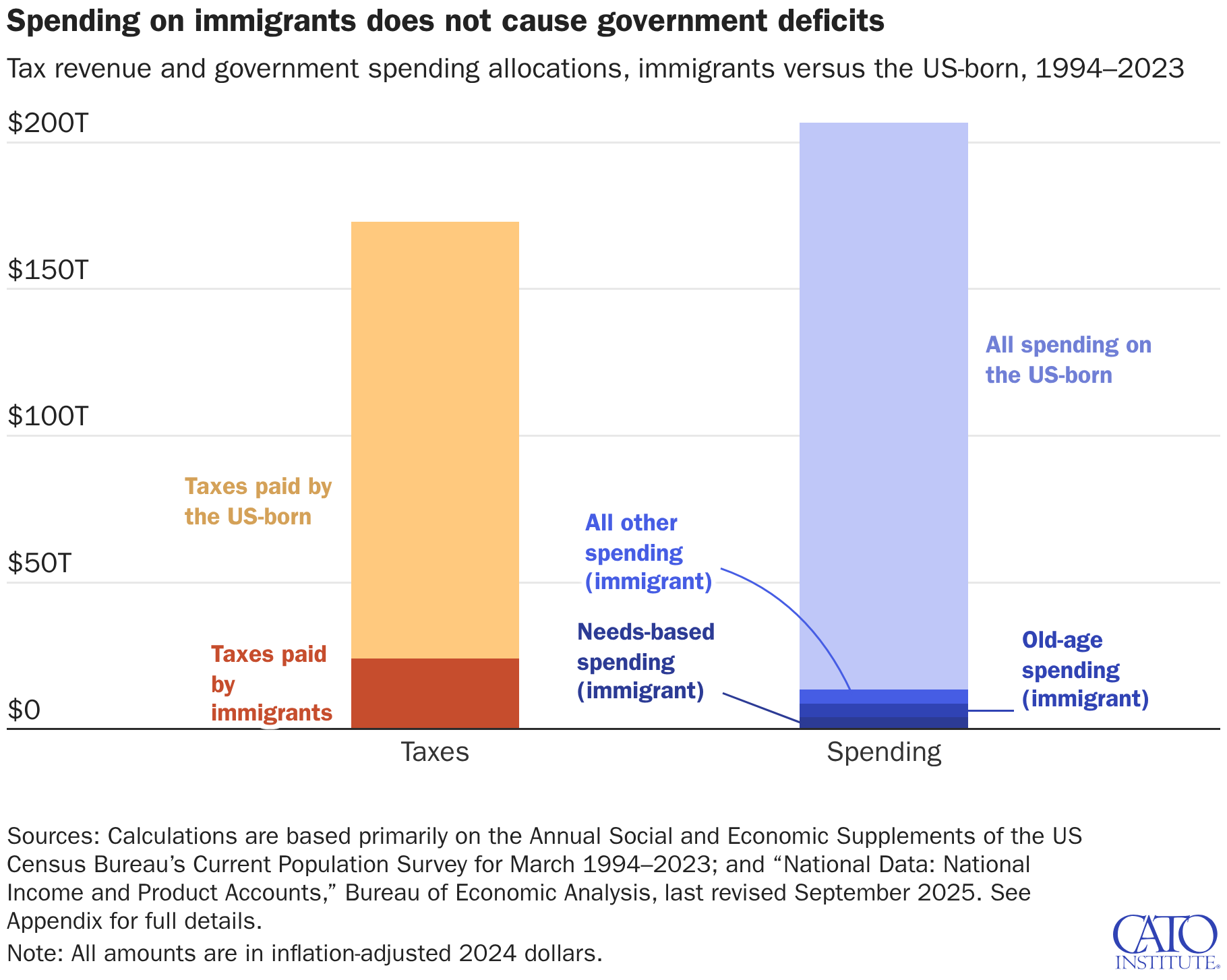
Even after accounting for their children, who will ultimately end up being even more fiscally positive than their parents over their lifetime, immigration has reduced deficits by nearly $8 trillion. Immigrants in Minnesota accounted for about $137 billion of the deficit reduction.
Nor are immigrants overall disproportionately responsible for welfare fraud. Noncitizens in all states accounted for 30 percent less welfare fraud losses per capita than the US citizen population from 2013 to 2024.2 In 2024, noncitizens were also 8 percent less likely to be convicted of welfare fraud, and noncitizen welfare fraud convictions have fallen in half in absolute numbers over the last decade.3 Undoubtedly, there are immigrants who commit fraud, but 95 percent of welfare fraud over the last decade has come from U.S. citizens.
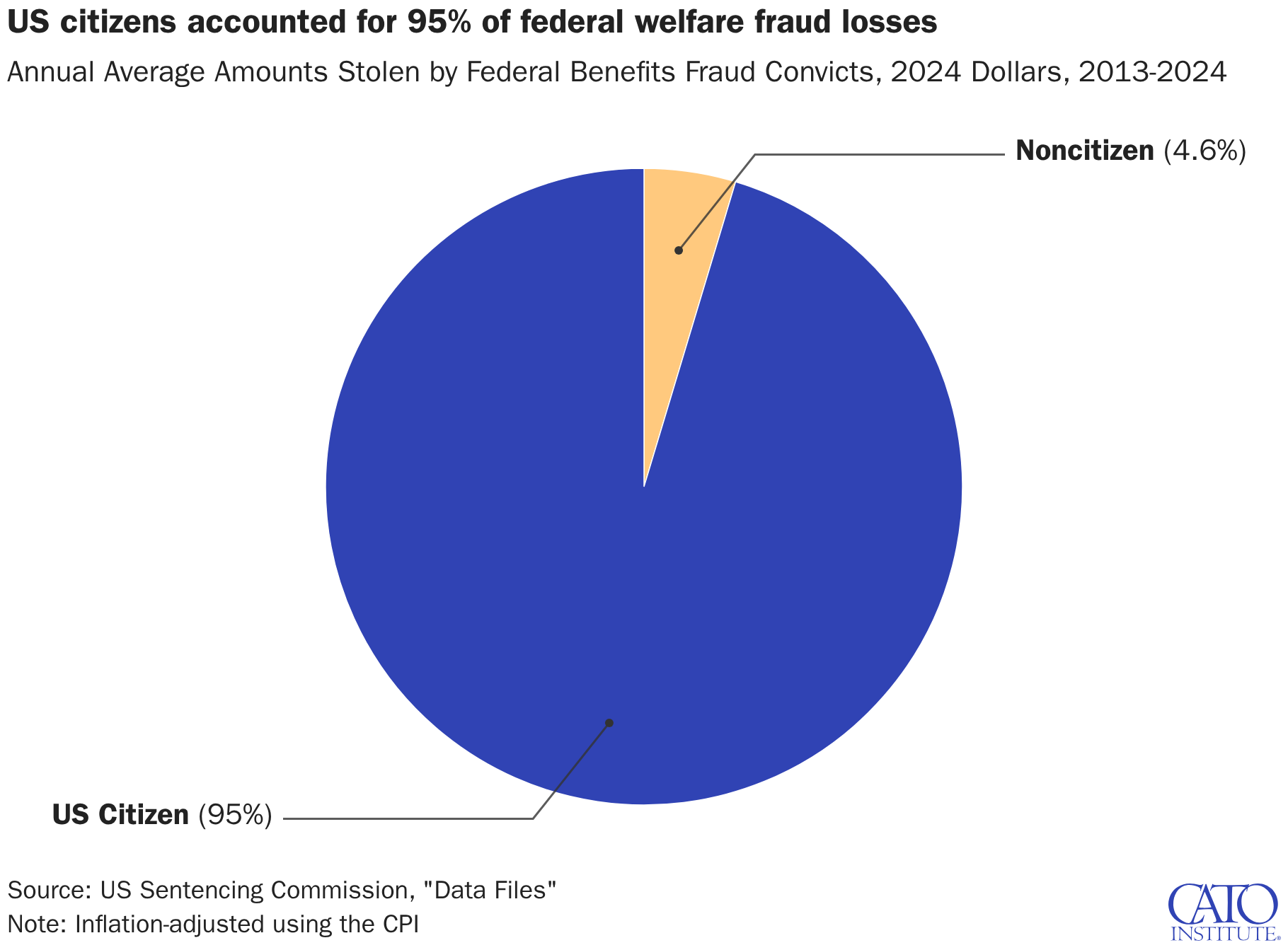
Although the available statistics do not include naturalized citizens, naturalized citizens are less likely to be arrested, convicted, or incarcerated for crimes generally, giving reasons to believe that they are as law-abiding as noncitizens in this area.4 Noncitizens were responsible for less welfare fraud per capita, even though they are more likely to live in poverty and face unique barriers to applying for benefits—barriers that partly explain why immigrants have reduced deficits so significantly. There are certainly outliers, but the point is that Congress should not make conclusions about immigrants in general or specific immigrant populations based on the actions of a few individuals. Every person should be treated as an individual, not as a representative of a particular demographic group. Individuals who commit fraud should be prosecuted and brought to justice, but the United States should never accept collective punishment for a group based on the actions of individuals.
Instead of immigrants, it is the size and unaccountable structure of the welfare state that generates fraud not just in Minnesota but in every state. Specifically, all the major welfare fraud cases in Minnesota have a common denominator: they were state programs funded in large part by federal grants.5 Federal grants to states obliterate the limited incentive that either level of government has to police welfare programs because the federal government sees it as a state responsibility, but states have little reason to investigate fraud involving federal dollars. Congress should end welfare grants to states.
DHS’s Operation Is Itself a Fraud on the Public
The Department of Homeland Security (DHS) has sold the public on Operation Metro Surge with the claim that it is in Minnesota to crack down on fraudsters and criminals. DHS has said, “We are in Minnesota to arrest the worst of the worst criminal illegal aliens,” calling those whom it has arrested “dirtbags.“6 DHS Secretary Kristi Noem has said, “we will expose and deliver accountability for the rampant fraud and criminality happening in Minnesota.“7 According to White House border czar Tom Homan, who is now leading the operation, Operation Metro Surge has been “very effective as far as public safety goes.“8
The truth is nearly the exact opposite. DHS’s mass deportation crusade is prioritizing indiscriminate arrests of peaceful immigrants over public safety and the rule of law. Indeed, it is actively undermining investigations and prosecutions into genuine fraud.
DHS Is Undermining the Investigation into Fraud in Minnesota
- Diverting personnel: DHS’s operation in Minnesota has not resulted in any criminal charges for welfare or visa fraud.9 It’s the FBI and the Department of Justice (DOJ), not DHS, that is handling the investigation and prosecution of welfare fraud with nearly all charges initiated under the prior administration. Indeed, DHS’s mass deportation effort has already severely hampered DOJ’s efforts. Last year, DHS forced nearly 2,600 FBI agents off their tasks to support DHS with low-level civil immigration enforcement.10
- Deprioritizing fraud: The president has ordered the Justice Department to prioritize immigration prosecutions over all other criminal priorities.11 In Minnesota, by attempting to detain so many immigrants without bond, DHS has flooded the courts with so many habeas petitions that it has shut down all affirmative non-immigration-related civil enforcement and deprioritized “pressing” criminal prosecutions in Minnesota, according to the administration’s U.S. attorney.12
- Forcing out prosecutors: DHS’s cover-up of the Renee Good and Alex Pretti killings forced out an FBI supervisor in charge of fraud investigations in Minnesota as well as 14 assistant US attorneys in Minnesota,13 including Joseph Thompson, the head prosecutor in Minnesota overseeing the fraud investigations and his deputy Harry Jacobs, the assistant US attorney directly responsible for the fraud prosecutions.14
DHS Is Not Targeting Immigrant Criminals in Minnesota or Elsewhere
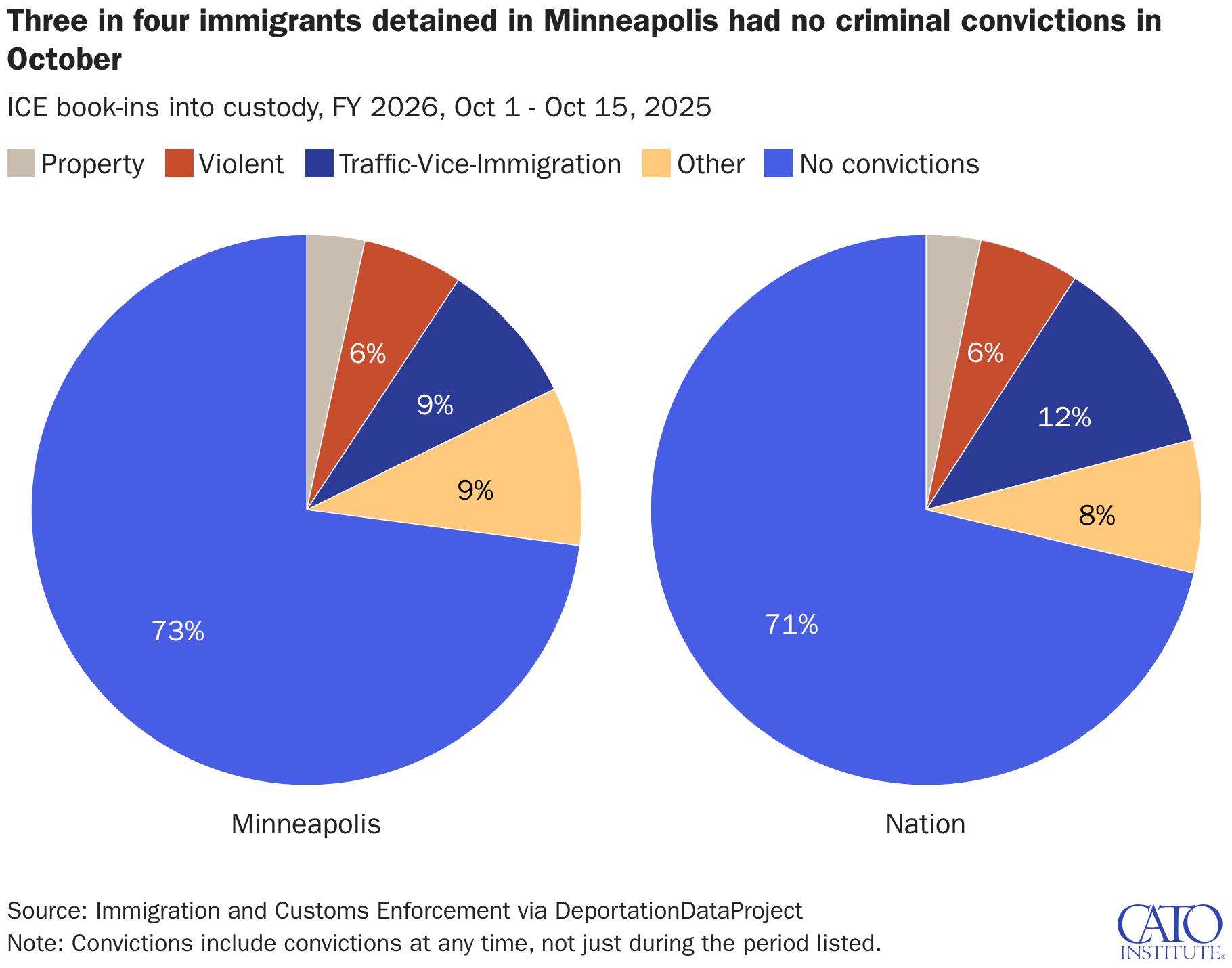
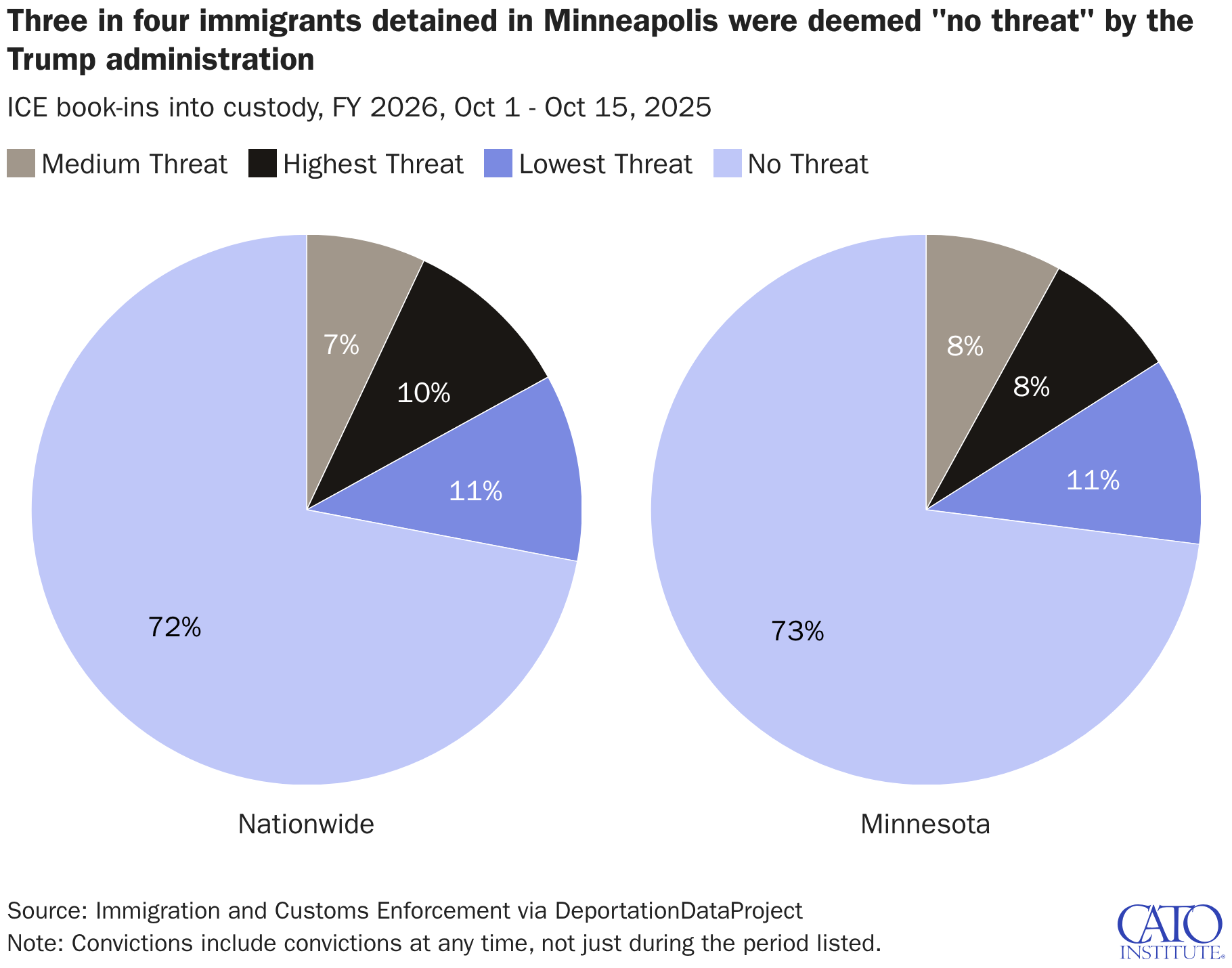
- Most ICE arrests in Minnesota aren’t criminals. Because DHS has discontinued regular statistical updates, we must rely on statistics from before the start of the Operation Metro Surge. However, as of mid-October, 73 percent of individuals booked into ICE detention in Minneapolis had no criminal convictions of any kind, and only 6 percent had violent criminal convictions. These statistics are broadly comparable with the nationwide figures during this time. Even if including people with pending charges for which they have not had their day in court, 60 percent in Minnesota had no pending criminal charges or convictions.
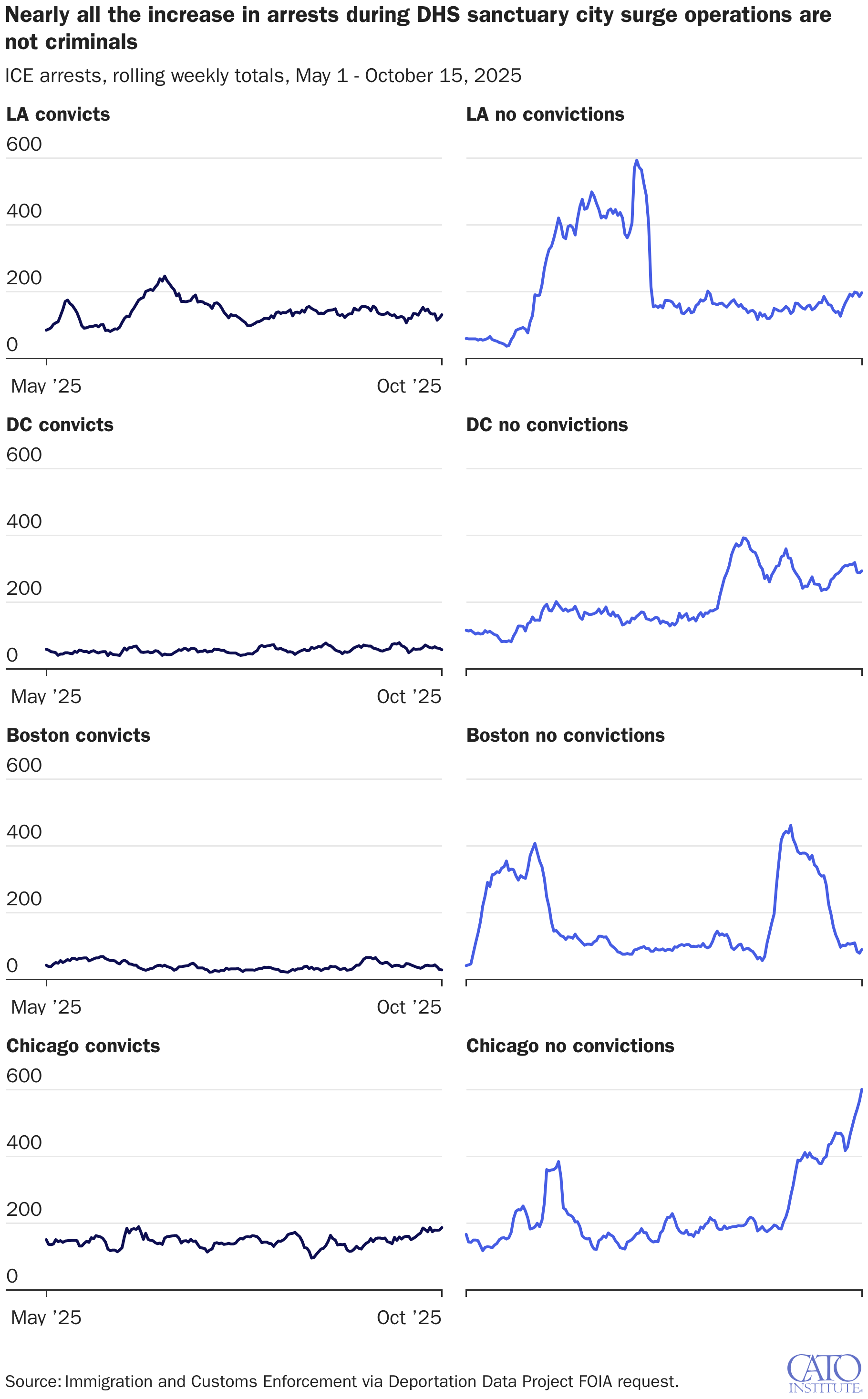
- DHS enforcement surge operations don’t target criminals. During the period for which we have data, DHS conducted four enforcement operations in cities that were smaller-scale versions of Operation Metro Surge.15 In each case, nearly all of the increase in arrests came from individuals without criminal convictions. From the week prior to the peak week, 91 percent of the increase in arrests were from non-convicts in Los Angeles; 95 percent in D.C.; 92 percent in Boston; and 88 percent in Chicago, though the data series ends before the peak in Chicago.
There is a small ambiguity in these statistics insofar as someone could theoretically be a threat without a criminal conviction. To clarify this, we can instead look at how DHS itself has categorized its detentions in Minnesota and nationwide. Once again, we find that DHS itself classifies only 8 percent of its detentions in Minnesota as the highest threat level, while 73 percent of DHS detentions were not deemed to be a threat at all. Again, this was before the surge. It has certainly fallen since then.
DHS Is Deceiving the Public about Its Operations in Minnesota
- Not identifying people in Minnesota prisons: DHS claimed that Minnesota prisons and jails held more than 1,300 when the real number—according to Minnesota officials—is fewer than 500 with most available for transfer to DHS at its request.16 DHS has failed to issue detainers for nearly 30 percent of the noncitizen inmates in Minnesota prisons, despite the prisons informing DHS of their presence and their willingness to coordinate transfers.17 In one revealing instance, DHS erroneously arrested a US citizen on January 19 and claimed it was looking for another man who was already in prison.18
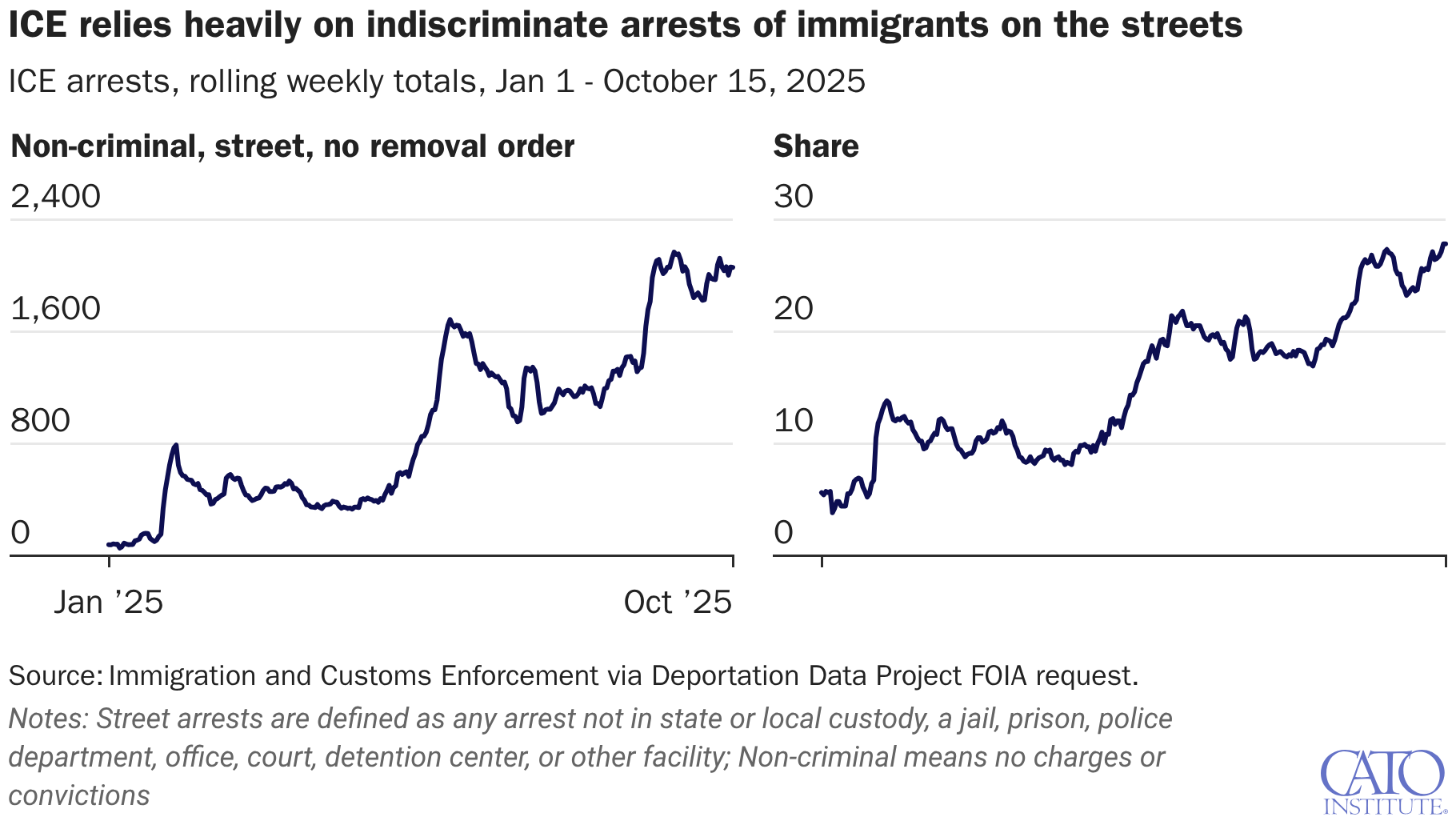
- Not “off the streets”: DHS has repeatedly claimed that the few criminal immigrants it has arrested in Minnesota were taken “off the streets” when, in fact, they were transferred directly from Minnesota prisons. In nearly six dozen cases identified by the Minnesota Department of Corrections, DHS has claimed to have arrested someone off the streets who was just transferred directly to them by the state.19 In fact, the street arrests are not nabbing criminals. Before the surge, nearly 80 percent of individuals arrested by ICE “on the streets”—outside of jails, prisons, courts, police stations, DHS offices, or other facilities—had no criminal convictions. During the enforcement surges in other cities, the share was closer to 85 percent.
- Not getting people released by Minnesota jails: Nearly 90 percent of the arrests that DHS has highlighted as “the worst of the worst” in Minnesota were not released by county jails during the current administration, undercutting the claim that the reason that DHS is operating on the streets is that the counties don’t cooperate.20 In one case, for example, DHS claimed that a target was released by Minnesota officials when, in fact, he had been released by DHS officials under the first Trump administration and had no connection to cooperation with DHS’s current operation.21
DHS Is Undermining Public Safety in Minnesota
- DHS shootings: DHS agents have shot three people and killed two in Minneapolis this year. They are responsible for about 30 percent of the gunshot wound victims and half of the homicides in the city.22 Minneapolis police did not shoot and hit anyone, including armed suspects, in the entire year of 2025.23 DHS has shot 13 people nationwide just since September.24 DHS has refused to assist any state investigations into the killings of U.S. citizens Renee Good and Alex Pretti, while the federal government has shut down its own investigation into Good’s death.25 DHS also shot at a man in St. Paul, Minnesota in December.26 As in the Renee Good case, DHS asserted that he hit an agent with his car, but there is no video evidence to confirm this account.
- DHS’s activities in Minnesota are consuming vast local police resources. In barely one month, DHS’s activities have led to over eighty 911 calls to Minneapolis police alone, including calls about kidnappings and assaults by unidentified people in masks.27 Minneapolis has had to assign a supervisor and a deputy to full-time monitoring of the public safety situations surrounding DHS operations.28 Almost every day during DHS’s operation, Minneapolis has had to deploy officers to the scene of ICE-related incidents, including shootings and other confrontations.29 ICE is abandoning numerous vehicles in the streets, including one vehicle that it failed to place in park, which rolled into the road and required police intervention. Minneapolis police had to pay for more than 3,000 hours of overtime related to ICE-induced situations, costing them more than $2 million in just three days in January. During this time, the city says officers were “not responding to 911 calls, investigating reports of crimes, or fulfilling other law enforcement obligations.“30
- DHS does not follow its own use of force protocols: The DHS agents who shot Renee Good three times violated standard police practices and DHS protocol by attempting to conduct an arrest without verifying that the vehicle was turned off, trying to stop a moving vehicle with their hands, walking in front of a moving vehicle, shooting at a moving vehicle, shooting at the driver of a moving vehicle, shooting despite no threat of death or serious bodily injury, and shooting despite the availability of a “safe alternative.“31 The DHS agents who killed Alex Pretti threw a bystander to the ground who was not impeding their operations and then used deadly force despite the absence of an imminent threat of death or serious bodily injury and the availability of other options. Despite these facts, DHS has asserted that both shootings were justified and according to officer training.32 DHS also shot a man who, according to an FBI affidavit, was 10 feet away and running away from the agent.33 After these incidents, DHS agents have continued to conduct vehicle arrests in similar manner, including by deliberately walking in front of cars with guns drawn, despite the absence of any imminent threat.34
- DHS deliberately causes accidents. ICE agents deliberately attempt to cause accidents and then blame the drivers that they hit for the accident. In a recent incident in Minnesota, “four SUVs carrying agents were riding their bumper and brake-checking [ICE observers] on suburban streets and highways.“35 No one knows how often DHS agents are causing accidents, but DHS reports that its officers were involved in at least 182 accidents since the start of last year, which it characterized as “attacks.“36 But a federal judge who reviewed DHS video of these incidents concluded that agents “brake-checked other motorists in an attempt to force accidents that agents could then use as justifications for deploying force.“37 One agent in Charlotte conceded on camera that agents brake check cars who are following them “to get them to stop.“38
- DHS is causing unnecessary chaos. Its poorly planned operations combined with its intentional policy of harassing bystanders, witnesses, observers, and protesters has led to a series of increasingly chaotic episodes on the streets. DHS has sent five times more agents than the entire Minneapolis police department, leading many to have nothing to do except engage with bystanders and protesters. The lack of urgent work was on full display when Renee Good was needlessly killed. Rather than continuing their operation, officers stopped purely because she was protesting, not because they were impeded or blocked. Indeed, other agents just drove around her moments before the incident, and she waved the agents who attempted to arrest her. Then they fired three shots, killed her, caused a violent car accident, and provoked a massive protest.39
- DHS tactics undermine ICE officer safety. DHS claims that assaults on ICE agents have increased by 1,300 percent, implying that they were about 93 percent lower under the policies of the prior administration.40 DHS should return to policies that better protect both officers and the public by conducting carefully planned, unmasked operations against serious public safety threats with warrants, due process, and humane treatment.
DHS Is Not Enforcing the Law: It Is Attacking the Constitution and the Rights of Citizens
Rather than targeting fraudsters or criminals, DHS is engaging in an unprecedented assault on the rights of all Americans:
- Racial and demographic profiling: A core component of ICE’s operation in Minnesota as in other cities has been its indiscriminate targeting of people on the street. During his time as operation lead, Border Patrol commander-at-large Greg Bovino told me on X in response to a US citizen being detained that “one must carry immigration documents.“41 DHS Secretary Kristi Noem was asked why U.S. citizens are being asked to prove their citizenship, and she said, “We may be asking who they are and why they’re there and having them validate their identity.“42 DHS agents are on camera repeatedly telling Minnesota residents to produce proof of citizenship because of their accents, including Ramon Menera and Ahmed Bin Hassan.43 Agents threaten the people whom they interrogate with arrest on the streets if they refuse their “papers-please” demands.44 The picture below is of a boy in Minnesota being interrogated about his citizenship walking home from the store with a snack. DHS agents arrested him and took him away.45

- Numerous US citizens, including Mubashir Khalif Hussen and Mahamed Eydarus, were detained or interrogated because they looked Somali or were speaking Somali.46 Mubashir was taken to an ICE facility, even though he offered to show ID. When he was finally released, he was told to walk two and a half hours through the snow to his home.47 In a lawsuit, dozens of US citizens and legal residents detail violations of their rights, interrogations, detentions, and arrests based on their appearance.48 DHS agents routinely ignored documents and used force against them.49 These behaviors are not surprising given the orders from the White House to use profiling to increase arrests in May of last year.50 Even an off-duty Brooklyn Park Police officer was detained by ICE.51
- DHS does nothing to track its use of profiling, but to give a sense of the prevalence of indiscriminate targeting of people on the streets, consider that by October 2025, greater than one in four arrests were of immigrants on the streets—that is, outside of any facility, prison, jail, court, DHS office, etc.—who had no criminal conviction or charges and no final removal order. In other words, there was no reason for them to be approached by government agents on patrol.
- First Amendment assault on bystanders and observers: DHS has detained or arrested numerous individuals for filming and recording them. DHS Secretary Kristi Noem has said that it is “violence” to be “doxing” and “videotaping them where they’re at when they’re out on operations.“52 But the Constitution protects every American’s right to protest, record, film, and report on government activity.53 But not only do DHS agents want to operate anonymously, with masks, no names, and often without even uniforms, they insist on threatening, detaining, and arresting people who observe, record, or protest their activities. Observers have recorded DHS agents threatening to “put hands on you and arrest you” if they “continue to follow us.“54 Numerous citizens were physically accosted, arrested, and detained in the DHS facility for hours without any charge for following and recording them, including Ryan Ecklund, Brandon Sigüenza, and Susan Tincher.55 In response to a lawsuit, a judge found “ongoing, sustained pattern of conduct” where drivers were stopped without probable cause of a crime for “following federal law enforcement agents at a safe distance to observe the agents’ activity.“56 DHS is using facial recognition software to record, identify, and build a database of ICE observers not accused of any crimes.57
- Threats to the Second Amendment: DHS agents shot and killed Alex Pretti after an agent removed a legally possessed firearm from his waistband. After the shooting, administration officials have justified the killing by saying that merely “approaching” law enforcement with a holstered weapon constitutes a threat.58 First Assistant U.S. Attorney for the Central District of California Bill Essayli erroneously stated afterwards that “If you approach law enforcement with a gun, there is a high likelihood they will be legally justified in shooting you. Don’t do it.“59 FBI Director Kash Patel said, “You cannot bring a firearm, loaded, with multiple magazines to any sort of protest that you want. It’s that simple.“60 Secretary Noem said, “I don’t know of any peaceful protester that shows up with a gun.“61 The Supreme Court rejected this type of argument in 2022.62 These statements are not just incorrect—they constitute a threat to use deadly force against people who protest while exercising their right to bear arms. Alex Pretti was unfortunately not the first person shot by DHS with a holstered weapon either. A DHS agent shot a preschool teacher five times in Chicago, and DHS again attempted to justify the shooting by stating she had a firearm, even though it was legal and holstered.63
- DHS is violating the Fourth Amendment, invading Americans’ homes without warrants. In direct violation of the Fourth Amendment, DHS is asserting and exercising the power to enter people’s homes without valid warrants signed by a judge, instead relying on warrants signed by its own officers.64 Six former general counsels for DHS under Republican and Democratic administrations have already denounced the policy as unconstitutional.65 The Supreme Court has said that police may not enter homes without a warrant even to catch violent felons, let alone individuals accused of civil offenses like immigration infractions.66 The policy is so clearly unconstitutional that according to the whistleblower complaint that brought it to light, the policy was hidden not just from the public but from most DHS employees, and it is still contradicted by DHS’s official training and guidance.67 In Minnesota, the administration has already been caught wrongly raiding the home of an elderly US citizen, Scott Thao, who was dragged from his home in his underwear in front of his grandchildren, arrested, and sent to a detention facility, all without a judicial warrant.68 A federal court in Minnesota found that a raid targeting a noncitizen was also unconstitutional.69
- DHS is deliberately and illegally arresting legal immigrants. Under Operation Parris, DHS has arrested, detained, and removed to Texas about 150 refugees who had lawful refugee status and have not committed any crime.70 DHS plans to arrest more than 5,600 such refugees in Minnesota alone.71 The purported basis is the need to reinterview them prior to them receiving legal permanent residence status, yet the government made no effort to ask them to appear anywhere to be interviewed, and numerous judges have already ordered the release of these legal immigrants in individual cases, and one court has at least temporarily enjoined the operation.72 One judge wrote about Te Eh Doh La, a Burmese refugee who entered legally and had properly filed an application for adjustment of status to permanent residence: “There is something particularly craven about transferring a nursing refugee mother out-of-state.“73 In a typical case, Selamawit Mehari, an Eritrean Christian refugee and single mother of three, was dragged from her home without warning in the middle of winter, chained, and shipped to an out-of-state detention center.74 DHS also canceled humanitarian parole and Temporary Protected Status (TPS) for a long list of countries, including Somalia, Haiti, and Venezuela, despite no change in country conditions solely to open these vetted immigrants to deportation.75 This gives lie to the claim that these operations are focused on illegal immigration.
- Violating habeas corpus and ignoring court orders: The Constitution guarantees all individuals in the United States the writ of habeas corpus, or the right to challenge their confinement in court. In thousands of cases, DHS has asserted that individuals have no right to seek release, and hundreds of times, judges have rejected these assertions.76 Nonetheless, DHS has violated nearly 100 court orders to release people detained without bond in Minnesota alone.77 DHS has violated court orders in dozens of other cases regarding different immigration matters as well, undermining the rule of law and the Constitution.78
Immigration Enforcement Should Focus on High-Priority Targets
Congress should:
- Order the prioritizations of welfare fraud prosecutions over immigration matters;
- Prohibit the diversion of FBI personnel to civil immigration enforcement;
- Order the administration to prioritize deportable criminals in immigration enforcement;
- Prohibit wearing masks and require federal agents to identify themselves;
- Ban racial profiling and require federal agents to obtain warrants for specific individuals based on probable cause of a violation of the law prior to making arrests;
- Reinforce current law that bars interrogation of U.S. citizens’ status;
- Require Border Patrol to patrol within a 10-miles radius of land borders;
- Create a private right of action for violations of constitutional rights by federal agents;
- Explicitly prohibit qualified immunity defenses for constitutional violations;
- Prohibit threats or arrests in retaliation for First Amendment-protected activity;
- Prohibit tracking of individuals for First Amendment-protected activity;
- Explicitly permit states and localities to investigate crimes committed by federal agents;
- Allow states to sue the federal government for violations of their residents’ rights; and
- Permit nationwide injunctive relief by courts for policies violating federal law.
About the Author


This work is licensed under a Creative Commons Attribution-NonCommercial-ShareAlike 4.0 International License.