Chairman McClintock, Ranking Member Jayapal, and distinguished members of the subcommittee, thank you for the opportunity to testify.1
I occupy The Selz Foundation Chair in Immigration Policy at the Cato Institute, a nonpartisan public policy research organization in Washington, D.C. I previously served as senior policy advisor for a member of this Committee, and I appreciate the opportunity to testify again about the positive effects of immigration on American cities. For nearly half a century, the Cato Institute has produced original research showing that people—whatever their ancestry, background, or birthplace—can benefit the United States when the Constitution’s principles of individual liberty and limited government are followed.
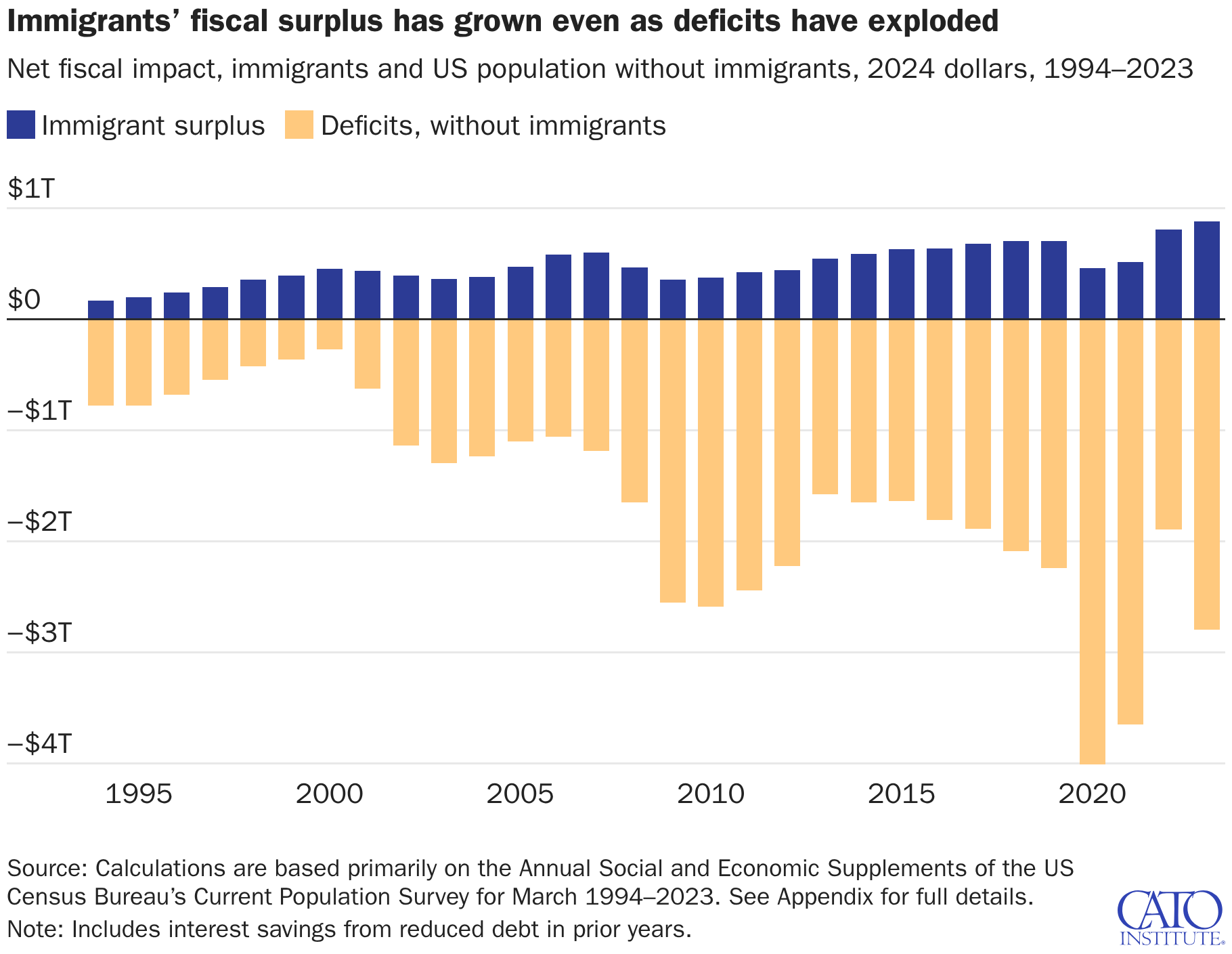
Immigrants come for freedom—freedom to work for us and with us, to improve our lives, and they will play critical roles in America’s economic vitality in the future.2 They work at higher rates and are nearly twice as likely to start businesses.3 Cato’s research has shown that immigrants have reduced federal, state, and local government budget deficits by a combined $14.5 trillion, including $1.7 trillion from illegal immigrants, over the last 30 years.4
The great success of Fairfax, Virginia highlights the value of immigration to the country. One third of the population is foreign-born, and nearly one-half of the residents are from immigrant families—double the national averages.5 Over 100,000 Fairfax residents are illegal immigrants, and nearly 20 percent of the county is here illegally or lives in a household of someone here illegally.6 Fairfax is one of the most prosperous, safest counties in the entire country. Its median household income is double the national average,7 and it has the second lowest homicide rate of any jurisdiction with more than 500,000 individuals.8 Rather than destroying the community, immigrants have proven essential to Fairfax’s success.
Cities Are Forced to Deal with the Fallout of Congress’s Flawed Immigration System
As I’ve explained to this Committee before, however, Congress has failed to update the legal immigration system in any meaningful way since 1990.9 As a result, only about 3 percent of those seeking lawful permanent resident status in the United States received green cards in 2024.10 For people who are not close relatives of US citizens, the percentage is less than one percent.
Unfortunately, rather than fix this system, the current administration has undermined it, banning a majority of the few legal immigrants from abroad who were previously permitted to immigrate. That includes nearly all legally admitted refugees—except for South African Afrikaners—and about half of all immigrant visa applicants, including half of all spouses and minor children of US citizens.11 Legal entries have fallen twice as much as illegal entries.12 It has also cut green card processing in half, setting up applicants for ICE arrests.13
Congress’s continual refusal to correct its past mistakes and legalize immigration has forced states and local governments to deal with the fallout of illegal immigration. America’s cities benefit from the economic contributions of these immigrants, who are integrated into their communities as family members, friends, parishioners, workers, and employers. In some areas of the United States, as many as one in five people lives in a household with an illegal immigrant.14 As a result, Congress and the president have forced these communities to choose between aiding federal law enforcement and tearing apart their cities.
Noncitizens who threaten the lives and liberty of Americans should be prosecuted, convicted, imprisoned, and deported—whether they came in legally or not—and states may have a role to play in that effort. However, the federal government’s focus on indiscriminate enforcement undermines trust and cooperation with municipalities. A better approach would require Immigration and Customs Enforcement (ICE) to concentrate its efforts on serious offenders so that localities could be confident about ICE’s intentions when working with local officers.
Cities Have Good Reasons to Limit Participation in Immigration Enforcement
- Illegal immigrants provide goods and services that improve the lives of Americans. Mass deportation would cut US production by about 7 percent of Gross Domestic Product.15 Illegal immigrants look after Americans’ children, provide their health care, and care for them when they become elderly and disabled. Immigrants build and clean Americans’ homes, harvest their fruits and vegetables, and process their meat and seafood. Mass deportation would crash local economies, creating a death spiral of lost consumers, closed businesses, and declining tax revenue.
- Many Americans’ jobs directly depend on illegal immigrant workers. For instance, there are 33 million US-born Americans who are managers or supervisors for over 8 million unauthorized immigrant workers.16
- Illegal immigrants are providers for US citizen family members. There are over one million undocumented spouses of US citizens, and nearly 17 million US citizens share a household with an unauthorized immigrant.17 Mass deportation would impoverish many of these families, cutting household income at least in half.18
- Illegal immigrants supported state and local governments with more than $37 billion in state and local tax revenue in 2022.19
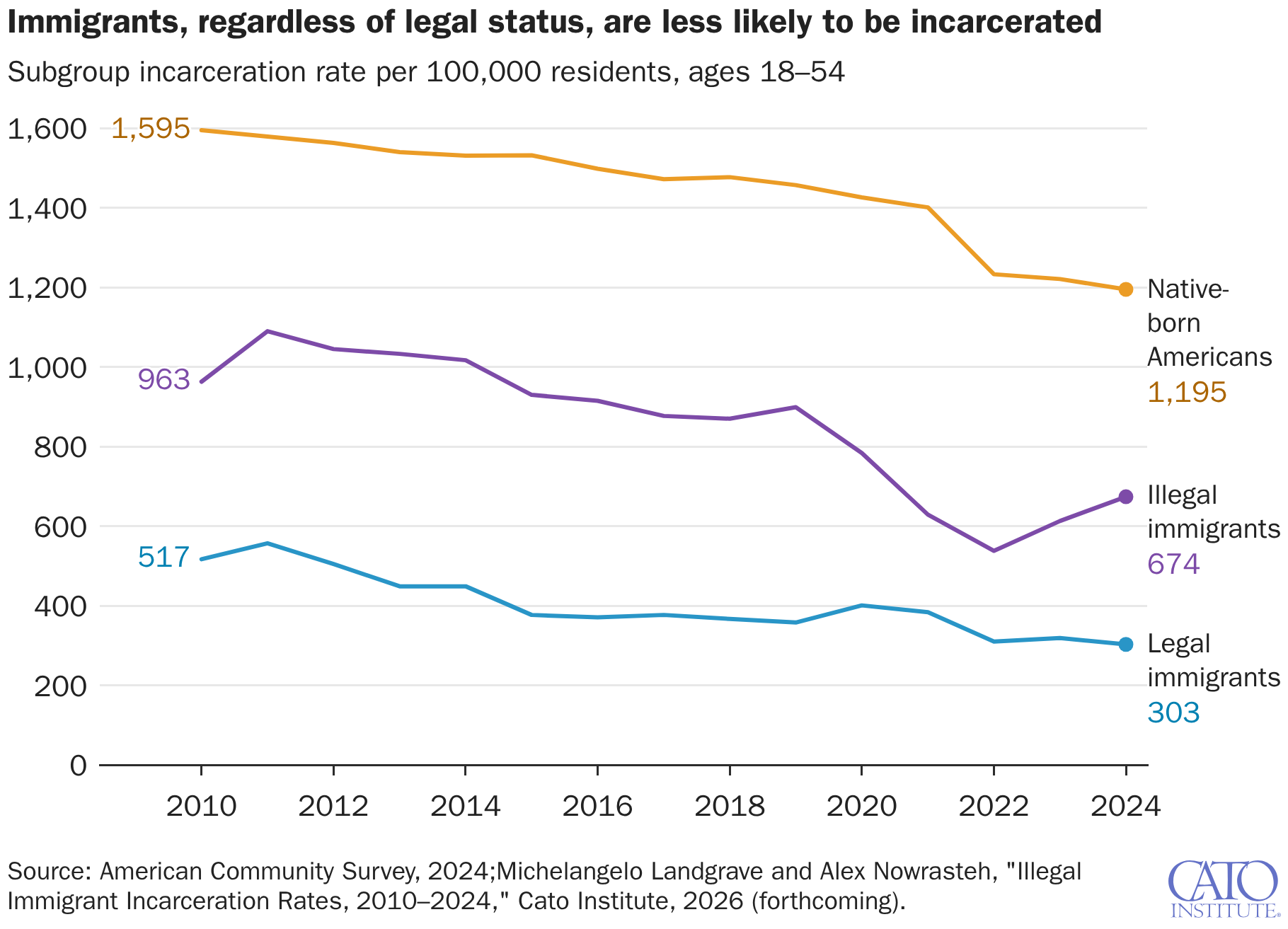
Illegal immigrants reduce crime rates by committing fewer crimes. More than a dozen studies have found that immigration, including illegal immigration, is associated with less crime.20 Illegal immigrants were half as likely to have committed an offense serious enough for them to be incarcerated in the United States in 2023.21 In recent years, there has been a negative correlation between murders and immigration court filings in major US cities.22
Fewer than half a million immigrants with criminal convictions of any kind were on ICE’s deportation docket in 2024—which is less than 3 percent of the roughly 14 million illegal immigrants.23 Like parking violations, illegal presence in the United States is a civil offense, not a crime. Although ICE’s docket does not include every illegal immigrant convicted of anything, it consists of the vast majority. Regardless, 3 percent is a low share compared to the broader population. Roughly 30 percent of Americans have been arrested,24 and about 8 percent have felony convictions.25
- Illegal immigrants in sanctuary cities can directly stop crimes. An unauthorized immigrant working as a convenience store nightwatchman stopped a burglary in Texas.26 Another in New Mexico chased down a child abductor, safely returning a 6‑year-old girl to her parents.27 Two Venezuelan asylum seekers in New York City (Oswaldo Robles Lino and Josnan Alberto Palacios) stopped a stabbing in 2024.28
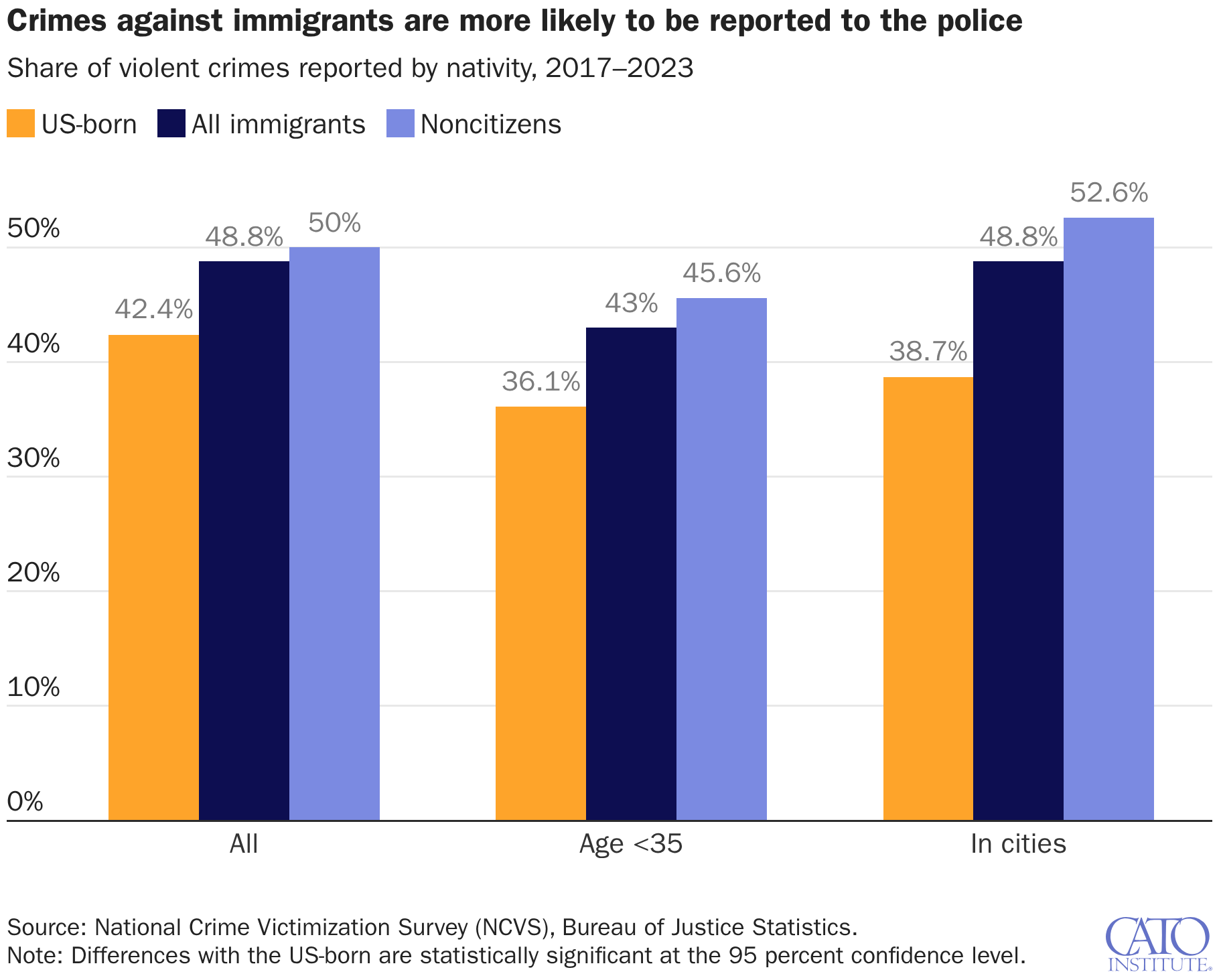
- Illegal immigrants help solve crimes. From 2017 to 2023, noncitizens—including illegal immigrants—reported 2.5 million crimes to police, reporting violent crimes at higher rates than US-born Americans.29 Over the last decade, about 100,000 unauthorized immigrants have obtained legal status through their collaboration with law enforcement,30 and local agencies have about 415,881 requests pending for unauthorized immigrants to receive legal status based on their cooperation with them right now.31 Hispanics were somewhat more likely to report crimes in sanctuary cities from 1980 to 2004.32
- Cities have more important law enforcement priorities. In the United States, more than 40 percent of murders, about 60 percent of violent crimes, and 85 percent of property crimes go unsolved.33 Mandating that police divert resources away from these offenses to enforce immigration status violations would make cities less safe. It prioritizes jail space for non-threatening individuals over addressing actual threats to the community. In Los Angeles, for instance, it costs over $400 per day to hold someone in jail.34
Illegal immigrants could contribute more to their cities and the country if they had a permanent legal status and employment authorization. States and cities should never participate in immigration enforcement efforts targeting peaceful individuals.
The Constitution Protects State Autonomy
States have the independent authority to decide how their law enforcement agencies interact with federal immigration enforcement. Although regulating immigration falls solely under federal jurisdiction, and federal law is supreme, states may still determine how to allocate their resources and whether to assist in enforcing federal law.
Under the Constitution’s federalist system, state governments are not creations of the federal government. Under the 10th Amendment, states retain all powers not delegated to the federal government. This system of “dual sovereignty” keeps the states directly accountable to their citizens for any actions that they take. State officials cannot claim that the federal government forced them to take any particular action.
As the Supreme Court stated in Printz v. United States (1997), “The power of the Federal Government would be augmented immeasurably if it were able to impress into its service—and at no cost to itself—the police officers of the 50 States.”35 The opinion written by Antonin Scalia stated, “the Federal Government may neither issue directives requiring the States to address particular problems, nor command the States’ officers…. such commands are fundamentally incompatible with our constitutional system of dual sovereignty.” This decision involved an effort to commandeer local officials into conducting gun control checks. In New York v. United States (1992), the same principle was affirmed in a case involving environmental regulation.36
The Supreme Court has extended this principle to include the use of federal monetary grants to coerce cooperation. NFIB v. Sebelius (2012) stated: “Congress may use its spending power to create incentives for States to act in accordance with federal policies. But when ‘pressure turns into compulsion,’ the legislation runs contrary to our system of federalism.”37 This case involved Obamacare Medicaid eligibility rules. In Murphy v. National Collegiate Athletic Association (2018), the Supreme Court clearly stated that: “Congress cannot issue direct orders to state legislatures.”38
Moreover, several courts have found that it is unconstitutional for states to detain individuals solely at the request of ICE.39 More than a dozen settlements have involved subjects of immigration detainers who were detained by localities.40 This includes a man unlawfully detained in Virginia.41 This means that states and localities cannot lawfully arrest and detain someone merely on the basis of an immigration detainer request from the federal government without a court order supported by probable cause unless they are deputized by ICE. Many states and cities are labeled “sanctuaries” simply for following these court decisions. Fairfax County, Virginia must comply with those orders.
During its first term, the Trump administration attempted to impose new immigration reporting requirements for certain law enforcement grants. However, four of the five appeals courts that considered the issue found that those requirements were adopted unlawfully and unconstitutionally.42 As the Seventh Circuit Court of Appeals wrote in 2020, “states do not forfeit all autonomy over their own police power merely by accepting federal grants.”43 The administration has lost similar cases in this term.44 If Congress wants sanctuary cities to change their policies, it needs to convince them to do so voluntarily, not through force or coercion. If Congress can force its will on the states on immigration matters, it can do so with respect to guns, environmental rules, and health care.
The Administration Fosters Mistrust Between Federal and Local Law Enforcement
Notwithstanding these facts, the administration is attempting to bully state and local governments into compliance with its agenda.
- The administration is attempting to coerce state governments unconstitutionally. The president has issued an executive order that attempts to block all federal grants to municipalities that do not allocate their resources to help ICE.45 His administration has sued Illinois and Chicago for refusing to help ICE, asserting that the president can mandate that they do what he wants,46 but the case was dismissed.47 The Department of Justice (DOJ) has also issued a memorandum requiring criminal investigations into state and local officials who fail to participate in federal enforcement.48
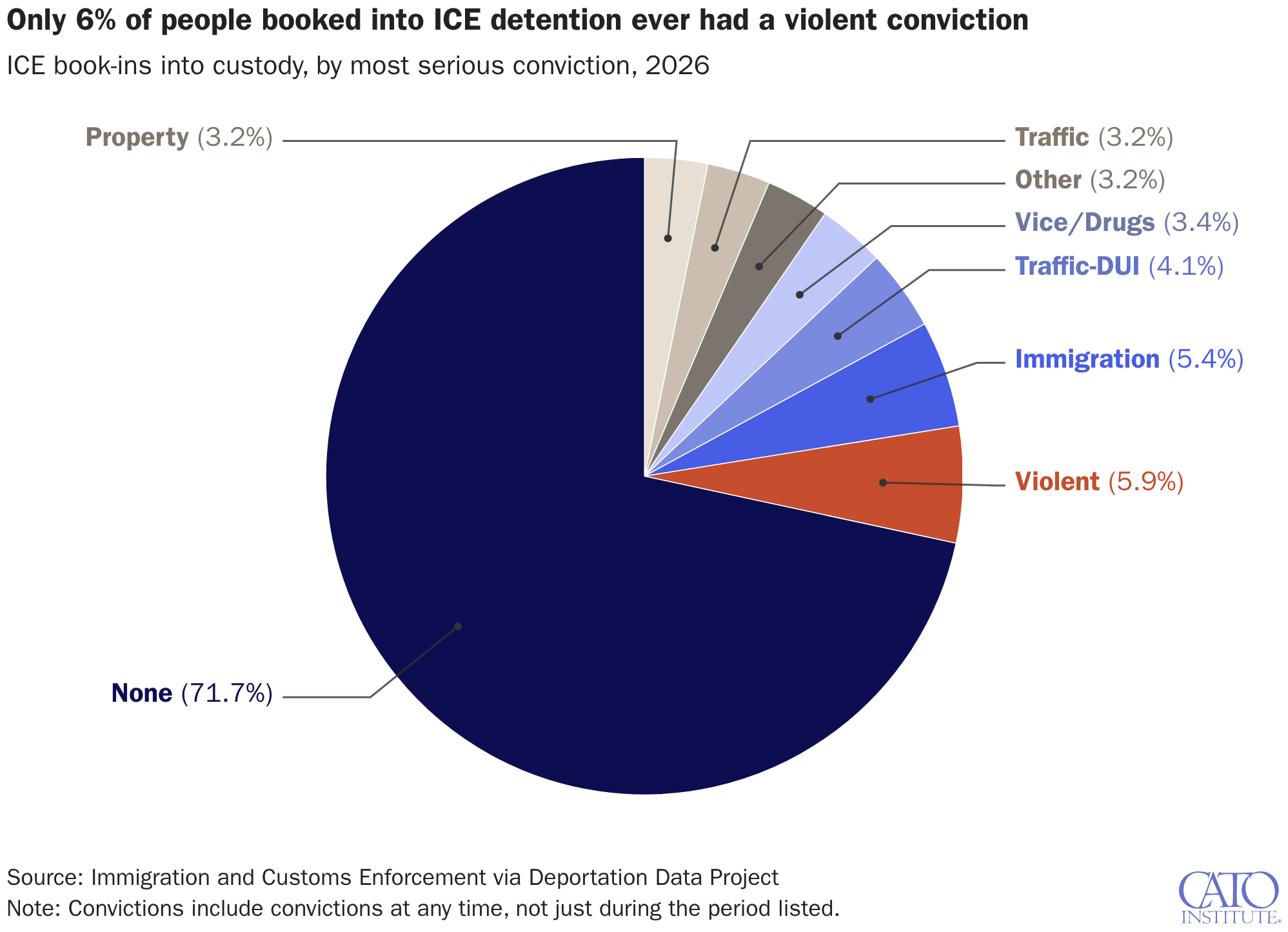
- The administration is attempting mass deportation of peaceful immigrants. President Trump signed an executive order removing requirements that ICE target public safety threats, and instead mandating that ICE and DOJ focus on immigration status violations.49 In 2026, only 6 percent of people booked into detention had a violent criminal conviction, and 72 percent had no conviction.50 Just as significantly, the Department of Homeland Security (DHS) itself classified just 10 percent of detainees as the highest threat level, and 72 percent of detainees were not deemed a threat at all.51
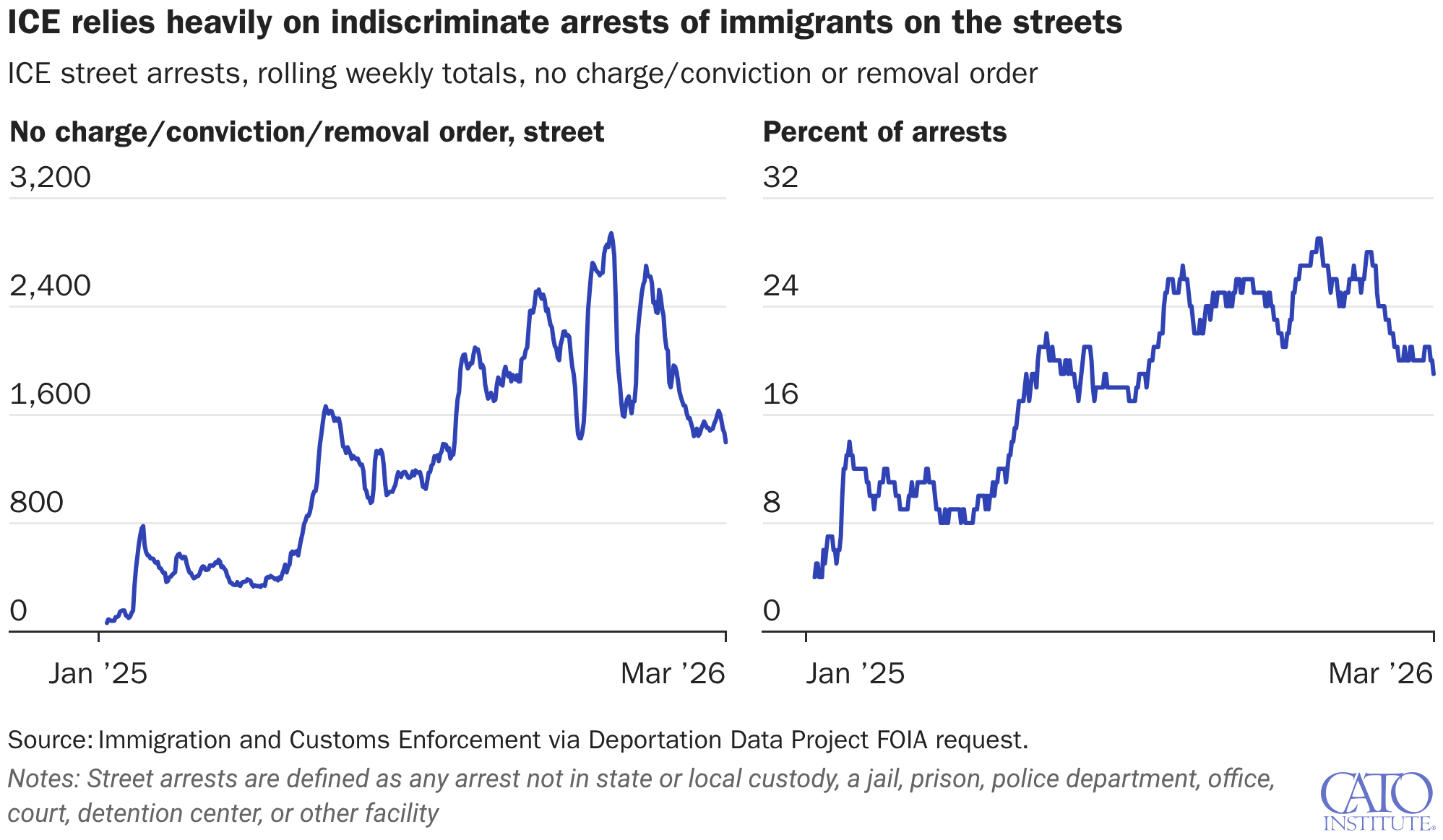
- The administration is engaging in racial and demographic profiling of US citizens. DHS agents detain, interrogate, and demand proof of residence from people on the street based on demographic profiling without evidence of a violation of the law. When this unconstitutional harassment was temporarily enjoined in Los Angeles, arrests fell by two thirds immediately after a court found it was illegal.52 DHS appears not to track its use of profiling. But to give a sense of the prevalence of indiscriminate targeting of people on the streets, consider that in recent months, more than one in four arrests were of immigrants on the streets—that is, outside of any facility, prison, jail, court, DHS office, etc.—who had no criminal conviction or charges and no final removal order. In other words, there was no reason for them to be approached by government agents on patrol. This policy ensnares many US citizens and legal residents. Fox News reported that ICE agents interrogated about ten people for every one person they arrested in Florida.53
- The administration is targeting lawful immigrants for deportation. DHS is ending parole and Temporary Protected Status for over two million immigrants who had legal status at the start of this administration.54 ICE is arresting people with valid parole status and subjecting them to detention and expedited removal,55 and before a court stopped the practice, ICE arrested legal immigrants with refugee status for not receiving green cards within one year of arrival, while it simultaneously stopped processing their green cards.56
- The administration is attempting to arrest and deport US citizens. The president signed an executive order that purports to strip US citizenship from, and render deportable, all children born to temporary legal residents and people without permanent legal status, despite the constitutional guarantee of birthright citizenship.57
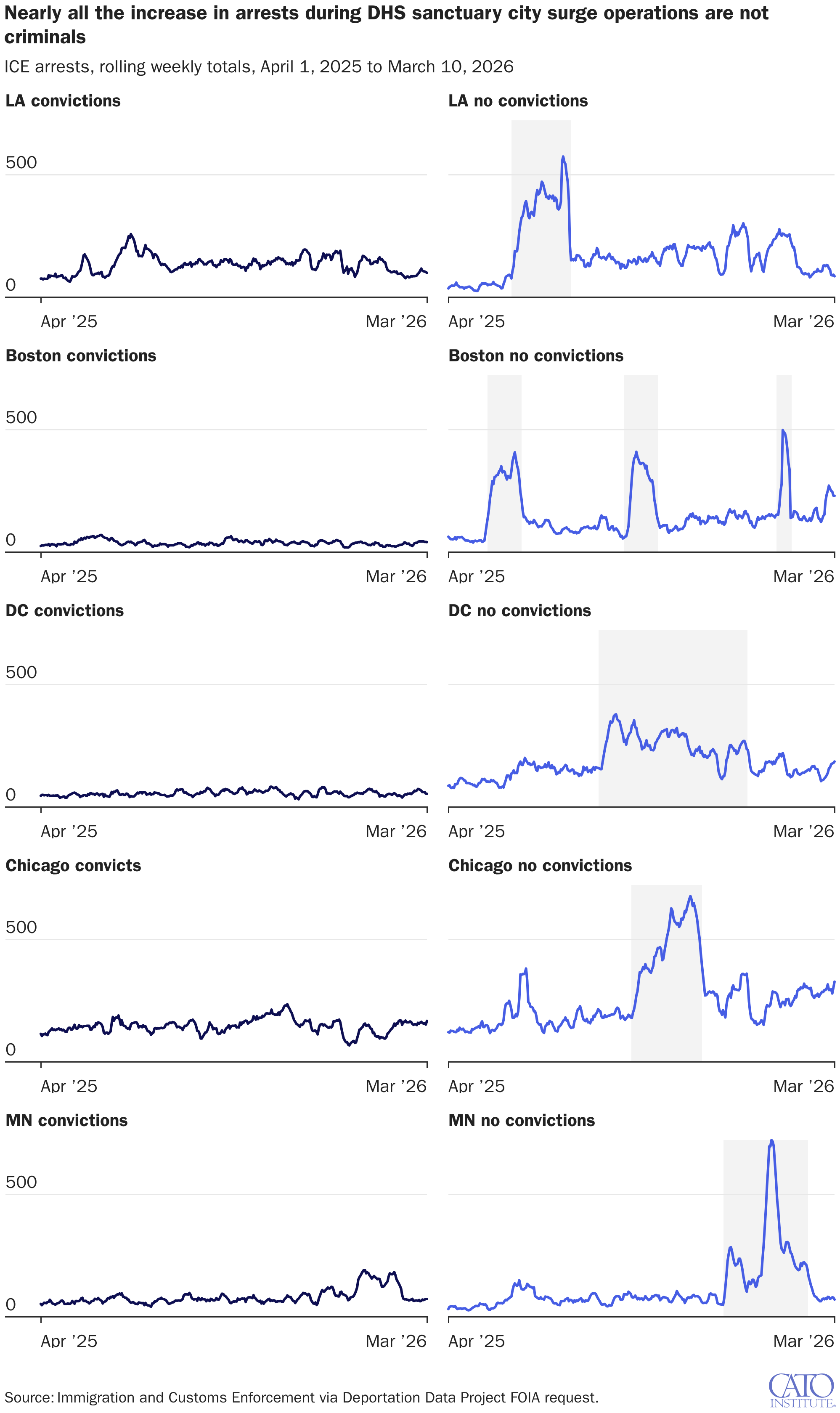
- The administration’s crackdown on sanctuary cities is not targeting criminals. In each case where DHS has conducted an enforcement surge operation in a sanctuary city, nearly all the increase in arrests came from individuals without criminal convictions. From the week prior to the peak week, 91 percent of the increase in ICE arrests came from non-convicts in Los Angeles; 95 percent in D.C.; 92 percent in Boston; 86 percent in Chicago; and 83 percent in Minneapolis.
- The administration refuses to coordinate with state and local police in cities. DHS does not notify local law enforcement of their operations to deconflict prior to making arrests.58 DHS officers have tear gassed local police,59 and they have even erroneously detained off-duty officers in Minnesota.60 They have detained state and local court employees outside of courthouses.61 In barely one month, DHS’s activities led to over eighty 911 calls to Minneapolis police, including calls about kidnappings and assaults by unidentified people in masks.62 Minneapolis had to assign a supervisor and a deputy to full-time monitoring of the public safety situations surrounding DHS operations.63
Almost every day during DHS’s operation, Minneapolis has had to deploy officers to the scene of DHS-related incidents, including shootings and other confrontations.64 ICE is abandoning numerous vehicles in the streets, including one vehicle that it failed to place in park, which rolled into the road and required police intervention. Minneapolis police had to pay for more than 3,000 hours of overtime related to ICE-induced situations, costing them more than $2 million in just three days in January. During this time, the city says officers were “not responding to 911 calls, investigating reports of crimes, or fulfilling other law enforcement obligations.”65
- The administration blames cities for its own failures. DHS has said that it must make arrests on the streets because jails in Minneapolis and other sanctuary cities do not cooperate. DHS has failed to issue detainers for nearly 30 percent of the noncitizen inmates in Minnesota prisons, despite the prisons informing DHS of their presence and their willingness to coordinate transfers.66 In one revealing instance, DHS erroneously arrested a US citizen on January 19 and claimed it was looking for another man who was already in prison.67 DHS has repeatedly claimed that the few criminal immigrants it has arrested in Minnesota were taken “off the streets” when, in fact, they were transferred directly from Minnesota prisons.68 When ICE did arrest immigrant criminals outside of a jail or prison in Minnesota, it usually had nothing to do with a sanctuary policy.69 In one case, for example, DHS claimed that a target was released by Minnesota officials when, in fact, he had been released by DHS officials under the first Trump administration and had no connection to cooperation with DHS’s current operation.70
- The administration is entering homes of US citizens without judicial warrants. DHS implemented a non-public policy of entering residences to make civil immigration arrests of people with administrative orders of removal. According to DHS Secretary Noem, DHS has already used this policy at least 28 times to enter homes.71 One such raid resulted in the illegal arrest of a US citizen in Minnesota, who was dragged from his home in nothing but shorts in freezing weather.72 This policy violates the Constitution, threatens Americans’ freedom, and creates unsafe, dangerous situations for DHS agents.
- The administration does not follow its own use of force protocols. The DHS agents who shot Renee Good three times violated standard police practices and DHS protocol by attempting to conduct an arrest without verifying that the vehicle was turned off, trying to stop a moving vehicle with their hands, walking in front of a moving vehicle, shooting at a moving vehicle, shooting at the driver of a moving vehicle, shooting despite no threat of death or serious bodily injury, and shooting despite the availability of a “safe alternative.”73 The DHS agents who killed Alex Pretti threw a bystander to the ground who was not impeding their operations and then used deadly force despite the absence of an imminent threat of death or serious bodily injury and the availability of other options. Despite these facts, DHS has asserted that both shootings were justified and according to officer training.74 DHS also shot a man who, according to an FBI affidavit, was 10 feet away and running away from the agent.75 Similar shootings, like that of Marimar Martinez in Chicago, occurred in other sanctuary cities.76
- The administration is arresting victims and witnesses of crimes. In one of its first actions, this administration rescinded policies that instructed officers to look for indications that an immigrant was a victim before arresting them, and it announced, “Current beneficiaries of victim-based immigration benefits may be subject to civil immigration enforcement.”77 In the months since, we have seen repeated cases of DHS arresting victims and witnesses of crimes.
- In Iowa, ICE arrested Felipe Hernandez after he reported being shot during an attempted robbery before he had even healed.78 Local police arrested him for a bench warrant based on an overdue traffic ticket and turned him over to ICE pursuant to state law.
- In Michigan, ICE arrested Veronica Ramirez Verduzco after she reported an assault.79
- In Kansas, ICE arrested U visa applicant Jose Madrid-Leiva, despite having worked with police on a robbery case.80
- In California, the Immigration Center for Women and Children filed a lawsuit on behalf of eight crime-victim U visa applicants who were arrested in 2025.81 In a typical case, ICE had arrested a domestic violence survivor named Lupe who had lived in the United States for three decades and who had helped police successfully prosecute her attacker in 2017.
- In California, a judge ordered the release of Victor Amada Rodriguez-Flores, an immigrant crime victim and U visa applicant whom ICE had arrested.82
- In Texas, ICE arrested Oscar Bonilla after he agreed to help investigators crack a criminal case.83 The Justice Department then criminally charged him for illegally entering the country.
- In Maine, local police notified Border Patrol about a man who was part of a group trying to stop a suicide attempt and who had called the police for help, and Border Patrol arrested him.84
- The administration arrests defendants before trial. As highlighted in a new report by the House Judiciary Committee Democratic Staff, the administration is also detaining and deporting defendants before trials can occur, and justice can be served.85 The administration has deported more than 100,000 individuals with pending charges against them, preventing them from proving their innocence but also undermining criminal prosecutions and cutting off restitution and justice for victims.86 Among the numerous instances of this phenomenon ICE deportations protected from consequences: one of the most prolific jewel thieves ever in California, an extortionist in Colorado, a violent robber in Washington, a domestic abuser in Colorado, and a fraudster in Texas. Deportations prior to sentencing prevent prison sentences, obstruct restitution, and even allow the deportees free to attempt return to the United States as thousands have under President Trump’s two terms in office.87
- The administration is harassing, detaining, arresting, and killing people for protesting their activities. DHS has detained or arrested numerous individuals for following, observing, and recording them, even though the Constitution protects every American’s right to do so.88 DHS Secretary Kristi Noem has said that it is “violence” to be “doxing” and “videotaping them where they’re at when they’re out on operations.”89 Not only do DHS agents want to operate anonymously, with masks, no names, and often without even uniforms, they insist on threatening, detaining, and arresting people who observe, record, or protest their activities. Observers have recorded DHS agents threatening to “put hands on you and arrest you” if they “continue to follow us.”90 One judge found an “ongoing, sustained pattern of conduct” where drivers were stopped without probable cause of a crime for “following federal law enforcement agents at a safe distance to observe the agents’ activity.”91
- The administration is violating habeas corpus and ignoring court orders. The Constitution guarantees all individuals in the United States the writ of habeas corpus, or the right to challenge their confinement in court. In thousands of cases, DHS has asserted that individuals have no right to seek release, and judges have overwhelmingly rejected these assertions.92 Nonetheless, DHS has violated nearly 100 court orders to release people detained without bond in Minnesota alone.93 DHS has violated court orders in dozens of other cases regarding different immigration matters as well, undermining the rule of law and the Constitution.94
The administration’s reckless assault on the rule of law in pursuit of indiscriminate mass deportation creates mistrust between immigrants and law enforcement and between state and local governments and the federal government. Congress should restore cooperation and trust by requiring that ICE target only serious criminal threats and work collaboratively with state and local governments on that mission.
Congress should be investigating and stopping the current constitutional violations in immigration policy, not enacting new ones. Instead, Congress should follow the advice of the Major City Chiefs Association: “The decisions related to how local law enforcement agencies allocate their resources, direct their workforce and define the duties of their employees to best serve and protect their communities must be left in the control of local governments.”95 While Congress may not always agree with state and local decisions about how to allocate their resources, their officials are better equipped to prioritize those resources than the federal government.
Fairfax County Is the Second Safest Major Jurisdiction in America
Fairfax County is one of the safest counties of its size in America. From 2018 to 2025, Fairfax had an average annual homicide rate of 1.5 per 100,000, which was second lowest among major cities only to Nassau County, New York.96 The Department of Justice considered Nassau County, not Fairfax County, to be a sanctuary jurisdiction in 2025.97 The graph below ranks the murder rate for all jurisdictions with at least half a million residents. During this period, sanctuary status had no relationship to the level of homicide in a city, and the foreign-born share of the population in these cities was associated with a lower homicide rate in these cities.
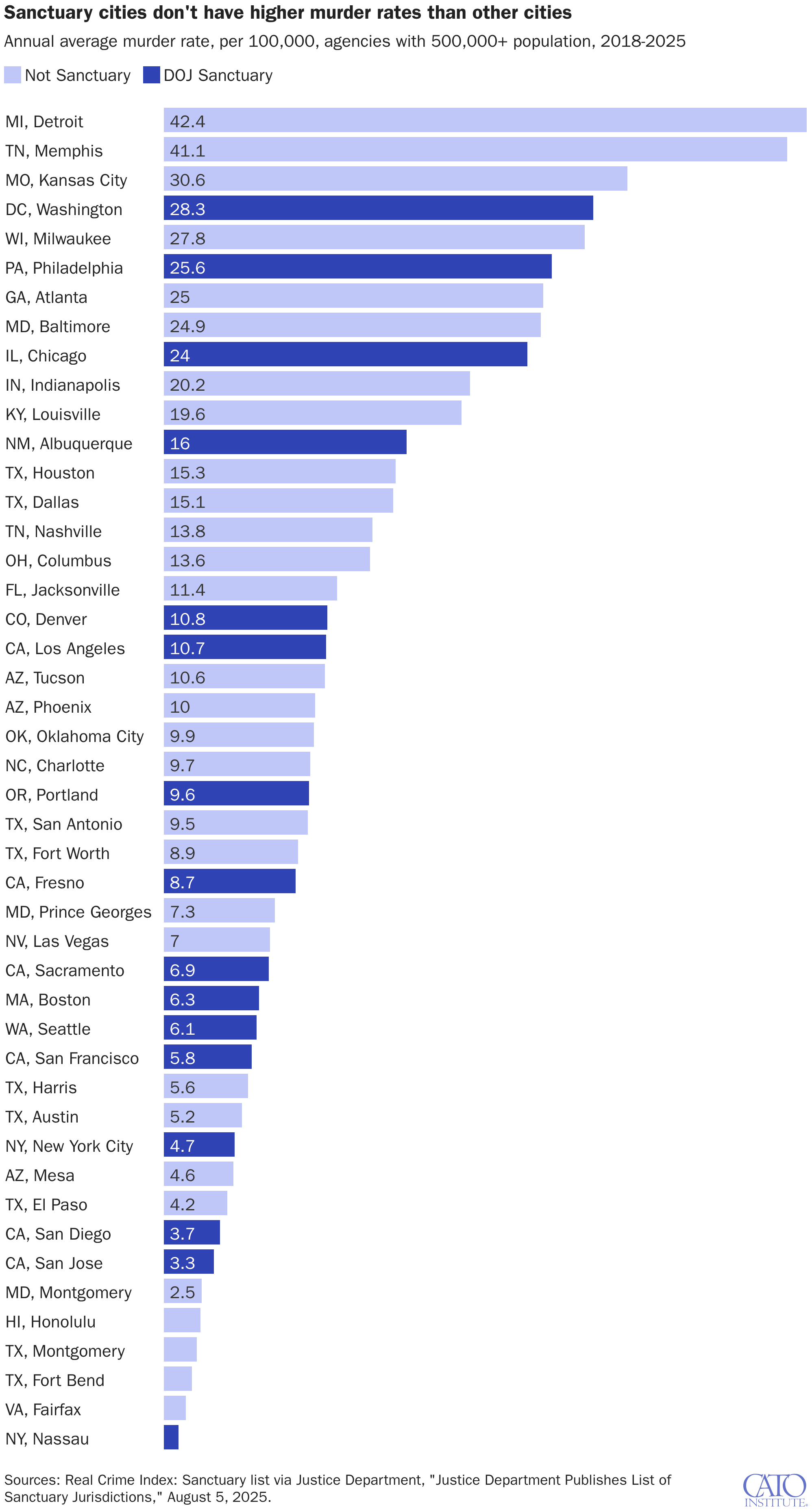
- Illegal immigrants in Fairfax don’t have a high murder rate. Fairfax has had four murders purportedly committed by illegal aliens in 2025 and 2026.98 There are 102,000 illegal immigrants in Fairfax, Virginia, which is an annualized homicide rate of about 3 per 100,000 residents.99 This is about 25 percent lower than the homicide rate for the country as a whole in 2025 and over 70 percent below the homicide rate for major cities.100 Systematic data from Texas shows illegal immigrants were similarly 26 percent less likely to be convicted of murder from 2013 to 2022.101 This is not an argument that policymakers should ignore illegal immigrant killers, but rather that they should focus all their efforts on serious criminal offenders to stop them before they kill, not indiscriminately target immigrants.
- The administration isn’t enforcing the law prioritizing serious offenders. The Laken Riley Act orders the federal government to target violent and property criminals, but DHS has failed to implement the law.102 As a result, DHS has repeatedly allowed offenders to commit new crimes. ICE officials have repeatedly told media outlets that they have been told not to prioritize criminal illegal immigrants. ICE agents told the New York Post, “All that matters is numbers, pure numbers. Quantity over quality.”103 ICE has arrested more than 150,000 individuals without any criminal convictions or even charges since January 20, 2025, rather than tracking down serious fugitives like the killers in Fairfax.
- Reasonable restrictions on aiding immigration enforcement do not increase crime. A dozen studies have found that limits on participation in immigration enforcement do not lead to higher crime rates.104 Sanctuary policies were associated with fewer assaults and burglaries after adoption in 2014.105 There was no change in Florida counties that adopted sanctuary policies in 2019.106 From 1999 to 2010, these policies had no effect on crime in sanctuary cities.107 Cities that first participated in ICE’s “Secure Communities” jail surveillance program did not see decreases in crime relative to other cities, which were de facto sanctuaries.108 “Sanctuary cities,” broadly defined, saw more significant decreases in both violent and property crimes from 2014 to 2016,109 and they did not experience higher violent or property crime rates than other cities.110 Additionally, California’s SB 54 did not increase crime rates.111
A limitation of this research is that it mostly predates many of the most restrictive policies on immigration enforcement participation, and it includes a diverse range of policies. From 2010 to 2015, these policies did reduce deportations, but not of people with violent convictions.112 This is an indication that those policies did not severely hamper ICE’s efforts to target violent criminals during that period. Whether these conclusions hold true for more recently enacted policies remains to be studied.
Immigration Enforcement Should Protect the Constitution and Prioritize Threats
Congress must require DHS to follow the law and the Constitution. DHS has violated the Constitution and the Bill of Rights nearly every day of the Trump administration.
- It has routinely violated court orders hundreds of times, including intentionally.113
- It has violated the First Amendment on numerous occasions, including by arresting immigrants for their political speech and by detaining Americans for protesting their actions.114
- It has violated the Fourth Amendment by invading the homes of US citizens without warrants115 and by seizing US citizens based on their demographic characteristics to interrogate them about their citizenship.116
- It has violated the Fifth Amendment’s due process clause and Constitutional guarantee of habeas corpus by detaining immigrants unlawfully and ignoring their right to seek release in court.117
- It has violated the Sixth Amendment right to trial by imprisoning immigrants in foreign prisons without trial.118
- It has violated the Fifth and Eighth Amendments by detaining and imprisoning immigrants in conditions that would amount to cruel and unusual punishment.119
- It has violated the Tenth Amendment by threatening states and localities for refusing to do the bidding of DHS.120
- It has violated the Fourteenth Amendment by threatening to strip citizenship of US-born children of immigrants who have no permanent status in the United States.121
To restore the rule of law, maintain accountability, and restore trust with states and cities across the country, Congress should:
- Order the administration to prioritize deportable criminal threats for removal;
- Prohibit wearing masks and require federal agents to identify themselves;
- Ban racial profiling and require federal agents to obtain warrants for specific individuals based on probable cause of a violation of the law prior to making arrests;
- Reinforce current law that prohibits interrogating US citizens about their status;
- Require Border Patrol to patrol within a 10-mile radius of land borders;
- Create a private right of action for violations of constitutional rights by federal agents;
- Explicitly prohibit qualified immunity defenses for constitutional violations;
- Prohibit threats or arrests in retaliation for First Amendment-protected activity;
- Explicitly permit states and localities to investigate crimes committed by federal agents;
- Allow states to sue the federal government for violations of their residents’ rights; and
- Permit nationwide injunctive relief by courts for policies violating federal law.
About the Author


This work is licensed under a Creative Commons Attribution-NonCommercial-ShareAlike 4.0 International License.