• Sweden’s experiment with state ownership in the 1970s and 1980s offers a cautionary tale for the United States today. An ambitious industrial policy program gradually became an ad hoc system for rescuing failing companies and preserving employment.

  • Governments proved worse than markets at identifying viable investments, while political ownership blurred the line between regulator and owner, multiplied corporate objectives, weakened accountability, and softened budget constraints.

  • Step-by-step, the state-owned enterprises were restructured and privatized. An evaluation of the Swedish privatization program showed that productivity in these companies increased by between 12 and 36 percent, depending on how it was measured.

  • When public ownership replaces private ownership, the constant feedback of a decentralized market is replaced with organized lobbying, bureaucratic discretion, and institutional self-preservation. The result is not only worse and more expensive policies but also a political system that becomes progressively less capable of correcting its own mistakes.

The Swedish government once financed the search for a Spanish treasure galleon. It sold hamburgers in Kuwait and vodka in the United States. And it lost so much money on state ownership that a Social Democratic finance minister described it as a “black hole” in the nation’s finances.

Sweden’s experiment with state ownership in the 1970s and 1980s offers a cautionary tale for the United States today. Sweden was no socialist outlier. The government’s involvement in business was justified by many of the same, often conflicting, objectives that are now being invoked by Washington: promoting national security, raising revenue, spurring regional development, protecting employment, fostering innovation, and rescuing failing firms.

Sweden’s approach was not a coherent socialist project so much as an effort to use state ownership to achieve an ever-growing list of political objectives. Yet the outcomes were much the same: poor corporate governance, weak incentives, mounting losses, and ultimately a broad Swedish consensus that the experiment had failed.

Laying the Foundations

Sweden’s history of extensive state ownership in commercial companies began in the late 1960s. Until then, state ownership had been concentrated in what were considered natural monopolies, particularly infrastructure such as railways, the postal service, and electricity generation. The main justifications were that private capital was insufficient for such investments or that state ownership provided a reliable source of government revenue.

A conservative government took a decisive step in 1907, when it took a 50 percent stake in LKAB, the company operating Sweden’s iron ore mines in the north. The state also secured the right to acquire the remaining shares, an option it exercised in 1957. The acquisition was motivated by a desire to prevent foreign control and safeguard supplies of iron ore for the domestic steel industry.

The Social Democratic Party, which ran Sweden for most of the years between 1932 and 1976, had a complicated relationship with state ownership. Although socialist ideas remained influential within the party, its leadership largely abandoned plans for large-scale nationalization before the 1932 election. This partly reflected political pragmatism, but it also reflected the cost of compensating private owners. Instead of socializing the means of production, the Social Democrats increasingly focused on socializing consumption through an expansive welfare state, introducing measures such as unemployment insurance and public pensions, while using regulation and fiscal policy to shape the economy.

During the late 1930s and World War II, state ownership grew mainly in sectors linked to infrastructure and national security. After the war, however, the Social Democrats assigned state-owned enterprises a broader role. They contended that publicly owned companies could complement the private sector by competing with private monopolies, correcting market failures, and expanding access to credit.

The Great Experiment

Only in the late 1960s did this approach become an ambitious program of state ownership. The turning point came after the Social Democrats’ disappointing electoral performance in 1966. Seeking a new political agenda, the party leadership elevated industrial policy to one of its main priorities.

This move reflected a broader international shift. Across the industrialized world, confidence in economic planning and activist government was growing. Influential economists and policymakers argued that the state could accelerate structural change, identify strategic industries, and guide long-term investment more effectively than decentralized markets could.

A series of institutional reforms quickly followed. The government established the Swedish Investment Bank in 1967 to channel long-term finance to industry and created a separate Ministry of Industry in 1969. In 1970, it founded the state holding company Statsföretag (Swedish State Company), which brought 22 companies under a single umbrella to coordinate and expand government ownership. By 1980, Statsföretag and the partly state-owned steel producer SSAB together accounted for around one-fifth of all industrial investment in Sweden.

Yet the new strategy suffered from a fundamental weakness. As Fredrik Johansson of the Swedish think tank Frivärld summarized, “The new industrial policy was characterized by two things: it was ambitious and it was vague.” Statsföretag was expected to achieve “the greatest possible expansion subject to the requirement of profitability” while taking special account of the public interest when making decisions about keeping employment high and supporting specific regions. This represented a fundamental shift in the state’s role as an owner. Rather than merely owning companies for commercial or strategic reasons, the government sought to use them as instruments for achieving wider economic and political objectives.

The result was a persistent conflict between those objectives. The company’s first years have been described as a “Sturm und Drang” (“Storm and Stress”) period, marked by deep disagreements among the board of directors and management over whether profitability or broader industrial policy goals should take precedence.

The ambitious plans for using state ownership to reshape Swedish industry were soon overtaken by events. The international recession following the 1973 oil crisis, combined with structural problems in shipbuilding, steel, textiles, and other manufacturing industries, transformed the state’s role from industrial strategist to bailout provider. Instead of creating new industries, the government increasingly found itself rescuing old ones, as executives, trade unions, and local politicians demanded that the government use its new powers to subsidize failing projects.

The center-right governments that ran the country from 1976 to 1982, despite being ideologically more favorable to private enterprise, actually expanded state ownership through the acquisition of shipyards, steel companies, textile firms, and other troubled businesses. The government created what critics dubbed the “Industrial Emergency Room” (Industriakuten), where struggling firms were put on government life support.

The shipbuilding industry illustrates the logic, or lack thereof. Despite early warnings that Swedish shipyards had little long-term future, politicians repeatedly rejected proposals for closures, even when management could not see a future. Instead, the state gradually took over the major shipyards and merged them into the wholly state-owned Svenska Varv in 1977. The rescue packages ultimately cost taxpayers the equivalent of roughly SEK 165 billion in today’s money (about $17 billion), a huge sum for a relatively small economy.

In 1978, economist Ingemar Ståhl memorably remarked: “The cream of Sweden’s manufacturing workforce … spend their days destroying steel plates, funded by taxpayers.” Indeed, many of the ships built with taxpayer money were eventually broken up for scrap, as the steel was worth more than the ships themselves.

The steel industry followed a similar path. As profitability collapsed after 1974, the state merged its own steel producer with the steel divisions of Gränges and Stora Kopparberg to create SSAB in 1977. The new company received substantial state support while undergoing years of restructuring before eventually returning to profitability and later being partly privatized.

SSAB is often seen as a more successful venture than the shipyards because the government ultimately received almost half as much from successive sales of shares as it had committed to the company by 1981. But this neglects both inflation and additional state commitments made in subsequent years. Taking those into account, the proceeds amounted to only around one-fifth of the state’s financial commitments to SSAB.

In retrospect, the period from roughly 1970 to 1982 was less an era of socialist expansion than one of crisis management. An ambitious industrial policy program gradually became an ad hoc system for rescuing failing companies and preserving employment. This was mission creep rather than socialism.

Despite its reputation for socialist experiments, Sweden was not an outlier in the broader European perspective. Even though Sweden had a bigger state-owned sector than its Nordic neighbors, such arrangements were not unusual for the time. In the mid-1970s, state-owned companies accounted for approximately 7 percent of total employment in Sweden compared to just under 8 percent in the United Kingdom and 11.5 percent in France (Figure 1).

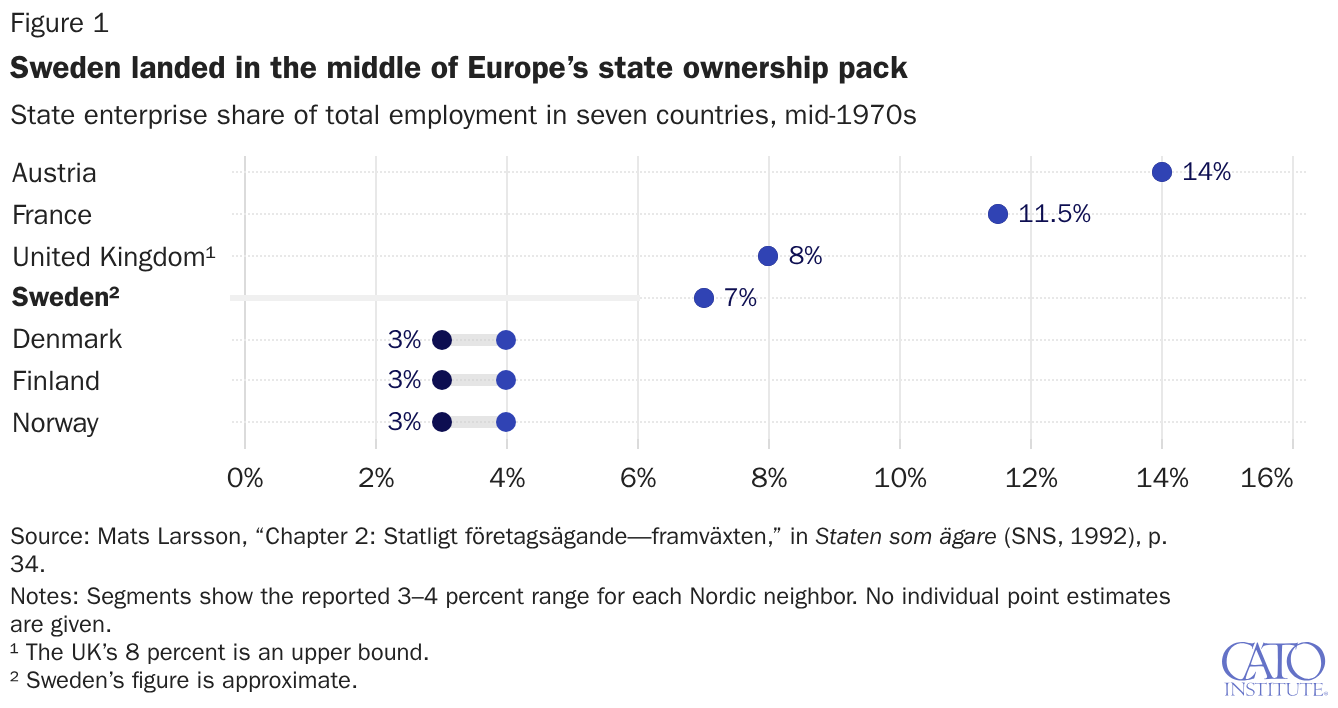
Sweden landed in the middle of Europe’s state ownership pack

The Retreat

Stockholm’s approach was, however, a massive waste of capital and slowed down the necessary restructuring of the Swedish economy. Between 1976 and 1982, the Statsföretag group accumulated total losses of around SEK 20 billion in today’s money ($2 billion), after net financial income and expenses. Financial resources were depleted, “leaving the group barely able to function,” the government wrote later.

Harry Schein, who became president of the Swedish Investment Bank in 1983, claimed that in the state-owned bank’s first 15 years, it “paid no dividends, paid no taxes, and lost 61 percent of its real capital.” Fredrik Johansson added: “It is difficult to discern what was actually accomplished with all that capital—even when one turns to sources other than Schein. It is as if someone had been quietly burning money.”

Nils Åsling, minister for industry in the center-right governments and responsible for many bailouts, admitted that “rational market and commercial considerations had been relegated to the background” and that his “experience illustrates the drawbacks of government involvement in the business sector.” A spokesman for the biggest center-right party summarized the experience: “State ownership of business has, with few exceptions, been a gigantic failure … and we must quickly reduce state ownership of business to a minimum.” Kjell-Olof Feldt, minister of finance in the Social Democratic government that took over in 1982, described state-owned companies at the time as “a black hole” and the best place for a new government to find “plenty of fat to cut.”

Remarkably, less than 15 years after the new industrial policy had been launched, the consensus was reached that it had been a costly failure and that the government had to reduce its involvement. The Social Democratic government concluded that giving state-owned businesses the combined goals of expansion and profitability had resulted in them failing on both accounts. Roine Carlsson, the minister responsible for state-owned companies, argued that state enterprises had to generate profits, otherwise they should either be closed or sold to owners capable of running them better. The Industrial Emergency Room was to be shut down.

In the following years, major shipyards were closed, the steel industry was restructured, mines were closed, and several state-owned companies were sold. The major industrial companies were separated from Statsföretag, marking its transformation from an industrial policy instrument into a commercially oriented holding company.

A government bill in 1983 made profitability the overriding objective of state-owned enterprises. Employment and regional policy no longer justified indefinite state ownership or continued subsidies. If the government wished state-owned enterprises to undertake activities that were not consistent with normal commercial justifications, it would henceforth have to enact those measures through separate agreements.

The Commercial State

Making state enterprises more commercial did not necessarily eliminate the distortions of state ownership. These enterprises could still enjoy privileges unavailable to private competitors, allowing them to pursue profits and take risks without being subject to the same market discipline.

When Schein took over the Swedish Investment Bank in 1983, he abandoned political objectives and instead used government guarantees and benefits to try to make a profit wherever he could. As he put it, “We are a commercial bank, and we provide loans for virtually any purpose. It is not our role to make political or moral judgments.”

One striking example happened in 1986, when the Swedish Investment Bank led a consortium trying to salvage the Spanish galleon San José, which had sunk off the Colombian coast in 1708 with a treasure of gold believed to be worth billions. Schein’s only argument for the venture was that “we have the opportunity to make an enormous amount of money.” The consortium failed, and the San José remains on the ocean floor.

This was not the only eccentric case of government activity. In the late 1970s, SARA, a state-owned hospitality and restaurant group within Statsföretag, tried to enter the rapidly growing fast-food market and sent two employees to work for McDonald’s in the US. With the acquired know-how, SARA started Clock—a rare example of a government-run hamburger chain, including the distinctly Swedish “Hawaii burger,” topped with pineapple. Clock also expanded abroad, and in 1986, it opened a restaurant in Kuwait.

The spirits producer Vin & Sprit represents one case of a highly successful state-owned enterprise. Its professional management decided to focus on exports, and with a creative marketing campaign, Absolut Vodka became the leading imported vodka in the United States by 1985. Impressively, the company achieved this in one of the world’s most competitive consumer markets, where it did not have any special privileges (arguably one reason it had to be innovative). Vin & Sprit was eventually sold to Pernod Ricard for a record SEK 55 billion (almost $6 billion) in 2008.

The Social Democrats’ reassessment of state ownership did not mean that the broader debate over ownership had ended. While the government was winding down loss-making state-owned enterprises and deciding that the remaining ones should be run as ordinary commercial companies, it was pursuing a different strategy for extending influence over the business sector. The “wage-earner funds” proposed by the trade union movement were intended to gradually transfer corporate ownership from private shareholders to collectively controlled funds. The versions enacted by the Social Democratic government in 1983 were far more modest than the original proposal and functioned largely as investment funds in private companies rather than as instruments of socialization.

The Social Democrats did not abandon the ambition to shape ownership in the business sector, but they increasingly abandoned the idea that commercial enterprises should be owned and managed directly by the government.

Back to Business

As state-owned enterprises turned into pure commercial ventures and politicians stopped interfering in management, many of the original contradictions and problems disappeared. But this left politicians and voters asking why the government should own such companies at all, with taxpayers taking the risk, and why the state should compete with private businesses in the first place. Was it really an essential Swedish government task to sell hamburgers in Kuwait? Or vodka to Americans?

Step-by-step, the state-owned enterprises were restructured and privatized. Statsföretag was transformed into Procordia in 1984, and the government gradually reduced its stake. The Swedish Investment Bank was dissolved in 1989.

After 1991, a newly elected center-right government, led by Prime Minister Carl Bildt, launched Sweden’s first comprehensive privatization program. The government argued that the state’s primary role was to establish the legal and institutional framework for the economy, not to own commercial enterprises. State ownership, it maintained, should be justified only by exceptional circumstances, and any sales should be conducted on commercial terms, at market prices.

Parliament authorized the government to sell all or part of its holdings in 35 state-owned companies, ranging from industrial firms to financial institutions and infrastructure businesses. At the same time, the wage-earner funds were abolished and the Ministry of Industry was reorganized as the Ministry of Enterprise. Together, these reforms marked the end of Sweden’s principal experiment with expanding public ownership of business.

An evaluation of the Swedish privatization program by economists Martin Olsson and Joacim Tåg showed that productivity in these companies increased by between 12 and 36 percent, depending on how it was measured. Another consequence of privatization was a reduced head count, but the gains exceeded workers’ pre-transfer wage losses by a factor of two to six.

Significantly, the productivity gains did not appear to come from increased investment or leverage and were particularly pronounced when privatization was accompanied by a change of CEO. Olsson and Tåg concluded that operational and governance changes following privatization were important contributors to the productivity gains, suggesting that changing how the firms were managed could unlock substantial efficiencies.

In 1998, Schein, the Social Democrat who used to run the Swedish Investment Bank, concluded that “on the whole, privatization has improved quality while reducing costs.” He added: “There is almost never any reason for the state, regional authorities, or municipalities to own companies that compete with privately owned firms in an open market.”

What Went Wrong

The first problem identified by Swedish politicians was that they had not been better than the market at finding and organizing successful business models. Despite a few exceptions (e.g., the vodka business), state ownership was not the source of revenue they had hoped for but a colossal drain on public resources, especially considering the opportunity cost of capital spent.

Assar Lindbeck, the Social Democratic economist who first came up with the idea for creating the 1967 investment bank, came to regret his advice: “The notion that a government agency can identify worthwhile investment projects that others have overlooked is hardly realistic. I have never heard any informed observer argue that the Investment Bank served any useful purpose during its existence.”

A second problem was that state ownership blurred the distinction between umpire and player. The same political institutions that wrote the rules, levied taxes, and distributed subsidies also had a direct financial interest in the success of particular firms. This inevitably raised questions about neutrality. A government could hardly be expected to act as a disinterested regulator while trying to maximize the value of its own companies.

The banking crisis of the early 1990s provided a stark example: The state-controlled Nordbanken became the first bank to receive public support. The government had to act both as the bank’s owner and as the ultimate guarantor of the stability of the wider banking system. A later official inquiry explicitly noted this dual role, illustrating how state ownership could make it difficult to separate the government’s interest in an individual company from its responsibility for the market in which that company operated.

A third problem was the proliferation of conflicting objectives. What had at first seemed like a strength—that ownership could help the government achieve many goals simultaneously—soon proved to be a corporate governance nightmare. State-owned enterprises were often expected to maximize profits while preserving employment, regional development, industrial policy, environmental goals, or other political objectives. Without a clear hierarchy among these goals, it became difficult for management to make strategic decisions and evaluate performance; therefore, it was difficult to hold management accountable.

This was obvious from the very beginning. As we have seen, the early years of Statsföretag have been described as its “Sturm und Drang” (“Storm and Stress”) period. The whole point of consolidating state ownership in one holding company was to introduce some order and strategy, but neither the board of directors nor senior management could agree on how to balance the objectives. One observer wrote: “Statsföretag ran into difficulties from the outset, not least because those in charge did not know what to do.” Few episodes better illustrate how far state ownership had drifted from its original purpose than a state investment bank, created to correct market failures and advance the national interest, ending up financing a search for sunken Spanish treasure.

A fourth problem was that the government was generally reactive rather than strategic as an owner. It rarely developed or pursued a long-term strategy for its companies. The absence of a clear strategy made the government more susceptible to pressure from local interests and trade unions during the industrial crises of the 1970s. The result was that it often threw good money after bad.

A fifth problem was blurred responsibility and accountability. It was often unclear who actually represented the owner: parliament, ministers, civil servants, or the board. The company managers were often uncertain about who spoke on behalf of the owner and what mandates had been given. Parliament was required to approve new capital injections while the relevant government minister was negotiating investment decisions directly with company management. It was difficult to know who held the ultimate authority. From his own experience running the Swedish Investment Bank, Schein said that publicly owned companies often ended up with people at the helm “who are generally entirely inexperienced in corporate management and, in particular, unfamiliar with the industries and businesses they are expected to oversee.”

Kjell-Olof Feldt, the Social Democratic minister of finance who led the restructuring of state-owned enterprises in the early 1980s, explained that his general view on public ownership was related to his understanding of the role of profits in a dynamic economy:

Their purpose is not merely to measure how efficiently economic resources are being used. The profit motive is also the only institution whose sole concern is to ensure that resources are used efficiently. For this mechanism to function, there must be a group of actors in society whose objective and raison d’être is to maximize the profits of the businesses they own.

This pointed to a sixth problem: the soft budget constraint of state ownership, which reduced incentives for efficiency. Managers and creditors expected the government to provide additional capital rather than allow failure. Any problem in publicly owned organizations is “viewed merely as a symptom of inadequate funding,” as Feldt put it. This weakened incentives for restructuring and encouraged the continued operation of loss-making activities.

When Feldt tried to reform industrial policy, he encountered what public choice economists would recognize as a classic problem: The system had created deeply entrenched vested interests that mobilized to defend it. He spoke of “the resistance generated by the system itself, i.e. the state administration and the interest groups dependent on the flow of public funds.” He also found resistance within the Ministry of Industry, whose minister realized that the reforms would reduce his power and prestige. This is one reason why the retreat took longer than the mounting evidence of failure might have suggested.

Conclusion

Sweden’s experience with state ownership was not a story of a single policy mistake but of a series of recurring problems. Governments proved worse than markets at identifying viable investments, while political ownership blurred the line between regulator and owner, multiplied corporate objectives, weakened accountability, softened budget constraints, and created constituencies with a stake in preserving unsuccessful policies. By the 1980s, Swedish policymakers increasingly came to recognize that even well-intentioned state ownership could make it harder to allocate resources efficiently and correct mistakes once they had been made.

One lesson for America today, as it begins to repeat some of Sweden’s experiments from the late 1960s and the 1970s, is that when public ownership replaces private ownership, the constant feedback of a decentralized market is replaced with organized lobbying, bureaucratic discretion, and institutional self-preservation. The result is not only worse and more expensive policies but also a political system that becomes progressively less capable of correcting its own mistakes.

For many years, the Swedish National Debt Office prominently displayed a two-meter scale model of the 1975 gas tanker the T. T. Sea Scape in its headquarters. The model stood as a cautionary reminder of industrial policy. “The experience of the shipbuilding subsidies of the 1970s is that they preserved obsolete industrial structures rather than creating new jobs,” said Bo Lundgren, who served as the agency’s director general from 2004 to 2013.

Perhaps it is time for the T. T. Sea Scape to make one final voyage—across the Atlantic, to be displayed in the halls of Congress.