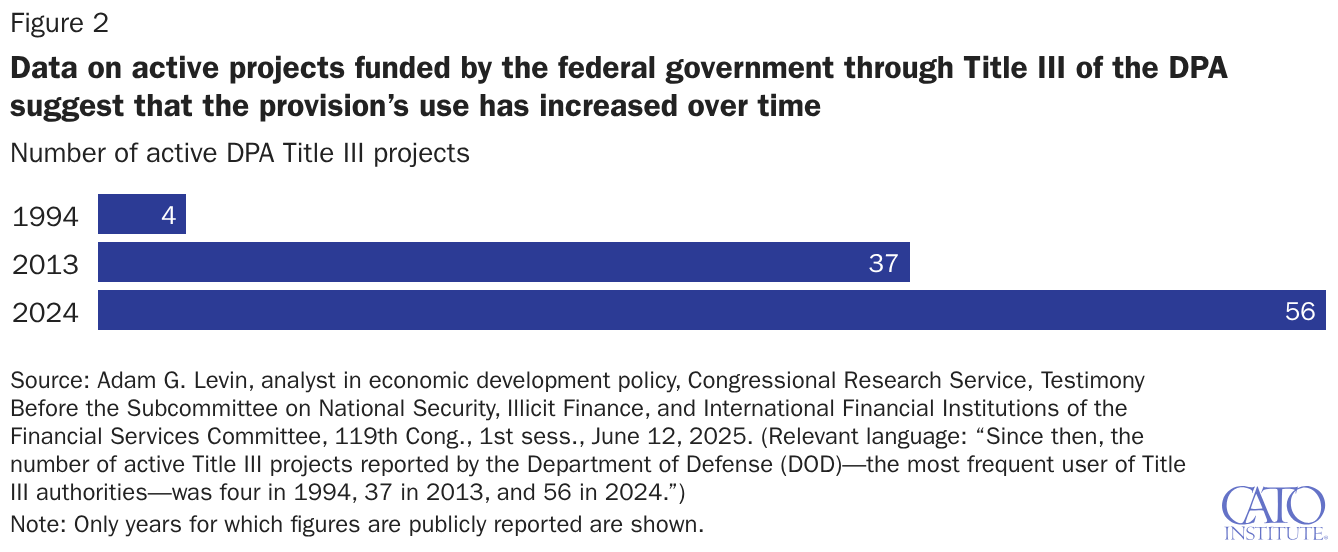
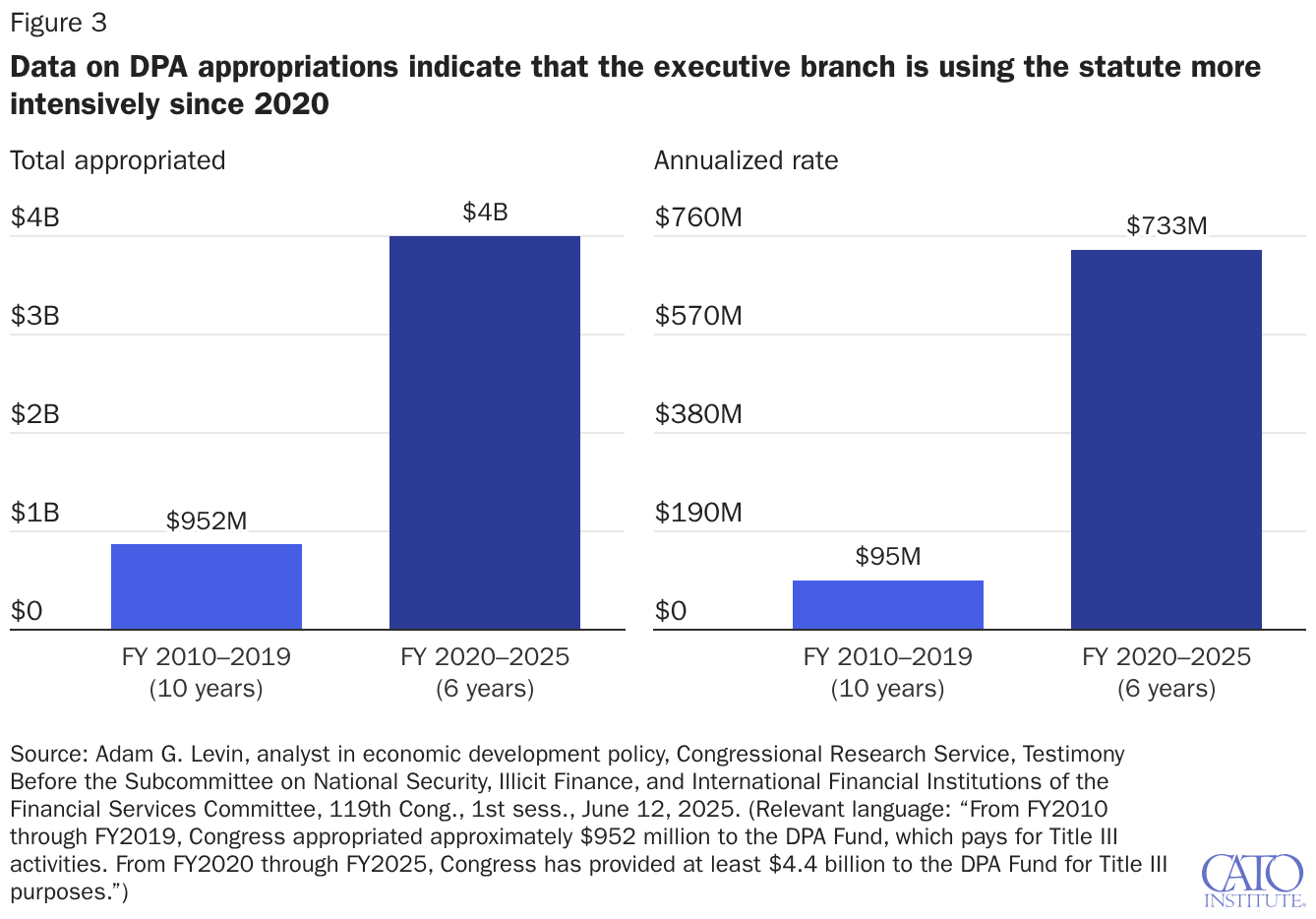
Although the DPA had been gaining strength for years, the COVID-19 pandemic arguably marked a new era in the law’s application. That era can be understood in three phases: emergency health uses during the pandemic itself, industrial policy uses that followed under both administrations, and novel compelled-access uses involving digital technologies that are still unfolding.
When confronted with the deadly new virus, the first Trump administration initially favored letting market forces handle matters. “We’re a country not based on nationalizing our business,” said President Trump in March 2020. But facing a rising death toll and mounting political pressure, the administration changed its tune only weeks later. It invoked Title I of the DPA to require General Motors (GM), General Electric (GE), Philips, and others to prioritize government contracts for ventilators and subsequently used Title III to expand production capacity for respirators and ventilator filters.
Title I’s prioritization authority meant that federal contracts jumped to the head of the line at the expense of others, including states scrambling for their own supplies. “It’s like being on eBay with 50 other states, bidding on a ventilator,” said New York Governor Andrew Cuomo in March 2020, as states found their own orders intercepted and diverted by federal authorities.
Simultaneously, the Coronavirus Aid, Relief, and Economic Security Act, or CARES Act, appropriated $1 billion to the DPA Fund and waived several key Title III oversight requirements for two years. Congress did not merely fund an expanded DPA but also temporarily dismantled the safeguards meant to constrain it.
The results were instructive. By August 2020, more than 94,000 ventilators had been delivered to the federal stockpile. But the approach to treating COVID-19 changed during the months it took companies to retool, and the vast majority sat unused in a strategic reserve (though some excess inventory was by design, given the genuine uncertainty about the pandemic’s trajectory at the time).
A subsequent ProPublica investigation alleged that the White House may have paid up to $500 million more than necessary for the ventilators it acquired. Meanwhile, the administration announced a $765 million DPA loan for camera film company Eastman Kodak to manufacture pharmaceutical ingredients, but the deal collapsed within weeks amid a Securities and Exchange Commission investigation into suspicious stock trading.
The effects of DPA-driven prioritization also extended beyond America’s borders. When the Biden administration invoked the DPA to secure vaccine inputs in early 2021, the Serum Institute of India, the world’s largest vaccine manufacturer, warned that production lines turning out more than 160 million doses a month would grind to a halt within weeks unless America supplied 37 critical items. A domestic prioritization law had, in effect, functioned as an export restriction because it left little capacity for foreign buyers to draw on.
Yet even as the pandemic receded, the Biden administration’s appetite for DPA invocation did not. Rather, it simply shifted from emergency health measures to broader industrial policy. But this was hardly breaking new ground. In April 2020, the Trump administration provided $50 million to the Austal shipyard in Mobile, Alabama—billed as part of its COVID-19 response—so that the facility could boost its steel shipbuilding capabilities (after previously specializing in aluminum construction).
A March 2022 presidential determination authorized Title III support for domestic mining and processing of materials for large-capacity batteries in the automotive and e‑mobility sectors. The Biden administration explained that the move signaled its commitment to a “robust, resilient, sustainable, and environmentally responsible domestic industrial base to meet the requirements of the clean energy economy.”
The defense rationale was strained. A 2021 report commissioned by the Department of Defense had concluded that all-electric ground combat vehicles were “not practical in the foreseeable future” through 2035. The June 2022 granting of DPA authority to the Department of Energy to accelerate clean energy manufacturing also raises eyebrows. Beyond the announcement’s strained linkage to national security, it highlighted that the move would help in “reducing energy costs for American families” and “creating more good-paying union jobs.”
That same spring, DPA authority was delegated to the Department of Health and Human Services to prioritize infant formula ingredients in response to a domestic shortage. Of the $500 million in DPA funding appropriated through the passage of the Inflation Reduction Act in August 2022, none went to core national defense needs. Instead, $250 million alone was directed toward electric heat pumps.
Another notable Biden administration invocation of the DPA occurred in October 2023, through an executive order that required leading AI developers to share safety test results with the government. This demonstrated that whether the DPA could reach AI systems was not a future hypothetical but an active policy consideration.
The second Trump administration, meanwhile, has further underscored the bipartisan nature of the executive branch’s appetite for an expansive DPA. Since taking office in 2025, the administration has issued presidential determinations authorizing Title III awards for tungsten, scandium, and gallium, and a February 2026 executive order designated elemental phosphorus a scarce defense material partly because of its role in producing glyphosate-based herbicides. In addition, Secretary of Defense Pete Hegseth has reportedly explored whether the DPA could compel AI company Anthropic, over its objections, to provide access to its AI models.
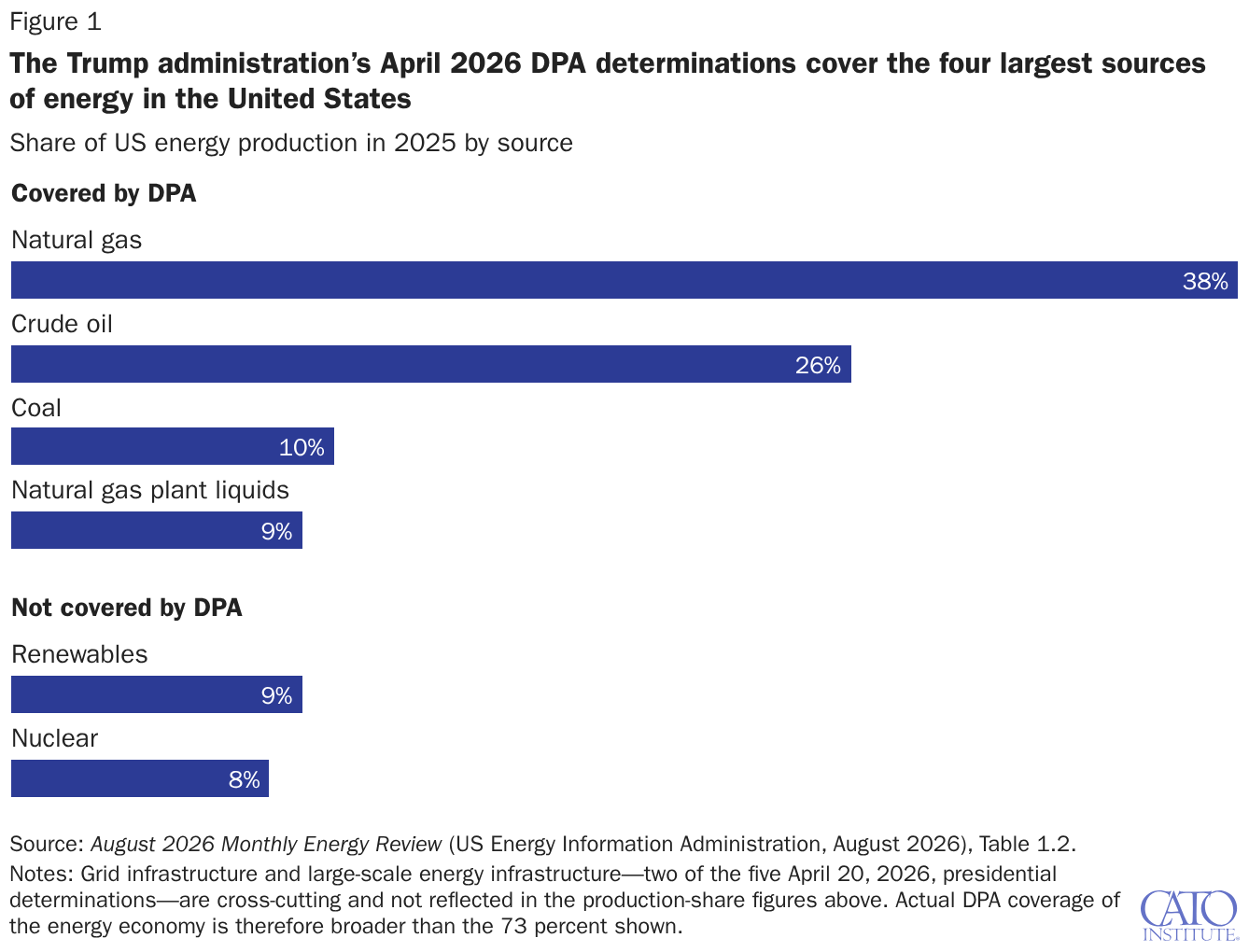
On April 20, 2026, the Trump administration issued five presidential determinations pursuant to Section 303 of the DPA, covering coal supply chains, large-scale energy infrastructure, grid equipment, domestic petroleum, and natural gas and liquefied natural gas (LNG) capacity. Taken together, Figure 1 shows that they represent an unusually sweeping deployment of DPA Title III authority, with five sectors of the domestic energy economy designated as essential to national defense. Each determination found that the relevant sector constituted an “industrial resource essential to national defense” that private industry could not address without federal action. Each also waived the statutory prerequisites for expedited deployment of loans, loan guarantees, purchase commitments, and cost-sharing arrangements.