
In the wake of the 2008 financial crisis, proponents of stricter regulation insisted that deregulation of the financial sector—especially nonbank financial firms, those in the so-called shadow banking sector—were the main drivers of the turmoil. According to the conventional narrative, these firms made excessively risky bets with derivatives, then the housing bubble burst and panic ensued. As the story goes, their activity nearly destroyed the financial system, but the federal government stepped in and prevented another Great Depression. The traditional banking sector, on the other hand, supposedly was prevented from taking such risky bets because it was so highly regulated.1 Therefore, according to this narrative, the best way to guard against future crises is to regulate the nonbanking sector more like commercial banks and to federally back their securities as if they were retail bank deposits backed by the Federal Deposit Insurance Corporation (FDIC).
This narrative is highly misleading. For starters, the 2008 financial crisis was not caused by a reduction in the scale or scope of financial regulations in the United States; rather, the number of financial regulations steadily increased after 1999, long before the 2010 Dodd-Frank Act was even contemplated.2 Moreover, federal banking regulators approved of much of the so-called shadow banking activity because it took place in partnership with—and in many cases because of guarantees provided by—the traditional banking sector. Overall, the evidence suggests that both banks and nonbank financial firms made carefully targeted risky bets owing, in part, to regulatory and legal requirements. Thus, even if Congress repealed the 2010 Dodd-Frank Act in its entirety, America would be left with an overly burdensome and paternalistic regulatory and monetary system that is filled with harmful incentives. Among other problems, the system infringes on citizens’ basic freedom and constitutional rights, increases the likelihood of taxpayer-financed bailouts, limits innovation and competition, and lowers economic opportunities for millions of people.
The US System Stifles Innovation and Competition
For decades, Congress has passed laws to address regulatory problems in US financial markets. Despite many good intentions, the US financial regulatory framework dampens innovation, protects incumbent firms from competition, and promotes taxpayer-financed bailouts. For years, the shortcomings of the regulatory framework have reduced entrepreneurs’ investment opportunities, reduced consumers’ choices, increased prices, and obscured financial risks. Moreover, as technology continues to evolve, including through generative artificial intelligence (AI), regulators must employ a technology-neutral approach so as not to undermine the potential of technology to deliver better, cheaper, and more accessible financial services to Americans.
There are many problems spread throughout different sectors of US financial markets. The following section provides a brief overview of the most important issues.
The 2010 Dodd-Frank Wall Street Reform and Consumer Protection Act
Many government officials, industry participants, and academics endorse an extensive federal role for financial regulation, one that requires regulators to promote financial stability by addressing systemic risks. This approach, embodied in the Dodd-Frank Act, requires regulators to address known threats to financial stability as well as potential threats, typically without specifying any objective definition of these terms. It mandates more regulatory control of bank risk-taking and expands such control to the nonbank financial sector.3 This approach is based on a mistaken belief that the 2007–2009 crisis stemmed from unregulated financial markets. Quite to the contrary, the government’s extremely active role in directing the financial markets—and its promises to absorb the losses of private risk-takers—brought about the financial crisis.
Money Market Mutual Funds
Just as decades of increasingly strict bank regulations have failed to produce financial stability, so too have increasingly strict money market mutual fund (MMF) rules. The increasingly prescriptive regulatory framework for MMFs has also drastically limited investors’ options, shrinking the private commercial paper market and pushing more of investors’ money into government funds. The failure of the most recent MMF rule amendments even fulfilled one of the harmful scenarios that its advocates insisted the new rules would prevent, directly reducing the funds available to finance private commercial activity as more money flowed into government-backed funds. Rather than acknowledge the failure of this top-down regulatory approach in short-term capital markets, a 2021 Securities and Exchange Commission rule doubled down, with higher liquidity requirements and mandatory liquidity fees.4
Housing Finance System
Robust mortgage financing exists in virtually every developed nation in the world without the high degree of government involvement that is found in the United States. While the perceived success of this involvement has helped create the belief that the private housing market cannot properly function without extensive federal involvement, the historical record demonstrates the opposite.
Most federal intervention in housing finance fuels demand, typically by making it easier to obtain a home mortgage, thus boosting consumer debt and home prices. Federal policies encourage borrowing by supporting the operations of Fannie Mae, Freddie Mac, and Ginnie Mae, and by providing loan insurance through the Federal Housing Administration (FHA), the Department of Veterans Affairs home-lending program, and the Department of Agriculture’s Rural Development Program. Prior to the 2008 financial crisis, the federal government controlled a dominant share of the US housing finance system, and that share has since expanded. The operations of Fannie and Freddie and the FHA account for the bulk of this federal intervention. Rather than increase homeownership, this involvement has accelerated purchases by individuals who would otherwise have obtained home loans later in the conventional market, and it has cost taxpayers billions of dollars. It has done little to measurably increase US homeownership rates.5
Massive Federal Regulatory Complex
US financial markets have too many regulations and too many regulators. Depending on the activity, at least seven federal regulators could supervise, examine, or otherwise regulate a bank, including the Federal Reserve, the FDIC, the SEC, the Commodity Futures Trading Commission, the Consumer Financial Protection Bureau, the Federal Housing Finance Agency, and various agencies within the US Treasury Department.
Capital markets participants are subject to a similar byzantine regulatory structure, including the SEC and the Commodity Futures Trading Commission, as well as “self-regulatory organizations,” including the Financial Industry Regulatory Authority, which are private not-for-profit organizations that have been delegated regulatory authority.
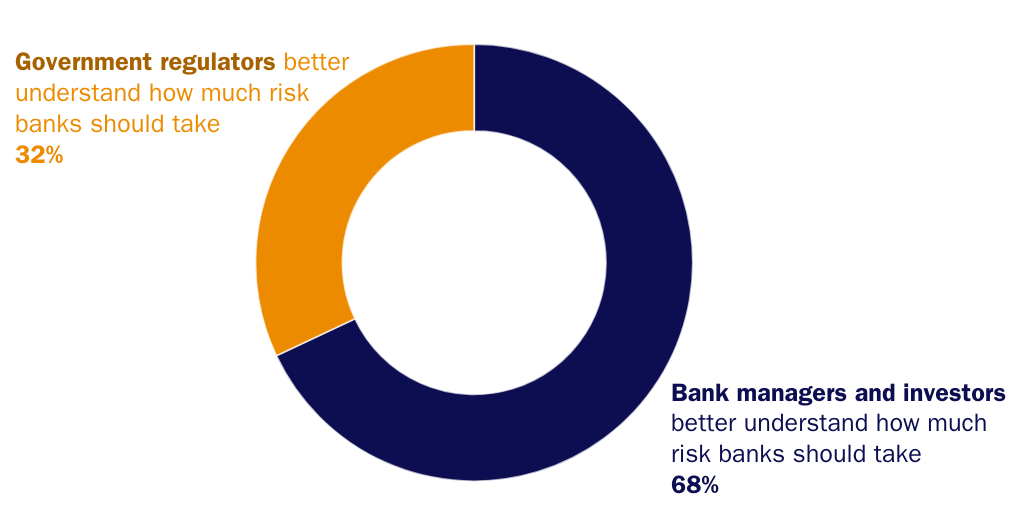
Banks are more heavily regulated than other financial firms, but virtually all financial companies are subject to extensive restrictions on their activities, capital, and asset composition. It is true that there have been many changes to these rules and regulations in the past few decades and that some of those changes allowed financial firms to engage in activities that they were previously prohibited from doing. However, there has never been a substantial reduction in the scale or scope of financial regulations in the United States. Government rules have increasingly been credited with guaranteeing financial market safety, creating a false sense of security, lowering private incentives to monitor risk, increasing institutions’ financial risk, and protecting incumbent firms from new competitors.6 Yet, as a Cato Institute survey suggests, most Americans still trust the professionals working in the financial industry more than government regulators to understand how much risk financial institutions should take. (See Figure 9.)
Federal Backing of Credit Markets
Americans are responsible for trillions of dollars in debt exposure from outstanding federal loans, loan guarantees, and subsidized insurance programs spread over more than 100 federal programs.7 The government credit portfolio consists of direct loans and loan guarantees for housing, agriculture, energy, education, transportation, infrastructure, exporting, and small business, among other enterprises. Federal insurance programs cover bank and credit union deposits, pensions, flood damage, declines in crop prices, and acts of terrorism. Capital for mortgage lending by banks is provided by the government-sponsored enterprises (GSEs), such as Fannie Mae, Freddie Mac, and the Federal Home Loan Banks. Taxpayer backing in the current framework also comes indirectly from the Federal Reserve, which has a long history of using its emergency lending and discount-window loan policies to support failing firms, as well as directly from deposit insurance provided by the FDIC. This redistribution of taxpayers’ money erodes the nation’s entrepreneurial spirit, increases financial risk, and fosters cronyism and corruption.
Financial Artificial Intelligence
Artificial intelligence and finance have been intertwined for decades, from algorithmic trading to payment fraud detection systems and beyond. But the arrival of generative AI—artificial intelligence capable of generating text, images, and other data after having learned patterns from training data—has sparked newfound regulatory interest in AI. Financial regulators, including cabinet-level departments, bank regulators, and capital markets regulators, have been active in warning of AI-related risks and promulgating rules and guidance to address them.8 Notably, the risks typically flagged by regulators—such as those related to fraud, cybersecurity threats, unlawful discrimination, and breaches of fiduciary duties—usually are already covered by existing laws and rules. Whereas some regulators have used this moment to reiterate the applicability of existing obligations, others have treated AI advances as manifesting entirely new kinds of risk requiring new (and expanded) regulations.
The conclusion that financial AI may not merely affect (positively or negatively) the degree of long-understood financial conduct risks, but rather poses inherently novel risks, is often based on fundamental misunderstandings of the nature of AI and its application to finance.9 Making policy based on these erroneous conclusions is the opposite of the technology neutrality that financial regulators should observe and undermines the vast potential of AI to deliver better, cheaper, and more accessible financial services to American consumers.
Solutions
Congress and federal agencies can implement many reforms to improve the overly burdensome and paternalistic regulatory and monetary systems, thus strengthening citizens’ basic rights, reducing the likelihood of taxpayer-
financed bailouts, expanding innovation and competition, and increasing Americans’ economic opportunities.
- Repeal Dodd-Frank. The 2010 Dodd-Frank Wall Street Reform and Consumer Protection Act is among the most inappropriately named laws ever enacted in the United States. It neither reformed Wall Street nor protects consumers, and it imposed massive new regulations on banks far from Wall Street. Congress should repeal the law.
- Fix money market mutual fund rules. A better alternative to the current MMF rules would use the 1983 regulatory framework for MMFs as a baseline. From there, the SEC should pare down the prescriptive rules to the bare minimum so that they include little more than an average maturity restriction. The rules should not provide incentives for holding specific types of short-term assets, including government securities, in MMFs. Rather than trying to improve financial markets by saddling MMFs with more operating restrictions, the SEC should allow fund managers and investors to figure out what works best for them. This approach would foster more competition in short-term credit markets and make them more resilient by decreasing the uniformity of investment options. If the SEC refuses to adjust the MMF rules, Congress should rewrite the statute.
- Shrink the Federal Housing Authority’s role. Congress should limit the FHA’s single-family insurance portfolio to first-time homebuyers, without any refinance eligibility (through the FHA) over the tenure of the loans in force. Additionally, the FHA should decrease the value of loan limits eligible for FHA single-family mortgage insurance to (at most) the first quartile of home prices.
- Wind down the government-sponsored enterprises. Congress should shut down Fannie Mae and Freddie Mac and all their subsidiaries. Any legislation to close the GSEs should avoid creating a smaller version of the companies under a new name. While the GSEs still exist, the Federal Housing Finance Agency should raise Fannie and Freddie’s mortgage guarantee fees, eliminate the geographic price differentials for the GSEs’ conforming loan limits, narrow the GSEs’ focus to the financing of primary homes, and gradually reduce conforming loan limits. Congress should also require the Federal Housing Finance Agency to enforce the excessive use provisions in the GSEs’ charters, and revoke Fannie and Freddie’s exemption from the requirements to register their securities offerings under the Securities Act of 1933. Banking regulators should adjust risk-weighted capital rules so that financial institutions cannot treat GSE debt and mortgage-backed securities as if they are US government obligations.
- Reform the regulators. Congress should eliminate duplicative federal agencies. There is no objective reason to have three federal banking regulators and two federal capital markets regulators. Congress should also improve the financial regulatory framework by taking an entirely different approach to regulating banks and capital markets. This reform program should reduce impediments to capital formation and market efficiency, reduce unwarranted regulatory costs, and eliminate policies that socialize private investors’ losses. Moreover, the main purpose of financial regulations should be to provide reasonable, scaled disclosure; enforce contracts; and deter fraud. The Fed’s primary responsibility is monetary policy, and it does not need to be a regulator. Congress should also eliminate the Fed’s ability to provide emergency lending and discount-window loans directly to firms, thus limiting the Fed to providing system-wide liquidity.
- Provide new financial firm charters. Congress should create a new federal charter for financial institutions, broadly defined, that ensures the owners will absorb their own financial risks with higher equity stakes. Congress could pair these charters with regulatory off-ramps so that scaled regulatory relief is provided for firms that agree to hold higher equity funding.
- Stop federally backing credit. Unconstrained spending, unfettered losses, and rampant cronyism are only part of the cost of the government’s vast credit-backing system. Proponents say that such backing is necessary to spur economic growth or to mitigate market imperfections, but government credit is a poor substitute for private financing where (to the contrary) great care is taken in lending decisions under the threat of loss. Well-intentioned or otherwise, there is abundant evidence that government-backed financing produces more harm than benefit for the nation as a whole and that these programs should be eliminated.
- Avoid counterproductive overreach on artificial intelligence. Policymakers should apply a pro-innovation policy framework to financial AI. This framework involves making three key assessments to avoid inappropriate regulation of the application of AI tools to financial services.10 First, determine whether AI is, in fact, introducing greater or novel risk based on validated evidence. Second, determine whether the AI-related risk is already covered by laws and rules regarding unlawful conduct before layering on novel or redundant regulatory obligations. Third, consider the lost benefits of applying a new or existing policy to AI and take an outcome-oriented approach. Notably, where existing policies relevant to an AI-related risk contain prescriptive obligations that are not suited to the operation of new AI tools, such prescriptions ought to be revised so that a comparable risk-mitigation outcome can be achieved without undermining consumers’ access to AI tools.
- Embrace decentralized policy responses to decentralized financial artificial intelligence. Where AI tools achieve sufficient degrees of autonomy (i.e., the ability to operate with limited ongoing human intervention), policy responses should look to long-standing legal principles, such as those enshrined in the common law of agency, as a guide instead of devising new and prescriptive regulations.11 Generally, where AI tools decentralize access to financial services, such as investment advice, policy responses themselves should be decentralized in nature—for example, based in common-law principles that incentivize appropriate care—as opposed to being reliant on centralized gatekeeping and licensing regimes.
Suggested Readings
Cato Institute Report to the Department of Government Efficiency (DOGE): How to Downsize and Reform the Federal Government, edited by Alex Nowrasteh and Ryan Bourne (December 11, 2024)
The GSE Experiment Has Failed—Congress Should End It by Norbert Michel, Cato Institute Briefing Paper no. 180 (October 14, 2024)
Decentralized Expertise: AI, DeFi, and the Recovery of American Trust by Jack Solowey, Digital Spirits (July 26, 2024)
AI Providers Should Not Be Liable for Users’ Securities Violations by Jack Solowey, Regulatory Review (April 8, 2024)
Financing Opportunity: How Financial Markets Have Fueled American Prosperity for More than Two Centuries by Norbert J. Michel and Jennifer J. Schulp, Cato Institute (October 2024)
Why Shadow Banking Didn’t Cause the Financial Crisis and Why Regulating Contagion Won’t Help by Norbert J. Michel, Cato Institute (2023)
Money Market Fund Reforms by Norbert Michel, Cato Institute, Public Comments (February 10, 2022)
The Case against Dodd-Frank: How the “Consumer Protection” Law Endangers Americans, edited by Norbert J. Michel, Heritage Foundation (April 26, 2016)


This work is licensed under a Creative Commons Attribution-NonCommercial-ShareAlike 4.0 International License.