
Fiscal constraints at home, China’s rise in the East, and America’s limited interests in Europe make reducing the US force presence in Europe an appealing concept for policymakers. Europe has economic and military advantages over Russia that make such action possible. As a narrow military analysis, this paper explains how a European-led NATO can deter Russia without US troops on the continent.
A European-led NATO should adopt a defensive doctrine using a “defense-in-depth” force deployment. As part of a defense-in-depth deployment, European countries within NATO should eschew deep strikes into Russian territory, instead investing in and deploying light defenses in the Baltics and deploying their mechanized and armored capabilities throughout Germany and Poland. To successfully implement a defensive doctrine exercising defense-in-depth force deployment, the Europeans must spend more on defense and reduce tensions with Russia. The United States should begin withdrawing American troops from Europe for several reasons, including to induce Europe to implement such policies.
This doctrine and force deployment would enable a European-led NATO to deter Russia while minimizing risks of escalation. They would also signal to Russia that it would be defeated on the battlefield should it attempt to conquer NATO territory. Although European forces likely would be incapable of fully protecting the Baltics, their lack of geographic depth makes them exceptionally difficult to defend regardless of force deployment and America’s involvement on the continent. Europe is wealthy and populous enough to carry out a defensive doctrine and defense-in-depth force deployment, and for it to do so would be less risky and costly than the status quo for the United States.
Introduction
After the collapse of the Soviet Union, NATO faced a choice: expand its geopolitical goals or close up shop. With Washington leading the charge, the alliance chose the former, expanding NATO eastward.1 At the same time, European powers within NATO cut their militaries, redirecting funds toward their social welfare systems. During the Cold War, NATO Europe spent about 3 percent of gross domestic product (GDP) on defense.2 That figure had dropped to 1.3 percent of GDP by 2014, the year Russia invaded Crimea.3
The United States had other options: It could have handed NATO over to its European members and refocused its resources on other priorities. Instead, to remain at the center of the alliance, the United States dug in.4 The United States carried, and continues to carry, a disproportionate share of the burden of NATO’s military power.5 From 1960 to 2024, the United States has made up an average of 68 percent of NATO’s defense spending.6 And following Russia’s invasion of Ukraine in February 2022, the US deployed about 20,000 additional troops to Europe, bringing the total to over 100,000 American troops stationed there.7
However, the United States is beginning to face trade-offs. Americans are learning that grand global ambitions in international politics carry massive monetary costs and run unnecessary risks to American lives.8 The United States can no longer afford calamities such as those in Iraq and Afghanistan and has serious crises to contend with: Washington faces a great-power competitor with the rise of China, and the United States’ national debt stands at over $36 trillion.9 An overextended nation will decline over time, and America is militarily overstretched.10 The Department of War recently cut military personnel numbers and recruiting standards for upcoming years. With fewer troops, it is more difficult to be able to deter so many adversaries at once.
The United States should not act as the cornerstone of Europe’s defense for the simple reason that the Europeans can defend themselves. At the same time, the continent continues to decline in importance for US national security, with the European Union today comprising 14 percent of the world’s GDP compared to these same countries comprising roughly one-third of the world’s GDP in 1960, and there being little prospect of a country overrunning the continent.11 This leaves the United States with a reasonable option: withdraw American troops from NATO and transfer the burden of Europe’s conventional defense to Europeans.
Some think this would spell the collapse of NATO.12 After all, America contributes the most to NATO’s military strength, with the country’s $968 billion defense spending and 1.32 million active armed forces for fiscal year 2024.13 Russia has also menaced the alliance with its invasion of Ukraine and saber-rattling toward members of NATO.14 Yet European security does not have to rely on US ground forces for two reasons. First, Europe is rich enough to provide for its own defense. In 2024, the European countries in NATO had a cumulative GDP of $23.76 trillion, compared to Russia’s $2.18 trillion.15 Second, Russia is incapable, for the moment at least, of easily conquering another European power should Europeans defend it. Fighting a war of attrition in Ukraine—and with an aging population at that—Russia’s military is a shell of what the Soviet Union’s used to be.16
Washington should continue to engage with Europe but give up its role as the continent’s primary protector. Since no country has a chance of dominating Europe, the United States should return to its historical role as an “offshore balancer.”17 That means the United States would seek to prevent any country from militarily dominating Europe. This would allow the United States to redirect funds and military power away from Europe toward regions with more pressing concerns, such as East Asia, and toward American domestic priorities.18
But this vision leads to an important question: Can European states effectively deter Russia without American conventional forces? To answer this question, this paper details what conventional deterrence would look like without American boots on the ground in Europe, arguing that a European-led NATO can and should adopt a defensive doctrine and a defense-in-depth force deployment.
The paper progresses in four parts. First, it defines the terms “deterrence” and “conventional deterrence” and examines the history of conventional deterrence in NATO. Next, it summarizes the contemporary debate about European security. Third, it shows that Europe can achieve conventional deterrence on its own with a defensive doctrine and a defense-in-depth force deployment. It concludes with policy recommendations for European and US policymakers detailing how European nations can strengthen their military power and how they should position their troops.
Conventional Deterrence in Europe
Analysts and pundits throw around the term “deterrence,” but many get its meaning wrong. Deterrence is the ability to convince an enemy that the cost of going to war is too high to justify whatever objectives the enemy seeks.19 It involves a state being constrained “not only by the amount of power that it holds in check, but also by the incentives to aggression residing behind that power.”20 The goal of deterrence is to discourage a would-be aggressor from attacking by making it believe doing so will produce a worse net outcome than the status quo.21
Though states have deterred one another throughout history, it was during the Cold War and amid the emergence of nuclear weapons that the term “deterrence” came into the popular lexicon.22 It became nearly impossible not to hear “deterrence” and “nuclear weapons” in the same sentence. Unlike nuclear deterrence, conventional deterrence focuses on the conventional military capabilities of a defender.23 A conventional deterrence strategy aims at convincing the other side that it cannot achieve a quick and decisive victory through the use of non-nuclear forces.24 If successful, conventional deterrence makes the costs of a drawn-out war—also known as a war of attrition—so high that would-be attackers do not even attempt to launch an offensive.25
To quote the first secretary general of NATO, Lord Hastings Lionel Ismay, the United States and Western Europe created NATO in 1949 with three goals in mind: “keep the Soviets out, the Americans in, and the Germans down.”26 It was reasonable enough to want American forces in Europe and Germany subdued. After all, Germany was the main antagonist of the two world wars. Moreover, the West’s fear of the Soviet Union’s Red Army was not unfounded. Four years prior, this military had defeated Nazi Germany in a ferocious military clash. After the war, NATO’s smaller conventional capabilities forced the alliance to rely on the threat of American nuclear retaliation to deter the Soviets from invading Western Europe.27
However, the Soviet Union began building up its own nuclear arsenal in the 1960s and ’70s. NATO no longer had an edge over the Soviet Union with its number of nuclear weapons.28 American policymakers began to fear that the Soviets could “deter our deterrent,” meaning nuclear parity between the two superpowers would permit the Soviets to use their superior conventional forces to conquer Europe.29 The parity of nuclear weapons between superpowers made Western policymakers look to bolster their conventional forces and rely more heavily on conventional deterrence in Europe.30
NATO’s defense strategy shifted from threats of using nuclear weapons against Soviet cities—known as punishment in deterrence parlance—to denial. NATO built up its conventional and tactical nuclear weapon capabilities to convince the Soviet Union that it would fail at conquering Western Europe.31 NATO also placed its forces along the inter-German border to meet any Soviet attack and stop it there due to the alliance’s lack of strategic depth.32 Essentially, NATO had no choice but to win the first battle if the Soviets ever invaded.
The end of the Cold War reduced the threat to Europe dramatically, as the demise of the Soviet Union meant there was no longer a threat to the alliance on its own continent. This led NATO members to cut their ground forces, transforming them into crisis response groups.33 In the early 2000s, rather than relying on mass troop formations and postures, NATO opted for “network-centric warfare” and “rapid decisive operations.”34 Both depended on new information technologies and long-range precision missiles for defense.35 Not surprisingly, Russia’s invasion of Ukraine in 2022 triggered Europe and NATO to rethink their defenses. Today, Europeans within the alliance have pledged to shift from small expeditionary forces to more massed troops along the NATO-Russian border.36 Though these are welcome signs, European NATO members must go further by following through on their pledges to increase their military capabilities and deter Russia from invading NATO territory.
A European-led NATO should pursue two primary goals, the first of which is to convince Russia of the high costs of conquering NATO territory. This is the best way to deter Russia from attacking. To prevent and prepare for a Russian attack on Europe, European nations need enough military capabilities and a suitable force deployment. European nations should band together against the Russian threat, giving a European-led NATO more than enough capabilities to defend itself against Russia.
Second, a European-led NATO can lessen the chances of Russia reaching for its nuclear weapons. Of course, NATO, through the US, French, and UK arsenals, should maintain its nuclear weapons as a deterrent to complement its conventional forces.37 With war being an unpredictable enterprise, it is conceivable that a war between NATO and Russia would escalate to the nuclear level. Nevertheless, NATO should aim to lessen the probability of this destructive scenario by constructing a conventional deterrence strategy that does the following: makes peace more desirable than a Russian attack on NATO or nuclear escalation, avoids heightening the security dilemma between NATO and Russia, and withholds NATO’s nuclear weapons as a deterrent of last resort.
The Contemporary Debate on Europe’s Security
There are two primary viewpoints on Europe’s security and the role of the United States on the continent. The first group contends that while European nations must spend more on defense, the United States must maintain troops in Europe and NATO must increase its forward presence on the continent.38 This group views Russia as an existential threat to Europe that must be contained with the help of the United States. Without US military support, in this view, Europe would be incapable of deterring Russia from attacking NATO countries. Accordingly, European nations must build up their militaries while the US continues to maintain its troops on the continent, specifically in the eastern parts of it.
The second viewpoint argues that European states can defend themselves with non-nuclear forces.39 Proponents of this second view do not see European security as a priority for the United States compared to China’s rise in East Asia and America’s domestic problems. However, much of the literature regarding this second viewpoint neglects to spell out what sort of doctrine and force deployment European nations can adopt to defend themselves without US troops in Europe.40 This paper contributes strategic and operational details about how this can be done, including the maintenance of a military force that would be stationed throughout central Europe, especially Poland, and capable of countering a potential Russian attack in either Poland or the Baltics. This paper also shows that while Russia is a threat to Europe, it is not an existential one. A European-led NATO has most of the forces and matériel needed to deter today’s Russia. In addition, the paper shows that, contrary to some claims, forward defense deployment is not desirable. Indeed, it is geographically infeasible in the Baltics, forcing a European-led NATO to come up with other means of deterring Russia.
Options for NATO’s Military Doctrine and Force Deployment
Military Doctrine
A military doctrine is the way in which a military’s forces train to fight.41 This paper examines two types of military doctrine: deterrent and defensive. Though there are many military doctrines, all generally fall within these two categories. To help determine which type of military doctrine a European-led NATO should adopt, Table 1 shows a checklist of each doctrine’s characteristics.
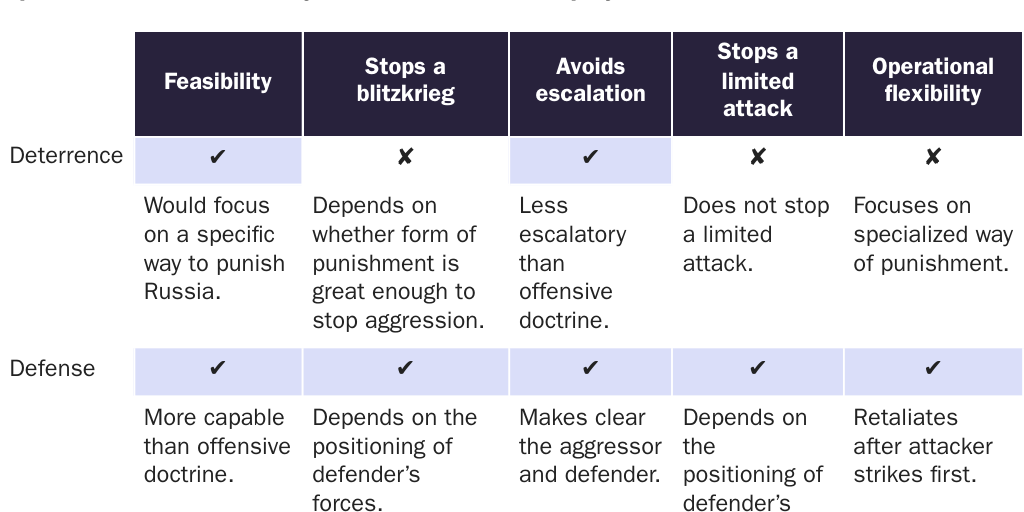
First, the doctrine must be feasible for Europe to perform. Second, a European-led NATO’s military doctrine should be able to stop a blitzkrieg—an essential component for successful conventional deterrence. Third, the doctrine should minimize the risks of escalation with Russia. Fourth, the Europeans should implement a doctrine that is likely to stop a limited attack. (This likely means raising the costs of a smash-and-grab attack in the Baltics.) Finally, a successful doctrine for conventional deterrence in NATO should possess operational flexibility. This describes the ability to move military forces in a flexible manner on the battlefield as events unfold.42 If the Europeans possess the military capabilities to adapt to Russia’s attacks and can convince Russia of this, they will have a better chance of deterring Russia.
This checklist is predicated on the mission to defend all NATO territory. Such a mission establishes a hard test for this paper’s argument. A valid critique of this mission is that an invasion of the Baltics does not threaten countries in southern Europe such as Italy or Spain. However, this paper is agnostic on what political goals a European-led NATO should set. Rather, it deals with NATO’s current goals and attempts to establish European nations’ means of achieving them. Regardless, even without American troops in Europe, European nations can and should continue to follow a defensive rather than deterrent doctrine, as argued below.
Deterrent Doctrine
A deterrent doctrine is the first option for a European-led NATO to consider. Under this doctrine, a country threatens to punish an enemy to prevent it from attacking.43 While a deterrent doctrine has its advantages—it decreases the chances of preemptive strikes between rivals and can be carried out with limited military capabilities—this doctrine would bring several serious disadvantages to a European-led NATO.44
As outlined in its 2022 “Strategic Concept,” NATO supposedly follows a defensive doctrine.45 In actuality, NATO adheres to a deterrent doctrine. The alliance stations four multinational battle groups throughout Estonia, Latvia, Lithuania, and Poland, a deployed force number far below the amount required to stop Russia from taking this territory.46 European nations may be tempted to adopt a deterrent doctrine as a way to achieve defense on the cheap, and some analysts see deterrence by punishment as Europe’s primary form of conventional deterrence.47 However, a deterrent doctrine would not stop a blitzkrieg. With its focus on punishing the enemy, if a deterrent doctrine fails, it has too few resources to stop the aggressor from advancing and leaves the defender open to retaliation.48 Under a deterrent doctrine, NATO forces would be unable to credibly threaten this sort of retaliation against Russia. The country possesses high-quality anti-missile and air defense systems that would destroy many of the missiles NATO would fire at it.49 And because a deterrent doctrine focuses on punishment, not denial, a European-led NATO adopting a deterrent doctrine would also be incapable of stopping a Russian limited attack. Finally, military forces operating under a deterrent doctrine are not very adaptable to circumstances on the ground. This doctrine punishes an adversary; it does not deny the adversary on the battlefield. Punishment gives the potential attacker a choice of how much more coercion and escalation it is willing to accept.50
A deterrent doctrine is feasible, and it (somewhat) avoids escalation. Yet it cannot stop a blitzkrieg or limited attack and is operationally inflexible, as shown in Table 1.
Defensive Doctrine
A European-led NATO’s other option is a defensive doctrine. The alliance has stated that it seeks to deny an adversary the ability to achieve its goals.51 However, in reality, NATO employs a deterrent doctrine, as it has not deployed the necessary amount of forces in central and eastern Europe to deny a potential Russian attack. Europe should implement a defensive military doctrine because it meets all five criteria: It is feasible, it can stop a blitzkrieg, it avoids escalation, it halts a limited-aims attack, and it is operationally flexible.
Unlike deterrent doctrine, a defensive doctrine seeks to deny an adversary from achieving its military objectives.52 Under a defensive doctrine, should Moscow ever launch an attack, NATO would look to defeat Russia on the battlefield through a war of attrition. Matériel and total troop numbers are important for attrition warfare, and Europe trumps Russia in both regards. A European-led NATO also has a decisive advantage over Russia in population size and GDP (Figure 1).53 These population sizes, matériel amounts, and troop numbers make it feasible for a European-led NATO to carry out a defensive military doctrine. Moreover, this doctrine clearly distinguishes the defender from the aggressor, limiting the incentives for either side to escalate.54 A defensive doctrine meets all the criteria for a successful military doctrine for a European-led NATO, as shown in Table 1.
Sources: “Chapter Three: Europe,” “Chapter Four: Russia and Eurasia,” and “International Comparisons of Defence Expenditure and Military Personnel,” in International Institute for Strategic Studies, The Military Balance 2025 (Routledge, 2025), 70–151, 180–190, 520–21; “Military Expenditure by Country, in Millions of US$ at Current Prices and Exchange Rates, 1948–2024,” in SIPRI Military Expenditure Database, Stockholm International Peace Research Institute.
Source: “Chapter Three: Europe,” and “Chapter Four: Russia and Eurasia,” in International Institute for Strategic Studies, The Military Balance 2025 (Routledge, 2025), pp. 71–146, 180.
Note: Canada and the US are excluded from the non-US NATO count.
2. Light infantry brigades
Source: “Chapter Three: Europe,” and “Chapter Four: Russia and Eurasia,” in International Institute for Strategic Studies, The Military Balance 2025 (Routledge, 2025), pp. 70–147, 182.
Notes: Mountain units were counted as light infantry and regiments were counted as battalions. Using The Military Balance unit count: Companies (100 troops) counted as 0.0333 brigades; battalions (500 troops) counted as 0.16667 brigades; divisions (15,000 troops) counted as 5 brigades; and corps (50,000 troops) counted as 16.6667 brigades.
3. Population
Source: “Chapter Three: Europe,” and “Chapter Four: Russia and Eurasia,” in International Institute for Strategic Studies, The Military Balance 2025 (Routledge, 2025), pp. 70–146, 180.
Note: Canada and the US are excluded from the non-US NATO count.
4. Other armored vehicles
Source: “Chapter Three: Europe,” and “Chapter Four: Russia and Eurasia,” in International Institute for Strategic Studies, The Military Balance 2025 (Routledge, 2025), pp. 73–151, 182–89.
Notes: Armored vehicles from countries’ naval forces included in count; gendarmerie and paramilitary equipment not included in count; armored vehicles used for medical or engineering purposes not included in count.
5. Airlift amount
Source: “Chapter Three: Europe,” and “Chapter Four: Russia and Eurasia,” in International Institute for Strategic Studies, The Military Balance 2025 (Routledge, 2025), pp. 70–150, 187–89.
Note: Includes multirole, transport, and tanker aircraft.
6. Defense expenditure
Source: “Military Expenditure by Country, in Millions of US$ at Current Prices and Exchange Rates, 1948–2024,” in SIPRI Military Expenditure Database, Stockholm International Peace Research Institute.
Note: Canada and the US are excluded from the non-US NATO count.
7. Anti-tank weapons
Source: “Chapter Three: Europe,” and “Chapter Four: Russia and Eurasia,” in International Institute for Strategic Studies, The Military Balance 2025 (Routledge, 2025), pp. 73–151, 182–89.
Notes: Anti-tank capabilities in naval forces included in count; anti-tank weapons listed as “in store” not included in count.
8. Artillery weapons
Source: “Chapter Three: Europe,” and “Chapter Four: Russia and Eurasia,” in International Institute for Strategic Studies, The Military Balance 2025 (Routledge, 2025), pp. 70–149, 182–89.
Notes: Includes mortars; gendarmerie and paramilitary equipment not included in count.
9. Main battle tanks
Source: “Chapter Three: Europe,” and “Chapter Four: Russia and Eurasia,” in International Institute for Strategic Studies, The Military Balance 2025 (Routledge, 2025), pp. 75–148, 182–89.
Note: Gendarmerie and paramilitary equipment not included in count.
10. Air defense launcher
Source: “Chapter Three: Europe,” and “Chapter Four: Russia and Eurasia,” in International Institute for Strategic Studies, The Military Balance 2025 (Routledge, 2025), pp. 76–149, 183–90.
11. Active ground forces
Source: “International Comparisons of Defence Expenditure and Military Personnel,” in International Institute for Strategic Studies, The Military Balance 2025 (Routledge, 2025), pp. 520–21.
12. Airstrike amount
Source: “Chapter Three: Europe,” and “Chapter Four: Russia and Eurasia,” in International Institute for Strategic Studies, The Military Balance 2025 (Routledge, 2025), pp. 73–150, 187–89.
13. Armored/mechanized brigades
Source: “Chapter Three: Europe,” and “Chapter Four: Russia and Eurasia,” in International Institute for Strategic Studies, The Military Balance 2025 (Routledge, 2025), pp. 73–147, 181–82.
Notes: Mountain units were counted as light infantry and regiments were counted as battalions. Using The Military Balance unit count: Companies (100 troops) counted as 0.0333 brigades; battalions (500 troops) counted as 0.16667 brigades; divisions (15,000 troops) counted as 5 brigades; and corps (50,000 troops) counted as 16.6667 brigades.
14. Reservists
Source: “International Comparisons of Defence Expenditure and Military Personnel,” in International Institute for Strategic Studies, The Military Balance 2025 (Routledge, 2025), pp. 520–21.
Note: These are reservists across all military branches.
Conventional Force-Deployment Options for a European-Led NATO
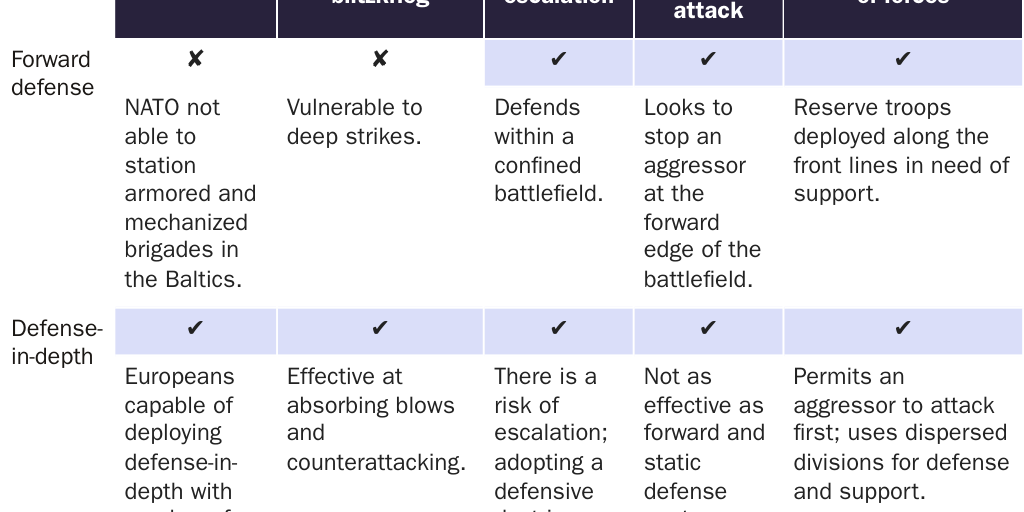
While NATO attempts to carry out a forward defense deployment by deploying troops and four multinational battle groups throughout Estonia, Latvia, Lithuania, and Poland, these forces are not nearly enough to resource a forward defense deployment.57 NATO—with or without US soldiers—could never hope to fit enough troops in the Baltics for an effective forward defense deployment (details of which are discussed below). Instead, defense-in-depth is the best force-deployment option for a European-led NATO’s conventional forces to implement.
Forward Defense
A forward defense force deployment places defending troops toward the forward edge of the battle area. The goal of a forward defense force deployment is to stop an attack at the front lines. Under this force deployment, defenders are trained to move quickly from one point to another along a defensive line.58 Multiple military analysts today recommend that NATO adopt a forward defense force deployment to defend the Baltics from a Russian invasion.59
This is a bad idea for three reasons. First, this force deployment risks placing European-led NATO forces in a configuration that would permit Russian forces to pin them down. Russian forces could simply cut off the Baltics from the rest of Europe, thereby cutting off NATO’s heavy armored vehicles and aircraft stationed there in a forward defense deployment. Second, a European-led NATO simply would be unable to station sufficient numbers of armored and mechanized brigades in a forward position in the Baltics. Third, as a forward defense force deployment works best against “shallow” offensive penetrations, it would leave a European-led NATO vulnerable to a Russian blitzkrieg.60 Blitzkriegs strike deep behind enemy lines, seeking to pick a point along a defensive line and blast through a defense’s thin line.61 If successful in penetrating a defense’s forward line, the attacking forces can pin down forward-positioned troops and continue pushing deep into a defender’s territory with minimal resistance.62
The United States employed a forward defense force deployment during the Cold War, when the NATO-Soviet border stretched a total of 1,670 kilometers.63 NATO built up forces in central Europe along an 800-kilometer front.64 At the time, NATO had little choice but to adopt a forward defense force deployment: Cold War–era NATO had about a 500-kilometer distance between the inter-German border and the English Channel.65 This lack of strategic depth forced NATO to posture its forces to defeat Russia at a potential first battle in West Germany.66
In contrast to the Cold War–era NATO, today’s NATO is incapable of adopting a forward defense force deployment—for the simple reason that its geography is much different today. NATO’s total border with Russia and Belarus stretches roughly 3,400 kilometers.67 The Baltics share a combined 1,635-kilometer border with Russia and Belarus.68 However, the Baltics have no strategic depth: Vilnius, the capital of Lithuania, is only 30 kilometers from Lithuania’s border with Belarus.69 (For the sake of comparison, that’s slightly less than the distance between Dulles Airport and the National Cathedral.)
Most defense analysts use a ratio of 1 brigade being capable of holding a maximum ground of 15 kilometers.70 If it were to adopt a forward defense force deployment in the Baltics, a European-led NATO would need to station a minimum of 26 brigades in Latvia, 20 brigades in Estonia, and 64 brigades in Lithuania—about 56 percent of NATO Europe’s total light and armored units.71 In addition, the Baltic states lack the infrastructure to house and train the number of brigades a forward defense calls for, making it especially difficult to deploy armored and mechanized brigades there.72 These brigades would need barracks, large areas for training maneuvers, and space to store tanks and other vehicles. Moreover, the low force-to-space ratio within the Baltics means that an attacking force is likely to use maneuver warfare to outflank and surround the defending forces.73 Currently, around 105,678 active-duty and reserve troops are stationed in the Baltic states, the equivalent of 35 brigades (Figure 1 compares the numbers of total reservists in non-US NATO and Russia).74 This number is far short of the amount required to implement an effective forward defense in the region.
And consider Poland, which shares a total of 631 kilometers with Russia’s Kaliningrad and Belarus.75 Over the centuries, the vast North European Plain has left Poland extremely vulnerable to blitzkrieg-type warfare.76 Tanks and armored vehicles can maneuver rapidly against a defending military on steppe terrain. With this favorable geography for blitzkrieg, a European-led NATO must also deploy its forces in Poland to deny such an attack. A forward defense force deployment focused on the Baltics would be unable to stop a blitzkrieg attack into Poland, leaving the defending forces susceptible to being penetrated and pinned down.77 Even in the unlikely scenario where a European-led NATO somehow mustered enough units to deploy a forward defense in the Baltics and Poland, NATO units would still be left vulnerable to a Russian blitzkrieg.
Defense-in-Depth
Defense-in-depth is the best of the possible force deployments for a European-led NATO. It can stop a blitzkrieg, preventing an attacker’s forces from breaking through its defending lines. Moreover, a European-led NATO can implement this force deployment with the current forces it possesses. Think of defense-in-depth as a checkerboard, with each square representing the positions of troop units along and behind the defensive front.78 These spaced-out formations degrade the attacking force’s power as it advances.79 If an attacker’s forces broke through a defender’s front lines, the attacker would still have to deal with further lines of defense.80 An attacking military that launches an offensive against a defender using defense-in-depth will lose strength each time it encounters another defending division or army.81 These troops held in reserve behind the front lines would be used to support and counterstrike against an enemy’s attacking troops.82
A defense-in-depth force deployment does require more soldiers compared to the other force-deployment options.83 However, a European-led NATO’s current active-duty ground forces stand at roughly 1.06 million, permitting a European-led NATO enough personnel to layer its units throughout eastern and central Europe (Figure 1).84 A defense-in-depth force deployment prevents an attacking force from having time to fortify its captured territory with defenses. Its goal would be to convince Russia that it could not win quickly and may not prevail over the long term.
A weakness of a defense-in-depth force deployment is its inability to stop a limited-aims attack as effectively as forward defense.85 Unlike forward defense, defense-in-depth does not position the full strength of troops at the front lines to halt an attack at the first line of defense. This is a potential issue for the Baltic states, as their location and geography make them vulnerable to a limited-aims attack.
Given this, another potential downside of a defense-in-depth force deployment for a European-led NATO is that the alliance’s eastern members will resist it.86 For instance, Estonia’s former prime minister, Kaja Kallas, who wants NATO forces forward-deployed in the Baltics, acknowledged in 2022 that under existing NATO doctrine in the case of a Russian attack, her country would “be wiped off the map, including our people, our nation.”87 Under a defense-in-depth force deployment, the eastern members of NATO would be unsure whether their western European allies would—or even could—defend them completely against a Russian invasion.88 However, this problem is more of a general issue with disparate alliances and the fear of states being abandoned by their stronger allies.89 This illustrates just how difficult it is to defend the Baltics, with or without the United States.
NATO currently maintains eight multinational battle groups.90 These groups give each member of the alliance vested interests in defending one another. Within these multinational battle groups, each country has its own soldiers involved in the defense of its members. A European-led NATO could use this multinational approach, stationing portions of each country’s units throughout eastern and central Europe to mitigate this fear of ally abandonment. A defense-in-depth force deployment for a European-led NATO would also station multinational light defenses in the Baltics. (The Policy Recommendations section below details what these would look like.)
A final critique of defense-in-depth is its risk of escalation between NATO and Russia. If the defending forces were to strike back against an attacker’s forces, they would need offensive capabilities.91 Such capabilities include the use of tanks to maneuver and destroy enemy forces. The opposing side could mistake training for defensive maneuvers as preparation for offensive moves.92 Under the impression that its adversary is preparing for an attack, the opposing side could be tempted to launch preemptive attacks. A European-led NATO should adopt a defensive doctrine in tandem with a defense-in-depth force deployment to help mitigate this problem. Applying a defensive doctrine would place limits on how deep a defender’s counterstrikes would be against an attacker’s forces. Indeed, militaries often use another side’s military doctrine to understand the behaviors and intentions of their opponents.93
A defense-in-depth force deployment’s greatest advantage is stopping a blitzkrieg—the most important factor in determining the success or failure of a conventional deterrence posture. Overall, a defense-in-depth force deployment best satisfies a European-led NATO’s two main objectives: deterring Russia from conquering NATO territory and avoiding the escalation of any potential conflict to the nuclear level.
Policy Recommendations
American and European policymakers should do five things to create a successful conventional deterrent in a European-led NATO. First, European nations within NATO should increase their defense spending, with a focus on anti-tank weapons, artillery, air defenses, and munitions. Second, the United States should begin withdrawing American troops from Europe to create a sense of urgency for European powers to implement this conventional deterrent against Russia. Third, a European-led NATO should strengthen the operational readiness of its troops to prepare for any possibility of a Russian attack on NATO. Fourth, to create a defense-in-depth force deployment, European powers should position more light infantry, artillery, anti-tank weapons and traps, and air defense capabilities in the Baltics. Fifth, these nations should deploy more tanks, armored infantry vehicles, armored brigades, aircraft, surface-to-surface missiles, and air-launched missiles throughout eastern Germany and Poland.
Recommendation #1: Increase European Defense Spending
US policymakers should encourage Europeans to spend more on their own defense. They should focus on building up and investing in four capabilities: anti-tank weapons, artillery, air defenses, and munitions.
In terms of US dollars, European NATO countries also spent approximately three times more on defense than Russia in 2024 (Figure 1). Despite this spending, Europe does not contribute its fair share toward defense in the alliance, with US defense spending making up 67.37 percent of NATO’s total defense spending in 2024.94 The European Union (EU) committed to a European Defense Industrial Strategy to invest more in its military-industrial capabilities, with the goal being to have EU members procure a minimum of 40 percent of defense equipment collaboratively and that 50 percent of each EU member state’s procurement budget should go toward defense equipment from within the EU by the year 2030.95 This year, the EU released a defense plan, ReArm Europe, which is set to accumulate €800 billion for defense spending over four years.96 These funds are to come from €150 billion in loans and from an activation of the national escape clause to permit EU member states to take on more debt, creating around €650 billion in fiscal space.97 The EU also invested €500 million toward ammunition production and plans to invest a total of €1.5 billion into Europe’s defense-industrial base between 2025 and 2027 through the European Defense Industry Programme.98 The EU also has a goal to produce 2 million 155-millimeter and 152-millimeter shells per year by 2026. (As a point of reference, Ukraine fires around 2,000 artillery shells per day in its war with Russia.)99 While these are steps in the right direction for Europe’s self-reliance, these investment and production goals remain far too small to produce a comfortable cushion for European defense.
Recommendation #2: Begin Withdrawing American Ground Forces
US policymakers should begin a withdrawal of American ground forces from Europe. As this paper has demonstrated, these conventional forces from the US are not necessary for Europe to deter Russia. Withdrawing American troops from Europe serves two purposes.
First, the United States would cut its defense budget. By withdrawing its conventional forces, the US would save at least $70 to $80 billion per year, permitting policymakers to redirect America’s resources and attention elsewhere.100 Second, this withdrawal of US ground forces would speed up the burden-shifting process. Without these troops, European nations would take their own defense commitments more seriously, being forced to rely on themselves for their own defense. In other words, the withdrawal of US ground forces from Europe removes the US security safety net.101
Recommendation #3: Focus on Troop Mobilization
Europeans need to improve their ability to mobilize their troops quickly should war break out with Russia. To accomplish this, Europeans should better train their personnel; improve their infrastructure for transport; obtain greater command, control, communications, computers, intelligence, surveillance, and reconnaissance (C4ISR) capabilities; and tear down legal and procedural constraints.
The Europeans should focus on training armored units for the two possible Russian attack scenarios mentioned below. European forces need to be able to deploy their reserve forces quickly to counterattack. In 2022, NATO countries agreed to a new force-deployment structure.102 Under this force model, European members of NATO would deploy troops in three tiers, with the first tier seeing 100,000 troops ready within 10 days; the second tier, 200,000 troops ready within 10 to 30 days; and the third, 500,000 troops ready within 30 to 180 days.103 This means that around 300,000 troops—the equivalent of 60 to 100 brigades depending if one counts a brigade as comprising 3,000 or 5,000 troops—are to be on high readiness. While exact details of NATO members’ progress toward this new force-deployment model structure remain classified, there are indications of progress.104 A European-led NATO should continue training its troops under this deployment model, with European militaries focusing on preparing their soldiers to deploy within tiered time frames. Within this force-deployment model, tier 1 forces should consist primarily of light infantry units, while tiers 2 and 3 should consist of armored and mechanized brigades.
Of course, it takes time to create top-notch soldiers.105 This only confirms the necessity for a transition from a US-led to European-led NATO to begin sooner rather than later. A committed withdrawal of US troops and a set timeline would signal to the Europeans a sense of urgency to improve their troops’ operational readiness without relying on the United States.
European members of NATO must also improve their infrastructure for transporting troops and supplies to the eastern regions of the alliance. Railroad and airlift capabilities would be the two primary modes of transporting troops and supplies to the front. Though European members of NATO have large amounts of lift capabilities, they lack the necessary railroads to be able to transport large equipment such as main battle tanks to the front lines.106 Thankfully, European nations seem to be moving to ameliorate this problem. For instance, Germany’s Bundestag recently approved a €500 billion fund for improving Germany’s infrastructure.107 European states in NATO also pledged to invest 1.5 percent of each of their GDPs on defense-related infrastructure and industry by 2035.108
European nations should increase their C4ISR capabilities. Currently, the United States provides the majority of Europe’s C4ISR capabilities, with NATO’s 2011 mission in Libya showing the alliance’s dependence upon the US.109 A European-led NATO should aim to transition from this dependence. Such improvements to a European-led NATO’s C4ISR capabilities, however, are easier said than done.110 As to command and control, this would involve making the Supreme Allied Commander Europe (SACEUR) a European (the position has traditionally been held by an American), sharing data more openly with one another’s militaries, and potentially creating Command, Control, Communications, and Computers coalitions across Europe for easier coordination.111
In regard to Europe’s ISR capabilities, Russia possesses over 100 in-orbit military satellites.112 However, European members of NATO have triple the amount of intelligence/early warning/C2 aircraft and unmanned aerial vehicles (UAVs) compared to Russia—which has approximately 133, compared to European-led NATO’s 483.113 In the short term, European nations should aim to acquire and produce more reconnaissance drones and UAVs, ISR capabilities that are relatively cheap compared to traditional aircraft and satellites. The war in Ukraine has demonstrated drones’ important role on the modern battlefield in targeting enemy units, especially those en masse.114 Still, improvements in Europe’s ISR capabilities will take decades to implement, meaning Europe will continue relying on the United States for ISR for some time.115
Finally, European members of NATO should cut legal obstacles that stand in the way of efficiently carrying out operations.116 The main legal obstacle European militaries face is their ability to move troops across borders, with each country having its own procedures for processing the paperwork required to authorize this cross-border movement—leading to delays.117 Mitigating this obstacle would permit troops from across the alliance to deploy quickly in a defense-in-depth force deployment.
A potential obstacle to pursuing this operational readiness is the varying threat perceptions across Europe regarding Russia.118 For instance, Poland is much more concerned about a revisionist Russia along its border than is Spain, with its safe perch on the Iberian Peninsula. Despite differences in threat perceptions among European powers, these countries would be capable of deterring Russia for two reasons. First, to repeat, Russia simply does not have the numbers to become a European hegemon (Figure 1). This means that even if all European members of NATO were incapable of unifying to enhance NATO’s operational readiness, there is still a high chance that Russia would be deterred for fear of failing to secure its goals through a weak military. Second, the United States’ withdrawing its forces from Europe would put pressure on European states to be more concerned about their own security.119 Russia’s invasion of Ukraine in 2022 has already increased Europe’s desire to deter Russia from attacking NATO territory. While a country with a lesser threat perception of Russia, like Spain, might contribute less to NATO’s conventional forces than a country like Poland, a withdrawal of US ground forces would compel every European member of NATO to invest more in the alliance and cut legal obstacles that block operational effectiveness.
Recommendation #4: Force Deployment in the Baltics
One of the two likely sites of a Russian attack is the Baltics. The region’s lack of strategic depth and position between Russia and the Baltic Sea make the region vulnerable to a smash-and-grab attack.
Deploying light infantry troops, artillery, anti-tank weapons and traps, and air defense capabilities would help deter Russia from conducting a limited-aims attack in the Baltics (Figure 1 has a comparison of these capabilities between non-US NATO and Russia). If Russia succeeded at a limited-aims attack, it would make retaking these territories much more difficult, as Russian forces would shift from offense to defense.120 Though these light defenses cannot solve the Baltics’ geographical vulnerabilities, they would keep Russia on an offensive footing to prevent it from digging in and transitioning to defense against a NATO counterattack. These light defenses would also ease the logistical demands on the defenders, as such defenses would not be nearly as logistically demanding as armored and mechanized brigades.121 The eastern portions of the alliance, namely the Baltics, lack the military storage and distribution capabilities to support large military equipment for an extended period of time.122 Without tanks and armored vehicles, this type of infantry is defensive in nature, as it is difficult to deploy in offense.123 Light infantry is also capable of urban warfare and is better at covering and concealing from enemy attacks.124 In defending against Russia, Ukraine provides a perfect example of the damage light infantry can do to an opponent’s attacking forces, with Ukraine’s light infantry inflicting significant damage on Russia’s initial attacking forces within Ukrainian cities.125
Urban warfighting—a likely scenario in a Russian invasion of the Baltics—gives the defender greater advantage, with more places to hide, set traps, and restrict the maneuverability of attacking forces.126 For Russia to succeed in conquering the Baltics amid urban warfare, it likely would need a force-to-force ratio of at least 6:1—a higher ratio to accommodate for the increased advantages urban terrain brings to the defender.127 About 105,678 active-duty and reserve troops are stationed throughout the Baltic states, the equivalent of 21 to 35 brigades.128 Russia has an estimated 144 armored and mechanized brigades and 13 light infantry brigades, bringing its total to around 157 brigades.129
In an attempt to take the Baltics, Russia would likely attack through the Suwałki Gap—an area between Poland, the Russian exclave of Kaliningrad, and Lithuania.130 This roughly 100-kilometer-long strip of land geographically connects the Baltics and Russia to the rest of NATO.131 By attacking and taking the Suwałki Gap, Russia would cut off the Baltics from the rest of NATO’s reinforcements.132 In this scenario, Russian military forces would likely attack simultaneously from Belarus and Kaliningrad to take the Suwałki Gap and cut off the Baltic states from NATO reinforcements (Figure 2).133
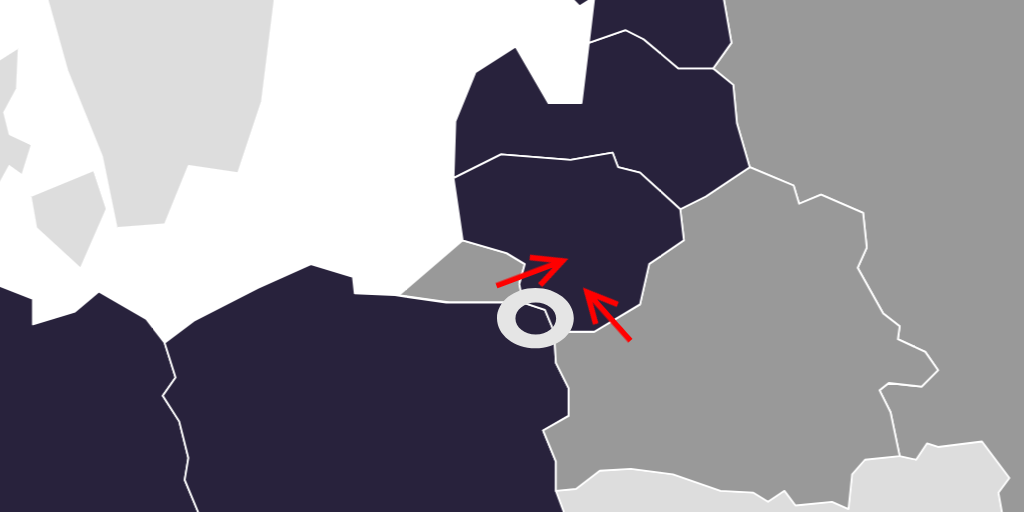
Russia could deploy around 34 brigades from Belarus and Kaliningrad in a first-wave attack to surround and take the Suwałki Gap.134 To prevent Russia from taking the Suwałki Gap, a European-led NATO should station at least 7 light infantry brigades in the Baltics, primarily in Lithuania. This number of brigades would deny Russia from having an over 6:1 force-to-force ratio in urban warfighting.
To further slow the Russian advance into the Baltics, a European-led NATO should station artillery in the region. This artillery could be used to attack oncoming Russian forces not yet in the Baltics. As mentioned, if Russia were to take the Suwałki Gap, it would be capable of deploying a combined 34 brigades from Belarus and Kaliningrad per wave of attack.135 Like the force-to-space ratios of a possible Soviet attack during the Cold War, the Russians would face a “crossing the T” scenario in this part of the Baltics.136 This means many of Russia’s other brigades would be stacked behind the 34 initial attacking brigades.137 These stacked units would be targets for NATO artillery, reducing the punch of Russia’s attack. European NATO members maintain a quantitative advantage in artillery over Russia and possess a wide array of artillery capabilities (Figure 1).
Anti-tank weapons would also be needed in the Baltics. These include man-portable anti-tank systems (e.g., Javelins), self-propelled anti-tank systems, recoilless launchers, and anti-tank guns.138 A European-led NATO should deploy most of its man-portable systems and recoilless anti-tank launchers to the Baltics. Light infantry can use these systems in urban environments while remaining concealed from counterfire.
Additionally, a European-led NATO should continue to set up anti-tank traps along the Baltics’ borders with Russia and Belarus.139 Anti-tank traps would slow down a Russian attack on the region, giving defending forces more time to mobilize their light infantry and prepare their cities for Russian attacks. Such traps would include trenches, dragon teeth, hedgehogs, and anti-tank ditches and trenches.140 Russia used similar traps to slow down and halt Ukraine’s counteroffensive in 2023.141
Finally, a European-led NATO should send air defense systems to the Baltics to bolster its light defense capabilities. The purpose of these air defenses would be to deny Russia air superiority over the Baltics. Europeans should deploy point-range and short-range surface-to-air missile systems throughout the Baltic region. Stingers are an example of short-range surface-to-air missile systems.142 Light infantry troops can carry weapons such as Stingers and use them with little training (Figure 1 has a comparison of air defense capabilities).143
It is important to concede that deploying these light defenses to the Baltics would only slow down a potential Russian advance into the region. Put bluntly, it would not prevent the probable destruction of the Baltic states. Due to their size and geographic position, however, this is the best of the bad strategies available for them. With or without American troops deployed in Europe, geography makes perfect defense of the Baltics impossible.
Recommendation #5: Force Deployment in Poland and Germany
The Europeans should station tanks, armored infantry vehicles, armored and mechanized brigades, aircraft, and medium- and long-range air defenses throughout Germany and Poland—behind the notional NATO-Russia front line. These capabilities would serve two purposes. First, they would act as operational reserves for the Baltics and strike Russian attacking forces in and around the region. Second, they would prevent Russian forces from conducting a blitzkrieg into Poland.
As mentioned previously, Poland’s flat topography makes the country vulnerable to a blitzkrieg attack.144 Germany and the rest of western Europe possess the majority of NATO’s industrial capabilities and manpower.145 If NATO must win a war of attrition, it needs to prevent Russia from destroying the alliance’s military-industrial capabilities. Stopping a Russian blitzkrieg through Poland is a European-led NATO’s best way of preventing such a scenario.
By stationing these forces throughout Poland and Germany, a European-led NATO would prevent their valuable equipment from being trapped and destroyed in the Baltics should Russia attack there first. Protecting these capabilities in the first wave of a Russian attack on the Baltics would allow them to be used in second and possibly third waves of counterstrikes against Russian forces there. Currently, a European-led NATO possesses more main battle tanks and armored vehicles than Russia (Figure 1).
The light defenses within the Baltics would deplete the number of Russian armored and mechanized brigades. A European-led NATO’s armored and mechanized brigades could then move through the Suwałki Gap to reinforce and strike back against these depleted Russian forces. A European-led NATO should avoid moving its mechanized and armored brigades through either Belarus or Kaliningrad, as ground troops entering Russian or Russian-allied territory would increase the chances of escalation. For the Baltic region, a European-led NATO could use its airlift capabilities to transport equipment and troops and its airstrike capabilities to destroy advancing Russian attacking forces. (Figure 1 has a comparison of the airlift and airstrike capabilities of non-US NATO and Russia.)
As mentioned previously, Russian units attacking the Suwałki Gap would be stacked upon one another in a “crossing the T” scenario.146 Europe’s attacking aircraft could fire air-to-surface missiles at these attacking Russian forces within the Baltics and along the region’s borders with Belarus and Kaliningrad. Europeans should also station medium- and long-range air defenses throughout Poland and Germany to defend NATO’s armored and mechanized brigades and aircraft before they are used to reinforce the Baltic states from a potential Russian preemptive strike.
An estimated 129 armored and mechanized brigades should be layered throughout Poland and Germany, roughly four times as many as the current 31 brigades stationed there.147 If Russia were to attack Poland with all its forces, it would be capable of deploying around 90 light infantry and armored and mechanized brigades in total in the first wave.148 Given that Russia has a total of 157 light infantry and armored and mechanized brigades, this offensive into Poland would leave around 67 of these brigades in operational reserve. To defeat this offensive, European-led NATO forces should prevent Russia from having a 1.5:1 theater-wide ratio advantage, prevent it from having a 3:1 attacking-to-defending ratio along the front line with Poland, and still have enough units to place behind the front lines.149 A good estimate would be for a European-led NATO to deploy around 42 brigades toward the front lines, with each brigade defending about 15 kilometers, and stagger its remaining 87 armored and mechanized brigades behind the front lines.150 In other words, a European-led NATO could create three layers of defense, the first being 42 brigades and the last two being roughly 43 brigades each. Even with this number of brigades deployed throughout Poland and Germany, a European-led NATO would still have 9 armored and mechanized brigades in reserve (Figure 1).
The number of units deployed in the Baltics and central Europe would make a Russian attack through both the Suwałki Gap and Poland unlikely. This scenario would split Russia’s ground strength between Poland and the Baltics, making them easier for a European-led NATO to defend. Deploying this number and type of units and equipment throughout the Baltics, Poland, and Germany is imperative for a European-led NATO to demonstrate to Russia that it would be difficult for its armed forces to conquer NATO territory.
Conclusion
Europe’s proximity to Russia—combined with its substantial military, demographic, and economic advantages—dictates that it should be the primary defender against Russia’s conventional forces. The Europeans can handle the conventional deterrence mission themselves. As this paper has demonstrated, the best course of action for a European-led NATO is to implement a defensive doctrine and defense-in-depth force deployment. To accomplish this, the Europeans should undertake four steps.
First, the Europeans should spend more on defense, specifically on anti-tank weapons, artillery, air defenses, and munitions. The Europeans are more than capable of increasing their defense expenditure and must do so if they are to take the lead on conventional deterrence on the continent.
Second, a European-led NATO should enhance the operational readiness of its troops. This would involve better training European troops on how to fight Russia; improving Europe’s rail infrastructure to ensure quick transport of troops and supplies from west to east; enhancing C4ISR capabilities; and streamlining legal obstacles that hinder the Europeans from coordinating their command-and-control capabilities.
Third, they should deploy light infantry troops, air defense systems, artillery, and anti-tank weapons throughout the Baltics. This force deployment makes the best of a bad geographic situation. Even if the United States remained in NATO, the Baltics’ security could not be certain. The best the Europeans can do is deal with the reality of fitting limited military capabilities into the region and prevent Russia from gaining anything of military value there.
Finally, the Europeans should stagger armored and mechanized troops as well as airlift and airstrike capabilities throughout Poland and central Europe. This force deployment deals with the limited capabilities that can fit into the Baltics, and signals to Russia the impossibility of a blitzkrieg through Poland and central Europe.
By implementing these policy recommendations, a European NATO can improve the probability of maintaining peace within its territory and be ready to defeat Russia if necessary. US policy should force the Europeans to stand on their own two feet.
Citation
Giltner, Benjamin David. “Their Own Two Feet: How Europeans Can Lead on Conventional Deterrence in Europe,” Policy Analysis no. 1006, Cato Institute, Washington, DC, October 23, 2025.

About the Author


This work is licensed under a Creative Commons Attribution-NonCommercial-ShareAlike 4.0 International License.