
“Checks and balances is a US invention that for some reason of intellectual mediocrity Europe decided to adopt.”
Viktor Orbán, 20141
“The accumulation of all powers, legislative, executive, and judiciary, in the same hands, whether of one, a few, or many … may justly be pronounced the very definition of tyranny.”
James Madison, Federalist no. 472
Some US conservatives see Prime Minister Viktor Orbán’s Hungary as a model for America’s future. In reality, Orbán’s crude majoritarianism has undermined the rule of law and media freedom in Hungary to take control of the economy and funnel resources to loyal oligarchs. The dismantling of institutional constraints on state power has gone further than in other modern democracies, and the results have consistently disappointed, even in areas where the government claims achievements such as strengthening the economy or increasing fertility rates. Far from being a model, Orbán’s Hungary is a cautionary tale of what results from an unrestrained executive with strongly centralized power, crony capitalism, and the systematic dismantling of the rule of law.
Introduction
Hungarian Prime Minister Viktor Orbán has been called “one of the great moral leaders in this world” by Donald Trump’s former chief strategist Steve Bannon.3 Praising Orbán from Hungary in 2022, political commentator Tucker Carlson declared: “If you care about Western civilization … you should know what is happening here right now.”4 Meanwhile, the postliberal theorist Patrick Deneen thinks that Hungary offers “a model”—one in which “the state and the political order can be oriented to the positive promotion of conservative policies.”5
Like many other national conservatives, these figures portray Orbán’s Hungary as a bastion of conservative values in Europe. They often describe it as a country where a self-confident, right-wing government has defeated the woke left, repeatedly been reelected by huge majorities, and changed institutions to promote conservative ideals.
Part of Orbán’s appeal stems from a genuine and arguably reasonable sentiment shared by many Hungarians and others in Central and Eastern Europe: The European Union can be a heavy-handed, distant bureaucracy that constantly imposes rules and values from above. Orbán’s defiance of what some see as EU overreach or bullying feeds into his image as a defender of national sovereignty.
However, Orbán’s main grievance with the EU is that Brussels stands in the way of his ability to enforce his personal preferences on the Hungarian population, funnel rewards to cronies, and dismantle media freedom and judicial independence. The system that Orbán and his government has built is the very opposite of the American tradition of limited government, rule of law, and free markets.
Transitioning from communism to democracy has famously been compared to turning fish soup back into an aquarium. Remarkably, most of the former Eastern Bloc countries have pulled it off. Hungary stands out as the country that, after having finally restored a functioning aquarium, chose to turn it back into fish soup.
When Orbán Was a Liberal
Viktor Orbán was once very different. He represented hope for the future of Europe. As communism was falling apart in Central and Eastern Europe in the late 1980s, an exciting new anti-communist youth movement was launched in Hungary. This was the Alliance of Young Democrats (Fiatal Demokraták Szövetsége, or Fidesz), founded in the great hall of Bibó College on March 30, 1988, by Viktor Orbán and 36 other students.
At the time, Fidesz members were classical liberals, advocating an open society characterized by the rule of law and free markets, and they attacked both the left’s socialism and the right’s nationalism and xenophobia. They often criticized the alliance between government and church.
Fidesz welcomed outside forces that helped break down insular power structures inherited from communism, including foreign businesses and philanthropists such as the Hungarian-born billionaire George Soros, who supported students, including Orbán, with language courses and study-abroad programs. Knowing that this irritated local elites, an official Fidesz statement in 1992 defended Soros against “malicious attacks,” saying that he “actively contributed to the creation of a freer and more open intellectual atmosphere through his support of the younger generation and university colleagues.”6
Whatever came later, it is worth recalling that in those years, Orbán and Fidesz genuinely helped open up Hungary. Far from today’s illiberal project, they challenged one-party rule and played a courageous role in building the very democratic institutions that would later come under assault.
Rarely has a leopard changed its spots so quickly. Initially, Fidesz failed to make the electoral breakthroughs it had expected. In April 1995, Orbán, who had risen to party president, concluded that “in the center we have, if we stand alone, no chance against either left or right.”7 It was obvious where he intended to go, as the right was largely vacant after those parties had a troubling spell in power and the socialists and a center-left party formed a coalition government. Fidesz moved in a nationalist, conservative direction, and many of the classical liberals left the party.
Whether or not it reflects political ambition or actual conversion, Orbán has always been quick to move to where it is politically convenient for him to be. The previously atheist Fidesz leader soon observed, “I was not aware that the Church is so important.… I cannot talk to the people about politics if I don’t understand that!”8 Orbán had a church wedding 10 years after his civil marriage, started using religious rhetoric, and fostered the kind of close alliance with the churches that the party had previously criticized.
Once a party of free marketeers, Fidesz began to rally against austerity measures, hospital fees, and privatization. Later, when a far-right party rose quickly in the polls, Orbán added an aggressive anti-immigration message, talking about how Hungarians “do not want to become peoples of mixed-race.”9
Orbán’s political acumen paid off. After 1998, he led a coalition government of three right-wing parties, but he did not have the power to transform the country. Then followed two terms in opposition, after which a left-liberal coalition crumbled under the weight of the global financial crisis, austerity policies, and a leaked scandalous speech in which the then–prime minister admitted to having lied to the public about the economic situation, opening the door to Fidesz’s sweeping return to power.
Riding this wave of discontent in the 2010 elections, Fidesz received 53 percent of the vote. Since the party was particularly strong in single-member districts, it ended up with an extraordinary 68 percent of the seats in parliament and a constitutional majority, enough to change the rules of the game. As Orbán had said during his time in opposition: “We have only to win once, but then properly.”10
Falling Down the Ranks
Viktor Orbán loves to describe himself as a “freedom fighter,” emphasizing his battle against the European Union’s constant meddling. But while the Hungarian prime minister may have acquired greater freedom to act according to his will, hard numbers show that this has resulted in a drastic decline in liberties for Hungarian citizens since 2010.
In 2019, democracy watchdog Freedom House found that under Orbán, Hungary’s freedom score had dropped by 20 points on a 100-point scale. This resulted in the country being reclassified from “Free” to “Partly Free”—the first EU member to be categorized as anything but “Free.”11 Since then, Hungary has declined further and effectively migrated out of the Western camp, with a score not only far below countries in North America and Europe, but even below many South American countries.12
In the Varieties of Democracy’s (V‑Dem) Liberal Democracy Index, which includes rule of law, checks and balances, and civil liberties, Hungary halved its performance from 0.65 to 0.32 between 2010 and 2024. (Scores closer to 1 are more free, and scores closer to 0 are less free.) This makes it the least free country in the European Union, where the average is above 0.7. Hungary’s rating is similar to Nigeria and Kuwait. According to V‑Dem, the deterioration in liberty makes Hungary the world’s leading “autocratizer” in terms of magnitude of change.13
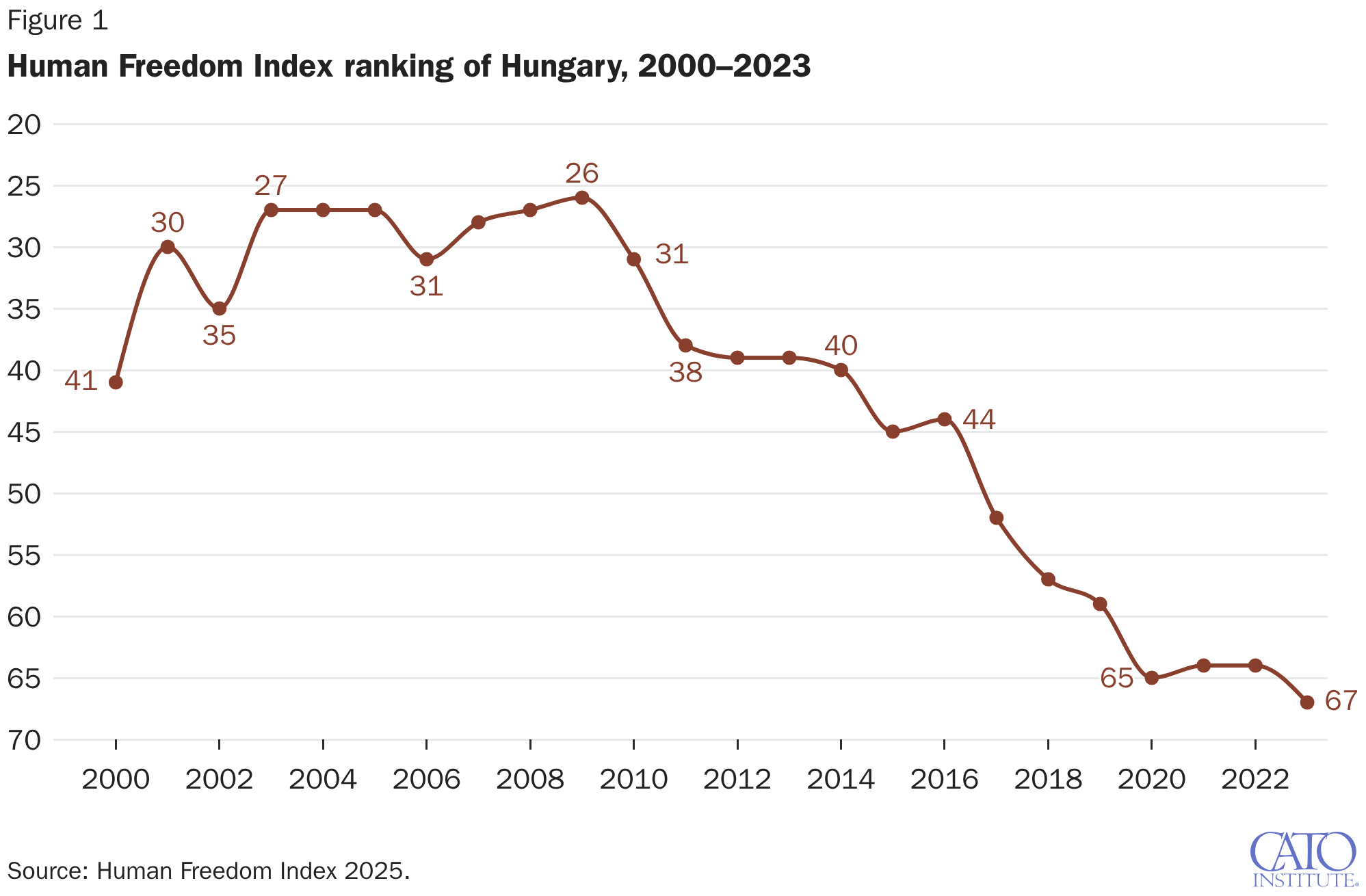
Similarly, Hungary has deteriorated markedly in the Cato Institute and Fraser Institute’s Human Freedom Index, which measures both personal and economic freedoms. In 2010, Hungary was the 31st-freest country on the planet. By 2023, it had fallen to 67th, last among EU countries and coming after African countries including Namibia and Botswana (Figure 1).14
In the World Bank’s Worldwide Governance Indicators, between 2010 and 2024, Hungary substantially lost ground on all but one measure of institutional quality: government effectiveness and by the tiniest of margins. The country’s rating fell for the following categories: rule of law, voice and accountability, political stability and absence of violence/terrorism, regulatory quality, and control of corruption.15
The Bertelsmann Transformation Index shows that Hungary’s transition from communism had gone quite successfully up to 2010. In terms of political transformation, it scored 9.35 out of 10. But by 2024, the score had fallen to 6.3, making the country a “defective democracy.” Hungary’s economic transformation slid back from 8.14 to 6.82 and governance performance from 6.07 to 3.79.16
If Viktor Orbán is a freedom fighter, clearly, he is not a very good one. In fact, the sharp deterioration in political and individual liberties that Hungarians have suffered under his watch has rarely been matched in other democracies.
An Illiberal State
In an infamous 2014 speech at the summer meeting of young ethnic Hungarians in Romania, Viktor Orbán outlined his political project: “The Hungarian nation is not simply a group of individuals but a community that must be organized, reinforced and in fact constructed. And so in this sense the new state that we are constructing in Hungary is an illiberal state, a non-liberal state.”17
Orbán was not targeting any kind of wishy-washy progressive liberalism. He had something very specific in mind. He said that the liberal principle he objected to is “the idea that we have the right to do anything that does not infringe on the freedom of the other party,” an accurate description of the very kernel of a classical liberal or libertarian philosophy. He rejected it and argued that limited government only means freedom for the stronger party (for example, banks) to trample on the weak.
Therefore, the principle of individual freedom must be replaced by government intervention and community organization, with the state actively controlling society and taking care of its citizens. Astonishingly, as international role models—“stars” that have made their nations successful—Orbán pointed not just to illiberal regimes such as Turkey but even to the outright dictatorships of Russia and China.
These references were not just rhetorical. Orbán has consistently cultivated unusually warm ties with Moscow and Beijing, even as most democracies have distanced themselves. He has maintained close contact with Vladimir Putin after the illegal annexation of Crimea and during Russia’s war against Ukraine, repeatedly slowing or watering down EU sanctions and striking long-term energy deals with the Kremlin. Simultaneously, he has positioned Hungary as China’s most reliable partner in the EU, embracing Beijing’s Belt and Road Initiative (BRI) and inviting projects such as the Budapest–Belgrade railway—intended as the BRI’s flagship infrastructure project in Europe—and a controversial Chinese state-owned and state-operated university campus in Budapest that has yet to be realized. In doing so, Orbán has signaled that his vision for Hungary’s future lay as much with authoritarian powers as with the liberal democracies of the West.
Orbán’s speech about building an illiberal state, which made waves around the world, was not merely sloganeering or an ambitious road map, it was a description of what Hungary was quickly becoming. In a liberal democracy, government power is limited by a separation of powers that check and balance each other, an independent judiciary, and a free media. Much of Orbán’s political program has been to abolish such institutions. His speeches and actions reveal that when he talks about fighting for freedom, he means freedom from institutional restrictions for the state, executive power, majoritarian rule, and himself.
As Orbán told the Wall Street Journal in 2013:
People like me would like to do something meaningful, something extraordinary. History grants me this opportunity.… In a crisis you don’t need governance by institutions. What is needed is somebody who says to [the people] follow me.… Now strong national leaders are required.18
Dismantling the Barriers
The first thing Fidesz did after winning a two-thirds majority in parliament in April 2010 was to start dismantling the rule of law. “Checks and balances only have meaning in the United States, or in presidential systems, where there are two identical sovereigns,” according to Orbán. In a parliamentary system, however, there is only one sovereign, and “it’s much more appropriate to talk about cooperation rather than checks and balances.”19
Hungary’s constitution can be amended with a two-thirds parliamentary majority—a legacy of the 1949 communist-era constitution. Fidesz, having won such a majority in 2010, used it to initiate and pass a completely new constitution. Although the party had not campaigned on writing a new one, the new government moved quickly and with minimal transparency. Opposition parties were excluded from the drafting process, and no national consultation or referendum was held. The new constitution was rushed through parliament in April 2011 and adopted on a party-line vote, coming into force January 1, 2012.
The new constitution allowed Fidesz to expand Hungary’s Constitutional Court from 11 to 15 members, enabling the government to add four new appointments. To do this, it changed the rule that required nominees to be approved by an all-party parliamentary committee before a full vote, a process that had ensured the appointment of broadly respected judicial experts. Instead, nominations could now come from a committee controlled by Fidesz, allowing the government to install loyalists. Meanwhile, another safeguard was removed: Previously, the judges themselves elected their own chief judge; however, that power was transferred to parliament, meaning the leadership of the court could now be chosen directly by the ruling party.
Even though adding members and other changes gave Fidesz control of the Constitutional Court, these measures also restricted the court’s authority. It became more difficult to take a case to court, and the court was no longer empowered to review tax and budget decisions, such as property rights violations.
Following the constitutional overhaul, Fidesz also forced judges into retirement at the age of 62, down from 70. With the stroke of a pen, the most senior tenth of the country’s judiciary, including about 20 percent of Supreme Court judges and most of the appeals courts’ presidents, were replaced by Fidesz appointees.20 The Supreme Court president was too young to be replaced in this manner, so the government dismissed him with a tailor-made requirement that any member had to have five years of experience in Hungary—his 16 years in the European Court of Human Rights was not enough.
A National Judicial Office was created. The Fidesz appointee who led it was granted the power to hire, fire, promote, and demote all of Hungary’s judges. She also had the right to move any case to the court of her choosing, which could be used to move any sensitive case (e.g., on political corruption) to a more sympathetic judge elsewhere. Incidentally, she was the wife of the Fidesz politician who bragged that he had drafted the constitution on his laptop.21
Concerned that even a tamed Fidesz court could sometimes raise objections, the government introduced an amendment saying that no act that violates the constitution would be illegal if a two-thirds majority in parliament simply voted to incorporate the act into the constitution. Fidesz amended the constitution no fewer than four times in the first 15 months.
The party has turned Henry Kissinger’s famous quip into its governing philosophy: “The illegal we do immediately. The unconstitutional takes a little longer.” It just didn’t take that long. Sometimes the whole amendment process took just a few weeks. As András Varga, current president of the supreme court (now renamed Curia), has said: “It is an urgent task to rediscover … the natural limits of judicial independence.”22
In the World Justice Project’s Rule of Law Index, Hungary has fallen to 79th out of 143 countries, last of all EU and North American countries. Dismally, in the category “Constraints on Government Power,” Hungary ranks 123rd out of 143, after notoriously illiberal countries such as Niger, Uzbekistan, and El Salvador.23
Parliamentary rules demand that the government announce new bills to allow members of parliament (MPs) to debate them. To avoid this, Fidesz often writes bills in the name of backbenchers, which are then rushed through parliament. An MP from another party recalls how a Fidesz colleague was shocked by a proposal to bar suspects from speaking to a lawyer for 48 hours. “Have you seen this bill?” the Fidesz MP asked. “Yes, I did see it,” the other MP replied. “But did you know you were the one who introduced it?”24
The governing party put loyalists in charge of other institutions that are supposed to check or balance government power, including the State Audit Office, Prosecutor General’s Office, tax authorities, National Bank, Media Council, Central Statistical Office, and ombudsman. Rather than acting as checks on executive power, these institutions have become enablers and, at times, instruments of political enforcement used to penalize nongovernmental organizations (NGOs) and opposition parties under the guise of independent authority.
Fidesz also entrenched its control by introducing unusually long terms for key positions. The prosecutor general, the head of the State Audit Office, and several other watchdog posts were given 9- or even 12-year mandates, ensuring that Orbán loyalists would remain in power long after any future change of government.
The 2012 constitution also gave significant powers to a restructured Budget Council. This three-member body consists of officials appointed to long, staggered terms—up to twelve years—ensuring they remain in office long after the government that appointed them may have left. They can veto the budget and if this results in no budget passed on time, the president can dissolve parliament and trigger new elections. As Orbán told an Austrian newspaper: “I make no secret of the fact that in this respect I tie the hands of the next government. Not just the next one, but the next ten.”25
Orbán and the group around him are lawyers, and they were meticulous in making sure that their power grab was done in a technically legal way. They also defended every single step of the process by saying that almost all of these institutional changes, taken separately, exist in other consolidated democracies. But that is institutional cherry-picking. The problem is that all these steps led in the same direction: toward unrestrained executive power, since other countervailing checks and balances that make such institutions work in other systems were also dismantled.
This is especially dangerous in a nonfederal and unicameral parliamentary system like Hungary’s. No state courts or parliaments balance the center, and no upper house balances a lower house in parliament. The executive, the prime minister, is elected by parliament and is usually guaranteed a majority there. Hungary has a president, but this is a largely ceremonial role, and that individual is also elected by parliament and not directly by the people. Therefore, dismantling constitutional controls and the independent judiciary hands potentially crushing powers to the central government.
Changing the Rules
Fidesz used its new powers to rewrite the electoral law in its favor. Until 2010, local constituencies used a two-round system, with a minimum turnout required to validate the result. After the reforms, there was only a single round: The candidate with the most votes won, regardless of turnout. By abolishing the second round, the opposition’s ability to coordinate tactically in a runoff was eliminated. Single-round plurality systems are common in democracies. The controversy lay not in the formula itself but in the unilateral manner in which it was enacted, with the governing party altering the strategic balance in a system that had previously relied on second-round coordination among opposition parties.
In most majoritarian systems, surplus votes for the winning candidate do not generate additional representation. However, Hungary’s post-2011 electoral reforms introduced a mechanism known as “winner compensation,” whereby the margin of victory in single-member districts is added to the party’s national list total. This unique system amplifies the seat share of the largest party.26
Orbán also reduced the number of parliamentary seats from 386 to 199 and gerrymandered constituencies. This happens in other countries as well, but Fidesz’s position made it possible for the government to do it throughout Hungary. Opposition constituencies were broken up and absorbed by areas where Fidesz dominated. With such changes, Fidesz managed to keep its two-thirds majority in parliament in 2014 with just a one-seat margin, despite declining from 52.7 percent of the vote to 44.9 percent. If the elections had been held according to the previous rules, Fidesz would have lost its supermajority.27
In 2012, Orbán gave voting rights to more than one million ethnic Hungarians who live just outside the country’s borders (largely a result of losing much of its territory in the 1920 Treaty of Trianon). They can send their votes via mail and have systematically supported the ruling nationalist party, which provides its local Hungarian civic groups with generous financial support. Ninety-five percent of the newly enfranchised voted for Fidesz in the 2014 elections.28
In contrast, the many expatriate Hungarians who have moved to study and work in other countries (and are less pro-Fidesz) cannot vote via mail-in ballots and have to appear physically at official polling stations. In a relatively large country such as the United Kingdom, there are only three polling stations, and the trip and the wait are often long.
In 2013, an amendment to the constitution banned political advertising during election campaigns everywhere but in public broadcast media, controlled by Fidesz. This denied independent media of important revenue and opposition parties of airtime. On the other hand, the government could freely flood any kind of media with tax-funded “public interest campaigns” that just happened to have slogans identical to Fidesz’s own campaign messages.
When the opposition realized that their only chance to grab public attention during the 2014 campaign was advertising on Budapest streetlamps, the city council banned such ads, supposedly for road safety purposes (sidewalk kiosks owned by a Fidesz-friendly company were exempted from the ban). This almost ruined the company that sold such ads. After the election, that company was bought by a businessman close to Fidesz, and after that, advertising on streetlamps was once again permitted.29
The State Audit Office, led by a former Fidesz MP, has repeatedly fined several opposition parties for alleged financing violations. Fidesz has been left untouched, leading to accusations of selective standards.
Unfree Media
Even with complete control of the government, independent journalism can act as a check on power, so Orbán next went after the free press. In 2010, Hungary had the world’s 23rd-freest media, according to Reporters Without Borders. By 2025, it had fallen to 68th.30
In general, this is not due to government censorship, although there has been some of that as well. For example, during the harsh Hungarian COVID-19 lockdowns, spreading “false information” about the pandemic was made a crime, punishable by five years in prison. Usually, however, Fidesz is not afraid to allow dissenting voices, so long as their reach is limited.
To begin with, the government took direct control of public service media and imposed uniform control of content across six television channels, six radio stations, and its press agency. Hundreds of editors and journalists were fired and replaced by loyal cadres. The loyalists received an enormous budget, almost €300 million, to promote a pro-government agenda in 2020.
How journalists were expected to report became clear through a leaked secret recording made by staff inside Hungary’s state television and later published by independent media ahead of the 2019 European elections. In the audio, an editor can be heard instructing his team: “I’m sure nobody will be surprised if I say that in this institution, it’s not the opposition alliance that is supported.” He then went on to dictate the approved narrative, concluding: “If anyone doesn’t like it, they can hand in their resignation.”31
During the 2018 election campaign, 61 percent of state media stories covered the government, of which 96 percent cast it in a positive light. Meanwhile, 82 percent of stories covering the opposition were negative. In the 2022 campaign, the united opposition candidate for prime minister received a total of five minutes of airtime.32
The government started to provide its tax-funded wire service free of charge, driving commercial news services out of business. It also started supporting friendly media with state loans, minority stakes, and an unbalanced allocation of radio frequencies, concessions, and permits. One television station even received subsidies from the state-owned Export-Import Bank, even though that agency is only supposed to promote foreign trade.
Loyal private media was rewarded with subscriptions from state authorities, institutions, and corporations. Most of all, they received generous spending on advertising from the central government, municipalities, and state-owned companies, while independent media was punished by the revocation of such spending. For example, a weekly publication started by a former Orbán spokesperson enjoyed six-times more state advertisement funding than the business magazine HVG, even though the latter had a circulation that was three times higher.33
In 2020, the government spent an incredible €365 million on state advertising at list prices (undisclosed discounts make the real sum smaller). The Prime Minister’s Cabinet Office itself was responsible for almost 44 percent of that money. This taxpayer-funded propaganda also subsidizes hundreds of pro-Fidesz media outlets that would not have survived in a competitive market. In several cases, the proportion of advertising revenue that originates with the government is as much as 60–80 percent.34
The government also started to punish private media that did not toe the party line. The powerful Media Council was set up with members appointed by the Fidesz majority. The council has the right to levy steep fines if companies violate vague content rules. Most financially painful was that these companies were deprived of state-related advertisements, while their competitors received them. This often leads management to self-censor or simply sell their companies. Media owners say they have been told that they could expect generous subsidies if they changed their tone or made staffing changes.
Private media can also expect regulatory harassment. The daily Metropol, freely distributed in public areas, learned that it would be denied those spaces unless it was sold to a Fidesz oligarch. In 2020, the Media Council denied a renewal for the license of the Orbán-critical radio station Klubrádió, claiming repeated legal violations including not playing a certain amount of Hungarian music. When RTL Klub, a leading television channel, resisted a takeover, the government introduced a special advertising tax structured in such a way that a station with only 16 percent of total advertising revenue was liable for 54 percent of the total tax collected.35 EU law allows the European Commission to challenge national measures that distort competition or discriminate between media businesses, and expecting a likely defeat at the European Court of Justice, the government later withdrew the RTL Klub tax.
One by one, critical private media has been sold to people close to Fidesz and turned into government mouthpieces. Often, the sequence of events is opaque. Hungary’s media and competition authorities only allowed a merger of the subsidiaries of the Swiss Ringier group and Germany’s Axel Springer in 2014 on the condition that Ringier sell its stake in the most influential Orbán-critical daily, Népszabadság, to Mediaworks, owned by an Austrian businessman who took complete control of it the next year. On October 9, 2016, those who accessed the newspaper’s website were met with an unexpected message: “Dear Followers, the editors of Népszabadság have learned simultaneously with the public that the paper is shut down with immediate effect. Our first thought is that this is a coup. More news soon.”36
In November 2018, 476 pro-government media outlets were donated by the nominal owners to a new foundation called KESMA (Közép-Európai Sajtó és Média Alapítvány). Television and radio stations, online news portals, as well as newspapers and magazines that had been bought by Fidesz allies with money made on state contracts and subsidized loans were now centralized, reducing the risk that some would go their own way. Orbán, who never hesitated to unleash the competition authority on opposition media, now blocked it from scrutinizing this foundation by declaring it a matter of public interest. In 2020, KESMA media outlets received €137 million in state advertisements at list prices.37
An assessment from 2018 estimates the pro-government market share in print and radio at above 80 percent, and in television at 57 percent.38 The only media segment that has retained a free-market structure is online media. Fidesz tried to tame online media use with an internet tax in 2014, but massive public protests forced it to abandon the plan.
Journalists and media owners who persist in scrutinizing Fidesz face many other forms of harassment and obstacles. In 2021, it was revealed that the Hungarian government had secretly used the Pegasus spyware to view all content on the cell phones of several journalists. In many instances, the Pegasus infections had come within days after a journalist had formally requested a comment on a story from the government. Several lawyers’ phones had also been hacked, violating attorney-client privilege.39 The Orbán government has never denied this, perhaps finding the deterrent effect on potential sources and whistleblowers useful.
In a free and liberal society, the government should have no role in the media, either through running state-owned enterprises or funding nominally private ones. However, Orbán and Fidesz have gone beyond typical state involvement in the media and weaponized outlets against its opponents in a way that is especially unusual for a supposedly Western democracy.
Uncivil Society
Hungary had a thriving civil society in the period between the waning years of communism and Fidesz’s ascendancy, with independent think tanks and governance watchdogs. Public educational establishments had to follow government guidelines but had at least some autonomy from direct politicized interference. Fidesz put an end to that.
The school system was centralized with the minister of education himself receiving the power to appoint principals of the country’s more than 5,000 schools. Local government officials took staffing power away from principals. Schools were deprived of power to direct budgets, shape curriculum, and choose textbooks. Instead of having 5,000 employers, teachers now had a single national agency as their employer; a teacher dismissed by the national body was effectively barred from teaching in the entire public system.
Higher education and the arts have also been co-opted. In 2012, the culture minister made himself president and seized control from professional councils of the National Cultural Fund, which distributes funds for arts and culture. In 2019, the prestigious Hungarian Academy of Sciences was stripped of its 15 research bodies, and direct control was handed to the prime minister and the Ministry for Innovation and Technology.
In an alarming 2021 move, the government entrusted 11 universities, along with billions of dollars in related state assets, to newly formed public interest foundations. Their boards were filled by the Orbán government, and when openings arose, members would be appointed by those boards. This move gave Fidesz associates direct control over higher education and huge assets, which will remain in their possession even if Orbán loses power.
The biggest beneficiary was a privately managed residential college, Mathias Corvinus Collegium. In the middle of this process, the government took the opportunity to hand over shares worth $1.3 billion and $462 million in cash to the college. Its main board happened to be led by Viktor Orbán’s own political director.40 Beyond its domestic role, Corvinus has extended its reach abroad, funding events and research at conservative think tanks. This support helps secure friendlier portrayals of Orbán’s policies in international circles willing to sing for their suppers.
The drive to reshape Hungarian society did not stop at schools, universities, or civil society. It extended into a broader culture war. Under the banner of child protection, the Fidesz government passed laws in 2021 banning any depiction or promotion of homosexuality or gender identity in schools, advertising, and media aimed at minors—legislation widely compared to Russia’s “gay propaganda” law.41 Adoption by same-sex couples was constitutionally prohibited, and legal gender recognition for transgender people was abolished. Leading Fidesz figures spoke of LGBTQ rights as a threat to children and the nation’s moral fabric. The speaker of parliament even likened same-sex adoption to pedophilia. Pride marches and similar events have been blocked.
In 2017, the government came for civil society with two new laws. The first was LexNGO, inspired by a Russian 2012 foreign agent law, which initially forced organizations that receive more than €20,000 in foreign funding annually to register and label themselves in all publications, websites, and press material as financed from abroad. Such organizations also had to give specific information on their donors.
This measure targeted international watchdogs including Transparency International and the Helsinki Committee, but revealingly, it excluded ethnic and religious NGOs, groups that also collect money from abroad but are often close to Fidesz. Foundations of political parties are also exempt. The EU warned that the new obligations threatened the union’s free movement of capital, freedom of association, and protection of data.
A second law in 2017 aimed to close one of the most respected educational institutions in the region, Central European University (CEU), founded in 1991 with an endowment from George Soros. The law included a complicated set of new requirements undermining higher education institutions that award foreign-recognized diplomas, specifically targeting CEU, which was registered in New York. The true motive of the measure was revealed by Orbán’s comment in December 2016 that “the following year will be about the squeezing out of Soros and the powers that symbolize him.”42
The government soon turned Soros into a public enemy, running billboard and media campaigns against him that were accused of having anti-Semitic undertones. The Federation of Jewish Communities in Hungary warned that the campaign “is very much able to raise uncontrolled, among other things, anti-Semitic anger,” pointing to incidents in its wake.43
In 2020, the European Court of Justice declared that the Orbán government’s attack on CEU was in breach of both academic freedom and the free movement of services. By then it was too late, as CEU had already left Hungary. The NGO law was also struck down. In its place, the government empowered the State Audit Office to annually report on the financial status of NGOs, even though they don’t receive state funding, and to selectively audit them and impose new burdens, making their work as difficult as possible. For example, auditors could demand extensive documentation of every foreign donation, threatening steep fines for minor administrative errors.
As critical organizations have been squeezed out, Fidesz has set up its own universe of thousands of government-organized NGOs (GONGOs), which run pro-government campaigns, stage rallies and events, and develop ideas, publications, and communications. They are called independent but are staffed with government allies and funded by the government, the Prime Minister’s Office, entities such as the National Cooperation Fund and the Urban Civic Fund, state companies including MVM Group (Hungarian electricity), and even the central bank.
Some foundations seem to have been set up with the sole purpose of channeling cash from Hungarian taxpayers in an opaque way. For instance, the Lajos Batthyány Foundation started the Danube Institute, which attracts foreign conservatives and bankrolls the Center for Fundamental Rights, the institution responsible for organizing the Hungarian version of the Conservative Political Action Committee, or CPAC.
Astonishingly, one major donor has been the central bank. When the bank made a large exchange rate gain in 2013, it did not return it to the central budget as is normally the case. Astonishingly, the bank diverted roughly €800 million, about 0.8 percent of Hungary’s GDP, to set up a network of formally independent foundations called the Pallas Athéné Foundations, which have funded pro-Orbán research institutes, media initiatives, and intellectual networks. Fidesz at first tried to make their spending secret by claiming that this transaction meant the foundations “lost [their] public money character.”44
“If something is done in the national interest, then it is not corruption,” said András Lánczi, then-president of the Századvég Foundation, a Fidesz think tank. The Századvég network alone has received around €40 million from the National Bank, the Ministry for National Development, the Ministry for International Development, and the Prime Minister’s Office.45
Anti-Market, “Unorthodox” Economics
Unconstrained by law, media, and an independent civil society, Fidesz has used its powers to take control of the economy. Orbán has christened it an “unorthodox economic policy” and said that “for rebuilding the economy it is not theories that are needed but rather thirty robust lads who start working to implement what we all know needs to be done.”46 Orbán had ridden a wave of anger at austerity policies, and now he claimed that privatization had gone further in Hungary than in any other EU country and had to be reversed.
Liberated from economic theories, these “thirsty robust lads” started carrying away the private property of others on a gigantic scale. Some nationalization was outright, such as the confiscation of private pensions. In 1998, Hungary had become the first postcommunist country in Europe to allow workers to invest a share of their salaries in private accounts. Fidesz wanted to lay its hands on that wealth to pay for its own spending promises. In late 2010, the party declared that those who did not return to the state pension system would effectively be excluded from it; they would lose their future right to a state pension despite being legally required to continue paying taxes into the system. Almost three million Hungarians left their private savings to the state system, and they were not compensated. Savings totaling almost 10 percent of GDP were expropriated.
In this way, the government also acquired, without paying for them, stocks in 20 companies previously owned by the pension funds. The economist András Inotai has said that this “robbery of 3 million citizens” would have led to criminal prosecution in any other country, but since the new constitution barred the Hungarian Constitutional Court from reviewing financial matters, the court could not intervene.47 Sixty thousand people, around 3 percent of private pension fund members, resisted the blackmail and refused to join the state system. In 2014, the government nonetheless shut down their funds and seized their assets as well.
Rallying against “speculative profit-hunters,” in 2010, Fidesz introduced a special 20 percent tax on large, foreign-owned banks and financial companies based on the size of their balance sheets. Since this tax was based on assets and independent of profits, some bankers described it as expropriation. At the same time, the banks who had lent to Hungarians in foreign currency (that had appreciated) were forced to redenominate mortgages in local currency at favorable rates. That this reduced their incentive to stay in the Hungarian market was not a problem for Orbán but rather the very point, since he wanted to control the financial system. The government took over or bought stakes in several banks and, under the pretext of financial stabilization, forcibly nationalized the regional savings cooperatives with relatively small asset bases. This made it easy for Fidesz to direct cheap credit to loyal businesses and away from the competition.
Special taxes were also extended to other sectors of the economy with significant foreign ownership, including energy, telecoms, and retail. To target major foreign owners, the taxes were sharply progressive. In retail, for example, the tax started at 0 percent, but above a certain threshold, it could reach 2.5 percent of turnover, and over 4 percent in later versions of the sectoral levy, rapidly eroding firms’ capital.48 By 2015, such special taxes were equivalent to 2.5 percent of GDP.49
At the same time, these companies faced much harsher regulations, including difficulties securing building permits (issued discretionally), new construction codes, restrictions on opening hours, and requirements to employ staff in proportion to the square footage of their premises. Many were subjected to price controls, and public utility corporations were forced to operate as nonprofit entities. All of this was a way of pushing them out of the country. Once they had agreed to sell their business, permits that had been held back quickly reappeared.
Before Orbán, Hungary had moved faster than other postcommunist countries in privatizing state property, but under him, the government quickly reversed that policy. In 2007, Hungarian state-ownership was 11 percent of GDP, 2.9 percentage points below the EU average. In 2016, the share of state-owned enterprises had increased to 16.5 percent of GDP, 1.6 percentage points above the EU average. The equity capital of the state increased two-and-a-half times between 2010 and 2015.50
By the end of Orbán’s second term in office, the state had taken control of around 300 to 400 companies in such diverse sectors as banking, energy, shipyards, airports, restaurants, broadcasting, waste collection, film production, and telecommunications. Many of these companies were eventually redistributed to the government’s friends and allies, creating a network of dependent companies.
Different means were used to acquire the companies. The message that Fidesz wanted to take over a business and kept regulators, tax inspectors, and prosecutors on standby if a company refused was often enough to pressure many Hungarian owners to pull out, but sometimes the government paid foreign owners market prices or even more. Pécs Waterworks was physically occupied by the public firm that wanted it. When Bombardier did not want to sell a vehicle repair company, the state-owned rail company held back orders until the company yielded. The National Gallop, a popular horse-racing festival in Budapest, was suddenly denied the traditional permit to use public space until it had been sold to a friend of the government.
One way of seizing a market without having to pay for it was to legally ban private companies from that market through the creation of a new public monopoly, such as water and waste management, metal trade, gas storage and construction, data administration, local public transportation, highway toll management, and parking and mobile ticket sales. The market for textbooks illustrates that the government often captured a sector in several steps. First, it pushed out private companies by monopolizing textbook retailing. Then it turned itself into one of many textbook publishers. Finally, it took away the right of schools to choose their own textbooks. From then on, schools could only choose books from the options that the ministry responsible for education provided. Private publishers were ruined, and the government abolished curricular autonomy while guaranteeing itself and favored printers an income stream.
In 2013, the government suddenly established a monopoly on tobacco sales, depriving 30,000 small food and convenience stores the right to act on this lucrative market. Every 20th shop had to shut down as a result. The stated reason was to combat smoking, but the move also gave local Fidesz politicians, who now handed out tobacco sales concessions, a chance to build their own crony networks. “Basically, what is important is that the people chosen must be committed to the political right,” as one of them said in a leaked audio recording.51 It also monopolized wholesale tobacco rights, handing them to a businessman who used some of his wealth to help set up a pro-government newspaper.
In 2014, a retroactive law canceled the land rights that foreigners had through companies they had set up in Hungary. Several thousand foreigners, mostly Austrians, were deprived of their rights without compensation, violating the EU’s fundamental rights to property and the free movement of capital, according to the European Court of Justice. However, the ruling offered little relief, as Hungary resisted returning the land or paying compensation.
The government started requiring that local committees dominated by Fidesz backers approve land transactions. They could block sales to a particular buyer, thereby reducing the value of that property, and then point the owner to an approved buyer. In effect, the “thirty robust lads” were the kind of lads who’d plant a small business owner firmly in a chair, lean in with a grin, and make the owner a deal they couldn’t refuse.
One exception to Orbán’s big government policies is the flat income tax, now at 15 percent. It has been lauded for simplifying the tax system and encouraging economic activity, contributing to Hungary’s low unemployment rate of 4.4 percent in December 2025.
However, this has not translated into lower taxes overall. Hungary’s total tax burden is fairly standard for postcommunist EU countries, and it has the sixth-highest income tax in the Organisation for Economic Co-operation and Development as a share of the average wage (including payroll taxes), higher than in countries such as Sweden and France.52 The tax burden on the minimum wage is the highest in the EU.
In the Fraser Institute’s Economic Freedom of the World report, Hungary improved rapidly between 1990 and 2010, from 5.52 to 7.37 on a 10-point scale. But since then, it has fallen to 7.07, only boosted by the free-trade policies it has agreed to as an EU member. Between 2010 and 2023, Hungary fell from 39th to 61st in economic freedom.53
Our Eight to Ten Capitalists
Viktor Orbán thought that a major mistake of József Antall, Hungary’s first center-right prime minister after the fall of communism, was that he tried to separate government from the economy. In Orbán’s opinion, Antall should have instead cultivated a group of friendly, favored businessmen who could also help the ruling parties:
Personal contacts should have been established with them, which they could then use as a competitive advantage in the market. The kind of connection that would have tied them to the Prime Minister of Hungary or his closest inner circle. Yes, the country’s economy would have been divided into the spheres of interest of eight to ten major capitalists in specific sectors.… The bankers should have been made to understand that these are our eight to ten people [and] some assistance could have been provided with development funds and grants.54
This is the vision that Orbán started realizing when he became prime minister. With the help of the interventions listed above, as well as the selective use of credit, taxes (sometimes retroactive), tax inspections, and health and safety requirements, the government squeezed out independent businesses and pushed them to sell their assets to Fidesz’s network of friends and allies. Increasingly, says a Hungarian consultant, “the government decides who wins or loses.”55
One of the most important tools to benefit cronies has been public procurement. With simple tweaks to the system, vast amounts of money can quickly be passed on to favored businesses. An examination of public contracts between 2009 and 2015 revealed that 62 percent of them were awarded without any official announcement, meaning only businesses that had been tipped off by the authorities had a chance to participate. In between 25 and 40 percent of the cases, there was only one bidder.56
Government contracts and funding have increasingly gone to the same small group. In 2010, a company with close ties to Fidesz had roughly the same probability of winning a public contract as other firms. By 2021, that chance had grown to six times that of a company without political ties.57 And this conceals the underlying dynamic that nonconnected firms soon started dropping out of tenders when they realized that their chances were minimal. “This money is our due,” as a Fidesz politician told an ex-colleague in a private conversation.58
Ironically, in light of Orbán’s costly campaigns against the European Union, this system was supercharged with huge subsidies from EU taxpayers. In the 2010s, annual EU funds to Hungary totaled up to 4 percent of GDP, a huge amount, similar to what East Germany received from West Germany after reunification. This massive inflow of capital should have helped lift the Hungarian economy, but much of it has been diverted to less productive uses. A 2022 review of public procurement found that between 2011 and 2021, just 12 businessmen close to Orbán and his inner circle captured 21 percent of the value of EU-funded contracts awarded through closed, noncompetitive procedures and 12 percent of those awarded under broader framework agreements.59
Over the years, the EU has repeatedly complained about irregularities, conflicts of interest, and a lack of transparency and anti-corruption efforts in Hungary. Only in 2020 did the EU create a new mechanism that allows it to suspend funds to countries that have systemic rule of law problems that affect EU finances. In December 2022, Hungary became the first and hitherto only country affected by the measure: $6.3 billion in cohesion funds were frozen due to “serious systemic irregularities, deficiencies and weaknesses in public procurement procedures.” These issues were compounded with an absence of independent investigation and prosecution of corruption, constituting “breaches of the principles of the rule of law, in particular regarding legal certainty, the prohibition of arbitrariness of the executive powers and effective judicial protection.”60
The EU’s agricultural subsidies have also been used to enforce Orbán’s system. Originally, Fidesz said that it would privatize state land by selling to local residents who were professionally involved in agriculture, which you might have expected from a government trying to build a strong, property-owning middle class. Instead, after 2015, it sold hundreds of thousands of acres to politically connected businessmen in rigged auctions. Local farmers said that they did not even know the land was for sale, and if they did, they were told that the winner had already been predetermined.
The land entitled the owners to huge subsidies. In 2018 alone, just two influential businessmen received a total of $28 million in agricultural subsidies, according to an investigation by the New York Times. Farmers complained that they had been blocked from grants and that they were suddenly visited by fierce environmental inspectors. József Ángyán, who served as Orban’s undersecretary for rural development until 2012, has said that “it’s an absolutely corrupt system” intended to make the countryside beholden to Fidesz and previous farmers into day laborers on oligarch farms. When Ángyán started criticizing the policy, the government retracted the lease on a farm that he had operated for 20 years and gave it to loyalists. “If you’re critical of the system,” he told the New York Times, “You get nothing.”61
A study of Hungary’s crony networks concludes that successful market players are not usually traditional entrepreneurs and businesspeople, but powerful politicians’ old “schoolmates, relatives, family members, friends from the neighborhood, spouses or ex-spouses, children, cousins and strawmen as well as faceless owners of quickly appearing and disappearing phantom companies.”62 One thing these people have in common is that they tend not to laud their achievements. Instead, they hide their role behind complicated and opaque ownership structures with many layers. “Top officials tend to declare modest assets but lead luxurious lives,” reported The Economist in 2019.63
István Tiborcz is one of these well-connected oligarchs. In 2013, he married Orbán’s eldest daughter and quickly increased his wealth based on public tenders, state subsidies, and cheap credit. According to the country’s 2024 ranking of wealth, Tiborcz is now Hungary’s 19th-richest man.64 In 2017, the EU’s anti-fraud office recommended that the Hungarian Prosecutor’s Office investigate him for rigging EU-funded municipal public lighting contracts for €40 million.65 One particularly creative practice was having the same people draft the requirements for the bids, as well as design the bid offered by Tiborcz’s company. Hungarian authorities found no wrongdoing.
Fidesz’s cronyism is also evident in the way in which this process is reversed when a friend becomes a foe. Lajos Simicska was one of Orbán’s closest friends and an architect of the party’s state capture. In the process, he used government and EU contracts to make himself one of the country’s richest oligarchs. After the 2014 election, Orbán apparently thought that Simicska had become too powerful, and the two men had a falling out.
When Simicska publicly attacked Orbán, his media empire quickly lost its state advertising and contracts for TV programs. The government suddenly annulled Simicska’s contract for advertisements in Budapest and canceled the M4 motorway that his construction company had worked on for months. Using the pretext that Simicska had provided false data, the government barred him from all public procurement tenders for three years. His agricultural company, which had prospered from subsidies, was suddenly deprived of those funds, and land he leased from the government without tenders was now offered to others. In 2016, the license for his popular commercial radio station was revoked and handed to another Fidesz ally.
On the other hand, new oligarchs can rise just as quickly. As Simicska fell out of favor, Lőrinc Mészáros, a childhood friend of Orbán and the mayor of Felcsút, the prime minister’s hometown, started to build a business empire and win public tenders en masse. In 2013, he made it onto the list of the 100 richest Hungarians, placing 88th, but his fortunes ballooned only after Orbán’s break with Simicska. This former plumber and gas fitter’s wealth increased more than 100-fold, and he is now by far the country’s richest man. Mészáros has famously credited his fortune to “God’s will, good luck, and the person of Viktor Orbán.”66 Simicska, on the other hand, dropped off the list in 2022.
One of the most brazen schemes to enrich Fidesz’s own political family was the huge transfer of public resources into the hands of friends and allies in 2021, perhaps as the party worried that it might lose the 2022 election and had to push as much through the door as possible beforehand. This was related to the takeover of universities by new public interest foundations. Many billions of dollars of other assets, including high schools, resorts, farmland, theaters, museums, harbors, parks, castles, and nightclubs, were entrusted to such newly established foundations. They have been promised ongoing government funding to run these services.
The boards are run by allies, often Fidesz politicians and government officials who appoint their own successors indefinitely, which means they can run these projects without transparency and public supervision. This has not only vastly expanded Fidesz’s control of education, research, and intellectual life but also ensures the party of assets in case of a future election loss. The government can’t hold these foundations accountable for failure to perform their tasks and can’t replace board members, even though they perform public services with public money. Some were endowed with shares in strategic companies, ensuring Fidesz a say in them even if the party loses political power.
Considering that Fidesz came to power campaigning against privatization, it is ironic that the party has itself carried out a colossal private takeover of public property. The difference is that this time, it did not come in the form of a transparent sale of assets on a market but rather as a kind of fideicommissum to its own political clan, guaranteed to stay there and funded by the taxpayers.
A Transparency International and Civitas Institute assessment concludes that “corruption appears in Hungary not as a result of a malfunction in the operation of the power of the state, but rather as a central characteristic of the operation of the state.”67 In the Corruption Perceptions Index, Hungary’s score has fallen from 55 (with 100 representing the least corruption) to 40 between 2012 and 2025. It is now the most corrupt country in the European Union, and remarkably, it is tied roughly with countries such as China, Cuba, and South Africa.68
András Lánczi, president of Fidesz’s Századvég Foundation, retorted: “What is called corruption is actually Fidesz’s supreme policy. What I mean by this is that the government has set for itself goals such as the establishment of a group of domestic entrepreneurs, the building of the pillars of a strong Hungary.”69 It is the realization of Orbán’s old dream of dividing the economy among eight to ten capitalists tied in a patron-client relationship to the prime minister. The pro-Fidesz commentator Gábor Bencsik admitted: “From an American perspective, this is, of course, crony capitalism. Tailor-made tenders, fattened subsidies, rigged competitions. But [to make Hungary rich] it cannot work any other way.”70
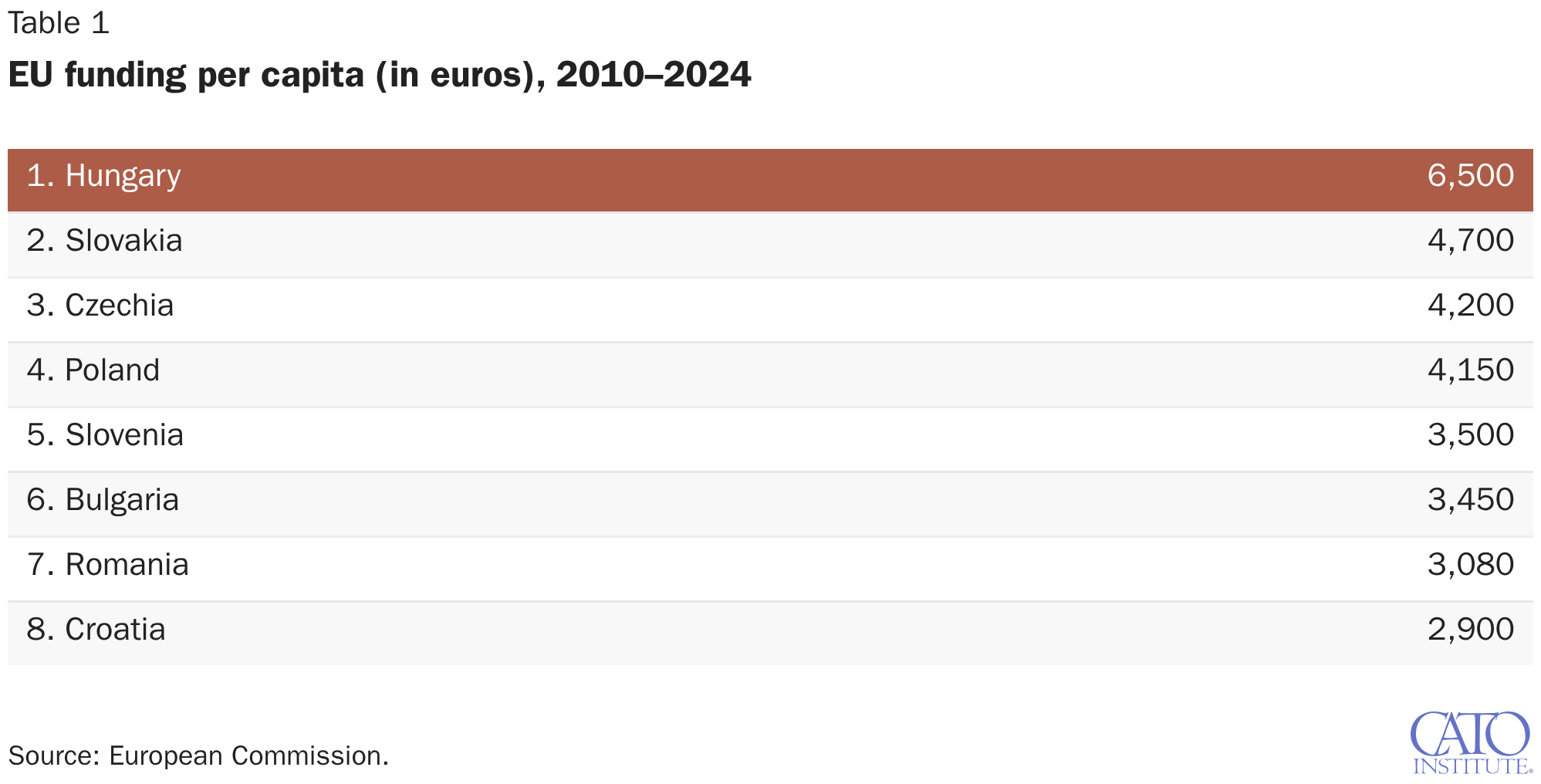
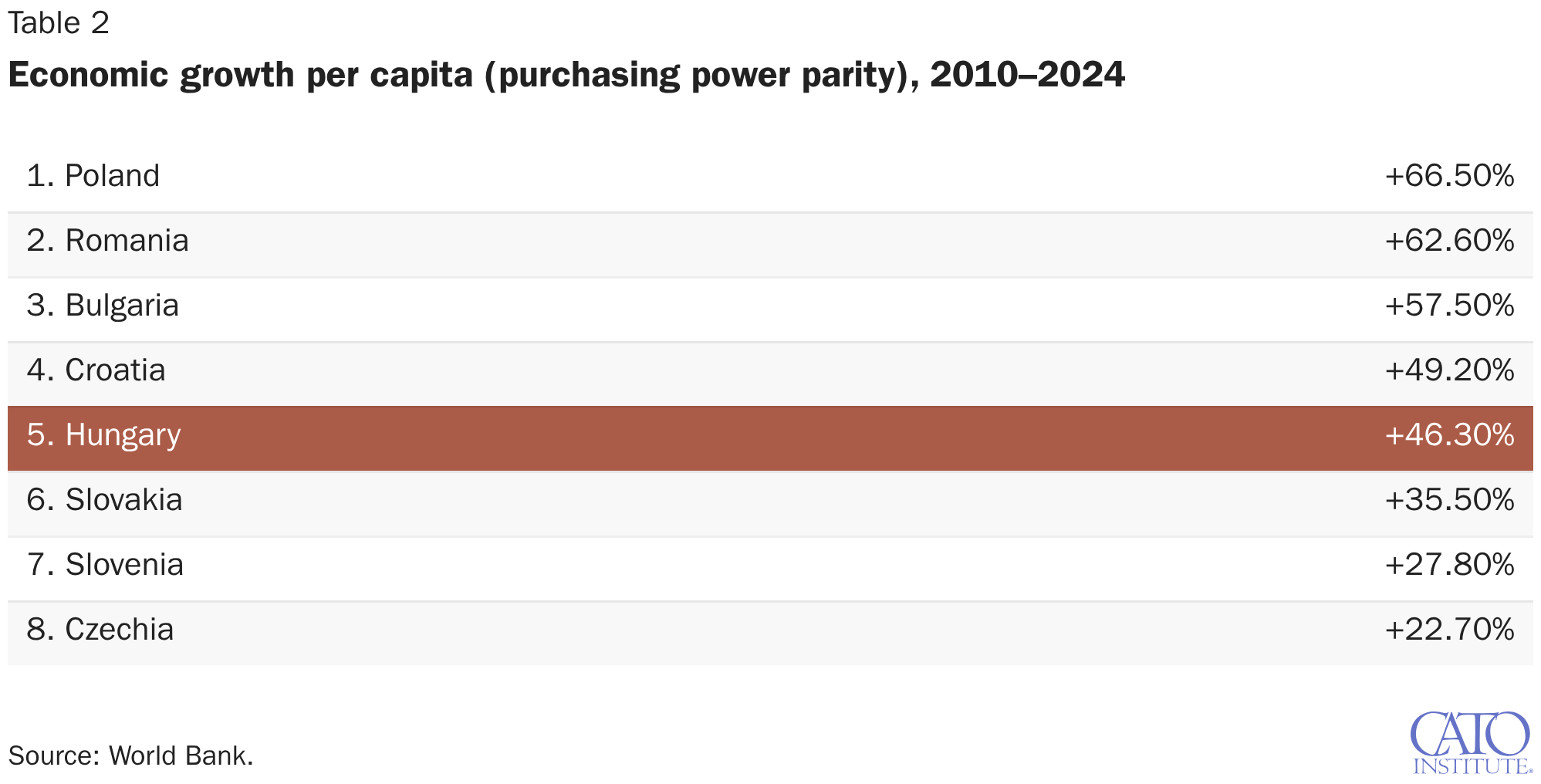
In the end, this system did enrich Fidesz cronies, but it did not make the country rich. Hungary has received more in EU funds than any other major postcommunist EU country, both as a share of GDP and per capita. Yet its economic return on these investments remains underwhelming, with the country being steadily outperformed by regional peers (Tables 1 and 2).71 The ones that have grown slower than Hungary were substantially richer to begin with and had less room for catch-up growth. In 2010, Poles were poorer than Hungarians. Today they are 11 percent richer.
Subsidizing Family
Some national conservatives think that Fidesz’s means are justified by the ends, specifically its interventions and subsidies to defend “Christian values” and promote pronatalist family policies. Liberals and libertarians have significant reservations about coercing people to subsidize the faiths and choices of others, but even defenders of such policies should question whether government intervention is an effective way of promoting certain identities and behaviors. Do Fidesz’s policies work on their own terms and achieve the stated objectives?
Orbán’s ambitious and popular family policies, dedicating an astonishing 5.5 percent of GDP to child subsidies and tax credits, have provided generous support to Hungarian families, earning widespread approval for addressing demographic concerns. In 2019, political commentator Tucker Carlson said: “Instead of abandoning Hungary’s young people to the hard-edge libertarianism [sic] of Soros and the Clinton Foundation, Orbán has decided to affirmatively help Hungarian families grow.”72 At a Fidesz congress, Speaker of Parliament László Kövér famously declared, “We would like our daughters to consider bearing us grandchildren as the highest form of self-realization”73 The government claimed victory in the battle for bigger families after Hungary’s total fertility rate increased from 1.25 per woman in 2010 to 1.61 in 2021—even though that is still far below the replacement level of 2.1.
However, since then, the rate has declined every year. In 2024, the total fertility rate was 1.39. According to preliminary data from the Hungarian Central Statistical Office, this decline is accelerating. In 2025, there were 7 percent fewer births in Hungary than in 2024. Hungary’s fertility rate is now estimated to be 1.31—one of the lowest in Central and Eastern Europe (see Figure 2).74 This rate means that Hungary is back to where it was in 2009, before Orbán’s long tenure in power and the huge family subsidies.
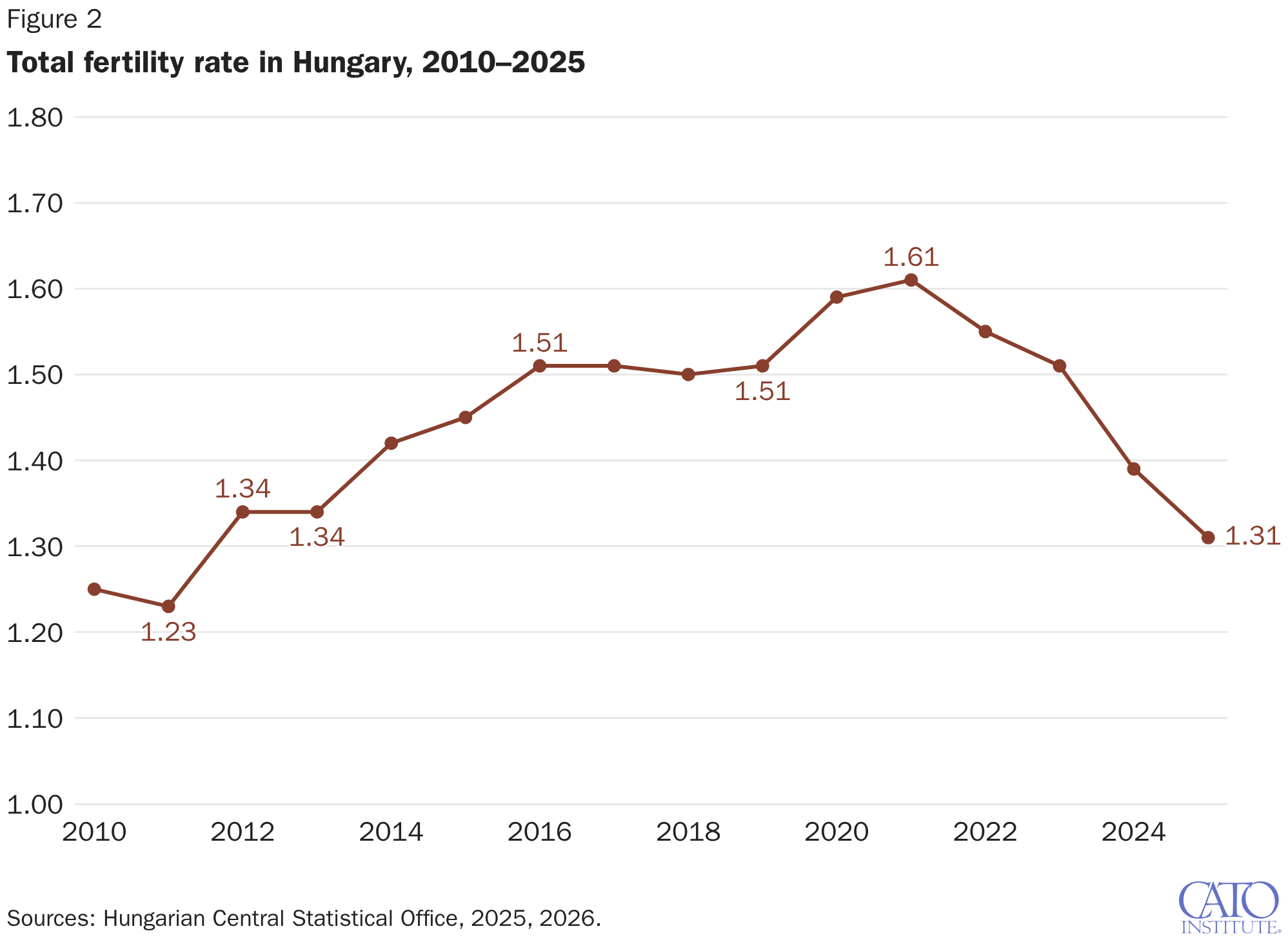
This suggests that the initial bump was not the result of a much-touted change in attitudes to forming a family and having children. It is more likely a combination of a catch-up after delayed births during the financial crisis and of families bringing births forward in response to the subsidies but not necessarily having more children over their lifetimes.
Combined with a large exodus of young Hungarians and resistance to immigration, this low fertility rate has reduced the Hungarian population from 10 million people in 2009 to fewer than 9.6 million in 2026, according to the United Nations. The median age of the population, meanwhile, has increased from 38.6 to 44.2 years old.75
Subsidizing Religion
Orbán’s Hungary likes to present itself as a bulwark against secularization. Orbán’s vocal commitment to preserving the country’s Christian heritage has resonated with a significant portion of the population, offering a counterpoint to secularization and reinforcing cultural identity for many conservative Hungarians. The heavily subsidized Catholic and Reformed Churches have been enrolled in Fidesz’s political project and have worked closely with Orbán and his campaigns. In 2024, Carlson said, “It’s one of the last countries that identifies as a nation built on Christian precepts [and] a big part of the population identify as Christians.” Carlson even claimed that this is the reason why Orbán is often criticized in the West: “It’s a Christian country and they hate that.”76
But in fact, Hungarians seem to be turning away from religion as it is becoming increasingly politicized. According to the official census, between 2011 and 2022, the share of Hungarians who self-identify as Christians declined from 54.2 to 42.5 percent. The share calling themselves Catholics declined from 38.9 to just 29.2 percent, a drop from an estimated 3.7 million Hungarians to 2.6 million. In urban areas and among the young, secularization has gone the furthest. In Budapest, less than a quarter describe themselves as Catholics. Among 20–29 year olds, no religious affiliation is almost as common as Christianity.77
According to another data series, membership in different religious denominations held fairly steady between 1991 and 2008, from 58 to 54 percent, but then declined to 45 percent in 2018. The share who say they believe in God declined only slightly, but those who believe in a personal God declined by a fifth. On the other hand, the share who believes in reincarnation jumped by a quarter, to 28 percent.78
The Hungarian Roman Catholic theologian Rita Perintfalvi thinks that the decline in organized religion is a conscious protest against the politicization of religion. However, she does not expect that to change: “The church’s entire financing is in the hands of the government, it is in a straitjacketed, completely dependent position.”79
A Pew Research Center study of religious beliefs in Europe in 2018 showed that Hungary is one of only three countries in Central and Eastern Europe where fewer than two-thirds of adults say they believe in God. Only 14 percent of Hungarians said that religion is very important in their lives, compared to a regional average of 33 percent. In Hungary, 17 percent said that they attend religious services at least monthly, and 16 percent said that they pray daily, compared to a regional average of 29 percent for both questions.80
In the same Pew poll, which focused on the differences between Eastern and Western Europeans, Hungarians were more like citizens in Western European countries, which, according to Orbán, have given up on Christianity and instead “experiment with a godless cosmos.”81 Liberal states should not be involved in promoting or persecuting religious belief, and Orbán’s efforts to reshape Hungarians beliefs in the manner he wishes have plainly failed.
Conclusion
Hungary is a small country, but as Viktor Orbán has pointed out: “There is one thing that makes our country an important place: the fact that Hungary is an incubator, where experiments are being conducted for the conservative politics of the future.”82 Yet as the center-right independent Zoltán Kész, who was formerly a member of Fidesz, observes: “The myth of Orban as a conservative icon is just that: a myth.”83 Orbán’s project is the opposite of the kind of Thatcher–Reagan conservatism that embraces the rule of law, limited government, and free markets. Orbán’s Hungary has become a model of sorts. Many would-be autocrats around the world are inspired by his dismantling of liberal democracy and the way in which he has enriched friends and allies.
By now, it is obvious that the capture of the state, civil society, and the economy by one political party and its cronies is not a transition to a system somewhere between communism and a free-market liberal democracy. Hungary had come far in that transition by 2010, but the ruling party decided to reverse that trend and create a very different regime.
The sociologist Ferenc Pataki talks about Orbán’s project as “a neo-collectivist, neo-communist experiment,” and similarly, the Fidesz oligarch Simicska has said that the party decided to pick up “the commies’ methods.”84 But while Fidesz is opposed to free markets and has used nationalization and state intervention to control the economy, it does not have an egalitarian ideology, and the party does not think it is necessary to place ownership in the hands of the state itself, as long as it is in the hands of friends.
Others have called it a fascist system, referring to how the government controls the economy and society through many different institutions and turns to nationalism and xenophobia to rally support. However, while Fidesz’s rhetoric is often aggressive, it refrains from the overt kinds of racist and anti-Semitic legislation that characterize fascist states.
These descriptions also ignore the ideological flexibility of Fidesz’s pursuit of power. Regarding the party, Orbán was onto something when he said: “It is not an organization based on one single coherent system of principles or an ideology—such an organization is incapable of expanding beyond a certain point.” Instead, he described the party as “reality without ideology.”85 He has been adept at transforming the party’s ideas whenever that helps it cling to power, saying that he has no need for his thoughts “to be forced into the cage of any ideology that can be summarized in a book.”86
Bálint Magyar, a sociologist and former education minister, thinks that Orban’s Hungary has become another form of state altogether, a “mafia state.” He rejects the idea that Hungary is a simple kleptocracy, since a kleptocracy is just a state that reaches out and grabs whatever happens to be available in the economy. Fidesz has done something more ambitious: It has used state coercion to restructure the nation’s economy, invented business structures in patron-client relationships, and then siphoned off the resources it wants.87
It is not a case of “state capture” in which oligarchs draw the state under their control. Rather, it is a case of “society capture,” in which the government uses procurement, subsidies, regulations, and taxes to replace market actors with its own oligarchs who are offered protection and privileges as long as they stay loyal. If they are not, or cease to be useful, they are taken down and replaced. The primary concern is not principles and ideology but the consolidation of power and wealth for the ruling clique.
This raises the question of the role of certain right-wing ideas in Orbán’s project. One interpretation is that Fidesz’s Hungary shows that the collectivist approach and statist means of national conservatism are easily exploited by power-hungry elites for rent-seeking and corruption. Such an approach to governance might sweep away institutional constraints on government in pursuit of the grandest visions of the common good, only to unshackle the smallest, most sordid ambitions.
Another possibility is that Orbán and Fidesz are not really national conservatives. Instead, such claims just happen to be useful cover for their illiberal project. In this interpretation, Orbán’s main quibble with classical liberalism is not that there is anything wrong with its ideas but that its institutions of the rule of law, limited government, and property rights do not easily lend themselves to the capture of power and assets. Collectivist ideas and nationalism, on the other hand, justify individual sacrifice for the state that can be used to centralize power and loot resources.
Whatever the intentions, the result for the Hungarian people is the same. As Orbán is fond of quoting from scripture: “Every tree is known by its own fruit.” And as for those who are tempted to adopt postliberal policies in the West in an effort to truly advance the welfare of their nations’ citizens, Orbán’s Hungary should serve as a cautionary tale.
Citation
Norberg, Johan. “How Viktor Orbán’s Hungary Eroded the Rule of Law and Free Markets,” Policy Analysis no. 1015, Cato Institute, Washington, DC, March 31, 2026.

About the Author


This work is licensed under a Creative Commons Attribution-NonCommercial-ShareAlike 4.0 International License.