
Wealth taxes are making headlines. Californians will vote this November on a one-time levy on wealthy residents, and some states are considering imposing annual taxes on wealth. In Congress, prominent members are pushing various proposals for annual wealth taxes and other special charges on high earners. Meanwhile, abroad, Norway and Spain have expanded their wealth taxes in recent years, while Brazil is pressing for the multilateral adoption of a global minimum wealth tax.
Such moves are starting to reverse the decades-long policy consensus that wealth taxes and high taxes on capital are damaging and should be reduced. Since the 1990s, most industrial nations have cut their corporate and capital gains tax rates, and most nations that had annual wealth taxes repealed them. Governments have found that wealth taxes and high taxes on capital income encourage tax avoidance and capital flight, raise little revenue, and tend to become riddled with loopholes.
The new push to impose higher taxes on wealth is misguided. Wealth in the United States overwhelmingly consists of productive business capital, which is mostly self-made rather than inherited. Wealth is savings, which the economy harnesses for investment to support higher wages and more jobs. Raising taxes on wealth would impose costs that ultimately fall on average Americans through reduced productivity and innovation. A further concern is that a federal wealth tax would be of dubious legality under the US Constitution.
A better way to tax wealth than special high-end charges is to shift the federal tax system toward a consumption base. This study describes how such a reform would fully tax millionaires and billionaires—but do so in a way that does not undermine jobs, investment, and economic growth.
Introduction
Federal taxes will raise $5.6 trillion in 2026.1 Some taxes are imposed on labor, such as payroll taxes. Some taxes are imposed on the flow of income from capital, such as taxes on interest and corporate profits, while other taxes are imposed on the stock of capital, such as estate taxes and proposed wealth taxes. Finally, some taxes are hybrid, imposed on both labor and capital, such as the individual income tax.
Proposals to raise taxes on capital, and wealth in particular, have gained attention in US and global tax debates. In November 2026, California voters will decide whether to enact a one-time 5 percent tax on the worldwide net wealth of state residents with assets above $1 billion.2 At the federal level, Sen. Elizabeth Warren (D‑MA) has reintroduced her Ultra-Millionaire Tax Act and Sen. Bernie Sanders (D‑VT) has reintroduced his Make Billionaires Pay Their Fair Share Act.3 The Biden administration had pushed a “billionaire” minimum income tax proposal that would have imposed an annual 25 percent minimum tax on the income—including unrealized capital gains—of households worth more than $100 million.4 Other proposals from both Republicans and Democrats include higher taxes on the wage and capital income of well-off Americans.5
A parallel debate is unfolding internationally. After three decades of repealing wealth and estate taxes, and cutting other taxes on capital, some countries have started reversing these reforms. Norway raised its wealth tax rate in 2022, which led to a high-profile exodus of wealthy taxpayers to Switzerland. Spain expanded its wealth tax in 2022 through an additional Solidarity Tax on Large Fortunes. France abolished its broad wealth tax in 2018 but is debating whether to reimpose it. Under Brazil’s leadership, the G20 group of countries commissioned a proposal for a global minimum wealth tax on high-wealth individuals.6
Why do some policymakers want to raise taxes on wealth and capital? Warren says that she wants to address “runaway wealth concentration.”7 Sanders demands that “the wealthy and large corporations start paying their fair share of taxes.”8 The union-led California ballot initiative targets “excessive accumulations of wealth.”9 And global initiatives are justified with lofty promises of “social cohesion and trust in governments to work for the common good.”10
The US federal tax system is already highly progressive, meaning that it lands heavily on top earners. When considering all federal taxes—income, payroll, estate, and excise—US Treasury data show that the average effective tax rate for the top 0.1 percent of households is 33.4 percent, the rate for the middle 60 percent is 12.3 percent, and the rate for the bottom 20 percent is near zero. The top 10 percent earn 46 percent of US income but pay almost two-thirds of all federal taxes.11 A recent report by the Fraser Institute found that the United States has the most progressive tax system among major industrialized countries.12 Similar reports from the Organisation for Economic Co-operation and Development (OECD) and the left-leaning World Inequality Lab find that US taxes are more progressive than those in any other country studied.13
There is no agreement that progressive tax systems are fairer than systems that burden households in equal proportion to their incomes. But even if there were, the US tax system is already strongly tilted against high earners.14 A better way to increase tax fairness would be to end narrow tax breaks or loopholes for the wealthy, such as the income tax exemption for municipal bond interest and the deduction for state and local taxes.15
This report addresses problems with wealth taxes and discusses how best to tax capital. The international experience with wealth taxes has been overwhelmingly negative. Most countries that had imposed wealth taxes have repealed them. The few wealth taxes that remain reveal the same failures that drove earlier repeals: widespread tax avoidance and high administrative costs compared to revenues collected. Wealth taxes are intended to soak the rich, but by landing on productive business capital, they impose costs on workers across the economy. A better way to tax capital would be with a consumption-based system, which would tax all earnings but without penalizing saving and investment. Loopholes would be closed and the economy would generate greater productivity and higher wages over time.
Wealth Tax Basics
Taxes on wages, interest, dividends, and business profits are generally imposed as they are earned. Excise and sales taxes are imposed on transactions. These sorts of taxes are imposed on flows of economic activity. By contrast, wealth taxes are imposed on stocks of assets regardless of whether the assets produce any current income.
The United States already imposes various taxes on stocks of wealth, but they are narrower than the comprehensive annual wealth taxes seen in some recent proposals. The federal estate tax is imposed at death on net wealth (assets minus debts) above an exemption of $15 million.16 It applies to accumulated savings rather than flows of income, but it only applies at death, not every year. Local property taxes are also wealth taxes. They are paid on the gross values of residential and business property without allowing deductions for the debts secured against them, such as mortgages. As a share of gross domestic product (GDP), US property taxes are the second highest among 38 major industrial countries.17
Recent proposals would impose a broad-based individual tax on net wealth, including real property, personal property, and financial assets. On California’s November 2026 ballot, the Billionaire Tax Act would impose a (supposedly) one-time 5 percent tax on the worldwide net worth of California residents with assets above $1 billion.18 At the federal level, Warren’s plan would impose an annual tax of 2 percent on net wealth above $50 million and 3 percent annually on net wealth above $1 billion.19 Sanders’s plan would impose a 5 percent tax on wealth above $1 billion.20 A previous Sanders proposal included a top rate of 8 percent.21
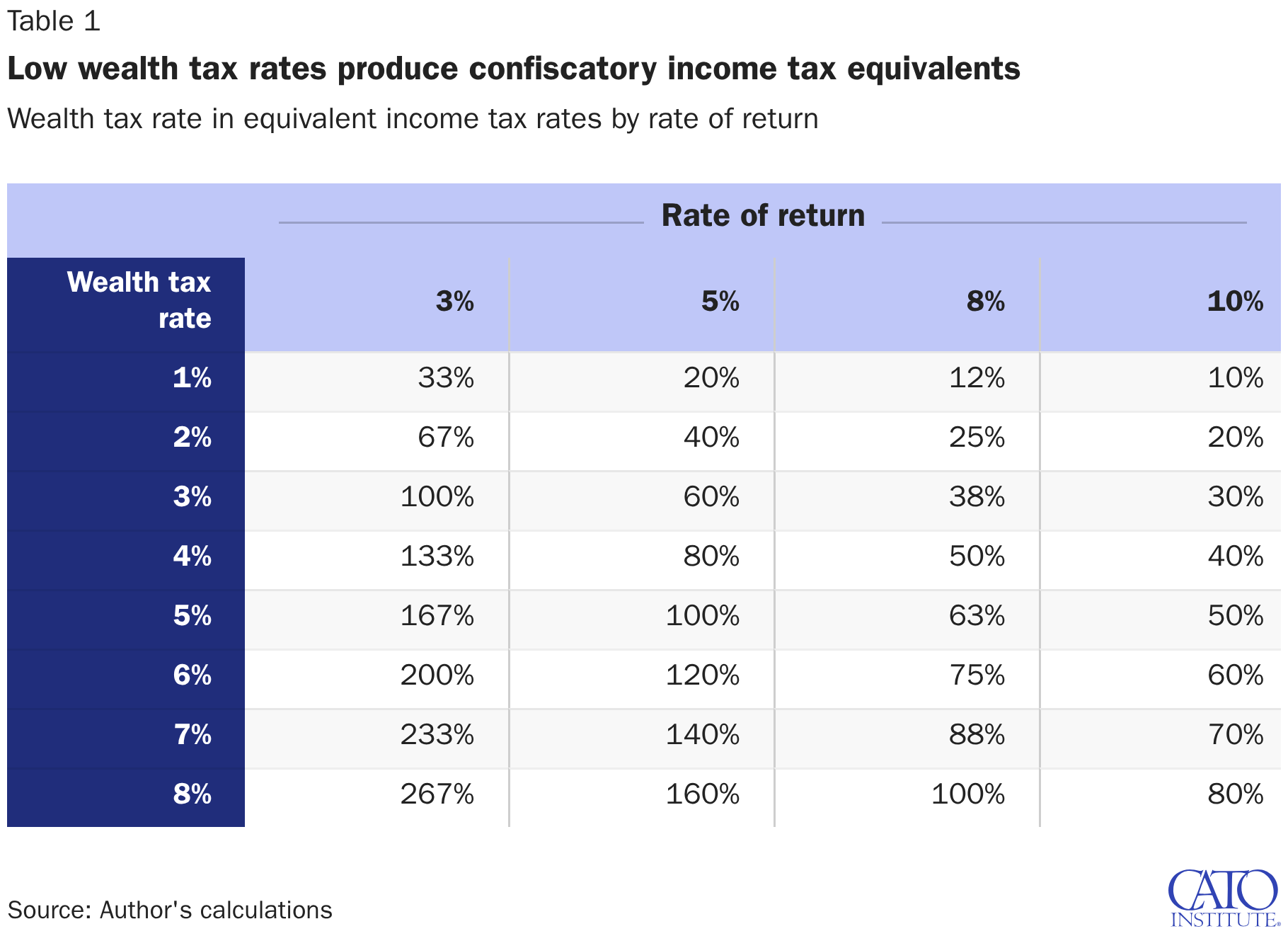
These low-rate wealth taxes are similar in economic effect to very high-rate income taxes. Wealth tax bills must be paid from annual income or cash flow. Suppose a person receives a pretax return of 8 percent on their family business. An annual wealth tax of 3 percent would effectively reduce that return to 5 percent, which would be like imposing a burdensome 38 percent marginal income tax rate. That 38 percent rate would be applied on top of the current federal and state individual income tax rates, which have top combined marginal rates ranging from 40.8 percent to 55.2 percent, depending on the state.22
Because the wealth tax is applied to asset value rather than yield, it imposes lower effective income tax rates on higher-yielding assets and higher rates on lower-yielding ones. Table 1 shows the equivalent income tax rates for various wealth tax rates at different rates of return. At California’s proposed wealth tax rate of 5 percent, any asset earning less than a 5 percent annual pretax return would face marginal effective income tax rates above 100 percent, even before paying other taxes. People with the lowest returns would perversely get hit with the highest tax rates. People losing money would face infinite marginal tax rates. At Sanders’s 2020 proposed 8 percent top rate, any annual returns below 8 percent would be hit with tax rates above 100 percent.
Wealth Taxes Abroad
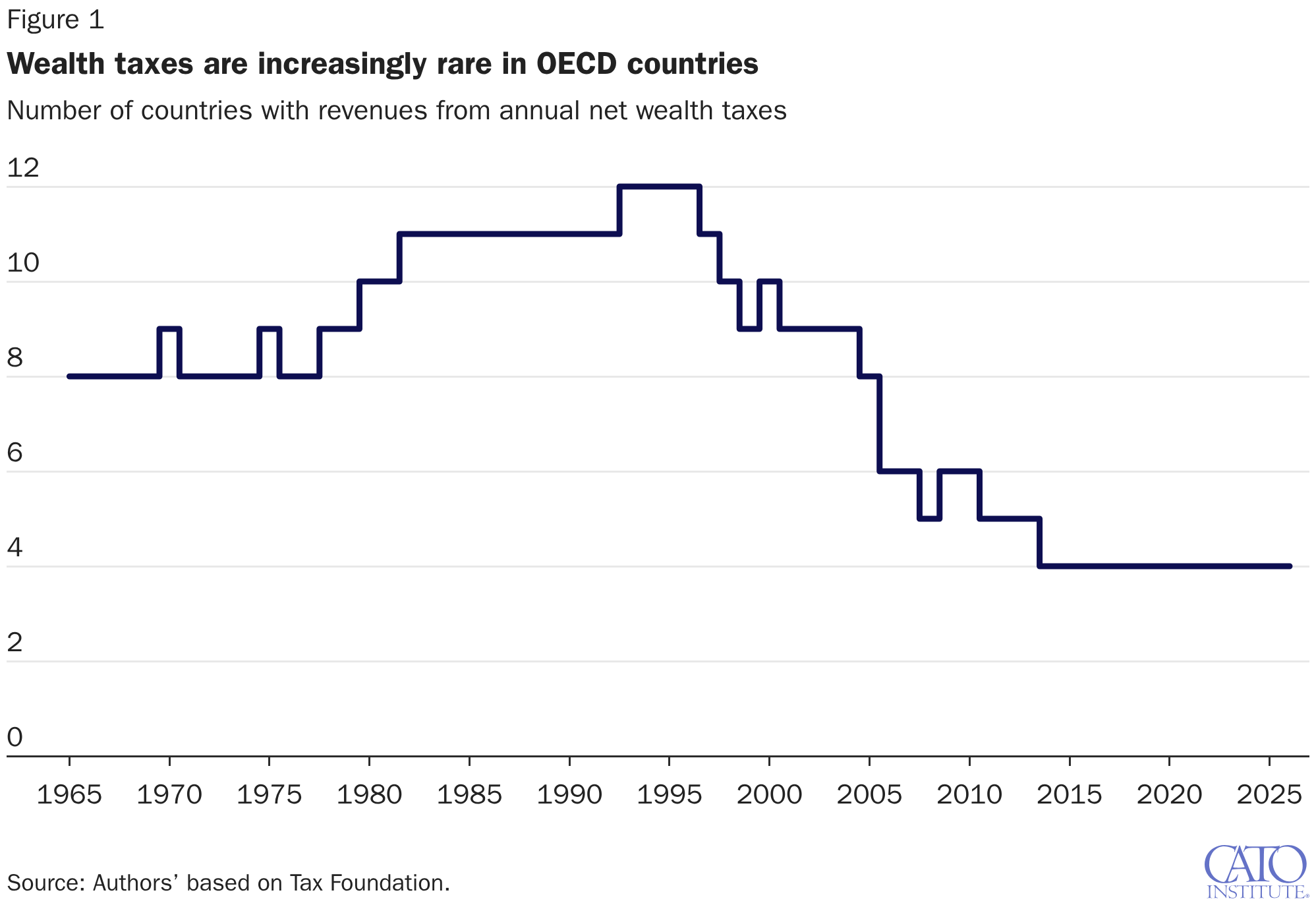
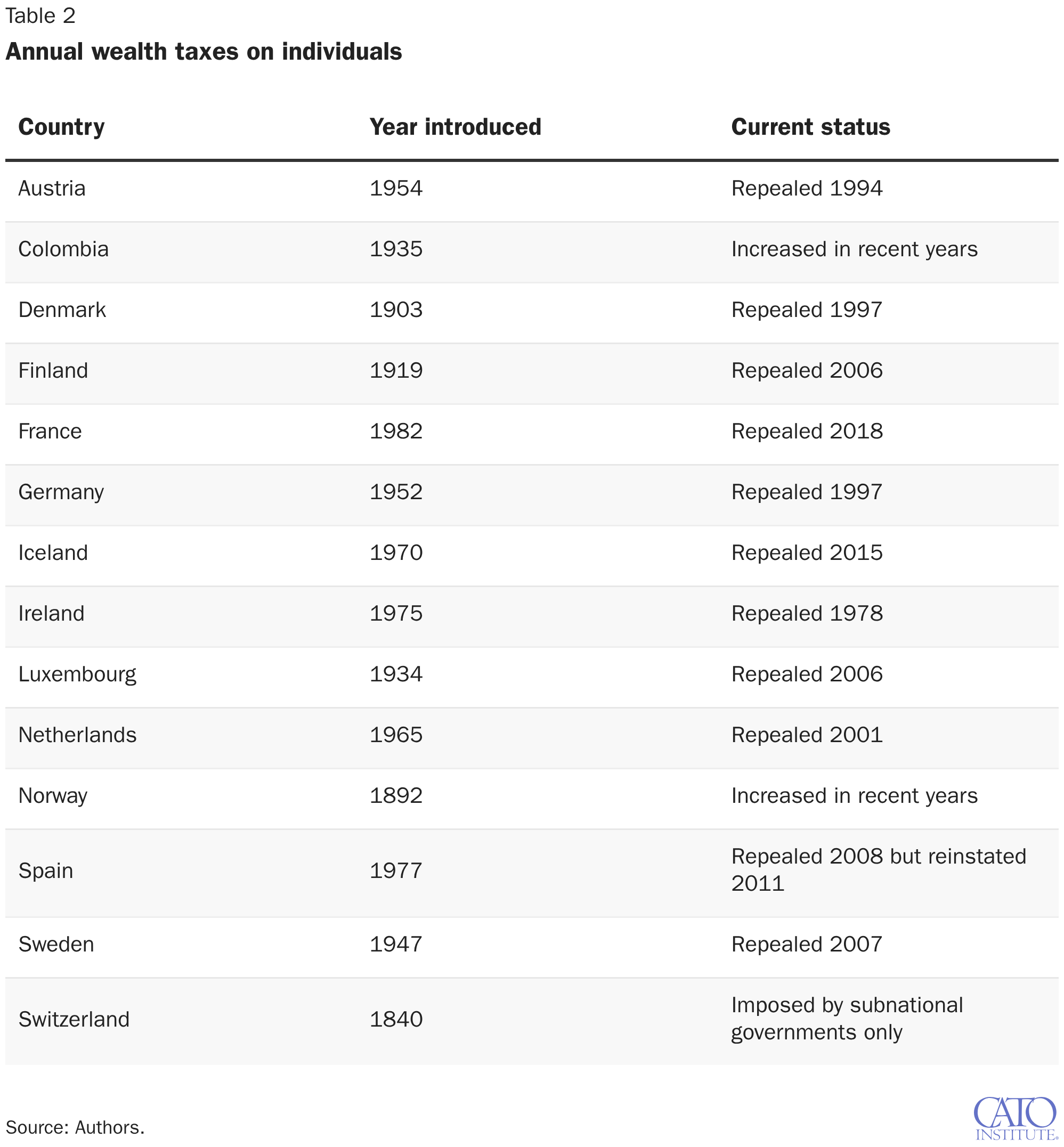
Numerous countries have imposed annual wealth taxes, but most have been repealed due to the high administrative burdens, political unpopularity, and the economic damage they caused. Figure 1 shows that the number of OECD countries with annual wealth taxes fell from 12 in 1990 to just 4 today—Norway, Spain, Switzerland, and Colombia.23 Ireland imposed, and then repealed, its wealth tax in the 1970s, while Colombia joined the OECD in 2020, so there have been 14 OECD countries that have had wealth taxes at some point.
Wealth Taxes Repealed
Countries have repealed their wealth taxes because they raised little revenue, imposed high administrative costs, induced the wealthy to flee, and damaged economic growth. A 2018 OECD study concluded that several countries have repealed their wealth taxes in response to capital flight and “concerns about their efficiency and administrative costs, in particular in comparison to the limited revenues they tend to generate.”26 In countries that have had wealth taxes, they typically raised only about 0.2 percent of GDP in revenue.27 In 2024, Norway raised about 0.6 percent of its GDP in taxes on personal wealth, Spain 0.2 percent, and Switzerland 1.1 percent.28
Following are the countries that have repealed their annual wealth taxes:
Austria abolished its wealth tax in 1994, “mainly due to the high administrative costs that accrued in the data collection process and because of the economic burden the wealth tax meant to Austrian enterprises.”29
Denmark cut its wealth tax rate in 1989 and repealed the tax altogether in 1997.30
Finland abolished its wealth tax in 2006, a reform “motivated by the fact that the tax had an unfair impact on enterprises and provided many possibilities to evade the tax,” noted a 2014 European Commission report.31
France abolished its broad wealth tax in 2018, narrowing it to only apply to real estate wealth, after many news articles discussed wealthy entrepreneurs and celebrities fleeing the country. The government estimated that “some 10,000 people with 35 billion euros worth of assets left in the past 15 years”—but the capital flight reversed following repeal of the tax.32 A related reform was the 2015 repeal of France’s 75 percent “supertax” on high incomes, which also raised little money and encouraged high earners to leave the country.33
Germany repealed its wealth tax in 1997 after a constitutional court struck it down due to inequities in the treatment of different asset types. The tax repeal appears to have had a positive effect on savings.34
Iceland imposed a wealth tax of 1.45 percent, which it reduced to 0.6 percent in 2003 and abolished entirely in 2006. Iceland also reduced its estate tax rate to 5 percent as part of the same reform plan.35 Following the 2008 financial crisis, Iceland briefly reintroduced the wealth tax from 2010 to 2014, before allowing it to lapse.36
Ireland imposed a wealth tax in 1975 due to concerns about wealth inequality. The tax was full of exemptions, raised little revenue, and had high administrative costs. It was repealed in 1978.37
Luxembourg repealed its individual wealth tax in 2006, citing the need to protect against capital flight and concerns about its high administrative costs.38
Netherlands abolished its wealth tax in 2001 and replaced it with an income tax on an assumed fixed return of 4 percent on financial assets (known as “Box 3”). The new tax replaced prior personal taxes on capital income. In 2021, the Dutch Supreme Court ruled that the deemed-return system (which taxed unrealized gains based on a fixed return) violated property rights whenever it taxed gains above what investors actually earned. The government has since been redesigning the tax.39
Sweden repealed its wealth tax in 2007 as it became clear that it was driving businesspeople—such as Ikea founder Ingvar Kamprad—out of the country. An analysis by Swedish economists found that wealth tax revenues were declining as “people could with impunity evade the tax by taking appropriate measures.”40 Sweden also abolished its inheritance tax in 2004, which was “offset in the long term by higher future recurring taxes tied to business activity.”41
These European wealth taxes typically applied to wealth levels far below those proposed in the current US debate. The Warren proposal would tax net wealth above $50 million, and the California ballot initiative above $1 billion. But other countries’ wealth taxes had lower exemption thresholds, typically $1 million or less.42 The problems that doomed the European taxes—avoidance, evasion, capital flight, and asset valuation complexities—are most pronounced at top-end wealth levels, which is exactly where proposed US wealth taxes are aimed.43
European experience suggests that the comprehensive tax bases envisioned in US proposals would not survive real-world politics. Every wealth tax enacted has been narrowed by loopholes, as special-interest groups have lobbied for carveouts. Pension assets were almost universally exempted; owner-occupied housing was either exempted or deeply discounted; and family business assets, farmland, forest holdings, and life insurance were carved out in most countries.44 France exempted antique cars, art, and stocks of wine and brandy.45 We could expect a Swiss cheese tax base if a US proposal ever wound its way through Congress.
Wealth Taxes Retained
Only four countries still impose annual wealth taxes. The taxes tend to have bases reaching into the middle class, but also generous carveouts for various types of assets. They are as follows:
Colombia, which joined the OECD in 2020, made its wealth tax permanent in 2022 after decades of intermittent use.46 The current tax applies at rates from 0.5 to 1.5 percent on net wealth above about $1 million.47 Under earlier versions of the tax, businesses cut investment and jobs, while individuals put large efforts into avoidance and evasion.48 The most recent tax increases appear to have induced renewed capital flight.49
Norway has imposed a national wealth tax since 1892. The 2026 combined municipal and state rates are 1 percent on net wealth above about $190,000 for individuals and $380,000 for couples, rising to 1.1 percent on net wealth above $2.1 million.50 The base excludes pensions, taxes primary residences at 25 percent of value, and taxes operating shares in listed companies at 80 percent of value.51 In 2022, Norway raised its wealth tax rate and the dividend and capital gains tax.52 Those hikes led to a widely reported exodus of wealthy Norwegians to Switzerland and other low-tax jurisdictions, including Kjell Inge Røkke, who was one of Norway’s largest taxpayers.53 The Norwegian Ministry of Finance has calculated that emigrants in 2022 and 2023 took $14.1 billion in deferred income out of the country, which represents about $5 billion in forgone tax revenue.54 That capital flight occurred despite Norway having strong civic norms, an exit tax regime, and substantial financial transparency. Norway abolished its inheritance tax in 2014 because it was considered unfair, raised little revenue, and impeded the transfer of family businesses.55
Spain repealed its wealth tax in 2008, reinstated it in 2011 as a “temporary” measure, and now has extended it indefinitely. Rates and thresholds are set at the regional level and vary widely; the national default applies to wealth above the €700,000 ($823,000) personal exemption, with rates from 0.2 percent to 3.5 percent.56 Madrid and some other regions had eliminated wealth taxes on their residents by applying a 100 percent federal credit. But that ended in 2022 when the central government enacted the Solidarity Tax on Large Fortunes with rates from 1.7 to 3.5 percent above €3 million ($3.53 million), which overrode the regional credits. The Spanish wealth tax base excludes €300,000 ($353,000) of personal residence value, family business shares, certain equity shares, art, and antiques. Spanish taxpayers responded to such law changes. When Madrid zeroed out its regional wealth tax, the stock of wealthy taxpayers in the region grew by roughly 10 percent relative to other regions in the first five years following the tax’s repeal.57 Meanwhile, under the new Solidarity Tax, the central government has only raised about 40 percent of its expected revenues as taxpayers responded negatively to the levy.58
Switzerland has long imposed wealth taxes at the canton level. With additional municipal taxes and local church taxes, the rates range from 0.13 percent to 0.86 percent.59 Exemption thresholds are typically quite low—for example about $102,000 for single filers and $203,000 for married filers in Zurich.60 Swiss data show that “reported wealth holdings in Switzerland are very responsive to wealth taxation,” with a 0.1 percentage point increase in the wealth tax rate lowering reported wealth by 4.3 percent.61 However, these negative effects are offset by the generally low-tax regime in the country. Switzerland has no federal capital gains tax, low corporate income taxes, and moderate value-added and individual income taxes.62
In sum, Switzerland offsets the damage caused by its wealth taxes with a generally low-tax system, while Spain, Colombia, and Norway are experiencing the same problems that prompted wealth tax repeals elsewhere: tax avoidance, tax evasion, capital flight to lower-tax countries, and movement of the wealthy abroad.63
California Wealth Tax Proposal
In November 2026, Californians will vote on the Billionaire Tax Act, a union-sponsored ballot initiative imposing a one-time 5 percent tax on the worldwide net worth of anyone who was a California resident on January 1, 2026, with assets above $1 billion.64 If the tax is approved, it would be layered on top of what is already the most progressive state tax system in the country.65 The highest-earning 2.5 percent of Californians—those making more than half a million dollars a year—already pay 49 percent of all state income tax revenues.66 The wealth tax would tip the scales even more aggressively against the wealthy, sending the message that they are not welcome in California.
It is unlikely that the tax would be a one-time levy. The tax would be payable over five years, and policymakers would get used to the extra spending that it allows. The initiative does nothing to reform the underlying special-interest and political pressures that continually expand state spending. This is the history of Spain’s “exceptional and temporary” 2011 wealth tax and Colombia’s temporary wealth tax, both of which were made permanent.
Proponents claim the California tax would raise $100 billion.67 But a recent Hoover Institution study estimates that nearly 30 percent of the expected tax base left California before the initiative qualified for the ballot.68 The authors catalog at least six billionaires, including Larry Page, Sergey Brin, Peter Thiel, and Steven Spielberg, who departed ahead of the 2026 deadline.69 After correcting the tax base and the methodology, the Hoover authors estimate that the wealth tax would collect about $40 billion, or 60 percent less than its proponents estimated.
Even $40 billion overstates the potential increase in state revenues. That is because California’s billionaires pay between $3.3 billion and $5.8 billion in state income taxes every year, and departing billionaires would take those payments with them permanently. Accounting for lost income tax revenue, the Hoover study’s authors find that California could lose $25 billion in net revenue over time.70 Economist Jared Walczak reaches a similar conclusion, estimating ongoing revenue losses of $3.5 billion to $4.5 billion per year.71
These estimates assume that only billionaires respond to the California tax. But entrepreneurs and investors below the billion-dollar threshold would likely expect that the tax would be expanded to include them in the future. Given California’s chronic budget shortfalls and its appetite for aggressive top-end taxation, high earners would expect that the one-time billionaire tax could become an annual tax on a larger population. Broader outmigration would deepen the state’s fiscal losses.
A final factor encouraging high earners to move out is the proposed aggressive and unfair collection methods. As Walczak details, the rules systematically overvalue wealth by counting voting control of shareholders instead of actual ownership, apply rigid valuation formulas to private businesses, impose severe penalties that discourage good-faith valuation disputes, and include anti-avoidance provisions written so broadly that they can tax assets that are no longer owned and wealth that may never be realized.72 The initiative also reaches backward to the beginning of 2026, before the initiative had qualified for the ballot. This structure is sure to bring legal challenges, but the threat of the tax is enough to drive wealth out of the state.73
Complex Administration
Proponents of a US annual wealth tax may imagine a system that is simple, broad-based, easy to administer, and lucrative for the government.74 Experience abroad suggests that the opposite is true. Wealth taxes have been complex and costly to collect, and they have induced large-scale avoidance while raising relatively little revenue. The gap between promise and performance has stemmed from problems with valuation, liquidity, administrative burdens, and unfairness.
Valuation. Wealth taxes require taxpayers to report the values of their financial securities, real estate, household furnishings, artwork, jewelry, vehicles, boats, life insurance policies, pensions, family businesses, and farm assets. Many of these items have no ready market prices. Accounting for wealth held in trusts adds further complexity.75 Because asset prices fluctuate, an army of accountants is needed to prepare regular valuations for tax returns. Finding that many forms of wealth are “difficult or impractical to value,” a UK expert review concluded: “Levying a tax on the stock of wealth is not appealing.”76 Similarly, tax law professor Miranda Perry Fleischer concluded that a US annual wealth tax would be “hobbled by valuation issues.”77
Consider that while the IRS handles about 7,000 estate tax returns a year, Elizabeth Warren’s 2019 proposed wealth tax would require annual filing by more than 75,000 taxpayers, with valuation disputes recurring year after year rather than once at death.78 The Michael Jackson estate illustrates the difficulty of valuing assets of the wealthy. Jackson died in 2009, and the Tax Court did not issue an opinion resolving all the valuation disputes until 2021.79 An IRS study comparing valuations on estate tax returns to valuations of the same estates on the Forbes 400 list found that estate tax valuations were, on average, only 50 percent of the Forbes figures.80 And in a 2019 survey of economists, 73 percent agreed, and only 7 percent disagreed, that Warren’s wealth tax would be “much more difficult to enforce than existing federal taxes because of difficulties of valuation.”81
Liquidity. Wealth tax payments are difficult for people who hold illiquid assets that generate little cash flow, such as homes, artwork, and ownership shares in family businesses. The need to pay a wealth tax each year can force inefficient asset sales, require taxpayers to borrow, and can pressure businesses to pay dividends just to fund an owner’s tax bill, thus pulling capital out of productive uses.82 The OECD found that liquidity issues have been a major problem with wealth taxes in Europe.83 Standard mitigations, such as exempting illiquid assets, create their own distortions.
Administrative costs. Valuation and liquidity problems result in wealth taxes being expensive to collect relative to revenues generated. Economist David Burgherr estimates that a best-case, well-designed wealth tax generates compliance costs for taxpayers of roughly 0.1 percent of taxable wealth and administrative costs for the tax authority of another 0.05 percent.84 That implies a 1 percent wealth tax effectively carries a 15 percent administrative surcharge before any avoidance is considered. Cedric Sandford and Oliver Morrissey’s 1985 study of the Irish wealth tax found that administrative costs were at least 25 percent of the revenues collected.85
Wealth taxes could be imposed just on domestic assets, but that would induce the wealthy to hold their assets overseas. As a result, wealth taxes typically apply to worldwide assets, which gives tax authorities a costly challenge in finding and valuing all foreign holdings. Leaked client lists from offshore financial institutions matched to administrative wealth records in Norway, Sweden, and Denmark found that wealthy households evade roughly 25 percent of their taxes through offshore vehicles, and standard enforcement detects less than 5 percent of evasion.86
India enacted an annual wealth tax in 1957 and repealed it in 2015.87 Indian finance minister Arun Jaitley described reasons for the scrapping of the tax: “The practical experience has been it’s a high cost and a low yield tax.”88 Similarly, an expert study in the UK, the Mirrlees Review, concluded that the wealth tax in Europe “has been a particularly inefficient tax to collect,” and that for the UK it would be “costly to administer, might raise little revenue, and could operate unfairly and inefficiently.”89
Fairness. Wealth taxes have undermined the sense of fairness that they were supposed to promote because valuations are contested, the wealthy pay for expert advice to avoid the taxes, and lobbying creates loopholes for the well-connected. In its study, the OECD concluded, “A major concern with net wealth taxes is the ability of wealthier taxpayers to avoid or evade the tax. This has limited the potential of net wealth taxes to achieve their redistributive objectives and has contributed to perceptions of unfairness.”90 Economist Åsa Hansson studied European wealth taxes and found that they often resulted in “poisoning general tax morale” because of the exemptions provided and the widespread avoidance.91 The OECD concluded that “wealth taxes were unpopular in a number of countries, which contributed to their repeal.”92
Tax Avoidance and Capital Mobility
The flow of capital across international borders has soared in recent decades. Corporations and individuals are moving their investments to countries with lower taxes and better growth opportunities. Most nations have responded by cutting tax rates on capital to prevent erosion of their tax bases and to spur economic growth. The OECD notes that the “repeal of net wealth taxes can also be viewed as part of a more general trend towards lowering tax rates on top income earners and capital.”93
Since 1981, the average corporate tax rate across OECD countries fell from 47 percent to 24 percent, the average top personal income tax rate fell from 66 percent to 48 percent, and the average combined corporate–individual rate on dividends fell from 75 percent to 48 percent.94
Many countries have also cut their capital gains taxes and withholding taxes on cross-border investment flows. Numerous OECD countries have abolished their estate and inheritance taxes, including Australia, Austria, Canada, the Czech Republic, Israel, Mexico, New Zealand, Norway, Portugal, the Slovak Republic, and Sweden.95 Estonia, Latvia, and Costa Rica never imposed them.96 The share of GDP raised by estate and inheritance taxes in the OECD fell from 0.3 percent in 1965 to 0.1 percent today.97 A similar trend of repealing estate taxes exists at the state level in the United States.98
These beneficial reforms spurred the OECD bureaucracy to try and impose the Inclusive Framework, which was a failed attempt to neuter global tax competition.99 Today, wealthy global entrepreneurs are continuing to shift their capital to reduce their taxes, which creates an opportunity for American policymakers to adopt policies to attract them.
Most OECD nations recognize that wealth and capital income are responsive tax bases. High rates shrink the base—both from domestic avoidance and from international mobility. Furthermore, the wealthiest individuals have the greatest flexibility in their business and financial affairs, making them particularly responsive to tax changes.
Avoidance was common under European wealth taxes and was made easier by governments that carved out loopholes.100 Farm and small business assets were often exempted due to concerns about entrepreneurship. Pension assets were exempted over concerns about fairness. Owner-occupied housing was either exempted or deeply discounted. Artwork and antiques were exempted because of difficulties in valuation and concerns about the breaking up of collections. Forest lands were exempted for environmental reasons. Life insurance, nonprofit organizations, and intellectual property rights were often exempted. As noted, the French wealth tax exempted antique cars and stocks of wine and brandy.101 Over time, taxpayers shifted their wealth into exempted assets, and tax bases shrank.
Net wealth taxes allow deductions for debts, which encourages people to borrow and then invest in tax-exempt assets and in assets that are hard for governments to find or value. Underreporting taxable assets and overreporting deductible debt lowers the wealth tax base. The OECD found that there was “clear evidence of wealth tax avoidance and evasion” in Europe.102 Similarly, an International Monetary Fund article concluded, “The design of wealth taxes is notoriously prone to lobbying and the granting of exemptions that the wealthiest can exploit. Furthermore, the rich have proved adept avoiding or evading taxes by placing their wealth abroad in low tax jurisdictions.”103
Ireland’s experience illustrates how politics and loopholes shrink wealth tax bases. The country imposed a wealth tax in 1975, but lobbying by agricultural, accountancy, commercial, and tourism groups stripped out so many assets—homes, farms, pensions, art, jewelry—that the tax raised little money and was abolished in 1978 because the “administration and compliance costs were very high relative to the yield.”104
The Swedish wealth tax experience was similar. Despite high statutory rates and growing wealth in the nation, wealth tax revenue remained chronically low, which economists Magnus Henrekson and Gunnar Du Rietz called “a strong indication that people could with impunity evade the tax by taking appropriate measures.”105 Over time, exemptions and other forms of relief narrowed the tax base, debt financing shifted assets into untaxed categories, and large fortunes moved offshore once exchange controls were lifted in 1989.106 Sweden repealed its wealth tax in 2007.
Norwegian, Spanish, and Colombian wealth taxes suffer similar failures.107 The tax in each country raises less revenue than projected, causes capital flight, and induces widespread avoidance. In Norway, Marie Bjørneby, Simen Markussen, and Knut Røed find that owners shift wealth into closely held firms, which receive valuation discounts under the wealth tax.108 Confirming the anecdotal evidence, Roberto Iacono and Bård Smedsvik exploit a Norwegian municipal reform and find a large elasticity of taxable wealth and large mobility of wealthy taxpayers.109
In Spain, a 2025 study by economists David Agrawal, Dirk Foremny, and Clara Martínez-Toledano found that when Madrid zeroed out its wealth tax, Spanish regions that lost residents who had moved to Madrid lost six times more personal income tax revenue from each departing taxpayer than they gained in wealth tax revenue.110 And in Colombia, Juliana Londoño-Vélez and Javier Ávila-Mahecha found that two-fifths of the wealthiest 0.01 percent of taxpayers evaded the tax, concealing about one-third of their wealth offshore.111 Each of these examples shows how capital mobility, on numerous margins, undermines real-world wealth taxes.
While the experiences of Colombia, Norway, and Spain show clear examples of domestic tax avoidance, in other countries, cross-border capital mobility is also a major issue. The Henrekson and Du Rietz’s study on Sweden finds:
In 1989 all foreign exchange controls were lifted, making it difficult to prevent people from transferring wealth to tax havens, either illicitly or when taking residence in another country. Several studies found that a sizable share of large fortunes was being placed outside of Sweden in countries like Luxembourg and Switzerland. In those cases the government not only lost income from wealth taxation, but also tax revenue on capital gains, dividends and interest income. The Swedish Tax Authority (Skatteverket) reported that in the early 2000s the value of assets illicitly transferred offshore may have amounted to more than SEK [Swedish krona] 500 billion, and the accumulated assets of Swedish billionaires living abroad were at least as large. The magnitude of these outflows was a major motivation for the repeal of the wealth tax in 2007.112
As Henrekson and Du Rietz observe, the problem with capital outflows is that governments lose not only wealth tax revenues but they also lose other tax revenues that would have been generated by the outgoing individuals and their assets, had they stayed.
In France, the wealth tax raised far less revenue than expected when it was introduced in the 1980s, due in large part to taxpayer avoidance and evasion.113 Bertrand Garbinti and coauthors studied a 2012 French reform that scaled back wealth tax reporting for taxpayers below a certain threshold, and found that reported wealth growth among the affected taxpayers fell by roughly 20 percent.114 Economist Eric Pichet calculated that domestic evasion reduced French wealth tax revenues by at least 28 percent, and that the tax induced a capital flight of about €200 billion ($235 billion) between 1988 and 2007.115 He estimated that, while the French wealth tax raised €3.5 billion ($4.11 billion) a year, the government lost about €7 billion ($8.23 billion) a year in other tax revenues from departing capital. He concluded, “The fact that it costs more than it yields engenders a paradoxical situation in which all of France’s other taxpayers, including its least wealthy citizens, must bear the brunt of its overall tax burden.”116
Who Bears the Burden of Wealth Taxes?
Advocates of wealth taxation pitch it as a tax on the rich. The actual incidence is more complicated. Taxes on capital do not simply burden the people who write the checks. They also partly shift the burden to workers whose livelihoods are supported by the capital.
Capital and labor are complements in production. Capital includes the machines, buildings, vehicles, and software that workers use to do their jobs. Taxing capital reduces the after-tax returns to saving and investing and shrinks the capital stock. As it shrinks, worker productivity declines, and taxes on capital are shifted to workers in the form of lower wages. A recent review of estimates on this relationship indicate that a 1 percent reduction in capital per worker reduces wages by about 3 percent.117
Economist Greg Mankiw describes a simple economy with two groups: workers and capitalists.118 The capitalists save and earn capital income, while the workers earn wages and do not save. The workers are in the democratic majority and can set tax policy any way they want. Should they tax wages, capital income, or both? It turns out that—acting in their own best interests—the workers should want to tax wages only, not capital income. This is because the supply of capital is perfectly elastic—or responsive—which is a reasonable approximation of today’s globalized economy in the long run.
However, the amount of the tax burden that lands on workers depends, in part, on who pays the tax and whether foreigners pay it also. The corporate income tax is imposed on firms regardless of who owns them. A factory in Ohio owes US corporate tax whether its shareholders are American or foreign. So, if the corporate tax is raised, investors shift to other jurisdictions with lower tax rates. In an open economy, the domestic capital stock shrinks, and workers bear a large share of the burden through lower productivity and wages. Empirical studies on corporate tax incidence have repeatedly confirmed this pattern.119
Individual capital taxes sometimes work differently. Taxes on dividends, interest, and capital gains apply to US shareholders, regardless of where the capital they own is located. When the United States raises its taxes on saving, American shareholders face a lower after-tax return and so they want to hold less wealth, which would drive down asset prices.120 Most foreign shareholders are exempt from this tax increase, although they are still subject to their own domestic taxes. As a result, foreigners step in and buy those assets, holding the pretax return and the cost of capital fixed. In this simple model, investment and employment do not change, but ownership shifts from Americans to foreigners so that foreign owners receive profits that would have otherwise accrued to Americans.
Wealth taxes are imposed on individuals. Economist Kyle Pomerleau explains that a wealth tax in an open economy may lead to a small decline in domestic investment and output, but the larger effect is “the increase in foreign lending and foreign ownership of the U.S. assets would result in less total income for Americans, or lower GNP.”121 Wealth tax proponents lean heavily on this residence-based, open-economy story. Economists Emmanuel Saez and Gabriel Zucman argue that a US wealth tax would not reduce the domestic capital stock because foreign saving would substitute for the lost domestic saving.122
This is a striking concession for wealth tax advocates to make. Saez and Zucman say that their wealth tax would not reduce US investment because foreigners would buy up US companies. The United States ends up with the same factories and equipment, but the investment returns would now flow abroad; US policymakers would strongly oppose a policy outcome whereby foreigners would own much more of American production.
Importantly, this defense also collapses under a globally coordinated wealth tax, which Zucman also proposes.123 If there are no investors in an untaxed jurisdiction to supply the needed investment, the tax burden falls on the global capital stock, reducing investment, productivity, and wages everywhere.
While this theoretical result is interesting, empirical studies paint a more complex picture.124 Most have focused on publicly traded companies, where foreign ownership substitution works with the least friction. But much of the wealth targeted by wealth taxes are other types of assets, including closely held businesses, illiquid holdings, real estate, and assets tied to specific owners and their human capital. As Pomerleau notes, “A significant amount of the U.S. capital stock is held in closely held businesses that are typically structured as passthrough businesses. A family-owned laundromat, for example, is unlikely to be acquired by foreigners. Owner-occupied housing, by definition, is owned by residents of the United States.”125
Empirical studies of wealth taxes find substantial real effects, not just changes in domestic and foreign ownership shares. Pichet found that the French wealth tax cost the government roughly twice as much in forgone income, dividend, and capital gains tax revenue than it raised, a magnitude inconsistent with foreign capital fully replacing departing French capital.126 A 2010 study by Åsa Hansson examined the relationship between wealth taxes and economic growth across 20 OECD countries from 1980 to 1999. She found “fairly robust support for the popular contention that wealth taxes dampen economic growth,” although the magnitude of the measured effect was modest.127 This is likely because much wealth is in the form of private businesses, real estate, and founder-controlled stakes in public firms.128 Hitting those forms of wealth translates more directly into reduced domestic investment. Closely held and founder-led firms are also the places where investment-level taxes are most likely to enter the service price of firm investment.
Additionally, taxes on capital and wealth are taxes on entrepreneurial labor. Building a company is hard work, and founders put years of effort into developing products, hiring employees, and managing operations before they see any payoff.129 Much of what capital and wealth taxes target is founder time and effort, which will shrink if taxes rise. Foreign capital is not likely to fully step in and replace American owners who are taxed out of the market. And if founders were forced to sell, firms would lose their founder-led performance premium.130 Through multiple channels, workers would be forced to bear a substantial portion of the wealth tax burden, even in a generally open economy.
Models invariably find that wealth taxes impose damage, but the effects vary depending on assumptions about economy openness. Germany’s Ifo Institute modeled a 1 percent wealth tax above €1 million ($1.18 million) in a relatively closed European economy. They found that long-run GDP would fall by about 5 percent and that related revenue losses would exceed revenue from the wealth tax, producing an overall net fiscal loss.131
Former Congressional Budget Office director Douglas Holtz-Eakin and economist Gordon Gray examined the Warren wealth tax within a moderately open economy.132 They found that the tax would reduce long-run GDP by 1 percent and shift roughly 63 cents of every dollar of revenue onto workers in the form of lost earnings.
Meanwhile, the Penn Wharton Budget Model assumed a moderately open economy in its estimates of the Warren wealth tax. The model found a 1.2 percent long-run GDP reduction, a 3.1 percent decline in the capital stock, and a 1.2 percent fall in wages.133
The Tax Foundation also modeled the Warren wealth tax. Its analysis assumed an almost completely open economy and found a long-run GDP reduction of just 0.37 percent, because the tax causes “international investors to replace home-grown billionaires as owners of capital.”134
The argument that a wealth tax targets only the rich relies on one of two strong assumptions: foreigners and domestic investors are perfectly substitutable, or capital does not matter much for productivity and wages. The first assumption fails empirically for a large portion of the assets that a wealth tax targets. The second is contradicted by decades of evidence on capital formation, productivity, and growth. Wealth taxes will fall, in large part, on American workers in the form of lower wages and fewer job opportunities.
Is Wealth a Problem?
Advocacy for a wealth tax treats the fortunes of the rich as if they were growing piles of gold that were taken from the rest of us and hoarded within a few families, passed down for generations. Warren says that her tax will address “runaway wealth concentration,” and the California wealth tax targets “excessive accumulations of wealth.”135 In championing Warren’s tax, former New York Times columnist Paul Krugman claimed, “we seem to be heading toward a society dominated by vast, often inherited fortunes.”136 Even Scott Bessent, the current US Treasury Secretary, has made comments suggesting that the economy is a zero-sum game, with capital and labor working at cross-purposes.137
However, capital and labor are complements in production. More savings or wealth supports the overall economy. Wealth at the top is overwhelmingly productive capital that benefits all of us, it is not idle accumulations of money. It is mostly built by entrepreneurs rather than inherited, and it has not caused the broader social harms that critics claim it does.
Wealth in America is not concentrated, but instead it is dispersed across the economy in productive business assets. Among the top 0.1 percent of households, 73 percent of net wealth is equity in private or publicly traded companies, and just 5 percent is the value of homes.138 Looking just at billionaires, only 2.7 percent of their wealth is accounted for by their homes and personal assets, such as yachts, airplanes, cars, jewelry, and artwork.139 The great majority of their wealth is business assets that generate output for the broader economy. Jeff Bezos’s roughly $250 billion fortune is mostly his stake in Amazon, which employs more than a million people and ships billions of packages a year.140 Private fortunes are also productive. The Cargill and MacMillan families own 90 percent of Cargill, a company with $150 billion in annual revenue and 155,000 employees, that was built over 160 years by multiple generations.141
When politicians say that wealth is concentrated, they mean that those who built America’s most valuable companies own large shares of them. But that is the arrangement that workers and the public should want: If entrepreneurs cannot expect to own the companies they build, they will build fewer of them.
The wealthy often do not just build one business; they also risk their wealth to fund new ones. Many wealthy individuals are angel investors, who back risky startups before the latter have gained access to banks or public markets. Apple, Amazon, Google, and Tesla all relied on early funding from wealthy individuals who were willing to fund untested ideas. The COVID-19 vaccines that Moderna and Pfizer/BioNTech delivered in less than a year were possible because angel investors and venture capitalists had funded mRNA research through more than a decade of losses.142 Without large pools of private wealth willing to take such long-term risks, many innovations would not have materialized and the US economy would not be at the leading edge.
In the United States, top wealth is mostly built, not inherited. Seventy-three percent of American billionaires are self-made, and the share of the Forbes 400 who built their own fortunes rose from 40 percent in 1982 to 71 percent by 2025.143 Just 15 percent of the net wealth of the richest 1 percent of Americans is inherited.144
Top wealth is dynamic. Only 13 of the original 1982 Forbes 400 names were still on the list in 2025.145 Robert Arnott, William Bernstein, and Lillian Wu followed the 1982 list through 2014 and found that the surviving names’ wealth grew more slowly than if they had simply invested passively in stocks and bonds, concluding “dynastic wealth accumulation is simply a myth.”146 Today’s top wealth holders are largely entrepreneurs who built companies, not heirs living the easy life, and the composition of the group changes rapidly as new businesses succeed and older fortunes are divided, consumed, and donated.
A report released by the United Nations worries that concentrations of wealth “have become a threat to democracy.”147 But the wealthy do not have homogeneous political views. The 20 wealthiest members of Congress are 8 Democrats and 12 Republicans, and a Pew survey finds that Americans in the upper-income tier are nearly as likely to identify as Republicans as Democrats.148 George Soros and Tom Steyer fund liberal causes. Charles Koch and Sheldon Adelson fund libertarian and conservative causes, respectively. They cancel each other out rather than collude for political power.
The wealthy fund political campaigns, but their money does not reliably buy elections or votes. Economist Steven Levitt analyzed repeat congressional challengers and found that “campaign spending has an extremely small impact on election outcomes.”149 Scholars Stephen Bronars and John Lott found that legislators vote the same way in their final terms—when they no longer need donations—as they did earlier in their tenures. They argue that donors select candidates who already share their views.150
A review of 40 studies on the relationship between campaign contributions and congressional voting behavior found that in three out of four studies, campaign contributions had no effect, or the directionally wrong effect, on legislators’ votes.151 The 2016 election was a good case study: Donald Trump won the presidency, spending about half of what Hillary Clinton did.152 In the following presidential cycle, Michael Bloomberg spent more than $1 billion of his own money in the 2020 Democratic primary and only won one primary, in American Samoa.153
Even when the preferences of the rich systematically diverge from those of the middle class, the rich do not consistently get their way. Examining 1,779 policy questions over more than two decades, three political scientists find that, when middle-income and affluent Americans disagree, the affluent win only 53 percent of the time. Moreover, the two groups don’t disagree all that often.154 Over the 22 years they studied, the rich got their way on roughly one extra bill every two years. That’s a small effect, and one that other research shows is better explained by party affiliation than by income.155
If political capture by a monolithic wealthy class were really driving policy, we would expect to see the welfare state get smaller as the number of wealthy people has increased. In the United States we see the opposite. Total federal and state social spending rose from 9.5 percent of GDP in 1980 to 15.8 percent in 2025.156 Also, there is no cross-country correlation between top wealth shares and social spending.157
Finally, the wealth share of the top is a poor proxy for the policy outcome that most people care about, which is alleviating poverty. Economist Martin Feldstein argued that the right concern “is not inequality but poverty,” and that the two move in different directions.158 Indeed, wealth inequality has risen modestly in the United States since the 1980s, but the poverty rate has fallen, median wealth has grown, wages have risen, and unemployment remains low.159
Wealth tax support is built on claims that do not survive scrutiny. Wealth at the top is mostly productive capital, self-made, and continually changing. But even inherited wealth is socially beneficial because pools of capital raise productivity, wages, and living standards throughout society.160 Wealth is good, no matter who owns it. It does not translate into political capture and is not associated with the broader harms to society that its critics claim.
Is a Federal Wealth Tax Constitutional?
The US Constitution requires that “direct” taxes be apportioned among the states by population. The Sixteenth Amendment created an exception for which Congress may “collect taxes on incomes, from whatever source derived, without apportionment.”161 That exception applies to income only. A federal wealth tax on property ownership rather than on income from the property would seem to fall outside the Sixteenth Amendment’s exception to apportionment.162 Moreover, apportionment would be a politically difficult process.
However, some scholars have argued that there may be wiggle room for a wealth tax to fall within the Sixteenth Amendment’s exception.163 Rather than taxing wealth directly, Congress could add a provision to the income tax code to tax an assumed fixed annual return on a measure of household wealth and treat it as income. The economic effect of such a tax would be similar to a wealth tax, but the tax would look like an income tax.
The Supreme Court’s 2024 decision in Moore v. United States addressed related issues but left the core questions about wealth and realization unanswered.164 The Court upheld the Tax Cuts and Jobs Act’s one-time mandatory repatriation tax on accumulated foreign earnings by a 7–2 vote. It narrowly found that a company’s foreign earnings had been realized, and that Congress could attribute the earnings to shareholders for tax purposes. The majority declined to decide whether realization is a constitutional requirement, adding “our analysis today does not address the distinct issues that would be raised by … taxes on holdings, wealth, or net worth; or … taxes on appreciation.”165
In both a concurrence and the dissent of Moore, four justices pointed out that taxing unrealized income is unconstitutional. Because net wealth taxes target unrealized gains, they likely would not survive a skeptical Court. However, some wealth tax plans would accrue tax liability on unrealized appreciation but defer collection until sale.166 The Court could decide to evaluate the tax at the moment of imposition (unrealized gains) or the moment of payment (realized gains).
Aside from these constitutional issues, however, annual wealth taxes are a bad idea for the economic and practical reasons that we have discussed. How best to tax capital is a complex issue that we discuss next, but the bottom line is that wealth taxes have no place in a fair and pro-growth tax system.
How to Tax Capital
Some policymakers believe that people with wealth should be targets of heavy taxation. They think that raising taxes on owners of capital would reduce the burden on workers—that taxing wealth would benefit the nonwealthy. However, as we discussed in the previous sections, a wealth tax would end up being both complex and damaging, and it would not meet its supporters’ goals.
If wealth tax supporters want to boost the incomes of workers, the way to do it is by low and equal taxation of capital. That would boost the capital stock, increase the productivity of workers, and generate faster wage growth. The idea goes back to Adam Smith. Writing in The Wealth of Nations, he described how heavy taxes on mobile “stock,” or capital, would cause losses to workers.167 Instead, he argued elsewhere that “peace, easy taxes, and a tolerable administration of justice” are the best ways to generate prosperity.168
The current income tax code is a long way from being easy and tolerable, especially the tax rules for capital. Some types of capital income are taxed heavily while others are exempt. The income tax distorts the choice between savings and consumption, and it is full of loopholes favoring some industries over others. Adding a wealth tax on top of the current income tax mess would only make existing distortions worse.
How can we have a tax system that does not penalize savings and investment but also distributes the tax burden fairly? How do we ensure that the rich pay taxes without all the current loopholes? The answer is consumption-based taxation, which can tax much of the same income as the current system, but in a neutral manner without the special breaks that fuel public anger. Consumption-based taxes can be assessed on transactions, such as retail sales taxes and value-added taxes. Or they can be assessed on individuals and businesses, such as the “flat tax” designed by economists Robert Hall and Alvin Rabushka and the “X‑Tax” designed by economist David Bradford.169
Both income and consumption-based taxes tax labor income and the above-normal returns to capital, which include profits from market power, innovation, windfalls, and economic rents. The difference is that income taxes also tax the normal returns to capital, while consumption-based taxes do not.170 That difference is important because it is the normal return that drives decisionmaking at the margin, and taxing it undermines savings and investment. By contrast, taxing only the above-normal profits under a consumption-based system avoids such distortions.
All taxes distort to some extent, but whereas income taxes distort both work efforts and savings, consumption-based taxes distort just work efforts. Consumption-based taxes are preferable to income taxes because they make it possible to raise a given amount of revenue with fewer distortions.171 Moreover, a consumption-based tax can be designed to match the progressivity of an income tax but collect the revenue more efficiently.172 Wealthier households receive a large share of their capital income from above-normal returns, which are taxed under consumption-based systems without exemptions.173
Bill Gates noted the benefits of consumption taxation in saying, “Think about the three wealthy people I described earlier: One investing in companies, one in philanthropy, and one in a lavish lifestyle. There’s nothing wrong with the last guy, but I think he should pay more taxes than the others.”174 That is generally true, but income taxes and wealth taxes do the opposite. They fall harder on entrepreneurial investors than on wealthy heirs who spend their fortunes on yachts and entertainment. Consumption-based taxation would fix that problem by taxing all wealth when it is consumed. Tax law professors Joseph Bankman and David Weisbach agree that consumption-based taxes would tax the “idle rich.”175
A consumption-based system would close income tax loopholes. Critics point to the “buy–borrow–die” strategy, where a taxpayer buys an appreciating asset, borrows against it to fund consumption without paying tax, and then dies and the heirs receive stepped-up basis to avoid capital gains taxes.176 Under a consumption tax, the borrowed funds would be taxed when they are spent. A consumption tax would eliminate the buy–borrow–die avoidance strategy.
A consumption tax would also eliminate the carried interest break. Under current law, the share of investment profits that private equity managers receive as compensation is taxed at long-term capital gains rates, which can be lower than the rates on ordinary wage income. The distinction of whether or not carried interest is either labor income or capital income is blurry under the income tax.177 But a consumption-based system removes the blur because wages and above-normal returns to capital are taxed at the same rate.
The income tax is riddled with distortions. Debt-financed investment is favored over equity-financed investment.178 The interest on municipal bonds is exempted from tax, with about 90 percent of the benefit accruing to the top income quintile.179 Green energy, real estate, agriculture, and many other industries enjoy special breaks. These breaks distort resource allocation and undermine the overall economy. By contrast, a consumption-based system would treat economic activities equally and allow resources to flow to the highest-valued uses.
A new wealth tax would double down on the most inefficient aspects of income taxation. Like income taxes, wealth taxes would hit the normal return to saving while letting some above-normal returns escape.180 The OECD pointed to this problem in its 2018 report on wealth taxes, noting that “the taxation of normal returns is likely to distort the timing of consumption and ultimately the decision to save, as the normal return is what compensates for delays in consumption.”181 The path forward is not to bolt a damaging wealth tax onto a flawed income tax—it is to rebuild the federal tax system around a consumption base.
Conclusion
Over recent decades, nations around the world have cut taxes on capital income and wealth. Corporate and individual income tax rates have fallen, and most nations that had annual wealth taxes have repealed them. Recent US proposals to increase taxes on capital income and wealth run counter to the lessons learned about efficient taxation in the global economy.
European countries found that imposing punitive taxes on the wealthy undermined economic growth. They found that annual wealth taxes encouraged tax avoidance and generated capital flight. European wealth taxes raised little money and became riddled with exemptions. Nearly all European wealth taxes were repealed.
Wealth is accumulated savings, which is socially beneficial and needed for investment. The fortunes of the richest Americans are mainly business assets that are used to create jobs and incomes for workers. Raising taxes on wealth and capital income would hurt average workers by undermining their productivity and wage growth.
Senator Warren says that she wants rich people to “pay a fair share, so the next kid has a chance to build something great and the kid after that and the kid after that.”182 But there is nothing about the wealth of entrepreneurs that stands in the way of the next generation. In fact, investment by the wealthy into startups and innovation are what creates opportunities for young people, not government redistribution.
Creating fair and efficient taxation of capital is a challenge, but experts widely agree that wealth taxes are not the way to do it. Rather than imposing a wealth tax or raising tax rates on capital income, policymakers should rethink the overall federal tax approach. A better way to tax capital and wealth is through consumption-based taxation, which would tax high earners but in a simpler way that does not stifle savings, investment, and growth.
Citation
Michel, Adam N., and Chris Edwards. “Failures of Wealth Taxation,” Policy Analysis no. 1021, Cato Institute, Washington, DC, July 23, 2026.

About the Authors


This work is licensed under a Creative Commons Attribution-NonCommercial-ShareAlike 4.0 International License.