
The Washington Post editorializes:
A balanced-budget amendment would deprive policymakers of the flexibility they need to address national security and economic emergencies.
A fair point. Statesmen should have the ability to “address national security and economic emergencies.” But the same day’s paper included this graphic on the growth of the national debt:
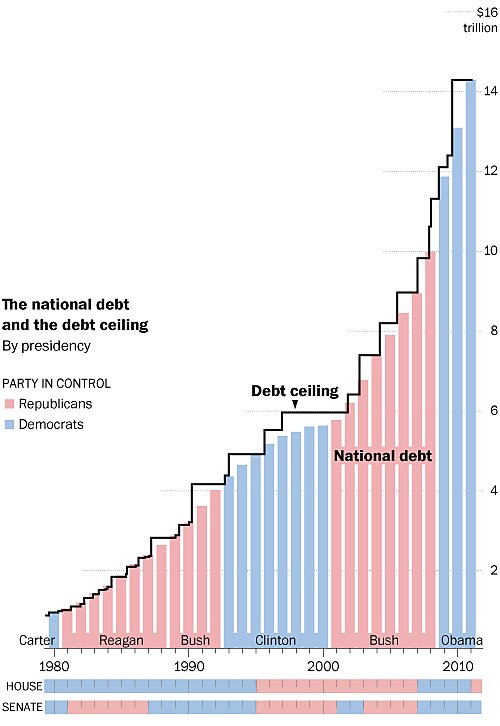
Does this look like the record of policymakers making sensible decisions, running surpluses in good year and deficits when they have to “address national security and economic emergencies”? Of course not. Once Keynesianism gave policymakers permission to run deficits, they spent with abandon year after year. And that’s why it makes sense to impose rules on them, even rules that leave less flexibility than would be ideal if you had ideal statesmen. Indeed, the debt ceiling itself should be that kind of rule, one that limits the amount of debt policymakers can run up. But it has obviously failed.
We’ve become so used to these stunning, incomprehensible, unfathomable levels of deficits and debt — and to the once-rare concept of trillions of dollars — that we forget how new all this debt is. In 1980, after 190 years of federal spending, the national debt was “only” $1 trillion. Now, just 30 years later, it’s sailing past $14 trillion.
Historian John Steele Gordon points out how unnecessary our situation is:
There have always been two reasons for adding to the national debt. One is to fight wars. The second is to counteract recessions. But while the national debt in 1982 was 35% of GDP, after a quarter century of nearly uninterrupted economic growth and the end of the Cold War the debt-to-GDP ratio has more than doubled.
It is hard to escape the idea that this happened only because Democrats and Republicans alike never said no to any significant interest group. Despite a genuine economic emergency, the stimulus bill is more about dispensing goodies to Democratic interest groups than stimulating the economy. Even Sen. Charles Schumer (D., N.Y.) — no deficit hawk when his party is in the majority — called it “porky.”
Annual federal spending rose by a trillion dollars when Republicans controlled the government from 2001 to 2007. It has risen another trillion during the Bush-Obama response to the financial crisis. So spending every year is now twice what it was when Bill Clinton left office. Republicans and Democrats alike should be able to find wasteful, extravagant, and unnecessary programs to cut back or eliminate. They could find some of them here in this report by Chris Edwards.
In the Kentucky Resolutions, Thomas Jefferson wrote, “In questions of power, then, let no more be heard of confidence in man, but bind him down from mischief by the chains of the Constitution.” Just so. When it becomes clear that Congress as a body cannot be trusted with the management of the public fisc, then bind them down with the chains of the Constitution, even — or especially — chains that deny them the flexibility they have heretofore abused.
Last week I askedif Dodd-Frank had ended “too-big-to-fail” (TBTF) that is the perception that some banks (or other companies) are simply too big to be allowed to fail, and thus, must be rescued by the government. As this was an explicit purpose of the reform efforts, it seemed like a reasonable question to ask. Apparently even raising questions about the wisdom of Chris Dodd and Barney Frank is enough to throw some people into a fit.
In offering what I assume is meant as a rebuttal to my suggestion that the debt markets seem to indicate that the largest banks are currently enjoying a significant funding advantage over the smallest banks, which could result from “too-big-to-fail”, Matt Yglesias makes the quite accurate observation: “The thesis that looking at the debt market was a good idea sounded compelling to me, but if you look at the chart it shows clearly that during the peak bubble years large banks didn’t have a funding advantage. The large bank funding advantage was a consequence of the crisis, not a cause of it”
Matt stumbles onto a critical point here. If we believe debt spreads can tell us something about “too-big-to-fail” then the debt markets during the housing crisis did not believe, or behave, as if the largest banks, as a whole, were “too-big-to-fail”. In fact the largest banks didn’t start enjoying a funding advantage until after the assisted sale of Bear Stearns. This TGTF funding advantage reached its peak in the Spring of 2009, after the bailouts of Fall 2008. I think the fact that both Bear and Lehman counter-parties started a slow “run” weeks before either failed is also evidence that the markets didn’t see these institutions as TBTF. I think its fair to say that what regulators were actually trying to do was stop market discipline, not replace a lack of it. Also why would market participants try to insure against the failure of a company (often via a credit-default-swap) if they believe such a company was going to be bailed-out. It would appear to me that market participants were, unlike regulators, taking actions to minimize the harm from the failure of a large bank.
What does all this amount to? It suggests to me that “too-big-to-fail” is ultimately a political/regulatory creation and not the result of the market. Which also suggests it can only be stopped with a political solution (stopping the regulators from being able to do bailouts). Again it seems as if one of the basic assumptions of Dodd-Frank, that TBTF drove the crisis, is false. No wonder the Act itself has done so little to fix our financial markets.
That’s the upshot of a recent decision by the Seventh Circuit Court of Appeals in the case of Ezell v. City of Chicago. This was a challenge to the new regulations the city enacted in the wake of McDonald v. City of Chicago case, which applied the Second Amendment to the states.
In an attempt to circumvent the Supreme Court’s clear holding, Chicago’s ordinance first mandates that would-be gun owners receive training at a firing range but then prohibits firing ranges from operating in the city. The court, in a striking opinion by Judge Diane Sykes (put her on your Supreme Court shortlist for the next Republican administration), tells the city to go back to the drawing board.
I won’t go into the details, but the court applied something greater than intermediate (but “not quite strict”) scrutiny and found that Chicago has not presented anything approaching a compelling reason for its restriction. Here’s an analysis of the opinion by Josh Blackman and some follow-up commentary from Cato associate policy analyst Dave Kopel.
Gratifyingly, Judge Sykes cites the Pandora’s Box article that Josh and I published early last year in the run-up to the McDonald argument (see footnote 11 on page 31). It’s quite an honor to appear in the same footnote as Randy Barnett, Steven Calabresi, Brannon Denning, Glenn Harlan Reynolds (the Instapundit), and many other noted scholars — including Akhil Amar, who in the wake of our Obamacare debate and bet may not appreciate it as much.
Congratulations to the intrepid Alan Gura (who also litigated McDonald and Heller v. District of Columbia) and to all the citizens of Chicago!
It’s an article of faith that government regulation always delivers better outcomes. The new consumer protection agency now ramping up its involvement in financial markets may prove to be an agency that harms consumer interests in the long term. Mark Calabria discussed the new agency in today’s podcast.
Subscribe to the podcast here (RSS) and here (iTunes).
Because we care about individual liberty here, we think you should be able to engage in self-defense to protect that liberty (and your life, if it comes to that). That includes the right to armed self-defense, of course, a right that becomes all the more important when encountering potential assailants who are stronger and/or more numerous than you.
Indeed you might recall from the legal fight to guarantee an individual right to keep and bear arms, that my colleague Tom Palmer once fended off some anti-gay marauders by just showing them that he had a gun.
And now we see that same story play itself out, except the would-be victim scared off a homophobic gang by merely maintaining the impression that he had a gun:
The situation could have gone either way: I could end up beaten or dead, or we could all go our separate ways.
All I could think to do was to get to my backpack and find my phone. As I fumbled for the phone, I heard one of them say, “Does he have a gun?”
So I kept my hand in my backpack, allowing them to wonder whether I was reaching for a gun. Then a couple of them started to run away, and the others soon followed. I got back on my bike and pedaled as fast as I could out of there.
When I got home, I began to reflect on what had happened, and more disturbingly what could have happened. I am in contact with the LGBT unit of the police department to file a report. But I’ve thought a lot about the turning point of the situation — the fact that one of them thought that I might have a gun. None of them said, “There’s a law against antigay hate crimes!” That wasn’t the deterrent. It was the possibility that I might have had a gun that saved my life Friday night.
It’s unfortunate that the people Mr. LaSalvia encountered are around — whatever their motivations — but would we be in a better world if people like him couldn’t imply the potential for armed self-defense?
Of course, in DC, Chicago, and many other places — which, after the recent Supreme Court rulings, must allow guns to be kept at home — it’s still illegal to carry a gun (open or concealed). If the thugs Mr. LaSalvia ran into knew the local gun regulations (as many professional criminals do) and accurately gauged their target as a law-abiding citizen, they would have known that he was bluffing.
Is that what gun-control proponents — many of whom I surmise strongly support gay and women’s rights — want?
(H/t: Lindsay Charles)
Cato Institute scholars Daniel J. Mitchell and Chris Edwards evaluate the plans offered by Republicans for lowering federal spending using a so-called “Cut, Cap and Balance” proposal that would make small cuts to federal spending in the short run, cap federal spending, and balance the federal budget using a tax-limited balanced budget amendment to the Constitution.