Here’s a scene we’d like to see.
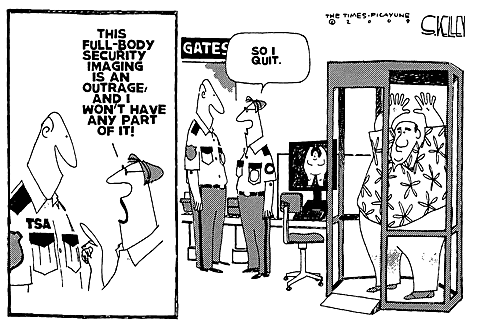
Here’s a scene we’d like to see.
Lee Gomes writes on Forbes.com with a clear-eyed reminder that privacy regulation has been costly, yet failed to deliver. Lovers of government intervention will, of course, take this as an argument to double-down.
No. But some members of Congress think they do.
In the section of Tim Lee’s “Durable Internet” paper titled Customers Gone Wild: Why Ownership Doesn’t Mean Control, he showed how powerful online consumers are. They can surely decide whether media markets are forming up contrary to their interests, and they can punish providers who get on the wrong side of their demands.
The Computers Freedom & Privacy conference is consistently one of the most interesting and forward-looking privacy conferences. This year, it’s at George Washington University in Washington, D.C. June 1–4.
I helped organize it this time, though by no means does the event skew libertarian. What it does is bring together people of all ideologies to discuss common concerns about the present and future state of privacy.
I’ll be speaking on a panel called “The Future of Security vs. Privacy” on Tuesday, June 2nd. Here’s the program page. And here’s the registration page if any of this whets your appetite.
There are two parts to securing a country: making the country secure and making the country feel secure.
The head of U.S. Strategic Command, General Kevin Chilton, failed at the latter when he talked about security in a way that produced the following headline: U.S. General Reserves Right to Use Force, Even Nuclear, in Response to Cyber Attack.
As a theoretical matter, every element of military power should be on the table to respond to attacks. But the chance of responding to any “cyber attack” with military force is vanishingly small. To talk about responding with nuclear weapons simply helps spin our country into a security tizzy.
Politicians and military leaders should stop inflating the risk of cyber attack.
L‑1 Identity Solutions is a leading biometric technology company, and with its acquisition of Digimarc ID Systems it has become the nation’s number one manufacturer of state identity cards and drivers’ licenses. Such a company would benefit massively from implementation of the REAL ID Act, the nation’s moribund national ID law.
But REAL ID is in trouble. No state was in compliance by the May 2008 deadline, and the Department of Homeland Security had to give deadline extensions even to states that flatly refused to participate in the national ID scheme.
So what does the primary beneficiary of the failing REAL ID Act do? Change the name. On a recent earnings call, L‑1’s Chairman, President, and Chief Executive Officer, Robert V. LaPenta, was a little too transparent in expressing his optimism about the government ID card buisiness:
We’re well-positioned in all of these opportunities and we’re seeing increased sell prices for those states that are incorporating and I won’t call it real ID, I’ll call it enhanced or higher security drivers license.
“I won’t call it real ID, I’ll call it enhanced or higher security drivers license.”
Enhanced driver’s licenses are a project at the Department of Homeland Security — with no congressional mandate — to move state driver’s licenses toward serving as national ID cards.
So it is with the “PASS Act,” a bill that would revive REAL ID under a different name.
Senator Daniel Akaka (D‑HI), formerly an opponent of having a national ID, has been working with the National Governors Association to round down the sharpest corners of REAL ID and give the national ID law a new name.
A news report says the new bill “explicitly prevents the creation of a national identification card.” It might also prevent things that walk like ducks, quack like ducks, and swim like ducks from being called “ducks.”
The only way to resolve the problems with REAL ID is to repeal REAL ID. Reviving the national ID program under another name is not a solution.
Ask anyone who has experienced life in a country where freedom of movement is not recognized, and you’ll come away impressed with the importance of having the right to travel. That right takes another step back in the United States today.
Today the federal government takes over from airlines the process of running passengers against its terrorist watch lists. This means that when you fly, the Transportation Security Administration now requires airlines to give the government your full name, your itinerary, your date of birth, your gender, and an optional “redress number.”
Running names against watch lists does not secure against even modestly sophisticated attackers — 17 of 19 9/11 hijackers were “clean skin” terrorists, without histories of activity that would get them on watch lists. And in 2002, an MIT study (the “Carnival Booth”) showed how passenger profiling failed as a security measure. Attackers could “step right up” and test the system on dry runs to see if it singles them out. The same applies to watch listing.
Transferring responsibility for checking watch lists is a small step, but it brings into sharp focus that the government is now pre-screening Americans’ travel and travel plans.
There is no telling which direction this mission will creep over time. In the event of an attack on some other mode of travel — even a small or failed attack — expect the government to extend pre-approval for travel in that direction. The government will soon discover that it can run names of travelers past other lists — first dangerous wanted criminals, then wanted criminals, then “deadbeat dads,” and on down the line to people with unpaid parking tickets.
With government officials pushing fear of disease to the level of mania, watch for medical records to be used in government pre-screening of travelers.
The current policy is to retain information about travelers for no more than seven days after each leg of a trip has been completed. If a person is a suspected match, TSA will retain the information concerning that potential match for seven years. If the potential match is confirmed, TSA will retain the confirmed match for 99 years.
Seven years is already a lot for people who just happen to have a name similar to a name on the burgeoning terror watch list. But the policy is likely to change too, and deep dossiers of Americans’ travel will grow.
Remember, again, that watch listing is security theater. It looks like it protects air travel, but it doesn’t. When you are prescreened for travel by the government — as this program saps your freedom to travel — you are giving up something for nothing.