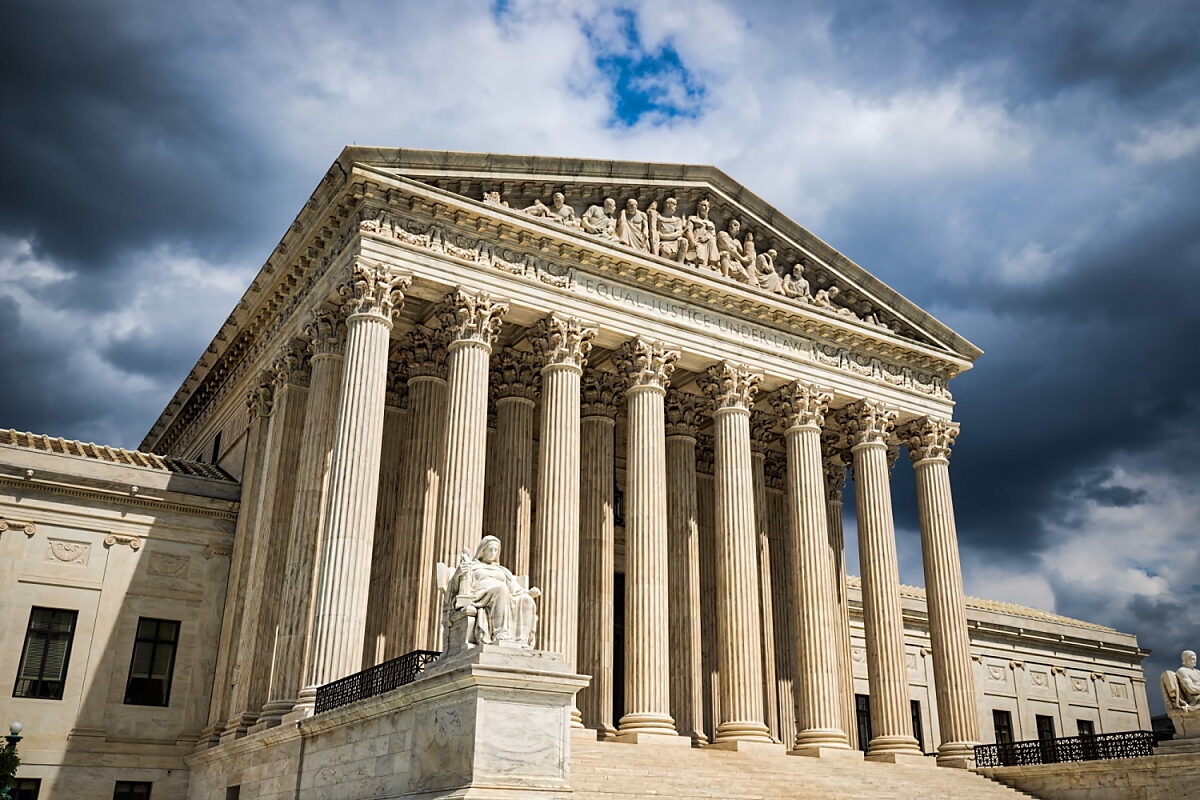
An editorial note atop Andy Craig’s June 26 article in the UnPopulist, “The Unfortunate Necessity of Court Packing to Stop America’s Authoritarian Drift,” opens with a striking observation: “Desperate times require desperate measures.” That aphorism is ancient: it dates back to Hippocrates’s precept that very sick patients require aggressive treatment. Its wisdom has traveled through centuries: in Hamlet, King Claudius explains that “Diseases desperate grown / By desperate appliance are relieved, / Or not at all.” Craig’s article diagnoses a social pathology; he prescribes adding four new Justices to the Supreme Court. He concedes that court packing will be very hard on the patient but explains that “sometimes a smaller harm is necessary to avoid a far bigger one.”
Cato at Liberty
Cato at Liberty
Topics
Constitutional Law
Election Policy Roundup #27: The Long View on Election Reform
Number 27 in our series of occasional roundups on election law and policy, focusing this time on issues of electoral reform that will endure beyond the midterm battles of the moment:
- Reform failure: One reason reaction has been muted to the Supreme Court’s new decision in NRSC v. FEC, striking down limits on party coordination of spending with candidates, is that many close observers on the left and center agreed that the existing rules were counterproductive [Samuel Issacharoff, NYU Law Democracy Project (calling ruling a “welcome correction” and citing what “Pam Karlan and I have called the hydraulics of campaign finance regulation: money under pressure does not disappear, it finds the path of least resistance”); Richard Pildes, Rick Hasen].
- “In my view, there are plausible policy reasons to specify that all ballots should be in hand, not simply in the mail, by Election Day. But the Supreme Court was not presented today with that, or any, policy question” [my statement on the Supreme Court’s Watson v. RNC for Cato, together with Stephen Richer’s statement]. More from me: Maintaining accurate and up-to-date voter rolls should be ranked as a real reform priority, and Maryland is falling short [Free State Notes; also, why Maryland’s recent primary mail ballot foul-up didn’t pose a practical integrity issue, though it was embarrassing and confused voters (Alexander Shur, Votebeat; Christine Condon, Maryland Matters)].
- “Report: ‘Understanding How Proportional Representation Might Work in New York City’ ” [Jack Santucci (and John Ketcham}]; Discontent with California’s top-two system contributing to interest in multiparty options [Dennis Lytton, Liberal Currents]; Rob Richie discusses the proportional-ish voting method known as cumulative voting, as well as the promise of ranked-choice balloting in presidential primaries [Expand Democracy]; A caution from the Netherlands on the difficulties of national coalition formation under proportional representation [Tarunabh Khaitan and Mike Winterwerp, Social Europe].
- I and others have generally praised as admirable the Nebraska–Maine approach of divvying up a state’s electoral votes based on congressional district. But what if it has a dark sibling that would enable a state to use gerrymandered districts to hand most or even all of its electoral votes to a candidate who loses its popular vote? [Henry Noyes, Marquette Law Review via Electoral Law Blog]
- Reformers of an earlier day structured the Federal Election Commission so appointees from no one party could control it, which made for either partisan fairness or a kludgy guarantee of ineffectiveness, depending on who you ask. Will that structure survive the Supreme Court’s ruling in Trump v. Slaughter? [Bob Bauer, Executive Functions]
- Meaningful representation of coherent geographical areas in national election processes seems to be less and less valued as time goes on, as witnessed by both the race to the bottom on gerrymandering and the continued momentum behind the National Popular Vote Interstate Compact electoral vote deal [Philip Wallach, American Enterprise Institute, with a discussion of “general ticket voting,” banned since the Apportionment Act of 1842, which was designed to award the party that won overall in a state its entire House delegation].
Related Tags
Beaird v. United States Brief: Courts Shouldn’t Defer to Agency Interpretations of Their Own Ambiguous Regulations
The US government operates on a division of labor: the legislature makes law, the executive implements law, and the judiciary interprets law. Two years ago, in Loper Bright Enters. v. Raimondo, the Supreme Court definitively rejected agencies’ appropriation of the power to interpret ambiguous statutes. Here, the Cato Institute filed an amicus brief asking the Court to reject agencies’ appropriation of the power to interpret ambiguous regulations. Allowing agencies to wield both the power to make law and the power to interpret it violates the separation of powers, encourages agencies to make bad rules, and displaces traditional legal rules.
Petitioner Kendrick Jarrell Beaird entered a guilty plea to a single count of felon-in-possession of a firearm. He faced an enhanced sentence for possessing a “large capacity magazine.” This finding was based on the district court’s deference to US Sentencing Guidelines commentary, which defined “large capacity magazine” as any magazine that accepts more than 15 bullets of ammunition.
The Supreme Court has held that because the US Sentencing Commission “drafts the guidelines as well as the commentary interpreting them,” the latter should receive the deference afforded to an agency when interpreting its own regulations. This means an agency’s interpretation becomes the “ultimate criterion” for what an agency’s own regulation means.
Such deference gives agencies both the power to make the law and to determine what the law means, collapsing the Constitution’s careful division of powers. It also encourages them to write regulations poorly and then come up with convenient post hoc interpretations. This deference is uniquely dangerous in the hands of the Sentencing Commission, given how insulated it is from public pressure and political accountability.
Damage to the coherence of the law as a whole has come as deference to agencies replaces core legal principles—such as the rule of lenity—with regulators’ own glosses. The Court should end agency deference and send Mr. Beaird’s case back for further proceedings.
Related Tags
The Purpose and Limits of Government—Excerpt from New Cato Book, A History of Repeated Injuries, Threats to Liberty Since American Independence
The excerpt below is Chapter 1 in the new Cato Institute book, A History of Repeated Injuries, Threats to Liberty Since American Independence. In this chapter, “The Purpose and Limits of Government,” Cato Senior Fellow Roger Pilon, founding director emeritus of Cato’s Robert A. Levy Center for Constitutional Studies, reads the Declaration of Independence as an argument for legitimate government, dedicated to securing our natural rights to life, liberty, and the pursuit of happiness. Yet today, he writes, “too many Americans have lost touch with those principles and the ways they secure our freedom. Indeed, we have imposed on ourselves many of the abuses that drove the Founders to revolution.” This chapter explores deeply the moral foundations of free societies.
THE PURPOSE AND LIMITS OF GOVERNMENT
Roger Pilon
When America’s Founders declared our independence from English rule in 1776, they did so through a document that has inspired countless millions around the world ever since: our Declaration of Independence. Written from “a decent Respect to the Opinions of Mankind,” the Declaration set forth not only the immediate causes that impelled our political separation but a moral, political, legal, and economic vision that spoke to the ages. In a few brief lines, penned near the start of our struggle to secure our independence, the Founders distilled their philosophy of government: equal liberty for all, defined by rights to life, liberty, and the pursuit of happiness, secured by a government instituted for that purpose, its limited powers derived from the consent of the governed.
Yet today, too many Americans have lost touch with those principles and the ways they secure our freedom. Indeed, we have imposed on ourselves many of the abuses that drove the Founders to revolution. We are not alone in that, of course. Around the world today, even where the people purport to rule, we see expanding, largely unaccountable governments limiting liberty and trampling rights. As the 21st century’s authoritarianism grows, we are thus called once again to breathe life into the foundational principles that have ever defined us as a people.
Courts Keep Blocking Trump’s Push to Federalize Elections
Earlier this week, Judge Emmet G. Sullivan (D.D.C.) ruled that the United States Postal Service’s (USPS) June 2, 2026, proposed rulemaking on mail ballots violates an agreement it had previously entered into with the National Association for the Advancement of Colored People (NAACP). The defeat is the latest in President Trump’s rough, two-week stretch of efforts to federalize broad swaths of American election administration.
Background
On March 31, 2026, President Trump issued his second Executive Order pertaining to election administration (“Ensuring Citizenship Verification and Integrity in Federal Election”). Among other things, the EO contemplates an expanded role of USPS in mail voting. In the past, the USPS has simply acted as a mail carrier for election mail—just as it does for all other customers. Election officials prepare the mail voter list, assemble the mail packet, label the outbound envelope for the specific voter, and then deliver it to USPS for delivery.
Under the president’s EO, states would be required to provide advance notice of their intent to use USPS for election mail. Then, 30 days before the election, states must provide USPS with a detailed list of all voters who will use a mail ballot. Under Trump’s Executive Order, the USPS is tasked with ensuring that only people on that list receive ballots and people not on the list don’t receive a mail ballot. Never before has USPS had a role in voter eligibility. For more on the EO, see my previous Cato blog post here.
NAACP lawsuit
The current NAACP lawsuit arises out of a previous lawsuit filed by the NAACP against the USPS, which alleged that USPS delivery delays disenfranchised voters. In December 2021, the parties settled the lawsuit, and USPS agreed to “prioritize monitoring and timely delivery of election mail” and to “issue ‘National Guidance documents’ for every national election cycle through 2028 that ‘reflect the Postal Service’s formal nationwide Election Mail practices and policies for prioritizing the monitoring and timely delivery of Election Mail.’ ” (At page 3).
According to Judge Sullivan, the proposed rulemaking would violate that settlement agreement. Therefore, the court granted the NAACP’s “Motion to Enforce Compliance with the Settlement Agreement.” (At page 19). Celebrating the win, NACCP’s general counsel, Anthony P. Ashton, said, “The proposed U.S.P.S. changes would have created unnecessary and unlawful barriers, in direct violation of the U.S.P.S.’s mandate to prioritize election mail.”
Latest in a String of Losses
The ruling is another setback in President Trump’s effort to expand the federal government’s role in administering the November midterm elections. Last week (June 25, 2026), Judge Talwani (D.Mass) ruled against Trump’s Executive Order that prompted the USPS rulemaking (which prompted the NAACP lawsuit). Talwani ruled that the president lacked “constitutional or statutory authority” for the vast majority of the election aims in the Executive Order (at page 32).
Several other losses were noted by my colleague Walter Olson in his most recent election policy round (#26). They include:
- June 27, 2026: Judge Bissoon (W.D.Pa.) dismissed the DOJ’s lawsuit against Pennsylvania for its complete voter rolls, including “highly sensitive personal identifiers.” The DOJ is now 0–11 against the states in such lawsuits.
- June 25, 2026: Judge Casper (D. Mass) converted a temporary injunction against Trump’s first election Executive Order into a permanent injuction.
- June 24, 2026: The Sixth Circuit affirmed one of the 11 DOJ losses in its voter registration database lawsuits against the states.
- June 22, 2026: Judge Sooknanan (D.D.C.) held that the federal government’s creation of the SAVE citizenship database violates the Social Security Act, the Privacy Act, and the Administrative Procedures Act.
Where Will President Trump Turn?
Perhaps given his consistent defeats in court, Trump has applied renewed pressure on the US Senate to pass the SAVE America Act, which would impose new federal election administration dictates on the states, including proof of citizenship requirements, identification requirements, and perhaps limitations on mail voting. The administration also continues exploring the extent to which it can leverage the investigatory power of the FBI to shape election administration.
Never a dull moment in election administration. Until next time, Happy Fourth, and happy Primary Election to Arizona (July 21).
Related Tags
The Supreme Court Affirms Birthright Citizenship
On June 30, the Supreme Court struck down President Trump’s executive order purporting to limit birthright citizenship. That order would have denied citizenship to children born on US soil if their parents were in the United States only temporarily or illegally. But the Court held that the Fourteenth Amendment guarantees citizenship to such children, as it does for nearly all children born on US soil. The Court’s opinion by Chief Justice John Roberts correctly interprets the original meaning of the Fourteenth Amendment and ensures that nearly universal birthright citizenship will continue as the law of the land, just as it has since the English common law.
The Fourteenth Amendment commands, “All persons born or naturalized in the United States, and subject to the jurisdiction thereof, are citizens of the United States and of the State wherein they reside.” The key debate in this case hinged on the meaning of the middle portion of that sentence: “subject to the jurisdiction thereof.” Looking at history, the Court found that this phrase had a clear meaning: jurisdiction is about being subject to a nation’s laws.
“Before the Revolution, the American colonists—like all in the British Empire—were considered subjects of the sovereign.” And this relationship between the King and his subjects came with both responsibilities and benefits. “The King, Blackstone explained, owes those ‘born within the dominions’ a duty of ‘protection.’ … And ‘in return for that protection,’ those ‘born within the dominions’ owe the King a ‘duty’ of ‘allegiance.’” This reciprocal relationship extended to everyone born on soil controlled by the King. “A foreign mother could enter the British Isles, give birth, and leave with her child the very next day, and that child would remain a British subject. Why? Because the child owed an implied allegiance to the sovereign who protected him at his birth.”
Of course, America has no king, but many aspects of English common law were adopted by analogy after independence. “This view crossed the Atlantic with the colonists—and was adopted with little fanfare after the Revolution, as ‘subject[s]’ of the sovereign became ‘citizens’ of the States. And the same logic applied to children born in the states: if they were born subject to the laws of the state, they were also born citizens of the state.”
As Chief Justice Roberts lays out, the logic of this rule also explains its exceptions. Ambassadors and diplomats from another country have long been held to have “diplomatic immunity,” meaning they are not subject to all the laws of the country they temporarily inhabit. So, children born to ambassadors and diplomats were not “subject” to the country of their birth and thus not born citizens. In America, the same logic led states to conclude that those born on Indian tribes were also not automatically citizens of the state because they, too, were not fully subject to state law.
These were the only two recognized exceptions to birthright citizenship until the Supreme Court’s “odious decision of Dred Scott v. Sandford” in 1857, which held that the rule of birthright citizenship “excluded all those descended from slaves.” After the Civil War, the Reconstruction Congress sought to both overrule Dred Scott and prevent any future diminishment of the rule of birthright citizenship. First, in 1866, the Civil Rights Act declared that “all persons born in the United States and not subject to any foreign power, excluding Indians not taxed, are hereby … citizens of the United States.” Then, to avoid all doubt and remove the power of future Congresses to revoke this rule, the Fourteenth Amendment guaranteed that all persons born in the United States and “subject to the jurisdiction thereof” are citizens.
As Chief Justice Roberts sums up, the meaning and purpose of this language is made clear by the history leading up to it. “Any child who was born ‘under the protection of’ the United States—that is, any child for whom no extraterritorial fiction applied—was made a citizen, for he owed a natural ‘allegiance’ (and thus ‘obedience’) to the Nation.” In practice, that means the Fourteenth Amendment guaranteed citizenship to all born in the United States, except those born to diplomats or within Indian tribes. Immigrants, even those here illegally or only for a short time, are subject to U.S. law and thus bound to both its restrictions and its benefits. The default rule of birthright citizenship, therefore, applies to them.
The Court’s decision is exactly right. In Cato’s amicus brief, we argued that “The Fourteenth Amendment was meant to extend its broad protections to ‘all persons,’ with only narrow exceptions rooted in the common law. … ‘All persons’ includes the children of temporary visitors and aliens.” Just as we urged, the Court rejected the government’s cramped view, which is that “jurisdiction” refers only to those subject to “political jurisdiction” who have “lasting ties to create allegiance” to the United States. In the government’s view, this meaning of jurisdiction would exclude the children of parents who are temporarily or illegally in the country. The dissents by Justices Thomas, Alito, and Gorsuch (and a partial concurrence by Justice Kavanaugh) each make some version of this argument (though mostly limited to temporary visitors rather than unauthorized residents).
But as the majority opinion put it, “there is scant evidence for this dramatically revisionist view.” To prove its case, the government would have had to show that “At some point before the ratification of the Fourteenth Amendment, … it became ‘deeply rooted’ in this country that ‘[d]omicile is the key concept that creates allegiance.’” But history does not support such a change in the common law. Instead, right up to the Fourteenth Amendment’s enactment in 1868, legal sources “defined ‘allegiance by birth’ just as the British did—as ‘the tie or duty’ owed by one who is ‘born within the dominions and under the protection of a particular sovereign.’”
The Court’s decision is a reaffirmation of a rule that had been nearly undisputed for over a century, since the Supreme Court’s decision in United States v. Wong Kim Ark (1898). As the Court explained, “What the Court held in Wong Kim Ark was simple: the Citizenship Clause incorporated the common law and granted citizenship to nearly all children born in the United States.” It is the government’s view that would have massively upended American law, injecting tremendous uncertainty into our process for citizenship. But because the Supreme Court ruled on constitutional grounds, it is now certain that no future president or Congress can alter this rule.
Those born on American soil are American citizens, subject to our laws and guaranteed our protection. This rule has helped generations of immigrant families quickly assimilate into equal status as Americans. The rule’s continued vitality and constitutional protection are something to be celebrated.
America’s 250th Anniversary: Triumphs, yet Troubles Ahead
This article appeared in the winter 2026 edition of inFOCUS Quarterly, published by the Jewish Policy Center.
Two hundred fifty years ago, America was born. Our birth certificate, the Declaration of Independence, proclaimed a new order of the ages, novus ordo seclorum. Fifty years on, Thomas Jefferson, the Declaration’s main author, would capture metaphorically the principle animating that seminal moment: “the mass of mankind,” he wrote, “has not been born with saddles on their backs, nor a favored few booted and spurred, ready to ride them legitimately, by the grace of God.” Yet have we, over the ensuing 200 years, not saddled ourselves with booted and spurred government riding us as the Founders would never have countenanced, at a price in liberties lost that they had pledged their lives, their fortunes, and their sacred honor to secure?
That is the troubling question before us as we celebrate our nation’s 250th birthday. To be sure, we enjoy liberties today only hoped for at our founding. Slavery is long gone, at a terrible price, as are laws separating one race from another. The franchise has greatly expanded. And rights of speech, association, criminal procedure, and more are secure well beyond what they once were. But the limited government the Founders envisioned and the Framers instituted in our Constitution is today little to be found. Our governments reach nearly every corner of our lives, politicizing everything, leaving us at war over government’s proper functions.
We often hear, for example, that our political leaders should come together to solve our problems—everything from health care to retirement, childcare, education, housing, jobs, drugs, student debt, and more—problems that, in truth, are simply the personal problems of life. That faith in government is profoundly misplaced. Earlier Americans had little like it. They were concerned mainly about what government could do to them—see the Bill of Rights—not what it should do for them. They yearned to be free, not to be dependent on government. That is why so many came to America. Perhaps by recovering that basic understanding of the proper role of government, we can reduce our divisions and reclaim our birthright, freedom.
In this celebratory year, therefore, we will have a much-needed opportunity to revisit and revive America’s first principles, which today are too little taught, mistaught, and misunderstood by too many Americans. That was evident in a recent NPR interview when a political activist contended that “what Congress and the president need to do is raise wages and lower prices.” The constitutional—to say nothing of economic—confusion that comment reflects is breathtaking, yet it is all too common. With “affordability” the political concern du jour, it hardly surprises.
To address this problem, there’s no better place to start than with our founding documents. Accordingly, I’ll begin with the moral, political, and legal vision implicit in the Declaration’s sparse language, then briefly show how that vision was largely instituted in our Constitution as corrected by the Civil War Amendments. I’ll then show, again briefly, how the Progressive Era’s vision, instituted through the New Deal’s constitutional revolution, fundamentally undermined the Founders’ plan for liberty under limited government, giving us the modern redistributive and regulatory state that today politicizes so much of life.
The Declaration of Independence
Addressing “a candid World,” the Founders’ immediate aim in the Declaration was to justify their decision to declare independence. Toward that end, they set forth a theory of legitimate government and then demonstrated how far British rule had strayed from that ideal. But their argument served not simply to discredit British rule; in addition, it set the course for future American government. Ever since, the Declaration’s ringing phrases have inspired countless millions around the world, prompting many to leave their homelands to begin life anew in America.
Appealing to all mankind, the Declaration’s seminal passage opens on a crucial point: “We hold these Truths to be self-evident.” Grounded in reason, “self-evident” truths invoke the long tradition of natural law, which holds that there is a “higher law” of right and wrong from which to derive human law and against which to criticize that law at any time. Moral reasoning, accessible to all, not political will, is the foundation of our Nation.
But if the Founders’ vision is derived through reasoned argument, liberty is its aim. Thus, the cardinal moral truths are these: “that all Men are created equal, that they are endowed by their Creator with certain unalienable Rights, that among these are Life, Liberty, and the Pursuit of Happiness—That to secure these Rights, Governments are instituted among Men, deriving their just Powers from the Consent of the Governed.”
We are all equal in the fundamental sense that no one has natural rights superior to those of others. We are born with those rights; we do not get them from government—indeed, government gets its powers from us. And our rights to life, liberty, and the pursuit of happiness imply the right to live our lives as we wish, provided only that we respect the equal rights of others to do the same. Drawing on the common law tradition of liberty, property, and contract—its principles grounded in “right reason”—the Founders thus outlined the moral foundations of a free society.
We institute government, the Declaration says, to secure our rights—our natural rights and the rights we create as we live our lives. But the powers government needs for that must be derived from our consent if they’re to be legitimate. Government is thus twice limited: by its end, to secure our rights; and by its means, which require our consent.
There is a practical problem here, however, for the consent the Declaration requires for government’s powers can never be more than imperfect. Invariably, we get majorities and minorities who haven’t consented. How, then, can the majority justify imposing its will over the minority? It cannot. Indeed, minorities well understand the tyranny of the majority.
There’s a silver lining here, however. Because government entails manifold forced associations, especially as it expands over our lives, we arrive at an inescapable moral presumption against doing things through government, where force is inevitable, and a clear presumption for individual liberty, with the burden on those who would do things through government to show why they must be done there rather than left to the private sector, where they can be done freely and hence in violation of the rights of no one. Government, in short, should be a last resort.
There, in a nutshell, is the moral and political argument for limited government, which Thomas Paine stated succinctly: “Government, even in its best state, is but a necessary evil; in its worst state, an intolerable one.” And Churchill: “Democracy is the worst form of government, except for all the others.” Democracy is not an end, only a means. Liberty is its end. To ensure that, a constitution is required.
The Constitution
Having recently overthrown oppressive British rule, the Constitution’s Framers were not about to impose oppression on themselves. Guided by the Declaration’s limited government principles, they crafted a federal government strong enough to secure our rights against domestic and foreign oppression yet not so powerful or extensive as to be oppressive itself. Toward that end, their document authorized governmental powers, then checked and balanced those powers. Thus, it divided powers between the federal and state governments, leaving most power with the states: federalism. And it separated powers among the three branches of the federal government, pitting power against power.
The Preamble establishes the basic political principle: “We the People,” for the purposes listed, “do ordain and establish this Constitution.” Thus, all power comes from us. And in the first sentence of Article I, we see that all legislative Powers “herein granted shall be vested in a Congress.” By implication, not all such powers were granted. In fact, in Article I, section 8, we find that Congress has only 18 such powers or ends. Finally, that doctrine of enumerated powers is reiterated explicitly, as if for emphasis, in the Tenth Amendment, the final member of the Bill of Rights: “The powers not delegated to the United States by the Constitution, nor prohibited by it to the States, are reserved to the States respectively, or to the people.” And the Ninth Amendment, an obverse of the Tenth, reads: “The enumeration in the Constitution of certain rights shall not be construed to deny or disparage others retained by the people.” In sum, the Constitution creates a government of delegated, enumerated, and thus limited powers.
Thus, the basic picture that emerges is no different than the one that emerged from the Declaration. We all have rights to pursue happiness as we plan and live our lives, with government there to secure those rights and do the few other things we’ve authorized it to do.
The Constitution was not perfect, of course, nor have we ever conducted ourselves perfectly under it. Thus, the Framers knew that its oblique recognition of slavery, made necessary if there were to be union, was inconsistent with the Declaration‘s principles. Most hoped that the “peculiar institution” would wither away over time. It did not. It took a brutal civil war and the ratification of the Civil War Amendments to end slavery and incorporate at last the great principles of the Declaration, thus bringing the states under the Bill of Rights, which could not have happened originally.
But as Reconstruction petered out and new ideas came to the fore, America’s constitutional ethos began slowly to decline. Indeed, by 1900 we could find the editors of The Nation, before it became an instrument of the modern left, lamenting the demise of classical liberalism. In an editorial entitled “The Eclipse of Liberalism,” they surveyed the European scene, then wrote that in America, too, “recent events show how much ground has been lost. The Declaration of Independence no longer arouses enthusiasm; it is an embarrassing instrument which requires to be explained away. The Constitution is said to be ‘outgrown.’”
Progressivism
Progressives were social engineers hailing from the elite universities of the Northeast. They were animated by ideas from abroad: British utilitarianism, which had supplanted natural rights thinking; German theories about good government, like Bismarck’s social security experiment; and homegrown theories about democracy and pragmatism. Undergirded by the new social sciences, they constituted a heady brew urging government planning to address all manner of perceived social and economic problems.
During the early decades of the 20th century, progressives operated mostly at the state level, where courts often rejected their efforts as inconsistent with the Constitution. During Franklin Roosevelt’s first term, however, things came to a head, especially after the Supreme Court rejected several of his New Deal schemes, prompting him, shortly after his 1936 landslide reelection, to unveil his infamous scheme to pack the Court with six new members. Uproar followed throughout the nation. Nevertheless, the Court got the message. There followed “the switch in time that saved nine” as the Court began effectively rewriting the Constitution—without the benefit of a constitutional amendment.
It did that in three main steps. In 1937, it eviscerated the doctrine of enumerated powers, thus opening the floodgates to the modern redistributive and regulatory state: so much for the Constitution’s authorization of only limited government. In 1938, from whole cloth, it bifurcated rights as either fundamental or nonfundamental, then created a bifurcated theory of judicial review, leaving economic liberties largely unprotected from legislative and administrative mischief. Finally, in 1943, it authorized Congress to delegate ever more of its legislative powers to unelected bureaucrats in the Executive branch where today most of our law and regulations are created: so much for democratic control of government. It was a triple-play, guaranteed to give us massive government, the politicization of virtually everything, and a war of all against all for the spoils.
What Is to Be Done?
Those outcomes were predictable and predicted. In fact, they were not unknown to the Founders, as the Federalist will show. Drawing on the Declaration’s moral vision, the Constitution was written to discipline not only the officials we elect but also we the people. When we fail to understand or appreciate that, ineluctable consequences follow. Increasingly, we have demanded ever more goods and services from government, nowhere authorized by the Constitution. Worse still, we have refused to pay for them through current taxation, so we borrow. Today, service on the federal debt exceeds defense costs, while entitlement programs continue to increase our out-of-control debt, which stands at over $38 trillion as of this writing. This cannot end well.
We are well down this undisciplined, irresponsible road. In recent years, the Supreme Court, our most disciplined branch, has taken important steps toward disciplining the political branches and the administrative state, but thus far it has only chipped away at the problem. As the weakest branch, “with neither purse nor sword,” as Alexander Hamilton wrote, the Court can do little more without causing chaos. In truth, it falls to Congress to address the larger problem. But for that to happen, it falls to us, the people, to grasp the nettle, recognize the problem, and act. What better time to start that than this year, when we will be celebrating America’s birth and the freedom that enables us to do so.
Roger Pilon is a senior fellow at the Cato Institute and the founding director emeritus of Cato’s Center for Constitutional Studies.