Critics of the H‑1B visa for skilled foreign workers often claim that the status amounts to “indentured” servitude. Indentured servitude is a contract to work for a single employer for a predetermined period without pay. H‑1B workers are not only paid—they receive wages in the top 10 percent of wage earners in the United States. As importantly, although they face more obstacles to changing jobs, H‑1B workers are not tied to a single employer and they change jobs regularly.
In fact, H‑1B workers are leaving their initial H‑1B employers more than ever. Figure 1 shows the number of H‑1B workers changing to a new employer by fiscal year. From fiscal year 2005 to 2023, H‑1B workers changed jobs almost 1 million times. The number of switches grew from about 24,000 in 2005 to a record 123,888 in 2022—a more than fivefold increase.
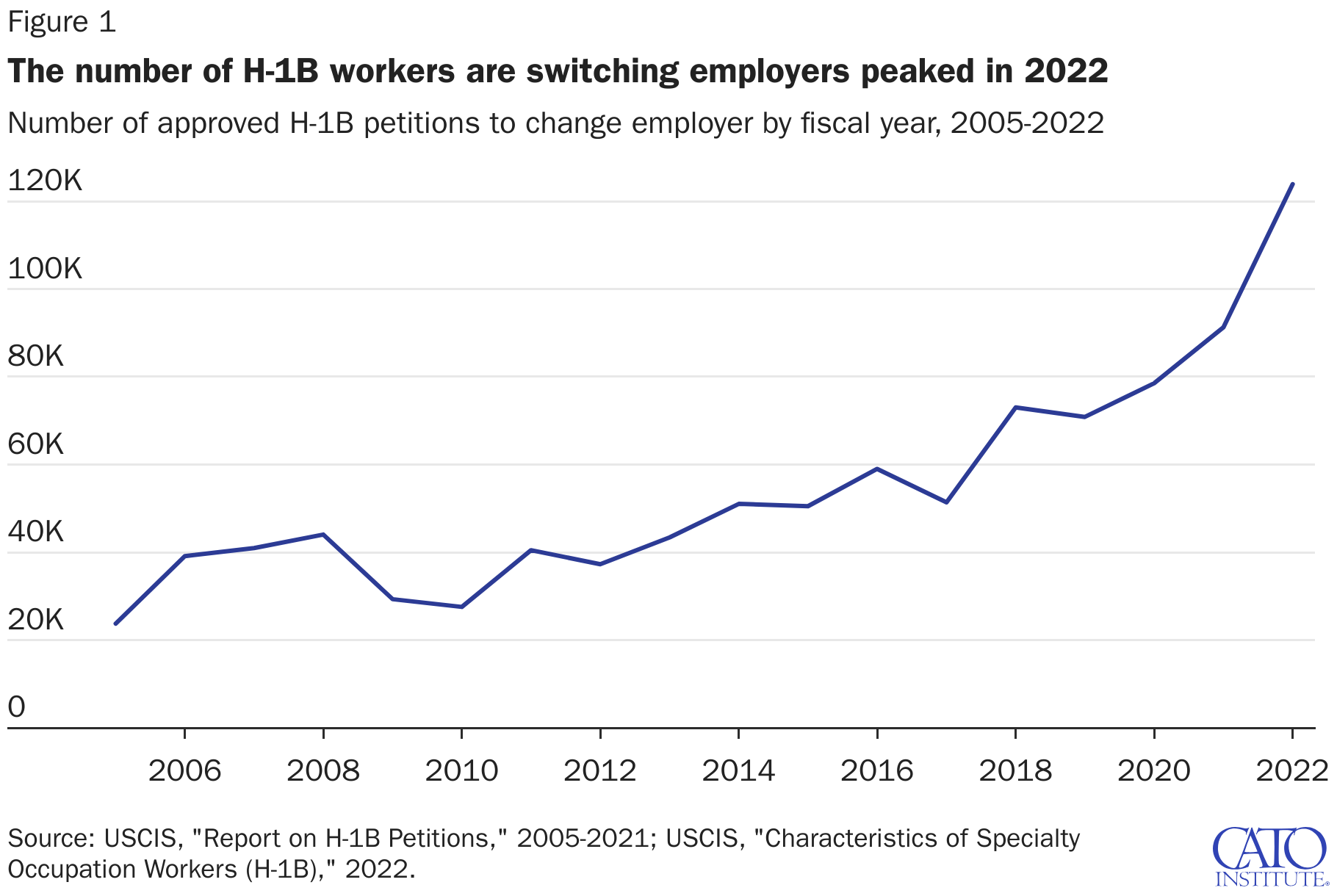
Moreover, H‑1B job shifting is nearly as common as H‑1B workers starting H‑1B employment for the first time. In 2022, 48 percent of all H‑1B workers starting with a new employer were existing H‑1B workers who were hired away from other employers in the United States. This means that US employers were as likely to hire an H‑1B worker already in the United States in H‑1B status as they were to hire a new H‑1B worker not already with H‑1B status.
Several causes for this increase are possible. The labor market has generally been tighter, leading to more job switching in general. In addition, more H‑1B workers are employed in the United States now for other employers to poach, and because the H‑1B cap has been so quickly met every year since 2014, there is more reason to poach. The government also made it somewhat easier to switch H‑1B jobs in 2017 by giving them a sixty-day grace period to find a new job after losing a job.
Finally, the jump in switching in 2021 is at least partially attributable to the record number of green card applications filed that year. After 180 days, H‑1B workers who have filed a green card application may change jobs without the employer being forced to restart the green card process, easing the job-switching process. However, in 2022, the number of pending employment-based green card applications declined from 2021, so this is only part of the story.
Of course, it is true that H‑1B workers are still not treated equally in the labor market. New H‑1B employers have to pay hefty fees to poach them, and the shortage of green cards for Indian workers can wrongly make those workers feel that they have to stick with their existing employer to complete that process. The best solution would be to make the conversion to a green card automatic rather than requiring a renewal after three years. The sixty‐day grace period to find a new job is still not long enough to give many workers the confidence to simply quit a problematic job without a new one already lined up.
Despite these government-imposed obstacles, the existence of widespread H‑1B job shifting further refutes the idea that H‑1B workers are “indentured” servants. The Pew Research Center reports that 2.1 percent of college graduates changed jobs per month in 2022. The population of H‑1B workers is estimated to be about 580,000. The data aren’t directly comparable, but with just over 123,000 H‑1B transfers in 2022, this implies a monthly job change rate of 1.8 percent—lower, but nothing remotely like the hyperbolic claims of “indentured servitude.”
The fact is that the government has wrongly unleveled the playing field for H‑1B workers by erecting artificial barriers to job change, but options exist to find better employment within the H‑1B system. The government should expand those options rather than try to reduce or eliminate these workers who contribute so significantly to the fields of science, technology, engineering, math, and medicine.
Note: This post is an update of a June 2023 post on the same subject using more up‐to‐date numbers.
Update: After this post was published, it was brought to my attention that USCIS’s H‑1B Petition reports listed the wrong number of H‑1B job changes every year starting in 2022. For some reason, USCIS has flipped the number of initial H‑1B petitions with the number of H‑1B job changes in these petition reports. Fortunately, USCIS has another report, the Characteristics of H‑1B Workers report, that has the correct number for those years. I have published a new post with the 2023 and 2024 numbers here.
