
The House recently passed its amendment to the ROAD to Housing Act, correcting several important problems in the original legislation. Yet the bill, like much of today’s housing debate, is built around the assumption that the United States is experiencing a historically unprecedented housing affordability crisis. In addition to recently declining home price trends, the evidence for that claim is far weaker than commonly suggested, as we have argued before.
None of this means that affordability problems do not exist. Housing costs are severe in many local markets, and localities can and should lessen these pressures through relaxing local regulatory measures. The question here instead is whether aggregate national data support the popular claim that the United States faces a historically unprecedented nationwide affordability crisis.
Many Americans understandably look at rapidly rising home prices and conclude that housing has become dramatically less affordable. Some conventional metrics appear to reinforce this view. In particular, house price-to-income ratios have risen substantially over the past several decades.
But these measures often provide a misleading picture of affordability. For instance, simple price-to-income ratios ignore important changes in housing quality and size over time, as the typical American home has become substantially larger and more amenity-rich than in previous decades.
Housing is not a homogeneous good. Just as homes have become larger and more amenity-rich over time, many buyers are increasingly willing to pay for access to particular locations. Proximity to high-wage labor markets, desirable schools, and local amenities is itself a form of housing quality. Rising prices in these locations therefore do not necessarily imply a proportional decline in affordability, although local land-use laws certainly can worsen it.
More fundamentally, comparing total home prices to annual income is not an especially useful way to evaluate affordability in the first place. Homes are long-lived assets typically purchased with multi-decade financing arrangements, so what matters for most households is not the full sticker price of the home but whether buyers can afford the upfront down payment and the ongoing mortgage payments once they purchase the home.
A useful way to think about housing affordability is to separate the problem into two distinct questions: whether households can accumulate enough wealth to enter the housing market and whether they can afford the ongoing cost of ownership once they do. For the first question, comparing down payments to median net worth is more appropriate than comparing them to income because down payments are paid out of accumulated assets rather than annual earnings. A household may have enough income to support monthly mortgage payments while still lacking the savings or home equity needed for an initial purchase.
By contrast, ongoing affordability is fundamentally a cash-flow question, so comparing annual mortgage payments to median income is more meaningful than comparing total home prices to income. Since homes are typically financed over decades, what matters for most households is the yearly payment burden relative to yearly earnings, not the full sticker price of the house. This distinction becomes especially important when interest rates change substantially because monthly payments can rise or fall dramatically even when home prices do not.
To address these questions, we compare representative mortgage payments to household income over time and down payments to household net worth over time. (We are abstracting a bit from the rental market, but housing costs for renters have also tracked income for the past several decades.)
No single statistic can fully capture housing affordability. Ideally, we would observe the affordability facing marginal buyers across income, wealth, age, and geographic distributions. Some households priced out of ownership will not appear in mortgage-payment data because they never enter the market in the first place. Nevertheless, if the United States were experiencing a historically unprecedented nationwide affordability crisis, we would expect broad measures of payment burdens and wealth requirements to depart dramatically from historical norms. They do not.
In fact, while median mortgage payments as a share of income rose after 2020 compared to the unusually low-rate environment of the 2010s, the most recent figure for 2024 remains well within the range observed during the 1990s and early 2000s. In fact, mortgage burdens today remain substantially lower than they were throughout much of the 1970s and 1980s (Figure 1).
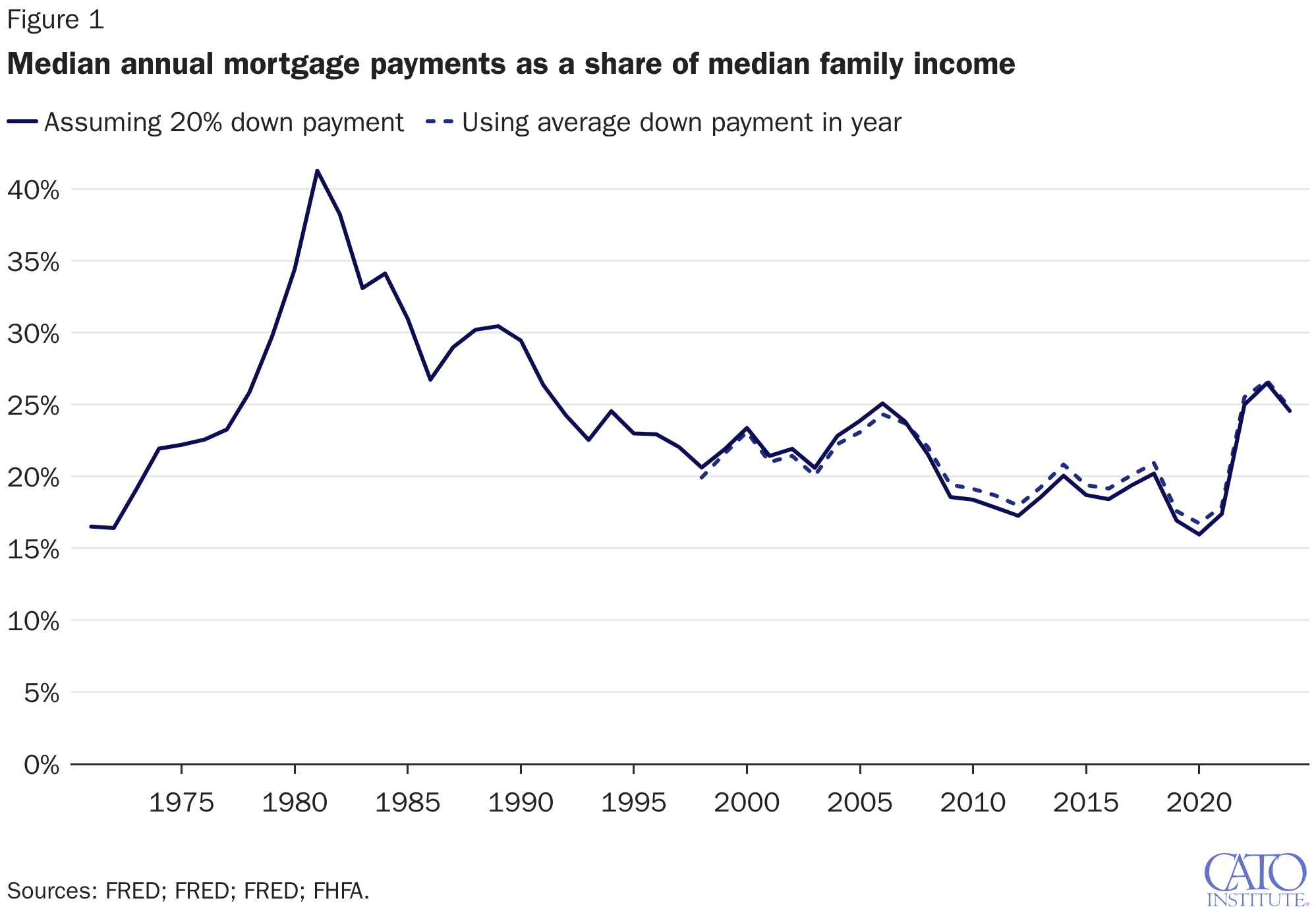
For this comparison, we calculate mortgage payments for the median home price, assuming a 30-year, fixed-rate mortgage at the annual average 30-year mortgage rate. Average yearly loan-to-value ratios are available starting in 1998, so we assume an 80 percent loan-to-value (20 percent down payment) to show the full period (solid line). The trend is essentially the same across those two specifications. Family rather than household income is used due to earlier availability.
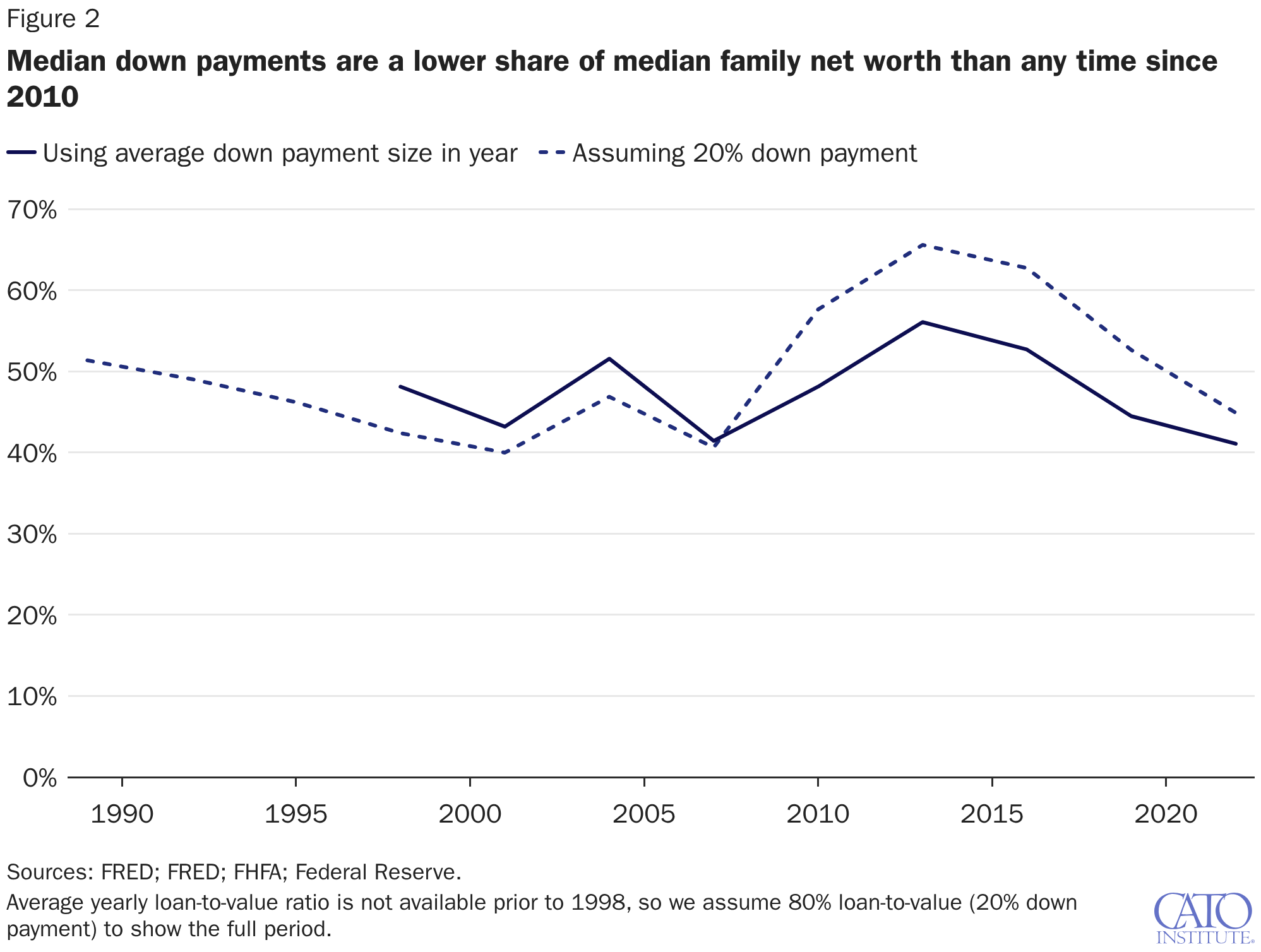
Meanwhile, the wealth required for a typical down payment appears far less burdensome than many popular narratives suggest. In 2022, the most recent year for which comparable data are available, the median down payment amounted to 41.1 percent of median family net worth—the lowest value in the entire series dating back to 1998 (Figure 2).
Some analysts argue that younger households face uniquely severe barriers to homeownership because rising home and asset prices disproportionately benefited older Americans while leaving younger families behind. But the data provide little support for this narrative. Among families whose reference person is under age 35, the typical down payment represents a smaller share of household wealth today than at any point in the past several decades (Figure 3).
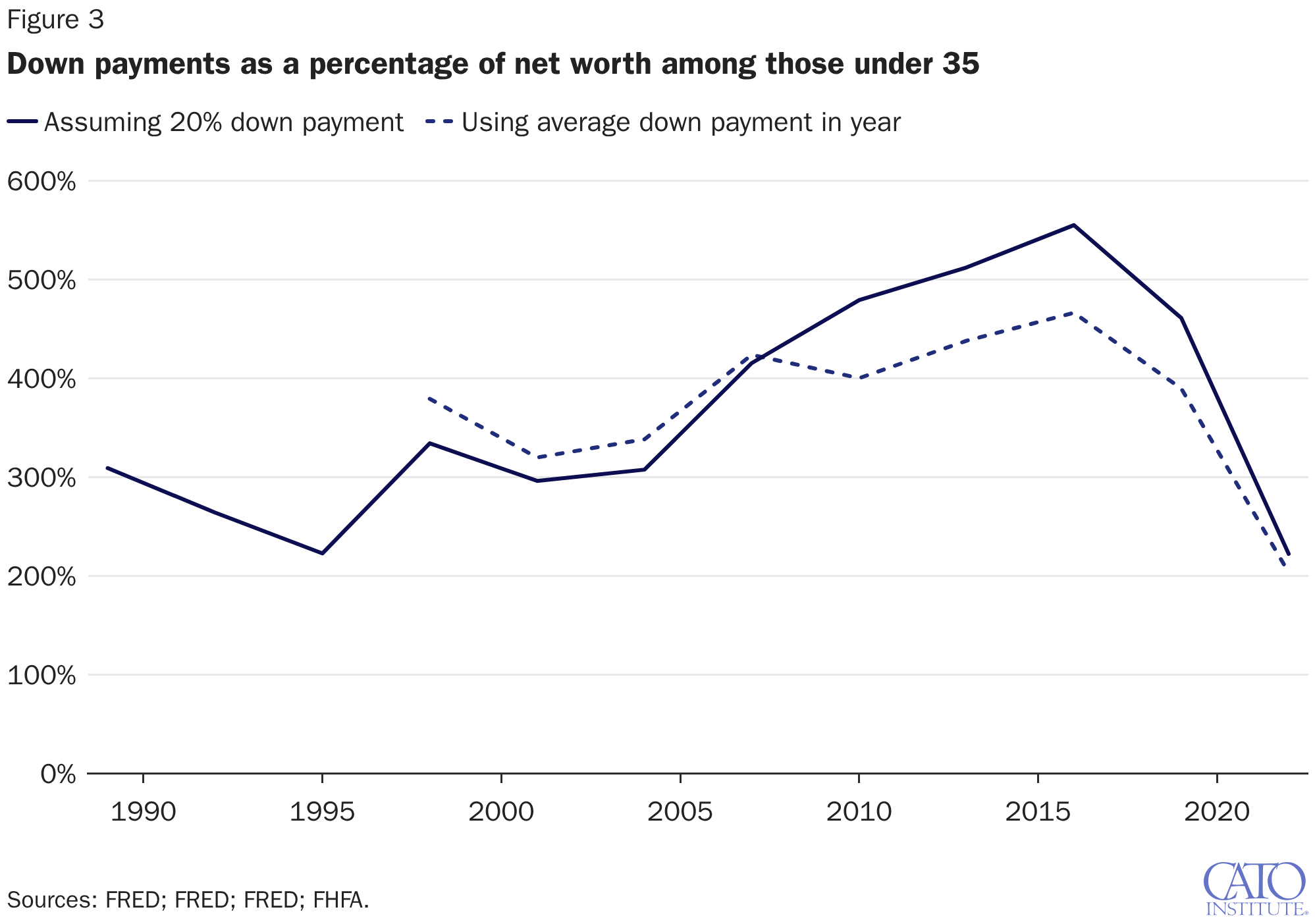
Importantly, throughout the entire data series, median net worth for households under age 35 remains below the typical down payment on a median-priced home. But this pattern is not evidence of a newly emerging crisis. If it were, the “crisis” would date back to at least 1989. Rather, it reflects a basic feature of the life cycle: Younger households generally possess less accumulated wealth than older households. As a result, many younger buyers either purchase less expensive homes or delay homeownership until they have accumulated greater savings and assets. Older age groups, by contrast, consistently possess median wealth levels above the typical down payment threshold.
This broader perspective also complicates popular narratives surrounding the so-called “first-time homebuyer age crisis.” Rising ages for first-time buyers (to the extent that the data are trustworthy) do not necessarily imply worsening affordability alone. Americans are marrying later, spending more years in higher education, delaying childbearing, and often waiting longer before purchasing larger or higher-quality homes. These broader demographic and social changes make it difficult to attribute delayed homeownership solely to deteriorating housing affordability. The long-term trend in mortgage payments as a share of income only reinforces this difficulty.
Additionally, the fact that younger families possess more wealth than previous generations at similar ages should not be surprising in a country that has experienced substantial long-run economic growth. Despite persistent narratives about stagnation, Americans have enjoyed higher incomes and become wealthier over time. This is just as true for younger households. High home prices may create sticker shock, but rising sticker prices alone do not demonstrate a historically unprecedented affordability crisis. Measures tied to actual payment burdens and household balance sheets show no indication of a crisis.
