
Success for democratic socialists in a string of primaries has people talking about the rise of the Democratic Socialists of America. New York City began 2026 by inaugurating DSA Mayor Zohran Mamdani, and by June his endorsements proved decisive in a number of New York primaries, unseating incumbents. The faction continued its run with primary successes in Colorado, Michigan, and Florida.
Cato’s own polling from July suggested Americans were evenly split on how favorably they viewed socialism, and among Generation Z, the ideology wins majority support. For self-identified Democrats, 61 percent said they’d be more likely to support a candidate for president who was a democratic socialist, while just 22 percent said they’d be less likely. Earlier polling from Gallup found support for socialism rose marginally from 36 percent in 2010 to 39 percent in 2025.
So, it’s worth asking what’s driving this supposed moment for democratic socialists and what democratic socialism even is. DSA’s own “What is Democratic Socialism” page is clearer on what democratic socialism isn’t. It isn’t capitalism nor the “authoritarian visions” it consigns to the “dustbin of history.”But its substantive definition comes in paragraph three. Democratic socialism is apparently collective ownership of “the key economic drivers that dominate our lives, such as energy production and transportation,” alongside other proposals like Medicare for All, defunding the police, and the Green New Deal.
The trouble for the DSA is nobody seems really to want this kind of socialism.
When Gallup asked an open-ended question inviting respondents to list one or two things they thought were good and bad about socialism, the most common answer was “nothing.” Another 15 percent gave no answer for something good about socialism.
The top substantive answers clustered around vague principles, like equality, “no social classes,” or inclusion (15 percent); then access to essential services and basic needs (13 percent); and cheaper or free healthcare (11 percent). Government, community, or democratic control over core parts of the economy was supported by just 2 percent of those surveyed.
July polling from The Argument lets us dig deeper. They polled support on a number of policies and provided Cato with results broken out by respondents’ opinions of the DSA. Even among DSA-friendly Democrats, the interventions that involve nationalizing businesses remain deeply unpopular.
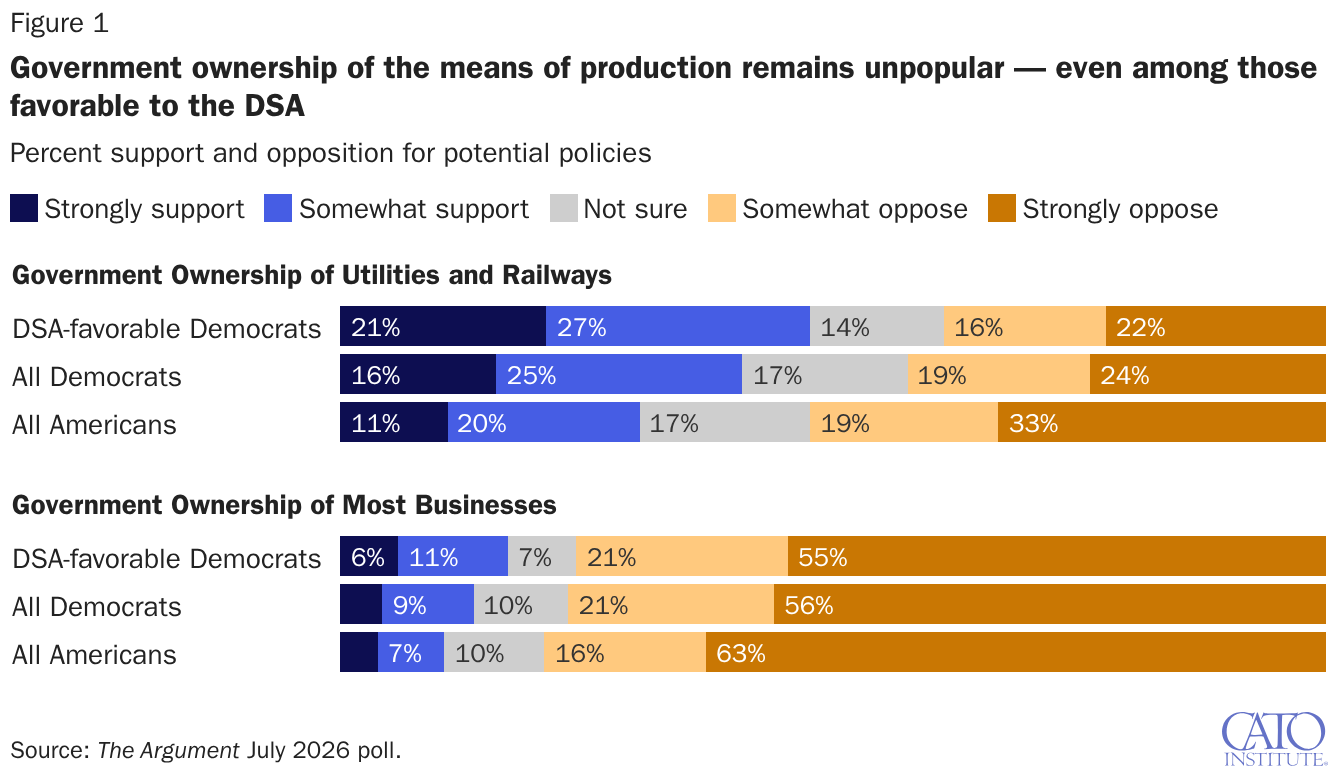
Government ownership of the means of production, DSA’s defining program and actual textbook socialism, draws support from just 11 percent of voters, with 79 percent opposed and 63 percent strongly opposed. Even among Democrats favorable to the DSA, it nets out at 59 percent opposition. The DSA’s defining program, public ownership of businesses, is underwater four to one even among those supporting the DSA.
Nor is this the only sign of confused beliefs about socialism among today’s supporters. Other polls of voters under 25 showing 77 percent thought their paycheck should be based on merit, 70 percent wanted to own their own business, and 63 percent saw America as the land of opportunity led Mark Penn and Andrew Stein to remark earlier this month that “today’s young adults must be the most entrepreneurial socialists in history.”
Even socializing only utilities and railways — socialist bread and butter — failed to command majority support among any group polled by The Argument, even though those are exactly the two sectors DSA identifies as pivotal for socialists to nationalize. That proposition is only supported by 48 percent of Democrats who view the DSA favorably, with 38 percent actually opposed.
In other words, while support for the socialist label is rising alongside the DSA’s success, apparent support for the key tenets of socialism remains fringe. Yes, we must take polling results with a pinch of salt. But even among sympathetic voters, almost no one supports the collective ownership the DSA champions.
That isn’t to say this is all nothing to worry about. Quite the opposite: we should worry very much that support for the DSA brand has become unmoored from its actual platform. That risks a program voters roundly reject sneaking to victory behind a curtain voters seem not to have looked behind.
